
PROPERTIES OF CONCRETEPROPERTIES OF CONCRETE
CARBONATIONCARBONATION
WHAT IS CARBONATION???WHAT IS CARBONATION???
“ It’s a reaction between the lime
in concrete and the carbon
dioxide from air, yielding Calcium
Carbonate.”
Carbonation of ConcreteCarbonation of Concrete
A reaction between the lime in concrete and
the carbon dioxide from air, yielding Calcium
Carbonate(CaCO3).
 The creation of calcium carbonate requires
three equally important substances: carbon
dioxide (CO2) calcium(Ca) and water(H2O)
In carbonation process actual agent is
carbonic acid
Carbonation ReactionCarbonation Reaction
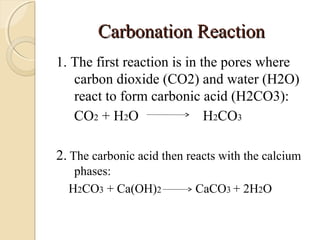
1. The first reaction is in the pores where
carbon dioxide (CO2) and water (H2O)
react to form carbonic acid (H2CO3):
CO2 + H2O H2CO3
2. The carbonic acid then reacts with the calcium
phases:
H2CO3 + Ca(OH)2 CaCO3 + 2H2O
DETECTING CARBONATIONDETECTING CARBONATION
 Depth of carbonation can be detected using
an indicator.
 A chemical such as Phenolphthalein sprayed
on to freshly broken concrete.
 Areas remaining alkaline will turn in a bright
purply-pink color.
 Carbonated areas of concrete will remain
unchanged in color.
Speed of CarbonationSpeed of Carbonation
The speed of the carbonation process
through the concrete mainly depends on
two parameters:
The porosity of the concrete
The moisture content of the concrete
Factors Affecting the carbonationFactors Affecting the carbonation
processprocess
Carbonation occurs between the 40-90%
relative humidity
Carbonation is most active at 50-70%
relative humidity.
 If the concrete is too dry, (RH<40%) carbon
dioxide cannot be dissolved and no
carbonation can occur.
If it is too wet (RH>90%) carbon dioxide
cannot enter water and the concrete will not
carbonate.
CO2 cannot pass through the pores filled
with water
Factors Affecting the carbonationFactors Affecting the carbonation
processprocess
Reaction starts at the surface and slowly
penetrates
Poor quality concrete suffers carbonation
earlier and deeper
If the surface is exposed to salts and moisture
or in salt laden environment, carbonation may
accelerate reinforcement corrosion.
EFFECT OF CARBONATIONEFFECT OF CARBONATION
 It can cause soft surface, dusting and color
change
 It reduces quality concrete
 It reduces the concrete ability to protect
reinforcement from corrosion (in an
exposed environment)
 It will result in additional shrinkage in
carbonated region.
Effects of CarbonationEffects of Carbonation
It reduces the quality of concrete
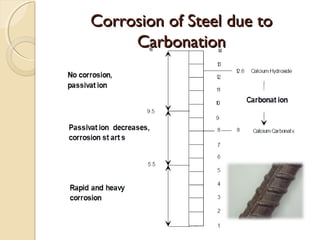
Normal pH value of concrete is 12.6-13.5
Carbonation reduces the pH value to 9
Changes alkaline nature to the acidic nature
Reduces the ability of concrete to prevent
reinforcement steel bars from rusting
Effects of CarbonationEffects of Carbonation
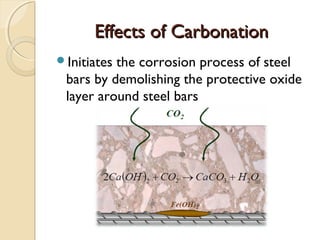
Initiates the corrosion process of steel
bars by demolishing the protective oxide
layer around steel bars
Passivation of SteelPassivation of Steel
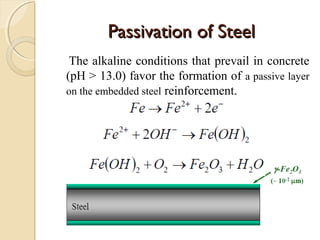
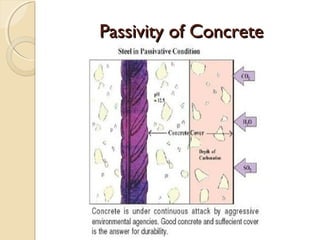
The alkaline conditions that prevail in concrete
(pH > 13.0) favor the formation of a passive layer
on the embedded steel reinforcement.
Corrosion of Steel due toCorrosion of Steel due to
CarbonationCarbonation
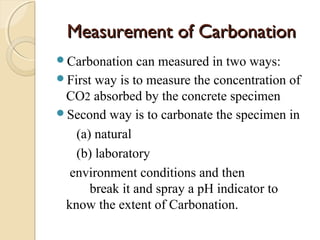
Measurement of CarbonationMeasurement of Carbonation
Carbonation can measured in two ways:
First way is to measure the concentration of
CO2 absorbed by the concrete specimen
Second way is to carbonate the specimen in
(a) natural
(b) laboratory
environment conditions and then
break it and spray a pH indicator to
know the extent of Carbonation.
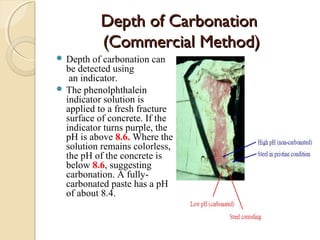
Depth of CarbonationDepth of Carbonation
(Commercial Method)(Commercial Method)
 Depth of carbonation can
be detected using
an indicator.
 The phenolphthalein
indicator solution is
applied to a fresh fracture
surface of concrete. If the
indicator turns purple, the
pH is above 8.6. Where the
solution remains colorless,
the pH of the concrete is
below 8.6, suggesting
carbonation. A fully-
carbonated paste has a pH
of about 8.4.
Depth of CarbonationDepth of Carbonation
(Laboratory Method)(Laboratory Method)
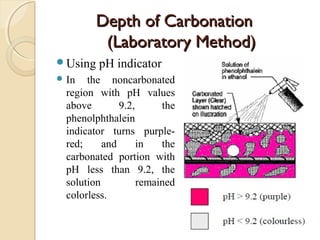
 Using pH indicator
 In this method, first concrete specimen is kept in an open
environment for a number of years or in Carbonation
Chamber for a number of months.
 Generally, conditions of 5% CO2, 50% Relative Humidity,
and 20-22ºC is maintained in a carbonation chamber.
 Then sample is broken and is sprayed with a pH indicator.
 Popularly a standard solution of 1% phenolphthalein in 70%
ethyl alcohol is used.
Depth of CarbonationDepth of Carbonation
(Laboratory Method)(Laboratory Method)
Using pH indicator
 In the noncarbonated
region with pH values
above 9.2, the
phenolphthalein
indicator turns purple-
red; and in the
carbonated portion with
pH less than 9.2, the
solution remained
colorless.
Corrosion of Reinforcement due toCorrosion of Reinforcement due to
CarbonationCarbonation
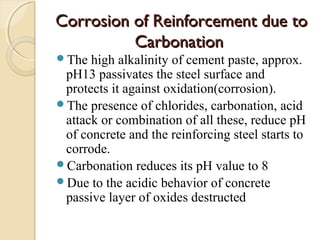
The high alkalinity of cement paste, approx.
pH13 passivates the steel surface and
protects it against oxidation(corrosion).
The presence of chlorides, carbonation, acid
attack or combination of all these, reduce pH
of concrete and the reinforcing steel starts to
corrode.
Carbonation reduces its pH value to 8
Due to the acidic behavior of concrete
passive layer of oxides destructed
Passivity of ConcretePassivity of Concrete
BicarbonationBicarbonation
Occasionally concrete may suffer from the so
called bi-carbonation process. Bi-carbonation
may occur in concrete with very high water to
cement ratio due to formation of hydrogen
carbonate ions at pH lower than 10. Contrary to
normal carbonation, bi-carbonation results in an
increase in porosity making the concrete soft.
BicarbonationBicarbonation
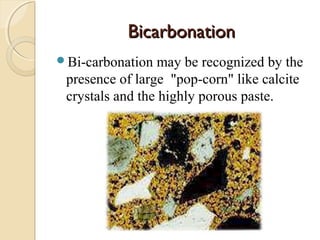
Bi-carbonation may be recognized by the
presence of large "pop-corn" like calcite
crystals and the highly porous paste.
Prevention from CarbonationPrevention from Carbonation
As carbonation is dependent on the
porosity of concrete. Decrease in
porosity will decrease the carbonation.
By decreasing water/cement ratio dense
concrete is produced with less porosity
Chances of the diffusion on CO2
becomes less

Carbonation

  • 1.
  • 2.
  • 3.
    WHAT IS CARBONATION???WHATIS CARBONATION??? “ It’s a reaction between the lime in concrete and the carbon dioxide from air, yielding Calcium Carbonate.”
  • 4.
    Carbonation of ConcreteCarbonationof Concrete A reaction between the lime in concrete and the carbon dioxide from air, yielding Calcium Carbonate(CaCO3).  The creation of calcium carbonate requires three equally important substances: carbon dioxide (CO2) calcium(Ca) and water(H2O) In carbonation process actual agent is carbonic acid
  • 5.
    Carbonation ReactionCarbonation Reaction 1.The first reaction is in the pores where carbon dioxide (CO2) and water (H2O) react to form carbonic acid (H2CO3): CO2 + H2O H2CO3 2. The carbonic acid then reacts with the calcium phases: H2CO3 + Ca(OH)2 CaCO3 + 2H2O
  • 6.
    DETECTING CARBONATIONDETECTING CARBONATION Depth of carbonation can be detected using an indicator.  A chemical such as Phenolphthalein sprayed on to freshly broken concrete.  Areas remaining alkaline will turn in a bright purply-pink color.  Carbonated areas of concrete will remain unchanged in color.
  • 7.
    Speed of CarbonationSpeedof Carbonation The speed of the carbonation process through the concrete mainly depends on two parameters: The porosity of the concrete The moisture content of the concrete
  • 8.
    Factors Affecting thecarbonationFactors Affecting the carbonation processprocess Carbonation occurs between the 40-90% relative humidity Carbonation is most active at 50-70% relative humidity.  If the concrete is too dry, (RH<40%) carbon dioxide cannot be dissolved and no carbonation can occur. If it is too wet (RH>90%) carbon dioxide cannot enter water and the concrete will not carbonate. CO2 cannot pass through the pores filled with water
  • 9.
    Factors Affecting thecarbonationFactors Affecting the carbonation processprocess Reaction starts at the surface and slowly penetrates Poor quality concrete suffers carbonation earlier and deeper If the surface is exposed to salts and moisture or in salt laden environment, carbonation may accelerate reinforcement corrosion.
  • 10.
    EFFECT OF CARBONATIONEFFECTOF CARBONATION  It can cause soft surface, dusting and color change  It reduces quality concrete  It reduces the concrete ability to protect reinforcement from corrosion (in an exposed environment)  It will result in additional shrinkage in carbonated region.
  • 11.
    Effects of CarbonationEffectsof Carbonation It reduces the quality of concrete Normal pH value of concrete is 12.6-13.5 Carbonation reduces the pH value to 9 Changes alkaline nature to the acidic nature Reduces the ability of concrete to prevent reinforcement steel bars from rusting
  • 12.
    Effects of CarbonationEffectsof Carbonation Initiates the corrosion process of steel bars by demolishing the protective oxide layer around steel bars
  • 13.
    Passivation of SteelPassivationof Steel The alkaline conditions that prevail in concrete (pH > 13.0) favor the formation of a passive layer on the embedded steel reinforcement.
  • 14.
    Corrosion of Steeldue toCorrosion of Steel due to CarbonationCarbonation
  • 15.
    Measurement of CarbonationMeasurementof Carbonation Carbonation can measured in two ways: First way is to measure the concentration of CO2 absorbed by the concrete specimen Second way is to carbonate the specimen in (a) natural (b) laboratory environment conditions and then break it and spray a pH indicator to know the extent of Carbonation.
  • 16.
    Depth of CarbonationDepthof Carbonation (Commercial Method)(Commercial Method)  Depth of carbonation can be detected using an indicator.  The phenolphthalein indicator solution is applied to a fresh fracture surface of concrete. If the indicator turns purple, the pH is above 8.6. Where the solution remains colorless, the pH of the concrete is below 8.6, suggesting carbonation. A fully- carbonated paste has a pH of about 8.4.
  • 17.
    Depth of CarbonationDepthof Carbonation (Laboratory Method)(Laboratory Method)  Using pH indicator  In this method, first concrete specimen is kept in an open environment for a number of years or in Carbonation Chamber for a number of months.  Generally, conditions of 5% CO2, 50% Relative Humidity, and 20-22ºC is maintained in a carbonation chamber.  Then sample is broken and is sprayed with a pH indicator.  Popularly a standard solution of 1% phenolphthalein in 70% ethyl alcohol is used.
  • 18.
    Depth of CarbonationDepthof Carbonation (Laboratory Method)(Laboratory Method) Using pH indicator  In the noncarbonated region with pH values above 9.2, the phenolphthalein indicator turns purple- red; and in the carbonated portion with pH less than 9.2, the solution remained colorless.
  • 19.
    Corrosion of Reinforcementdue toCorrosion of Reinforcement due to CarbonationCarbonation The high alkalinity of cement paste, approx. pH13 passivates the steel surface and protects it against oxidation(corrosion). The presence of chlorides, carbonation, acid attack or combination of all these, reduce pH of concrete and the reinforcing steel starts to corrode. Carbonation reduces its pH value to 8 Due to the acidic behavior of concrete passive layer of oxides destructed
  • 20.
  • 21.
    BicarbonationBicarbonation Occasionally concrete maysuffer from the so called bi-carbonation process. Bi-carbonation may occur in concrete with very high water to cement ratio due to formation of hydrogen carbonate ions at pH lower than 10. Contrary to normal carbonation, bi-carbonation results in an increase in porosity making the concrete soft.
  • 22.
    BicarbonationBicarbonation Bi-carbonation may berecognized by the presence of large "pop-corn" like calcite crystals and the highly porous paste.
  • 23.
    Prevention from CarbonationPreventionfrom Carbonation As carbonation is dependent on the porosity of concrete. Decrease in porosity will decrease the carbonation. By decreasing water/cement ratio dense concrete is produced with less porosity Chances of the diffusion on CO2 becomes less

Editor's Notes

  • #13 Demolishing means beating, Defeating
  • #14 Passivation is the process of treating or coating a metal in order to reduce the chemical reactivity of its surface. In stainless steel, passivation means removing the free iron from the surface of the metal using an acid solution to prevent rust.