Abdelmageed Rashed
Abdelmageedrashed@gma-
il.com
Brief Of The Research
• INTRODUCTION
• Definition Of Corrosion and it’s types
• Causes of occurring and Factors affecting on it
• Negative Protection of the Reinforcement steel bars
• Formula of reinforcement steel corrosion
• Damages caused by steel corrosion
• Treatment methods
• PROTECTION METHODS
• CONCLUSION
 Concreteis a complex material of construction that enables the high compressive strength
of natural stone to be used in any configuration. This is accomplished by breaking natural stone
to suitable sizes and mixing the aggregates so formed with suitable proportions of water and
cement. This mixture can then be moulded into any required shape while still fluid. The water
and cement react chemically, forming a “glue” that bonds the pieces of stone aggregate
together into a structural member, which becomes rigid and strong in compression when the
chemical reaction is completed (i.e. the concrete is “cured”). In tension, however, concrete can
be no stronger than the bond between the cured cement and the surfaces of the aggregate.
This is generally much lower than the compressive strength of the concrete
 Steel can be used for such reinforcement in one of two ways. When a system of steel bars or
a steel mesh is incorporated in the concrete structure in such a way that the steel can support
most of the tensile stresses and leave the immediately surrounding concrete comparatively free
of tensile stress, then the complex is known as “reinforced concrete”. When the steel
introduced is initially tensioned in such a manner that it applies a compressive stress to the
surrounding hardened concrete such that no subsequent loading applied to the structure puts
that concrete into tension, then the complex is known as “prestressed concrete”.
 The chemical or electrochemical reaction between a material,
usually a metal, and its environment that produces a deterioration
of the material and its properties.” For steel embedded in
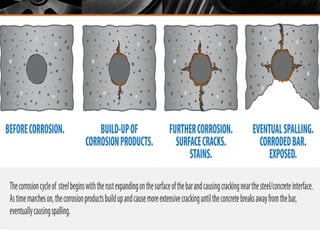
concrete, corrosion results in the formation of rust which has two
to four times the volume of the original steel and none of the
good mechanical properties. Corrosion also produces pits or
holes in the surface of reinforcing steel, reducing strength
capacity as a result of the reduced cross-sectional area.
Volumetric change
Electrochemical process of steel
corrosion in concrete
COMMON CORROSION TYPES
1) Crevice Corrosion
Crevice corrosion is a localized form of corrosion usually
associated with a stagnant solution on the micro-environmental
level. Such stagnant microenvironments tend to occur in crevices
(shielded areas). Oxygen in the liquid which is deep in the crevice
is consumed by reaction with the metal. Oxygen content of liquid
at the mouth of the crevice which is exposed to the air is greater,
so a local cell develops in which the anode, or area being attacked,
is the surface in contact with the oxygen-depleted liquid.
2) Pitting
Theories of passivity fall into two general categories, one based on adsorption and
the other on presence of a thin oxide film. Pitting in the former case arises as
detrimental or activator species, such as Cl-, compete with O2 or OH- at specific
surface sites. By the oxide film theory, detrimental species become incorporated
into the passive film, leading to its local dissolution or to development of
conductive paths. Once initiated, pits propagate auto-catalytically according to the
generalized reaction, M+n + nH2O + nCl- → M(OH)n + nHCl, resulting in acidification
of the active region and corrosion at an accelerated rate (M+n and M are the ionic
and metallic forms of the corroding metal).
Airborne, marine, industrial, groundwater, cast-in
Cl– can penetrate through the passive film
At Cl- > “threshold”, passive film breaks down, corrosion
initiates
Cl- “threshold” value is typically 0.05% by wt of concrete
(0.02% prestressed concrete)
Pitting corrosion
Chlorides are main cause of reinforcement corrosion
Chlorides
 Chlorides
 Chlorides Are Generally Acidic In Nature And Can Come From A Number Of Different Sources,
The Most Common Being, De-icing Salts, Use Of Unwashed Marine Aggregates, Sea Water
Spray, And Certain Accelerating Admixtures (Their Use Is Now Prohibited).
 In The Presence Of Chlorides Localized Pitting Corrosion Occurs Which Does Not Always Have
Associated With It The Early Warning Signs Of Surface Cracking.
 Chlorides Induced Corrosion Is Potentially More Dangerous Than That Resulting From
Carbonation. Like Most Of The Aspects Of Concrete Durability, Deterioration Due To Corrosion
Of The Reinforcement Can Take Place Years (5 To 20) To Manifest Itself.
 Factors Influencing Corrosion Of Steel Reinforcement
 The Factors Which Generally Influence Corrosion Of Reinforcement In RC Structures Are:
 Ph Value,
 Moisture,
 Oxygen,
 Carbonation,
 Chlorides,
 Ambient Temperature And Relative Humidity,
 Severity Of Exposure,
 Quality Of Construction Materials,
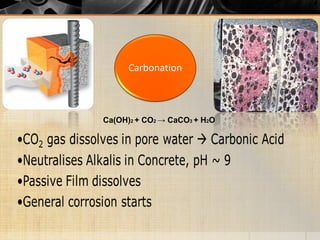
Carbonation
Ca(OH)2 + CO2 → CaCO3 + H2O
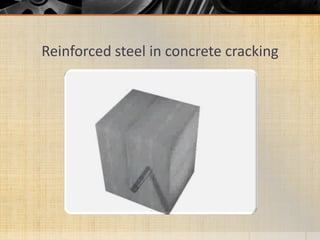
Reinforced steel in concrete cracking
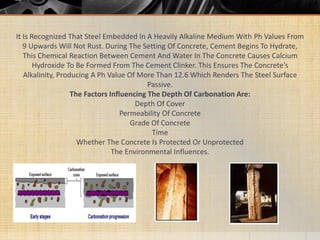
It Is Recognized That Steel Embedded In A Heavily Alkaline Medium With Ph Values From
9 Upwards Will Not Rust. During The Setting Of Concrete, Cement Begins To Hydrate,
This Chemical Reaction Between Cement And Water In The Concrete Causes Calcium
Hydroxide To Be Formed From The Cement Clinker. This Ensures The Concrete’s
Alkalinity, Producing A Ph Value Of More Than 12.6 Which Renders The Steel Surface
Passive.
The Factors Influencing The Depth Of Carbonation Are:
Depth Of Cover
Permeability Of Concrete
Grade Of Concrete
Time
Whether The Concrete Is Protected Or Unprotected
The Environmental Influences.
EFFECT OF CARBONATION
 It can cause soft surface, dusting and color
change
 It reduces quality concrete
 It reduces the concrete ability to protect
reinforcement from corrosion (in an exposed
environment)
 It will result in additional shrinkage in
carbonated region.
DETECTING CARBONATION
 Depth of carbonation can be detected using
an indicator.
 A chemical such as Phenolphthalein sprayed
on to freshly broken concrete.
 Areas remaining alkaline will turn in a bright
purply-pink color.
 Carbonated areas of concrete will remain
unchanged in color.
Negative Protection of the Reinforcement steel
bars
Reinforced steel corrosion is the main reason to damage which
occurs in concrete due to over whelming with co2 or above at the
present of salts and chlorides , concrete at it’s nature is an alchine
ph =12.5 or more a negative cover from isolating layer of oxide
around the buried steel ,, if ph =10 or lower then this layer is
destroyed due to air and oxygen and moisture which will cause a
certain steel corrosion , so we are trying as possible as we can to
maintain the the alchine ph above 12
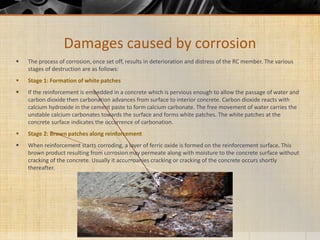
• Ca, Na, K hydroxides in
hydrated cement raise the pH
to ~13.5
 A dense protective  ferric
oxide (Fe2O3) passive film
forms around the
reinforcement
• This passive film stops iron
dissolution, and is stable at
pH >10
Passive film develops on the bar surface
pH >13
Passive film protection method
 The process of corrosion, once set off, results in deterioration and distress of the RC member. The various
stages of destruction are as follows:
 Stage 1: Formation of white patches
 If the reinforcement is embedded in a concrete which is pervious enough to allow the passage of water and
carbon dioxide then carbonation advances from surface to interior concrete. Carbon dioxide reacts with
calcium hydroxide in the cement paste to form calcium carbonate. The free movement of water carries the
unstable calcium carbonates towards the surface and forms white patches. The white patches at the
concrete surface indicates the occurrence of carbonation.
 Stage 2: Brown patches along reinforcement
 When reinforcement starts corroding, a layer of ferric oxide is formed on the reinforcement surface. This
brown product resulting from corrosion may permeate along with moisture to the concrete surface without
cracking of the concrete. Usually it accompanies cracking or cracking of the concrete occurs shortly
thereafter.
Damages caused by corrosion
 Stage 3: Occurrence of cracks
 The products of corrosion normally occupy a much greater volume about 6 to 10 times than the parent
metal. The increase in volume exerts considerable bursting pressure on the surrounding concrete resulting in
cracking.
 The hair line crack in the concrete surface lying directly above the reinforcement and running parallel to it is
the positive visible indication that reinforcement is corroding. These cracks indicate that the expanding rust
has grown enough to split the concrete. Even at this stage the reinforcement looks as though it is rust free if
the concrete is chipped off.
 Stage 4: Formation of multiple cracks
 As corrosion progresses, there will be formation of multiple layers of ferric oxide on the reinforcement which
in turn exert considerable pressure on the surrounding concrete resulting in widening of hair cracks. In
addition, several new hair cracks are also formed. The bond between concrete and the reinforcement is
considerably reduced. There will be a hollow sound when the concrete is tapped at the surface with a light
hammer.
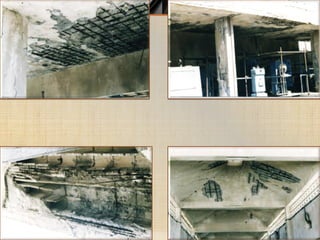
 Stage 5: Spalling of cover concrete
 Due to loss in bond between steel and concrete and formation of multiple layers of scales, the cover concrete
starts peeling off. At this stage, there is considerable reduction of the size of the bar.
 Stage 6: Snapping of bars
 The continued reduction in the size of bars, results in snapping of the bars. Usually snapping occurs in ties /
stirrups first. At this stage, there will also be a considerable reduction in the size of the main bars.
 Stage 7: Buckling of bars and bulging of concrete
 The spalling of the cover concrete and snapping of ties (in compression member) causes the main bars to
buckle, thus resulting in the bulging of concrete in that region. This follows a collapse of the structure.
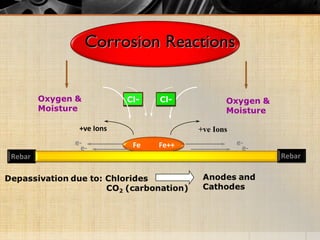
e- e-
Cl-Cl-
Rebar
e- e-
Rebar
Fe Fe++
+ve Ions +ve Ions
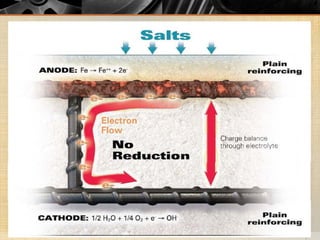
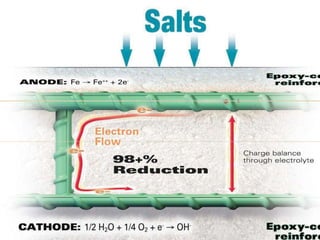
 ANODIC REACTIONS:
 FE -> FE++ + 2E–
 FE++ + 2(OH)– -> FE(OH)2 (FERROUS HYDROXIDE)
 4FE(OH)2 + 2H2O + O2 -> 4FE(OH)3 (FERRIC HYDROXIDE)
 (WATER) (AIR) 2FE(OH)3 -> FE2 × O3 × H2O + 2H2O — HYDRATED FERRIC
OXIDE (RUST).
 CATHODIC REACTION:
 4E– + O2 + 2H2O -> 4(OH)–
Cl-
Cl- Cl-
Cl-
Cl-
Cl-Cl-
Cl-
Cl-
Cl-
Cl-
Cl-
.
.
.
.
. .
.
.
.
.
.
.
.
.
.
.
. .
.
. .
.
.
..
.
.
.
.
.
.
.
.
.
.
.
.
.
.
.
.
.
.
.
.
.
.
.
.
.
.
.
.
. .
.
..
.
Electrolyte
Cl-
Cl- Cl-
Cl-Cl-
Cl-
Cl-
Cl-
Cl-
Cl-
Cl-
Cl-
Cl-
Cl-
Cl-
Cl-
Cl-
Cl-
Cl-
Cl-
Cl-
Cl- Cl-
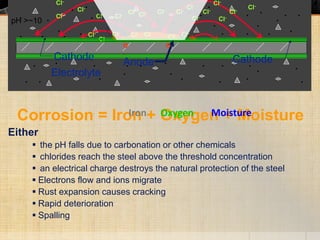
Corrosion = Iron + Oxygen + Moisture
Either
 the pH falls due to carbonation or other chemicals
 chlorides reach the steel above the threshold concentration
 an electrical charge destroys the natural protection of the steel
 Electrons flow and ions migrate
 Rust expansion causes cracking
 Rapid deterioration
 Spalling
pH >~10
Anode CathodeCathode
e
-
e
-
MoistureOxygenIron
DegreeofCorrosion
Time
I
Initiation Propagation
(corrosion)
Critical chloride
threshold
Migration of chlorides, H20
and O2 into the concrete, no
corrosion and no damage to
concrete
Corrosion of the steel
reinforcement and
cracking and/or spalling
of concrete
Reinforcing steel corrosion
Spalling
Cracks
with
Rust
Staining
Rebar
loss
Delamination
Abandoned Electric Pole
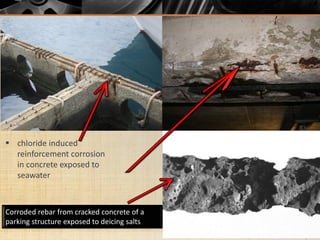
 chloride induced
reinforcement corrosion
in concrete exposed to
seawater
Corroded rebar from cracked concrete of a
parking structure exposed to deicing salts
1. Repairs to spallen concrete portions (steel and concrete)
• Cement based repairs
•Resin based repairs
2. Large volume repair
• Poured concrete
• Prep laced concrete
3. Sealing of cracks
• Cracks with no further movements expected
• Cracks with further movements expected
4. Surface coatings
5. Dry packing
Step 1
The repair process is started by cutting away all the loose and deteriorated
concrete until the hard core is reached preferably behind the corroding
reinforcement.
Step 2
All exposed reinforcements must be thoroughly cleaned. Loose rust or any
contamination is removed by abrasive blast cleaning. Wire brushing by hand is
not usually effective.
Step 3
The portions of steel bars severely corroded require replacement. This is
achieved by cutting away the corroded portions and replacing with new bars of
the same type and size, either welded or tied to the existing bars.
Step 4
After the corrosion affected bars are replaced in position, immediately a
protective primer (Zinc, neat resin or any other suitable coating) is applied. The
primer chosen should be such that it should good adhesive strength and good
adhesion to subsequent repair layers.
Step 5
In order to build up the section, either cement based repair, or Resin based repair can be
carried out.
Typical repair procedure for corrosion damaged concrete
Cement based repairs:
Step 6
The slurry (bonding coat) is applied to all concrete surfaces to which bond is required and
the patching mortar (readily available in pre-weighed packets) is applied, while the slurry is
still tacky. (Care should be taken to wit the concrete surface before the application of the
material but there must be no standing water left on the surfaces).
Step 7
As usual, the priming coat is applied over the prepared surfaces to protect the surfaces. The
interval between coats should not be too long; otherwise there will be bond failure.
Resin-based materials cure by exothermic chemical reaction immediately, when the
constituents are mixed. It is essential that the materials should be well compacted to
become impermeable, because they do not protect the steel by alkalinity.
Large volume repair
Step 1
The crack is thoroughly cleaned using compressed air.
Step 2
Superficial seal is applied over the crack at the surface by using a fast setting polyester resin or a thermoplastic
material into which injection nipples are fixed at intervals.
Step 3
Injection is started at the lowest point and when resin reaches the next higher point, the injection gun is moved
up to the next and the lower point is sealed. The process is continued until the whole crack gets sealed. The
pressure used is carefully controlled to avoid bursting of the seal and concrete scale work.
Repair of cracks (where further movement is expected)
When a crack is subjected to continuing movement, it is absolutely necessary to reduce the strain in it to
reasonable amount. This can be easily done by widening the crack at the surface and sealing it with an elastic
material such as polysulphide rubber or a performed neoprene strip.
Surface coatings
It is necessary, that after the completion of repair work, to treat both the repaired areas and the rest of the
structure with some coatings, principally, to reduce the permeability of concrete, to moisture, carbon dioxide,
and other aggressive agents. The coatings further can also give aesthetic look to the structure by containing
the patches, discolouration and stains and match colour and textures.
Dry packing
Dry packing or plugging is the hand placement of a low w/c ratio mortar followed by ramming or tamping of
mortar into place producing a intimate contact between new and existing work. The method is applicable to
dormant cracks in a structure.
CORROSION PREVENTION METHODS
 REBAR COATING
 SCARIFIED & PATCHED DECK AWAITS ANODE MESH
 FLY ASH
 HOT-DIP GALVANIZING
 WIRELESS SENSOR FOR MONITORING CHLORIDE IN
CONCRETE
 INHIBITORS
REBAR COATING
EPOXY COATING PREVIEW MODEL
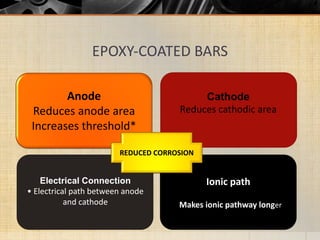
EPOXY‐COATED BARS
Anode
Reduces anode area
Increases threshold*
Cathode
Reduces cathodic area
Electrical Connection
• Electrical path between anode
and cathode Makes ionic pathway longer
Ionic path
REDUCED CORROSION
thermally sprayed coatings of
Zn and Al, combat corrosion
 For atmospheric, buried, and marine environment corrosion protection, Zn
(TSZ), Al (TSA), and their alloys have proven that they provide long term
corrosion protection and outperform most all other methods.
 Anodic (TSZ/TSA) metal coatings applied to steel cathodes (more noble than
Zn or Al), are referred to as cathodic or sacrificial protection coating
systems.
 These thermal spray coatings provide corrosion protection by excluding the
environment (or electrolyte) and acting as a barrier coating (like paints,
polymers, and epoxies), but unlike typical barrier coatings they also provide
sacrificial anodic protection.
Zinc and zinc alloys are also sprayed directly onto concrete to protect the
steel rebar within
Arc spraying of zinc on a concrete bridge pier
in the Florida Keys. In this case the zinc acts as
sacrificial anode, although it is more frequently
used in impressed-current systems. Three
impressed-current zinc systems have already
been installed by the Ministry of
Transportation of Ontario in Toronto
Sacrificial cathodic protection of steel in
concrete by thermal zinc spraying
FLY ASH
 using a Fly Ash concrete with very low permeability, which will delay the
arrival of carbonation and chlorides at the level of the steel reinforcement.
 Fly Ash is a finely divided silica rich powder that, in itself, gives no benefit
when added to a concrete mixture, unless it can react with the calcium
hydroxide formed in the first few days of hydration. Together they form a
calcium silica hydrate (CSH) compound that over time effectively reduces
concrete diffusivity to oxygen, carbon dioxide, water and chloride ions. By
reducing ion diffusion, the electrical resistance of the concrete also
increases
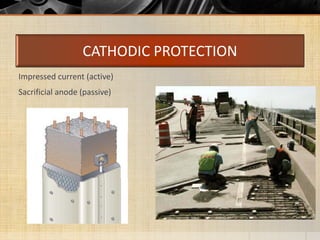
CATHODIC PROTECTION
Impressed current (active)
Sacrificial anode (passive)
TITANIUM ANODE MESH
A. TYPICALLY ATTACHED TO THE CONCRETE SURFACE AND
THEN ENCAPSULATED IN CEMENTITIOUS MATERIALS.
B- EASILY CONFORMS TO THE STRUCTURE GEOMETRY.
C- MOST USED IMPRESSED CURRENT ANODE FOR CONCRETE.
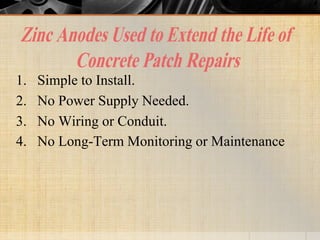
1. Simple to Install.
2. No Power Supply Needed.
3. No Wiring or Conduit.
4. No Long-Term Monitoring or Maintenance
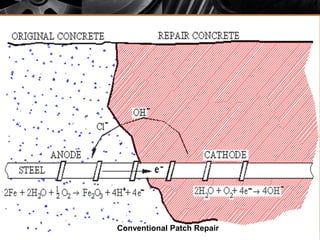
Conventional Patch Repair
Embedded Zinc Anode for Patch Repair
REFRENCES
 Concrete Society Technical Reports TR 36 and 37
 ‫د‬ ‫كتاب‬/‫امام‬ ‫محمود‬
 http://www.cement.org/for-concrete-books-learning/concrete-
technology/durability/corrosion-of-embedded-materials
 https://en.wikipedia.org/wiki/Reinforced_concrete
 http://theconstructor.org/
 ‫للخرسانه‬ ‫المصري‬ ‫الكود‬
 Repair and strengthen concrete (Dr.maatz awry)
 Hoffman architects journal
Corrosion Research

Corrosion Research

  • 1.
  • 2.
    Brief Of TheResearch • INTRODUCTION • Definition Of Corrosion and it’s types • Causes of occurring and Factors affecting on it • Negative Protection of the Reinforcement steel bars • Formula of reinforcement steel corrosion • Damages caused by steel corrosion • Treatment methods • PROTECTION METHODS • CONCLUSION
  • 3.
     Concreteis acomplex material of construction that enables the high compressive strength of natural stone to be used in any configuration. This is accomplished by breaking natural stone to suitable sizes and mixing the aggregates so formed with suitable proportions of water and cement. This mixture can then be moulded into any required shape while still fluid. The water and cement react chemically, forming a “glue” that bonds the pieces of stone aggregate together into a structural member, which becomes rigid and strong in compression when the chemical reaction is completed (i.e. the concrete is “cured”). In tension, however, concrete can be no stronger than the bond between the cured cement and the surfaces of the aggregate. This is generally much lower than the compressive strength of the concrete  Steel can be used for such reinforcement in one of two ways. When a system of steel bars or a steel mesh is incorporated in the concrete structure in such a way that the steel can support most of the tensile stresses and leave the immediately surrounding concrete comparatively free of tensile stress, then the complex is known as “reinforced concrete”. When the steel introduced is initially tensioned in such a manner that it applies a compressive stress to the surrounding hardened concrete such that no subsequent loading applied to the structure puts that concrete into tension, then the complex is known as “prestressed concrete”.
  • 4.
     The chemicalor electrochemical reaction between a material, usually a metal, and its environment that produces a deterioration of the material and its properties.” For steel embedded in concrete, corrosion results in the formation of rust which has two to four times the volume of the original steel and none of the good mechanical properties. Corrosion also produces pits or holes in the surface of reinforcing steel, reducing strength capacity as a result of the reduced cross-sectional area.
  • 5.
  • 6.
    Electrochemical process ofsteel corrosion in concrete
  • 8.
    COMMON CORROSION TYPES 1)Crevice Corrosion Crevice corrosion is a localized form of corrosion usually associated with a stagnant solution on the micro-environmental level. Such stagnant microenvironments tend to occur in crevices (shielded areas). Oxygen in the liquid which is deep in the crevice is consumed by reaction with the metal. Oxygen content of liquid at the mouth of the crevice which is exposed to the air is greater, so a local cell develops in which the anode, or area being attacked, is the surface in contact with the oxygen-depleted liquid.
  • 10.
    2) Pitting Theories ofpassivity fall into two general categories, one based on adsorption and the other on presence of a thin oxide film. Pitting in the former case arises as detrimental or activator species, such as Cl-, compete with O2 or OH- at specific surface sites. By the oxide film theory, detrimental species become incorporated into the passive film, leading to its local dissolution or to development of conductive paths. Once initiated, pits propagate auto-catalytically according to the generalized reaction, M+n + nH2O + nCl- → M(OH)n + nHCl, resulting in acidification of the active region and corrosion at an accelerated rate (M+n and M are the ionic and metallic forms of the corroding metal).
  • 12.
    Airborne, marine, industrial,groundwater, cast-in Cl– can penetrate through the passive film At Cl- > “threshold”, passive film breaks down, corrosion initiates Cl- “threshold” value is typically 0.05% by wt of concrete (0.02% prestressed concrete) Pitting corrosion Chlorides are main cause of reinforcement corrosion Chlorides
  • 13.
     Chlorides  ChloridesAre Generally Acidic In Nature And Can Come From A Number Of Different Sources, The Most Common Being, De-icing Salts, Use Of Unwashed Marine Aggregates, Sea Water Spray, And Certain Accelerating Admixtures (Their Use Is Now Prohibited).  In The Presence Of Chlorides Localized Pitting Corrosion Occurs Which Does Not Always Have Associated With It The Early Warning Signs Of Surface Cracking.  Chlorides Induced Corrosion Is Potentially More Dangerous Than That Resulting From Carbonation. Like Most Of The Aspects Of Concrete Durability, Deterioration Due To Corrosion Of The Reinforcement Can Take Place Years (5 To 20) To Manifest Itself.  Factors Influencing Corrosion Of Steel Reinforcement  The Factors Which Generally Influence Corrosion Of Reinforcement In RC Structures Are:  Ph Value,  Moisture,  Oxygen,  Carbonation,  Chlorides,  Ambient Temperature And Relative Humidity,  Severity Of Exposure,  Quality Of Construction Materials,
  • 14.
  • 15.
    Reinforced steel inconcrete cracking
  • 16.
    It Is RecognizedThat Steel Embedded In A Heavily Alkaline Medium With Ph Values From 9 Upwards Will Not Rust. During The Setting Of Concrete, Cement Begins To Hydrate, This Chemical Reaction Between Cement And Water In The Concrete Causes Calcium Hydroxide To Be Formed From The Cement Clinker. This Ensures The Concrete’s Alkalinity, Producing A Ph Value Of More Than 12.6 Which Renders The Steel Surface Passive. The Factors Influencing The Depth Of Carbonation Are: Depth Of Cover Permeability Of Concrete Grade Of Concrete Time Whether The Concrete Is Protected Or Unprotected The Environmental Influences.
  • 17.
    EFFECT OF CARBONATION It can cause soft surface, dusting and color change  It reduces quality concrete  It reduces the concrete ability to protect reinforcement from corrosion (in an exposed environment)  It will result in additional shrinkage in carbonated region.
  • 18.
    DETECTING CARBONATION  Depthof carbonation can be detected using an indicator.  A chemical such as Phenolphthalein sprayed on to freshly broken concrete.  Areas remaining alkaline will turn in a bright purply-pink color.  Carbonated areas of concrete will remain unchanged in color.
  • 19.
    Negative Protection ofthe Reinforcement steel bars Reinforced steel corrosion is the main reason to damage which occurs in concrete due to over whelming with co2 or above at the present of salts and chlorides , concrete at it’s nature is an alchine ph =12.5 or more a negative cover from isolating layer of oxide around the buried steel ,, if ph =10 or lower then this layer is destroyed due to air and oxygen and moisture which will cause a certain steel corrosion , so we are trying as possible as we can to maintain the the alchine ph above 12
  • 20.
    • Ca, Na,K hydroxides in hydrated cement raise the pH to ~13.5  A dense protective  ferric oxide (Fe2O3) passive film forms around the reinforcement • This passive film stops iron dissolution, and is stable at pH >10 Passive film develops on the bar surface pH >13 Passive film protection method
  • 21.
     The processof corrosion, once set off, results in deterioration and distress of the RC member. The various stages of destruction are as follows:  Stage 1: Formation of white patches  If the reinforcement is embedded in a concrete which is pervious enough to allow the passage of water and carbon dioxide then carbonation advances from surface to interior concrete. Carbon dioxide reacts with calcium hydroxide in the cement paste to form calcium carbonate. The free movement of water carries the unstable calcium carbonates towards the surface and forms white patches. The white patches at the concrete surface indicates the occurrence of carbonation.  Stage 2: Brown patches along reinforcement  When reinforcement starts corroding, a layer of ferric oxide is formed on the reinforcement surface. This brown product resulting from corrosion may permeate along with moisture to the concrete surface without cracking of the concrete. Usually it accompanies cracking or cracking of the concrete occurs shortly thereafter. Damages caused by corrosion
  • 22.
     Stage 3:Occurrence of cracks  The products of corrosion normally occupy a much greater volume about 6 to 10 times than the parent metal. The increase in volume exerts considerable bursting pressure on the surrounding concrete resulting in cracking.  The hair line crack in the concrete surface lying directly above the reinforcement and running parallel to it is the positive visible indication that reinforcement is corroding. These cracks indicate that the expanding rust has grown enough to split the concrete. Even at this stage the reinforcement looks as though it is rust free if the concrete is chipped off.  Stage 4: Formation of multiple cracks  As corrosion progresses, there will be formation of multiple layers of ferric oxide on the reinforcement which in turn exert considerable pressure on the surrounding concrete resulting in widening of hair cracks. In addition, several new hair cracks are also formed. The bond between concrete and the reinforcement is considerably reduced. There will be a hollow sound when the concrete is tapped at the surface with a light hammer.  Stage 5: Spalling of cover concrete  Due to loss in bond between steel and concrete and formation of multiple layers of scales, the cover concrete starts peeling off. At this stage, there is considerable reduction of the size of the bar.  Stage 6: Snapping of bars  The continued reduction in the size of bars, results in snapping of the bars. Usually snapping occurs in ties / stirrups first. At this stage, there will also be a considerable reduction in the size of the main bars.  Stage 7: Buckling of bars and bulging of concrete  The spalling of the cover concrete and snapping of ties (in compression member) causes the main bars to buckle, thus resulting in the bulging of concrete in that region. This follows a collapse of the structure.
  • 24.
    e- e- Cl-Cl- Rebar e- e- Rebar FeFe++ +ve Ions +ve Ions
  • 25.
     ANODIC REACTIONS: FE -> FE++ + 2E–  FE++ + 2(OH)– -> FE(OH)2 (FERROUS HYDROXIDE)  4FE(OH)2 + 2H2O + O2 -> 4FE(OH)3 (FERRIC HYDROXIDE)  (WATER) (AIR) 2FE(OH)3 -> FE2 × O3 × H2O + 2H2O — HYDRATED FERRIC OXIDE (RUST).  CATHODIC REACTION:  4E– + O2 + 2H2O -> 4(OH)–
  • 26.
    Cl- Cl- Cl- Cl- Cl- Cl-Cl- Cl- Cl- Cl- Cl- Cl- . . . . . . . . . . . . . . . . .. . . . . . .. . . . . . . . . . . . . . . . . . . . . . . . . . . . . . . . .. . Electrolyte Cl- Cl- Cl- Cl-Cl- Cl- Cl- Cl- Cl- Cl- Cl- Cl- Cl- Cl- Cl- Cl- Cl- Cl- Cl- Cl- Cl- Cl- Cl- Corrosion = Iron + Oxygen + Moisture Either  the pH falls due to carbonation or other chemicals  chlorides reach the steel above the threshold concentration  an electrical charge destroys the natural protection of the steel  Electrons flow and ions migrate  Rust expansion causes cracking  Rapid deterioration  Spalling pH >~10 Anode CathodeCathode e - e - MoistureOxygenIron
  • 27.
    DegreeofCorrosion Time I Initiation Propagation (corrosion) Critical chloride threshold Migrationof chlorides, H20 and O2 into the concrete, no corrosion and no damage to concrete Corrosion of the steel reinforcement and cracking and/or spalling of concrete Reinforcing steel corrosion
  • 28.
  • 29.
  • 33.
     chloride induced reinforcementcorrosion in concrete exposed to seawater Corroded rebar from cracked concrete of a parking structure exposed to deicing salts
  • 34.
    1. Repairs tospallen concrete portions (steel and concrete) • Cement based repairs •Resin based repairs 2. Large volume repair • Poured concrete • Prep laced concrete 3. Sealing of cracks • Cracks with no further movements expected • Cracks with further movements expected 4. Surface coatings 5. Dry packing
  • 35.
    Step 1 The repairprocess is started by cutting away all the loose and deteriorated concrete until the hard core is reached preferably behind the corroding reinforcement. Step 2 All exposed reinforcements must be thoroughly cleaned. Loose rust or any contamination is removed by abrasive blast cleaning. Wire brushing by hand is not usually effective. Step 3 The portions of steel bars severely corroded require replacement. This is achieved by cutting away the corroded portions and replacing with new bars of the same type and size, either welded or tied to the existing bars. Step 4 After the corrosion affected bars are replaced in position, immediately a protective primer (Zinc, neat resin or any other suitable coating) is applied. The primer chosen should be such that it should good adhesive strength and good adhesion to subsequent repair layers.
  • 36.
    Step 5 In orderto build up the section, either cement based repair, or Resin based repair can be carried out. Typical repair procedure for corrosion damaged concrete Cement based repairs: Step 6 The slurry (bonding coat) is applied to all concrete surfaces to which bond is required and the patching mortar (readily available in pre-weighed packets) is applied, while the slurry is still tacky. (Care should be taken to wit the concrete surface before the application of the material but there must be no standing water left on the surfaces). Step 7 As usual, the priming coat is applied over the prepared surfaces to protect the surfaces. The interval between coats should not be too long; otherwise there will be bond failure. Resin-based materials cure by exothermic chemical reaction immediately, when the constituents are mixed. It is essential that the materials should be well compacted to become impermeable, because they do not protect the steel by alkalinity.
  • 37.
    Large volume repair Step1 The crack is thoroughly cleaned using compressed air. Step 2 Superficial seal is applied over the crack at the surface by using a fast setting polyester resin or a thermoplastic material into which injection nipples are fixed at intervals. Step 3 Injection is started at the lowest point and when resin reaches the next higher point, the injection gun is moved up to the next and the lower point is sealed. The process is continued until the whole crack gets sealed. The pressure used is carefully controlled to avoid bursting of the seal and concrete scale work. Repair of cracks (where further movement is expected) When a crack is subjected to continuing movement, it is absolutely necessary to reduce the strain in it to reasonable amount. This can be easily done by widening the crack at the surface and sealing it with an elastic material such as polysulphide rubber or a performed neoprene strip. Surface coatings It is necessary, that after the completion of repair work, to treat both the repaired areas and the rest of the structure with some coatings, principally, to reduce the permeability of concrete, to moisture, carbon dioxide, and other aggressive agents. The coatings further can also give aesthetic look to the structure by containing the patches, discolouration and stains and match colour and textures. Dry packing Dry packing or plugging is the hand placement of a low w/c ratio mortar followed by ramming or tamping of mortar into place producing a intimate contact between new and existing work. The method is applicable to dormant cracks in a structure.
  • 38.
    CORROSION PREVENTION METHODS REBAR COATING  SCARIFIED & PATCHED DECK AWAITS ANODE MESH  FLY ASH  HOT-DIP GALVANIZING  WIRELESS SENSOR FOR MONITORING CHLORIDE IN CONCRETE  INHIBITORS
  • 39.
  • 40.
  • 43.
    EPOXY‐COATED BARS Anode Reduces anodearea Increases threshold* Cathode Reduces cathodic area Electrical Connection • Electrical path between anode and cathode Makes ionic pathway longer Ionic path REDUCED CORROSION
  • 44.
    thermally sprayed coatingsof Zn and Al, combat corrosion  For atmospheric, buried, and marine environment corrosion protection, Zn (TSZ), Al (TSA), and their alloys have proven that they provide long term corrosion protection and outperform most all other methods.  Anodic (TSZ/TSA) metal coatings applied to steel cathodes (more noble than Zn or Al), are referred to as cathodic or sacrificial protection coating systems.  These thermal spray coatings provide corrosion protection by excluding the environment (or electrolyte) and acting as a barrier coating (like paints, polymers, and epoxies), but unlike typical barrier coatings they also provide sacrificial anodic protection.
  • 45.
    Zinc and zincalloys are also sprayed directly onto concrete to protect the steel rebar within Arc spraying of zinc on a concrete bridge pier in the Florida Keys. In this case the zinc acts as sacrificial anode, although it is more frequently used in impressed-current systems. Three impressed-current zinc systems have already been installed by the Ministry of Transportation of Ontario in Toronto Sacrificial cathodic protection of steel in concrete by thermal zinc spraying
  • 46.
    FLY ASH  usinga Fly Ash concrete with very low permeability, which will delay the arrival of carbonation and chlorides at the level of the steel reinforcement.  Fly Ash is a finely divided silica rich powder that, in itself, gives no benefit when added to a concrete mixture, unless it can react with the calcium hydroxide formed in the first few days of hydration. Together they form a calcium silica hydrate (CSH) compound that over time effectively reduces concrete diffusivity to oxygen, carbon dioxide, water and chloride ions. By reducing ion diffusion, the electrical resistance of the concrete also increases
  • 47.
    CATHODIC PROTECTION Impressed current(active) Sacrificial anode (passive)
  • 48.
    TITANIUM ANODE MESH A.TYPICALLY ATTACHED TO THE CONCRETE SURFACE AND THEN ENCAPSULATED IN CEMENTITIOUS MATERIALS. B- EASILY CONFORMS TO THE STRUCTURE GEOMETRY. C- MOST USED IMPRESSED CURRENT ANODE FOR CONCRETE.
  • 49.
    1. Simple toInstall. 2. No Power Supply Needed. 3. No Wiring or Conduit. 4. No Long-Term Monitoring or Maintenance
  • 50.
  • 51.
    Embedded Zinc Anodefor Patch Repair
  • 52.
    REFRENCES  Concrete SocietyTechnical Reports TR 36 and 37  ‫د‬ ‫كتاب‬/‫امام‬ ‫محمود‬  http://www.cement.org/for-concrete-books-learning/concrete- technology/durability/corrosion-of-embedded-materials  https://en.wikipedia.org/wiki/Reinforced_concrete  http://theconstructor.org/  ‫للخرسانه‬ ‫المصري‬ ‫الكود‬  Repair and strengthen concrete (Dr.maatz awry)  Hoffman architects journal