Carbon in ecosystems
Markku Kanninen & Markku Larjavaara
VITRI, University of Helsinki
University of Helsinki Viikki Tropical Resources Institute (VITRI)
Greenhouse gas emissions from land use,
land use change and forestry (LULUCF)
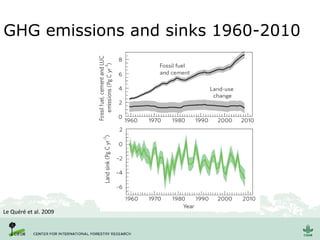
GHG emissions and sinks 1960-2010
Le Quéré et al. 2009
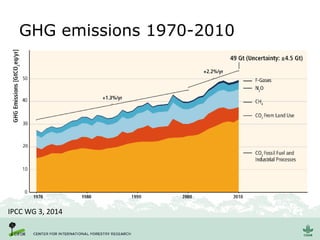
GHG emissions 1970-2010
IPCC WG 3, 2014
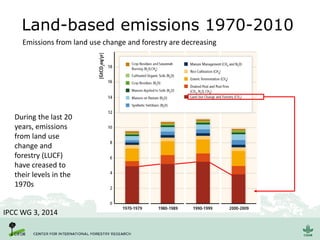
Land-based emissions 1970-2010
During the last 20
years, emissions
from land use
change and
forestry (LUCF)
have creased to
their levels in the
1970s
IPCC WG 3, 2014
Emissions from land use change and forestry are decreasing
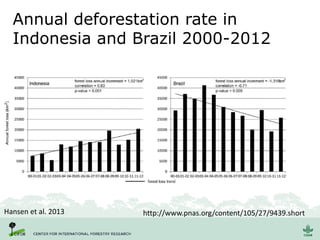
Annual deforestation rate in
Indonesia and Brazil 2000-2012
Hansen et al. 2013 http://www.pnas.org/content/105/27/9439.short
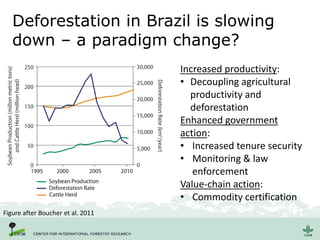
Deforestation in Brazil is slowing
down – a paradigm change?
Figure after Boucher et al. 2011
Increased productivity:
• Decoupling agricultural
productivity and
deforestation
Enhanced government
action:
• Increased tenure security
• Monitoring & law
enforcement
Value-chain action:
• Commodity certification
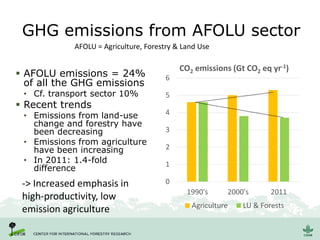
GHG emissions from AFOLU sector
▪ AFOLU emissions = 24%
of all the GHG emissions
• Cf. transport sector 10%
▪ Recent trends
• Emissions from land-use
change and forestry have
been decreasing
• Emissions from agriculture
have been increasing
• In 2011: 1.4-fold
difference
0
1
2
3
4
5
6
1990's 2000's 2011
CO2 emissions (Gt CO2 eq yr-1)
Agriculture LU & Forests
AFOLU = Agriculture, Forestry & Land Use
-> Increased emphasis in
high-productivity, low
emission agriculture
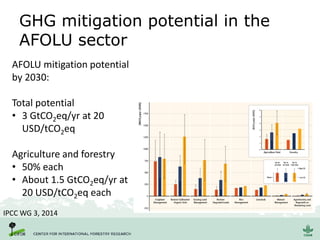
GHG mitigation potential in the
AFOLU sector
IPCC WG 3, 2014
AFOLU mitigation potential
by 2030:
Total potential
• 3 GtCO2eq/yr at 20
USD/tCO2eq
Agriculture and forestry
• 50% each
• About 1.5 GtCO2eq/yr at
20 USD/tCO2eq each
University of Helsinki Viikki Tropical Resources Institute (VITRI)
Role of forest ecosystems in
mitigation
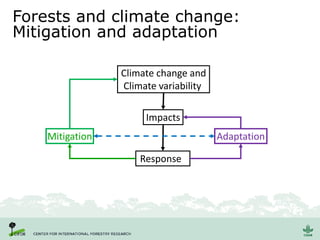
Forests and climate change:
Mitigation and adaptation
Climate change and
Climate variability
Impacts
Responses
AdaptationMitigation
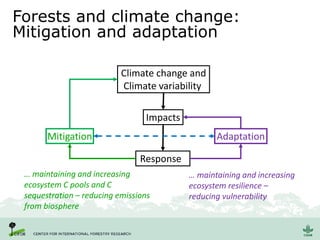
Forests and climate change:
Mitigation and adaptation
Climate change and
Climate variability
Impacts
Responses
AdaptationMitigation
… maintaining and increasing
ecosystem C pools and C
sequestration – reducing emissions
from biosphere
… maintaining and increasing
ecosystem resilience –
reducing vulnerability
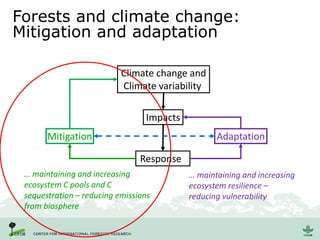
Forests and climate change:
Mitigation and adaptation
Climate change and
Climate variability
Impacts
Responses
AdaptationMitigation
… maintaining and increasing
ecosystem C pools and C
sequestration – reducing emissions
from biosphere
… maintaining and increasing
ecosystem resilience –
reducing vulnerability
(3-5y)
(50 y)
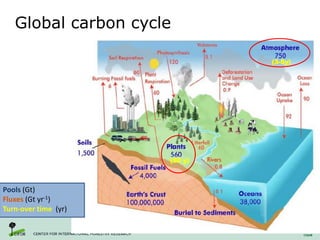
Global carbon cycle
Pools (Gt)
Fluxes (Gt yr-1)
Turn-over time (yr)
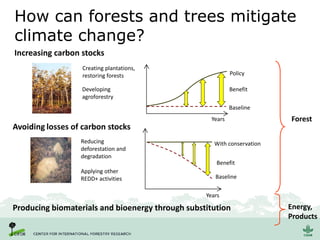
How can forests and trees mitigate
climate change?
Producing biomaterials and bioenergy through substitution
Forest
Energy,
Products
Developing
agroforestry
Creating plantations,
restoring forests
Increasing carbon stocks
Years
Policy
Baseline
Benefit
Avoiding losses of carbon stocks
Reducing
deforestation and
degradation
Applying other
REDD+ activities
Years
With conservation
Baseline
Benefit
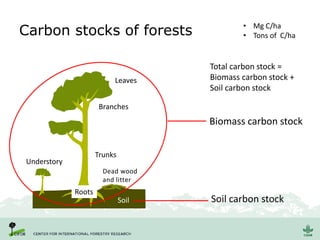
Carbon stocks of forests
Leaves
Branches
Dead wood
and litter
Soil
Roots
Trunks
Understory
Biomass carbon stock
Soil carbon stock
• Mg C/ha
• Tons of C/ha
Total carbon stock =
Biomass carbon stock +
Soil carbon stock
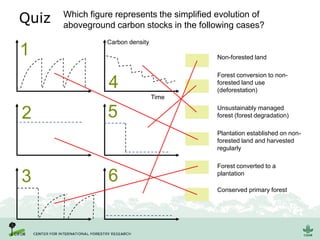
Time
Carbon density
1
2
3
4
5
6
Non-forested land
Forest conversion to non-
forested land use
(deforestation)
Unsustainably managed
forest (forest degradation)
Plantation established on non-
forested land and harvested
regularly
Forest converted to a
plantation
Conserved primary forest
Quiz Which figure represents the simplified evolution of
aboveground carbon stocks in the following cases?
University of Helsinki Viikki Tropical Resources Institute (VITRI)
Definitions, units, examples
Terms and units for ecosystem carbon
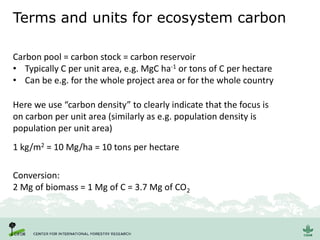
Carbon pool = carbon stock = carbon reservoir
• Typically C per unit area, e.g. MgC ha-1 or tons of C per hectare
• Can be e.g. for the whole project area or for the whole country
Here we use “carbon density” to clearly indicate that the focus is
on carbon per unit area (similarly as e.g. population density is
population per unit area)
Conversion:
2 Mg of biomass = 1 Mg of C = 3.7 Mg of CO2
1 kg/m2 = 10 Mg/ha = 10 tons per hectare
Biomass
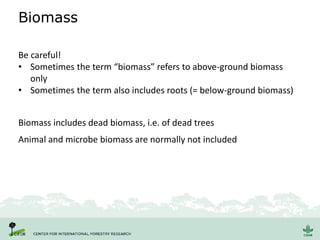
Be careful!
• Sometimes the term “biomass” refers to above-ground biomass
only
• Sometimes the term also includes roots (= below-ground biomass)
Animal and microbe biomass are normally not included
Biomass includes dead biomass, i.e. of dead trees
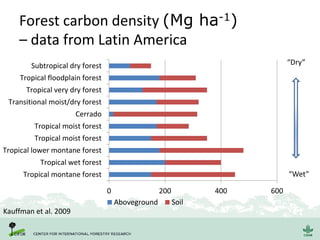
Forest carbon density (Mg ha-1)
– data from Latin America
0 200 400 600
Subtropical dry forest
Tropical floodplain forest
Tropical very dry forest
Transitional moist/dry forest
Cerrado
Tropical moist forest
Tropical lower montane forest
Tropical wet forest
Tropical montane forest
Aboveground Soil
Kauffman et al. 2009
“Dry”
“Wet”
To actual numbers
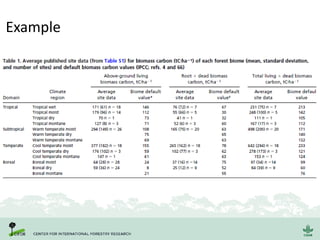
Example
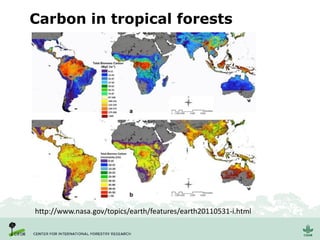
Carbon in tropical forests
http://www.nasa.gov/topics/earth/features/earth20110531-i.html
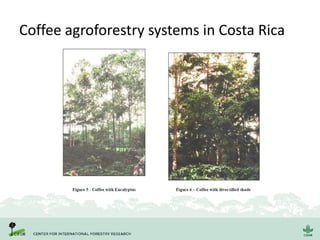
Coffee agroforestry systems in Costa Rica
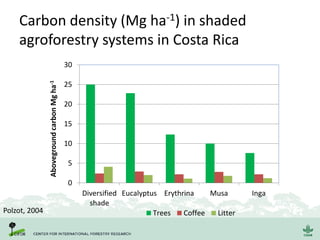
Carbon density (Mg ha-1) in shaded
agroforestry systems in Costa Rica
0
5
10
15
20
25
30
Diversified
shade
Eucalyptus Erythrina Musa Inga
AbovegroundcarbonMgha-1
Trees Coffee LitterPolzot, 2004
Carbon scenarios in landscapes
Comparing with what?
Additionality in carbon projects (CDM, REDD+)
• Comparing with what?
• What is the reference level or base line?
Comparisons are using
• Reference levels or baseline scenarios
They can also be called as
• Business-as-usual or reference scenarios
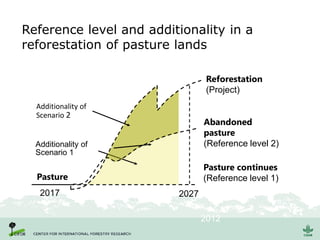
Reference level and additionality in a
reforestation of pasture lands
2012
Additionality of
Scenario 1
Additionality of
Scenario 2
2017
Pasture
Pasture continues
(Reference level 1)
Abandoned
pasture
(Reference level 2)
Reforestation
(Project)
2027
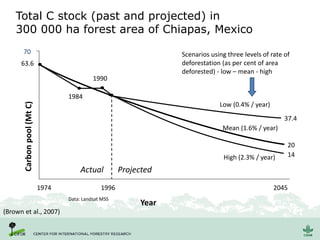
1984
1990
63.6
Actual Projected
37.4
Low (0.4% / year)
20
Mean (1.6% / year)
14High (2.3% / year)
70
19961974 2045
Year
Data: Landsat MSS
Total C stock (past and projected) in
300 000 ha forest area of Chiapas, Mexico
(Brown et al., 2007)
Scenarios using three levels of rate of
deforestation (as per cent of area
deforested) - low – mean - high
References
• Boucher, D., Elias, P., Lininger, K., May-Tobin, C., Roquemore, S., Saxon, E. 2011. The Root of the
Problem. What ’s Driving Tropical Deforestation Today? In. Union of Concerned Scientists,
Cambridge, MA, 113 p.
• Brown, S., Hall, M., Andrasko, K., Ruiz, F., Marzoli, W., Guerrero, G., Masera, O., Dushku, A.,
DeJong, B., Cornell, J. 2007. Baselines for land-use change in the tropics: application to avoided
deforestation projects. Mitigation and Adaptation Strategies for Global Change 12, 1001-1026.
• Hansen, M.C., Potapov, P.V., Moore, R., Hancher, M., Turubanova, S.A., Tyukavina, A., Thau, D.,
Stehman, S.V., Goetz, S.J., Loveland, T.R., Kommareddy, A., Egorov, A., Chini, L., Justice, C.O.,
Townshend, J.R.G. 2013. High-Resolution Global Maps of 21st-Century Forest Cover Change.
Science 342, 850-853.
• IPCC. 2014. Climate Change 2014: Mitigation of Climate Change. Contribution of Working Group III
to the Fifth Assessment Report of the Intergovernmental Panel on Climate Change.Cambridge
University Press, Cambridge, United Kingdom and New York, NY, USA. 1435 p.
• Kauffman, J.B., Hughes, R.F., Heider, C. 2009. Carbon pool and biomass dynamics associated with
deforestation, land use, and agricultural abandonment in the neotropics. Ecological Applications 19,
1211-1222.
• Polzot, C.L. 2004. Carbon storage in coffee agroecosystems of Southern Costa Rica: potential
applications for the Clean Development Mechanism. MSc Thesis. York University, Ontario, Canada.
162 p.
Terima kasih
Thank you
markku.kanninen@helsinki.fi
markku.larjavaara@gmail.com

Carbon in ecosystems

  • 1.
    Carbon in ecosystems MarkkuKanninen & Markku Larjavaara VITRI, University of Helsinki
  • 2.
    University of HelsinkiViikki Tropical Resources Institute (VITRI) Greenhouse gas emissions from land use, land use change and forestry (LULUCF)
  • 3.
    GHG emissions andsinks 1960-2010 Le Quéré et al. 2009
  • 4.
  • 5.
    Land-based emissions 1970-2010 Duringthe last 20 years, emissions from land use change and forestry (LUCF) have creased to their levels in the 1970s IPCC WG 3, 2014 Emissions from land use change and forestry are decreasing
  • 6.
    Annual deforestation ratein Indonesia and Brazil 2000-2012 Hansen et al. 2013 http://www.pnas.org/content/105/27/9439.short
  • 7.
    Deforestation in Brazilis slowing down – a paradigm change? Figure after Boucher et al. 2011 Increased productivity: • Decoupling agricultural productivity and deforestation Enhanced government action: • Increased tenure security • Monitoring & law enforcement Value-chain action: • Commodity certification
  • 8.
    GHG emissions fromAFOLU sector ▪ AFOLU emissions = 24% of all the GHG emissions • Cf. transport sector 10% ▪ Recent trends • Emissions from land-use change and forestry have been decreasing • Emissions from agriculture have been increasing • In 2011: 1.4-fold difference 0 1 2 3 4 5 6 1990's 2000's 2011 CO2 emissions (Gt CO2 eq yr-1) Agriculture LU & Forests AFOLU = Agriculture, Forestry & Land Use -> Increased emphasis in high-productivity, low emission agriculture
  • 9.
    GHG mitigation potentialin the AFOLU sector IPCC WG 3, 2014 AFOLU mitigation potential by 2030: Total potential • 3 GtCO2eq/yr at 20 USD/tCO2eq Agriculture and forestry • 50% each • About 1.5 GtCO2eq/yr at 20 USD/tCO2eq each
  • 10.
    University of HelsinkiViikki Tropical Resources Institute (VITRI) Role of forest ecosystems in mitigation
  • 11.
    Forests and climatechange: Mitigation and adaptation Climate change and Climate variability Impacts Responses AdaptationMitigation
  • 12.
    Forests and climatechange: Mitigation and adaptation Climate change and Climate variability Impacts Responses AdaptationMitigation … maintaining and increasing ecosystem C pools and C sequestration – reducing emissions from biosphere … maintaining and increasing ecosystem resilience – reducing vulnerability
  • 13.
    Forests and climatechange: Mitigation and adaptation Climate change and Climate variability Impacts Responses AdaptationMitigation … maintaining and increasing ecosystem C pools and C sequestration – reducing emissions from biosphere … maintaining and increasing ecosystem resilience – reducing vulnerability
  • 14.
    (3-5y) (50 y) Global carboncycle Pools (Gt) Fluxes (Gt yr-1) Turn-over time (yr)
  • 15.
    How can forestsand trees mitigate climate change? Producing biomaterials and bioenergy through substitution Forest Energy, Products Developing agroforestry Creating plantations, restoring forests Increasing carbon stocks Years Policy Baseline Benefit Avoiding losses of carbon stocks Reducing deforestation and degradation Applying other REDD+ activities Years With conservation Baseline Benefit
  • 16.
    Carbon stocks offorests Leaves Branches Dead wood and litter Soil Roots Trunks Understory Biomass carbon stock Soil carbon stock • Mg C/ha • Tons of C/ha Total carbon stock = Biomass carbon stock + Soil carbon stock
  • 17.
    Time Carbon density 1 2 3 4 5 6 Non-forested land Forestconversion to non- forested land use (deforestation) Unsustainably managed forest (forest degradation) Plantation established on non- forested land and harvested regularly Forest converted to a plantation Conserved primary forest Quiz Which figure represents the simplified evolution of aboveground carbon stocks in the following cases?
  • 18.
    University of HelsinkiViikki Tropical Resources Institute (VITRI) Definitions, units, examples
  • 19.
    Terms and unitsfor ecosystem carbon Carbon pool = carbon stock = carbon reservoir • Typically C per unit area, e.g. MgC ha-1 or tons of C per hectare • Can be e.g. for the whole project area or for the whole country Here we use “carbon density” to clearly indicate that the focus is on carbon per unit area (similarly as e.g. population density is population per unit area) Conversion: 2 Mg of biomass = 1 Mg of C = 3.7 Mg of CO2 1 kg/m2 = 10 Mg/ha = 10 tons per hectare
  • 20.
    Biomass Be careful! • Sometimesthe term “biomass” refers to above-ground biomass only • Sometimes the term also includes roots (= below-ground biomass) Animal and microbe biomass are normally not included Biomass includes dead biomass, i.e. of dead trees
  • 21.
    Forest carbon density(Mg ha-1) – data from Latin America 0 200 400 600 Subtropical dry forest Tropical floodplain forest Tropical very dry forest Transitional moist/dry forest Cerrado Tropical moist forest Tropical moist forest Tropical lower montane forest Tropical wet forest Tropical montane forest Aboveground Soil Kauffman et al. 2009 “Dry” “Wet”
  • 22.
  • 23.
    Carbon in tropicalforests http://www.nasa.gov/topics/earth/features/earth20110531-i.html
  • 24.
  • 25.
    Carbon density (Mgha-1) in shaded agroforestry systems in Costa Rica 0 5 10 15 20 25 30 Diversified shade Eucalyptus Erythrina Musa Inga AbovegroundcarbonMgha-1 Trees Coffee LitterPolzot, 2004
  • 26.
    Carbon scenarios inlandscapes Comparing with what? Additionality in carbon projects (CDM, REDD+) • Comparing with what? • What is the reference level or base line? Comparisons are using • Reference levels or baseline scenarios They can also be called as • Business-as-usual or reference scenarios
  • 27.
    Reference level andadditionality in a reforestation of pasture lands 2012 Additionality of Scenario 1 Additionality of Scenario 2 2017 Pasture Pasture continues (Reference level 1) Abandoned pasture (Reference level 2) Reforestation (Project) 2027
  • 28.
    1984 1990 63.6 Actual Projected 37.4 Low (0.4%/ year) 20 Mean (1.6% / year) 14High (2.3% / year) 70 19961974 2045 Year Data: Landsat MSS Total C stock (past and projected) in 300 000 ha forest area of Chiapas, Mexico (Brown et al., 2007) Scenarios using three levels of rate of deforestation (as per cent of area deforested) - low – mean - high
  • 29.
    References • Boucher, D.,Elias, P., Lininger, K., May-Tobin, C., Roquemore, S., Saxon, E. 2011. The Root of the Problem. What ’s Driving Tropical Deforestation Today? In. Union of Concerned Scientists, Cambridge, MA, 113 p. • Brown, S., Hall, M., Andrasko, K., Ruiz, F., Marzoli, W., Guerrero, G., Masera, O., Dushku, A., DeJong, B., Cornell, J. 2007. Baselines for land-use change in the tropics: application to avoided deforestation projects. Mitigation and Adaptation Strategies for Global Change 12, 1001-1026. • Hansen, M.C., Potapov, P.V., Moore, R., Hancher, M., Turubanova, S.A., Tyukavina, A., Thau, D., Stehman, S.V., Goetz, S.J., Loveland, T.R., Kommareddy, A., Egorov, A., Chini, L., Justice, C.O., Townshend, J.R.G. 2013. High-Resolution Global Maps of 21st-Century Forest Cover Change. Science 342, 850-853. • IPCC. 2014. Climate Change 2014: Mitigation of Climate Change. Contribution of Working Group III to the Fifth Assessment Report of the Intergovernmental Panel on Climate Change.Cambridge University Press, Cambridge, United Kingdom and New York, NY, USA. 1435 p. • Kauffman, J.B., Hughes, R.F., Heider, C. 2009. Carbon pool and biomass dynamics associated with deforestation, land use, and agricultural abandonment in the neotropics. Ecological Applications 19, 1211-1222. • Polzot, C.L. 2004. Carbon storage in coffee agroecosystems of Southern Costa Rica: potential applications for the Clean Development Mechanism. MSc Thesis. York University, Ontario, Canada. 162 p.
  • 30.