Strategies for Minimizing Your
Carbon Footprint: A
Comprehensive Approach
Strategies for Minimizing Your
Carbon Footprint: A
Comprehensive Approach
Introduction to Carbon Footprint
Carbon footprint refers to the total amount
of greenhouse gases emitted directly or
indirectly by an individual, organization, or
product. Understanding its significance is
crucial for implementing effective
strategies to reduce our impact on the
planet. This presentation will explore
comprehensive approaches to minimize
your carbon footprint.
Carbon footprint refers to the total amount
of greenhouse gases emitted directly or
indirectly by an individual, organization, or
product. Understanding its significance is
crucial for implementing effective
strategies to reduce our impact on the
planet. This presentation will explore
comprehensive approaches to minimize
your carbon footprint.
Understanding Carbon Emissions
Carbon emissions primarily stem from
fossil fuels, transportation, and industrial
processes. By recognizing the sources of
these emissions, we can identify key areas
for reduction. Awareness is the first step
towards effective action in minimizing our
overall carbon impact.
Carbon emissions primarily stem from
fossil fuels, transportation, and industrial
processes. By recognizing the sources of
these emissions, we can identify key areas
for reduction. Awareness is the first step
towards effective action in minimizing our
overall carbon impact.
Improving energy efficiency in our homes
can significantly reduce our carbon
footprint. Simple actions like using LED
lighting, upgrading appliances, and
enhancing insulation can lead to
substantial energy savings and lower
emissions. Every small change contributes
to a larger impact.
Improving energy efficiency in our homes
can significantly reduce our carbon
footprint. Simple actions like using LED
lighting, upgrading appliances, and
enhancing insulation can lead to
substantial energy savings and lower
emissions. Every small change contributes
to a larger impact.
Energy Efficiency at Home
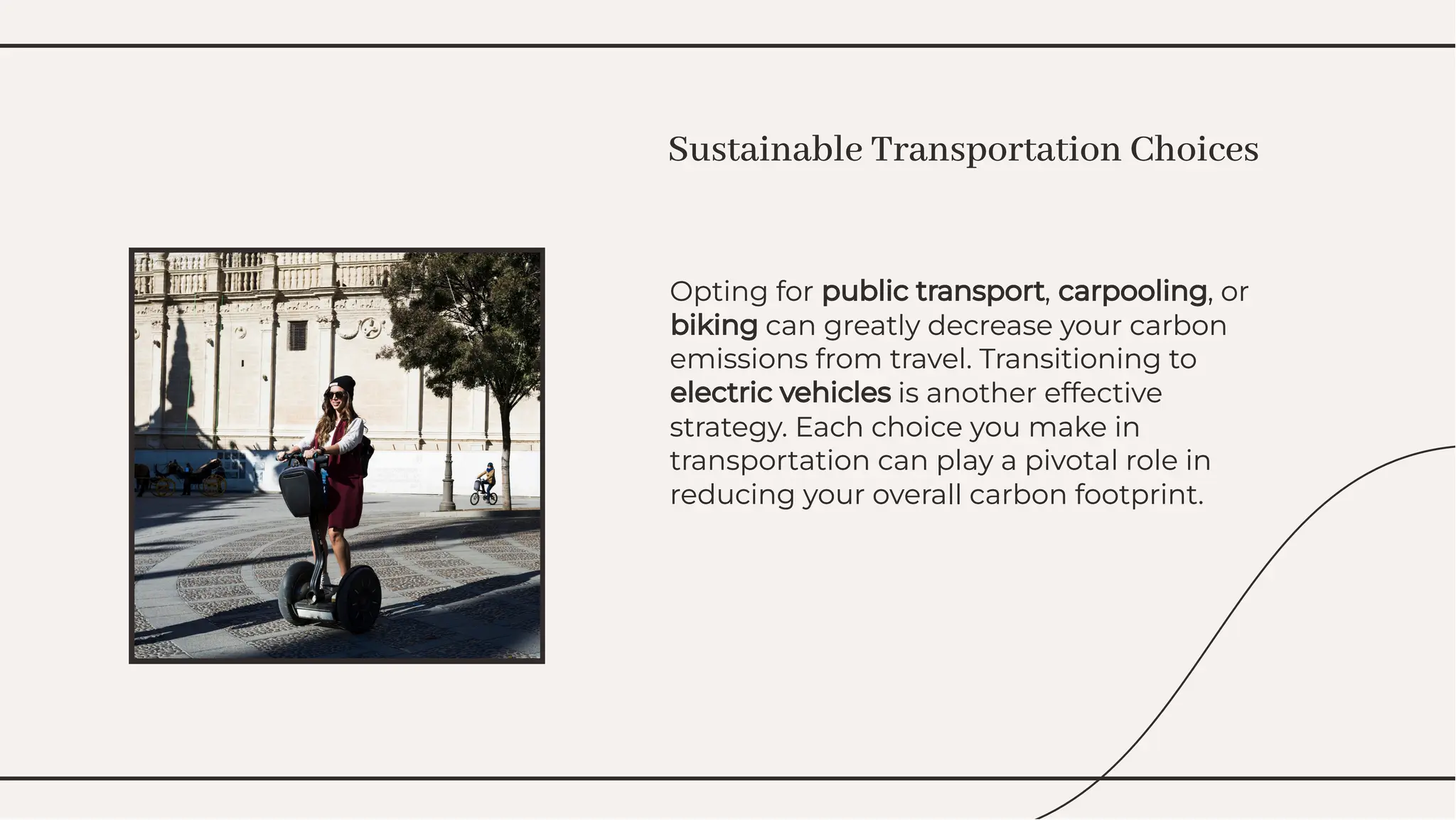
Opting for public transport, carpooling, or
biking can greatly decrease your carbon
emissions from travel. Transitioning to
electric vehicles is another effective
strategy. Each choice you make in
transportation can play a pivotal role in
reducing your overall carbon footprint.
Opting for public transport, carpooling, or
biking can greatly decrease your carbon
emissions from travel. Transitioning to
electric vehicles is another effective
strategy. Each choice you make in
transportation can play a pivotal role in
reducing your overall carbon footprint.
Sustainable Transportation Choices
Minimizing waste through recycling,
composting, and reducing single-use
products is essential. By adopting a
circular economy mindset, we can
significantly lower the carbon emissions
associated with waste disposal and
material production. Every item recycled
counts.
Minimizing waste through recycling,
composting, and reducing single-use
products is essential. By adopting a
circular economy mindset, we can
significantly lower the carbon emissions
associated with waste disposal and
material production. Every item recycled
counts.
Reducing Waste and Recycling
Sustainable Food Choices
Choosing local, organic, and plant-based
foods can drastically reduce your carbon
footprint. The production and
transportation of food contribute
significantly to emissions. By being
mindful of our food choices, we can
support sustainable practices and lower
our impact.
Choosing local, organic, and plant-based
foods can drastically reduce your carbon
footprint. The production and
transportation of food contribute
significantly to emissions. By being
mindful of our food choices, we can
support sustainable practices and lower
our impact.
Engaging in community initiatives and advocating for sustainable policies can
amplify individual efforts. Collaborating with others fosters a collective impact,
promoting larger-scale changes in behavior and policy that benefit the
environment and reduce carbon footprints.
Engaging in community initiatives and advocating for sustainable policies can
amplify individual efforts. Collaborating with others fosters a collective impact,
promoting larger-scale changes in behavior and policy that benefit the
environment and reduce carbon footprints.
Minimizing your carbon footprint requires
a comprehensive approach that
encompasses individual actions,
community efforts, and policy advocacy.
By implementing these strategies, we can
collectively contribute to a healthier
planet. Start today to make a difference for
future generations.
Minimizing your carbon footprint requires
a comprehensive approach that
encompasses individual actions,
community efforts, and policy advocacy.
By implementing these strategies, we can
collectively contribute to a healthier
planet. Start today to make a difference for
future generations.
Conclusion and Call to Action
Thanks!
Thanks!
Do you have any questions?
youremail@email.com
+91 620 421 838
www.yourwebsite.com
@yourusername
Do you have any questions?
youremail@email.com
+91 620 421 838
www.yourwebsite.com
@yourusername

ways to reduce carbon footprint presentation.pdf

  • 1.
    Strategies for MinimizingYour Carbon Footprint: A Comprehensive Approach Strategies for Minimizing Your Carbon Footprint: A Comprehensive Approach
  • 2.
    Introduction to CarbonFootprint Introduction to Carbon Footprint Carbon footprint refers to the total amount of greenhouse gases emitted directly or indirectly by an individual, organization, or product. Understanding its significance is crucial for implementing effective strategies to reduce our impact on the planet. This presentation will explore comprehensive approaches to minimize your carbon footprint. Carbon footprint refers to the total amount of greenhouse gases emitted directly or indirectly by an individual, organization, or product. Understanding its significance is crucial for implementing effective strategies to reduce our impact on the planet. This presentation will explore comprehensive approaches to minimize your carbon footprint.
  • 3.
    Understanding Carbon Emissions UnderstandingCarbon Emissions Carbon emissions primarily stem from fossil fuels, transportation, and industrial processes. By recognizing the sources of these emissions, we can identify key areas for reduction. Awareness is the first step towards effective action in minimizing our overall carbon impact. Carbon emissions primarily stem from fossil fuels, transportation, and industrial processes. By recognizing the sources of these emissions, we can identify key areas for reduction. Awareness is the first step towards effective action in minimizing our overall carbon impact.
  • 4.
    Improving energy efficiencyin our homes can significantly reduce our carbon footprint. Simple actions like using LED lighting, upgrading appliances, and enhancing insulation can lead to substantial energy savings and lower emissions. Every small change contributes to a larger impact. Improving energy efficiency in our homes can significantly reduce our carbon footprint. Simple actions like using LED lighting, upgrading appliances, and enhancing insulation can lead to substantial energy savings and lower emissions. Every small change contributes to a larger impact. Energy Efficiency at Home Energy Efficiency at Home
  • 5.
    Opting for publictransport, carpooling, or biking can greatly decrease your carbon emissions from travel. Transitioning to electric vehicles is another effective strategy. Each choice you make in transportation can play a pivotal role in reducing your overall carbon footprint. Opting for public transport, carpooling, or biking can greatly decrease your carbon emissions from travel. Transitioning to electric vehicles is another effective strategy. Each choice you make in transportation can play a pivotal role in reducing your overall carbon footprint. Sustainable Transportation Choices Sustainable Transportation Choices
  • 6.
    Minimizing waste throughrecycling, composting, and reducing single-use products is essential. By adopting a circular economy mindset, we can significantly lower the carbon emissions associated with waste disposal and material production. Every item recycled counts. Minimizing waste through recycling, composting, and reducing single-use products is essential. By adopting a circular economy mindset, we can significantly lower the carbon emissions associated with waste disposal and material production. Every item recycled counts. Reducing Waste and Recycling Reducing Waste and Recycling
  • 7.
    Sustainable Food Choices SustainableFood Choices Choosing local, organic, and plant-based foods can drastically reduce your carbon footprint. The production and transportation of food contribute significantly to emissions. By being mindful of our food choices, we can support sustainable practices and lower our impact. Choosing local, organic, and plant-based foods can drastically reduce your carbon footprint. The production and transportation of food contribute significantly to emissions. By being mindful of our food choices, we can support sustainable practices and lower our impact.
  • 8.
    Engaging in communityinitiatives and advocating for sustainable policies can amplify individual efforts. Collaborating with others fosters a collective impact, promoting larger-scale changes in behavior and policy that benefit the environment and reduce carbon footprints. Engaging in community initiatives and advocating for sustainable policies can amplify individual efforts. Collaborating with others fosters a collective impact, promoting larger-scale changes in behavior and policy that benefit the environment and reduce carbon footprints.
  • 9.
    Minimizing your carbonfootprint requires a comprehensive approach that encompasses individual actions, community efforts, and policy advocacy. By implementing these strategies, we can collectively contribute to a healthier planet. Start today to make a difference for future generations. Minimizing your carbon footprint requires a comprehensive approach that encompasses individual actions, community efforts, and policy advocacy. By implementing these strategies, we can collectively contribute to a healthier planet. Start today to make a difference for future generations. Conclusion and Call to Action Conclusion and Call to Action
  • 10.
    Thanks! Thanks! Do you haveany questions? youremail@email.com +91 620 421 838 www.yourwebsite.com @yourusername Do you have any questions? youremail@email.com +91 620 421 838 www.yourwebsite.com @yourusername