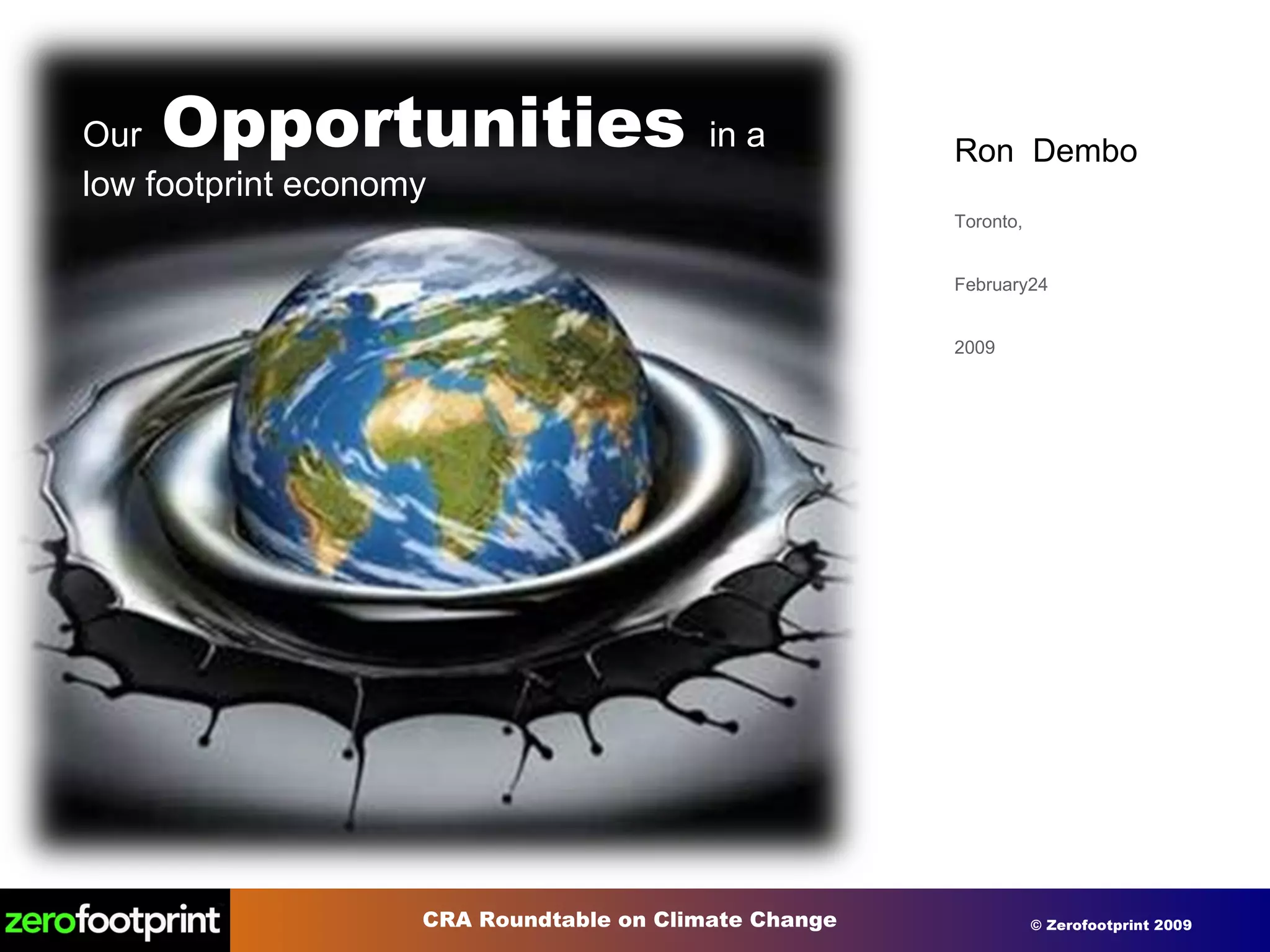
Ron  Dembo Toronto, February24 2009 Our  Opportunities  in a low footprint economy
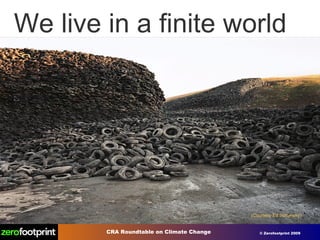
We live in a finite world (Courtesy Ed Burtynsky)
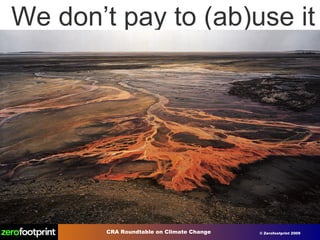
We don’t pay to (ab)use it (Courtesy Ed Burtynsky)
It didn’t seem to matter in 1950   but...
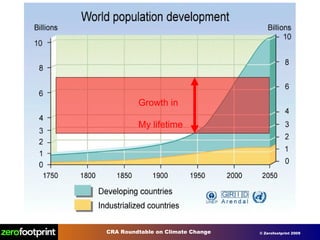
Growth in My lifetime
U.N. Report, October 25,  2007 “ Human activities have become a dominant influence on the planet’s climate and ecosystem”
U.N. Report, October 25,  2007 “ sixth major extinction of species has begun” First 440 million years ago Last 5 due to physical shocks This one is  man made
Wildlife is Disappearing
The world is getting  too small
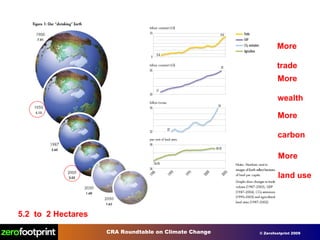
5.2  to  2 Hectares More trade More wealth More carbon More land use
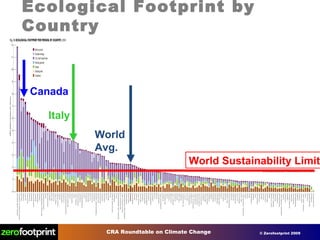
Ecological Footprint by Country World Sustainability Limit Canada Italy World Avg.
Why is this relevant   to us?
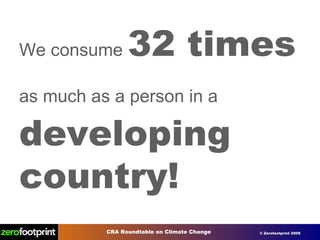
We consume  32 times as much as a person in a   developing country!
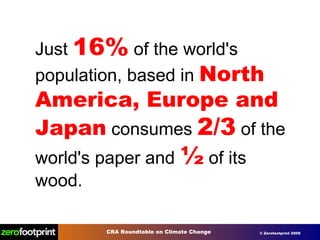
Just  16%  of the world's population, based in  North America, Europe and Japan  consumes   2/3  of the world's paper and  ½   of its wood.                     
It’s clear,  we have a problem…
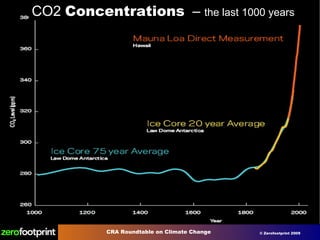
CO2  Concentrations   –  the last 1000 years
Not a question of whether, but   when, where   and  how much
Carbon Will be a very important  commodity  in the future!
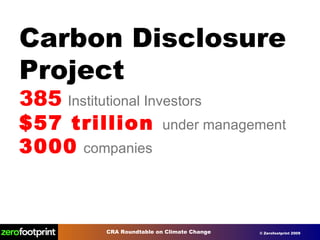
Carbon Disclosure Project 385   Institutional Investors $57 trillion  under management 3000   companies
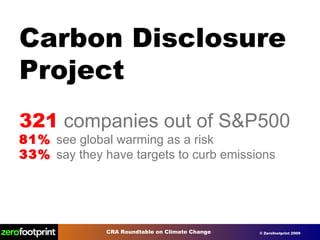
Carbon Disclosure Project 321  companies out of S&P500 81%   see global warming as a risk 33%  say they have targets to curb emissions
Why is this relevant   to  us ?
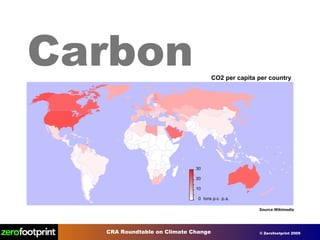
Carbon CO2 per capita per country Source Wikimedia
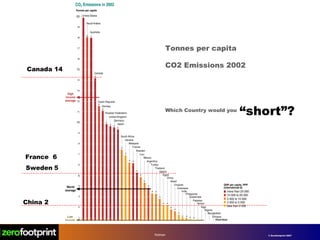
Canada 14 Sweden   5 Tonnes per capita CO2 Emissions 2002 Which Country would you   “short”? China 2 © Zerofootprint 2007 Rotman France  6
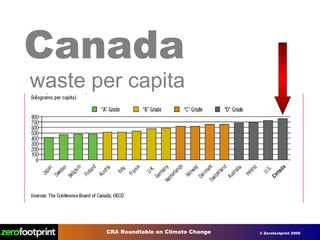
Canada waste per capita
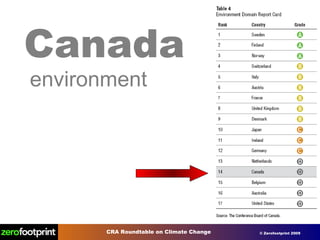
Canada environment
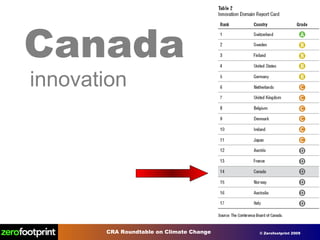
Canada innovation
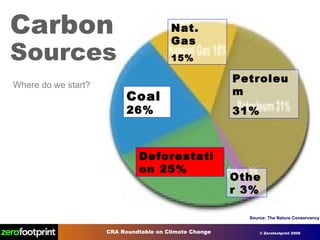
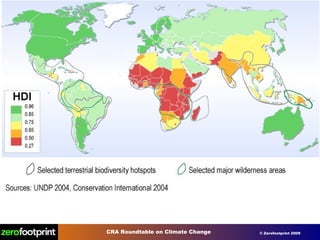
Carbon Sources Source: The Nature Conservancy Coal  26% Deforestation 25% Nat. Gas 15% Petroleum 31% Other 3% Where do we start?
We cannot ignore  poverty  and other indicators of   sustainability
 
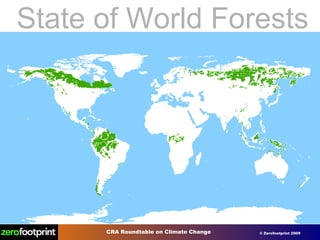
How Much is Enough? State of World Forests Source: World Resources Institute / Forest Ethics
This is one  big  problem!
No wonder… most people feel  disempowered and don’t know just how they can contribute
Some facts…
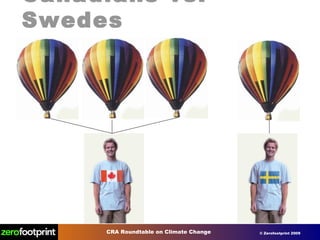
Canadians vs. Swedes
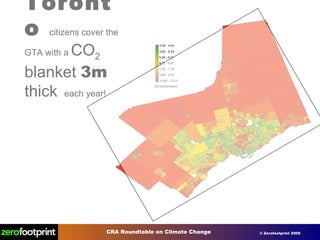
Toronto  citizens cover the GTA with a  CO 2  blanket  3m  thick  each year!
So what can we  do  about it?
We will have to  adapt… all things being equal low  carbon footprint  countries   will  outperform high  carbon footprint  countries
We will have to  adapt… all things being equal low  carbon footprint  companies   will  outperform high  carbon footprint  companies
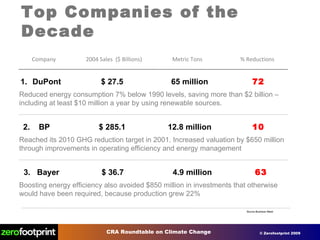
Top Companies of the Decade Source Business Week Company 2004 Sales  ($ Billions) Metric Tons % Reductions DuPont $ 27.5 65 million 72 Reduced energy consumption 7% below 1990 levels, saving more than $2 billion – including at least $10 million a year by using renewable sources. 2.  BP $ 285.1 12.8 million 10 Reached its 2010 GHG reduction target in 2001. Increased valuation by $650 million through improvements in operating efficiency and energy management 3.  Bayer $ 36.7 4.9 million 63 Boosting energy efficiency also avoided $850 million in investments that otherwise would have been required, because production grew 22%
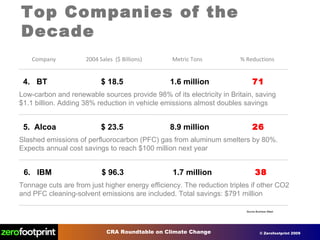
Top Companies of the Decade Source Business Week Company 2004 Sales  ($ Billions) Metric Tons % Reductions 4.  BT $ 18.5 1.6 million 71 Low-carbon and renewable sources provide 98% of its electricity in Britain, saving $1.1 billion. Adding 38% reduction in vehicle emissions almost doubles savings 5.  Alcoa $ 23.5 8.9 million 26 Slashed emissions of perfluorocarbon (PFC) gas from aluminum smelters by 80%. Expects annual cost savings to reach $100 million next year 6.  IBM $ 96.3 1.7 million 38 Tonnage cuts are from just higher energy efficiency. The reduction triples if other CO2 and PFC cleaning-solvent emissions are included. Total savings: $791 million
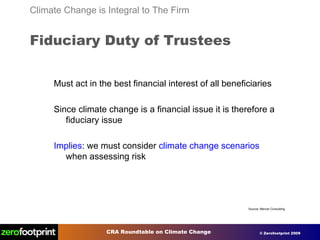
Must act in the best financial interest of all beneficiaries Since climate change is a financial issue it is therefore a fiduciary issue Implies : we must consider  climate change scenarios  when assessing risk Climate Change is Integral to The Firm Fiduciary Duty of Trustees Source: Mercer Consulting
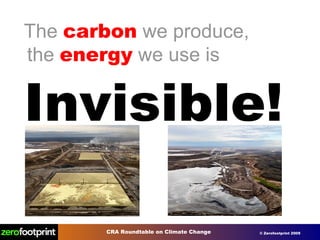
The  carbon  we produce, the  energy  we use is  Invisible!
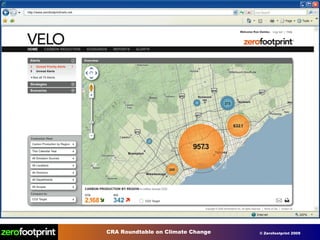
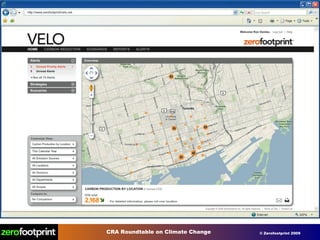
We can use technology to   make the invisible   visible!
Imagine….
It’s about measuring   so that we can  manage
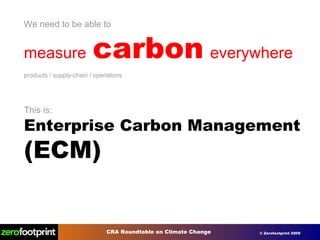
We need to be able to measure   carbon   everywhere products / supply-chain / operations This is: Enterprise Carbon Management  (ECM)


Some (minimal) Science
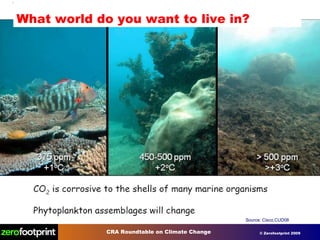
Some facts… Source: Cisco,CUD08 What world do you want to live in?
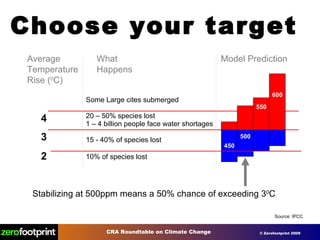
450 500 2 3 4 10% of species lost 15 - 40% of species lost 1 – 4 billion people face water shortages 20 – 50% species lost Some Large cites submerged Source: IPCC Choose your target Average Temperature Rise ( 0 C) What Happens Model Prediction 550 600 Stabilizing at 500ppm means a 50% chance of exceeding 3 0 C
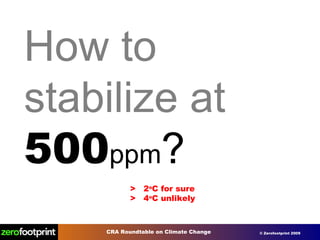
How to stabilize at   500 ppm ? >  2 o C for sure >  4 o C unlikely
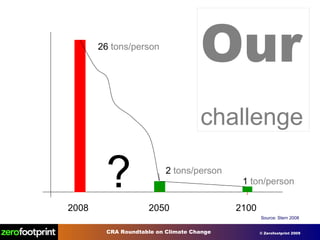
j j 26  tons/person 1  ton/person 2008 2050 ? Our   challenge j 2100 2  tons/person Source: Stern 2008
This is one  big  problem!
So what can we   do  about it?
The way we use electricity is   dumb!
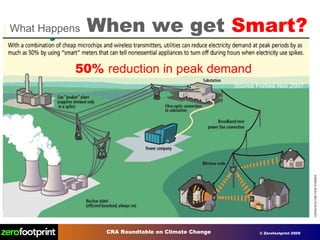
Source Forbes Nov 2007 What Happens  When we get  Smart? 50%  reduction in peak demand
ICT  is part of the problem today   (>2%)   but also a big part of the  solution
We can use technology to   change the way we work
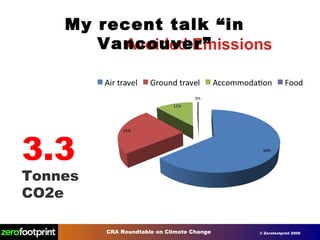
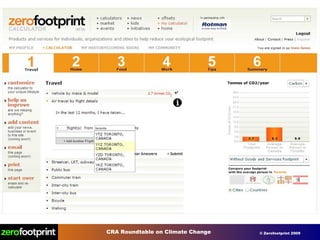
3.3  Tonnes CO2e My recent talk “in Vancouver”
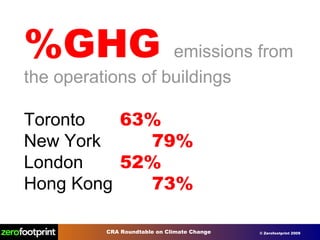
%GHG  emissions from the operations of buildings Toronto 63% New York 79% London 52% Hong Kong 73%
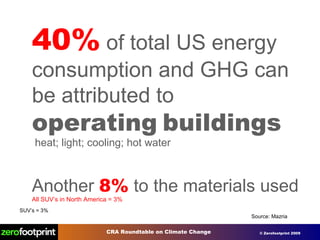
40%  of total US energy consumption and GHG can be attributed to operating   buildings heat; light; cooling; hot water Another  8%  to the materials used All SUV’s in North America = 3% Source: Mazria SUV’s = 3%
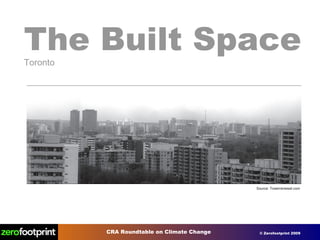
The Built Space Toronto Source: Towerrenewal.com
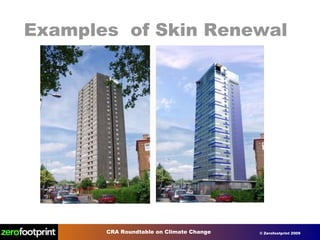
Skin Renewal Source: Towerrenewal.com
We can re-skin our cities
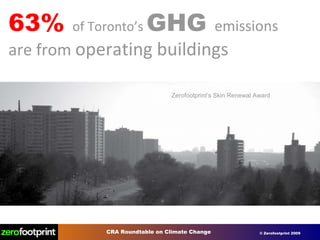
63%   of Toronto’s  GHG  emissions   are from  operating buildings Zerofootprint’s Skin Renewal Award
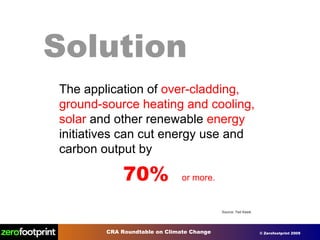
The application of  over-cladding, ground-source heating and cooling, solar  and other renewable  energy  initiatives can cut energy use and carbon output by  70%  or more. Source: Ted Kesik Solution
Skin Renewal
Skin Renewal Up to  70%   reduction in  GHG  +  Aesthetics!
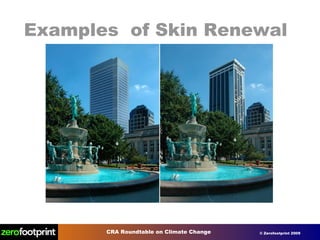
Examples  of Skin Renewal
The Mayor’s Tower Renewal Project in Toronto 1000 buildings!
The Zerofootprint re-skinning Competition Worldwide Focus on existing buildings in Ontario OCAD, Waterloo, Tridel, City
5 Criteria Aesthetics Reproducibility Cost Energy Smarts
Our buildings are  dumb!
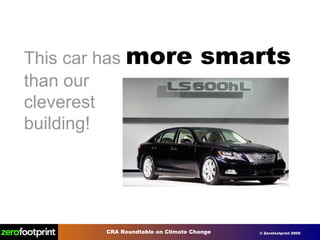
This car has  more smarts  than our cleverest building!
We can use technology to   make our buildings smart
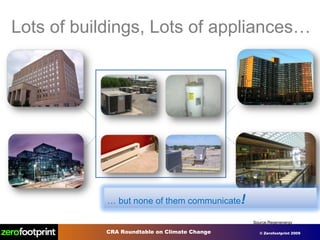
Lots of buildings, Lots of appliances… Source:Regenenergy …  but none of them communicate !
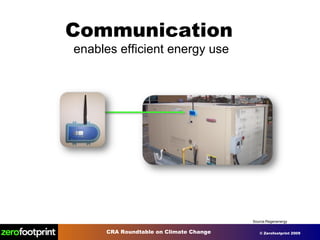
Communication   enables efficient energy use Source:Regenenergy
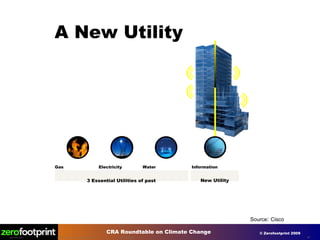
Electricity Gas 3 Essential Utilities of past Information New Utility Water © 2006 Cisco Systems, Inc. All rights reserved. Cisco Confidential 2007 WW UCPS Source :  Cisco A New Utility
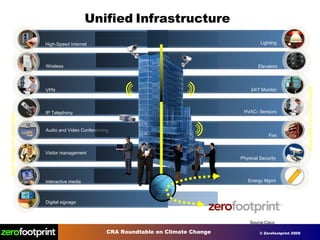
Unified   Infrastructure High-Speed Internet IP Telephony Audio and Video Conferencing Interactive media Visitor management VPN Wireless Digital signage Tenant Services and Technologies HVAC- Sensors Energy Mgmt Building Services and Technologies Physical Security Source:Cisco Fire 24/7 Monitor Elevators Lighting
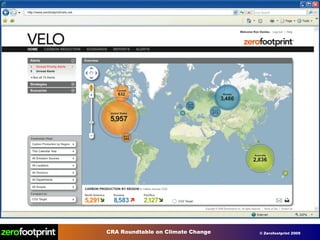
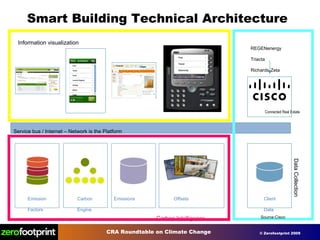
Measuring Carbon Emissions w/ Zerofootprint ZFP-GUI Service bus / Internet – Network is the Platform Information visualization Emission Factors Carbon Engine Emissions Offsets Client Data Carbon Intelligence Data   Collection Connected Real Estate REGENenergy Triacta Richards-Zeta Smart Building Technical Architecture Source:Cisco
We can   influence   our supply chain
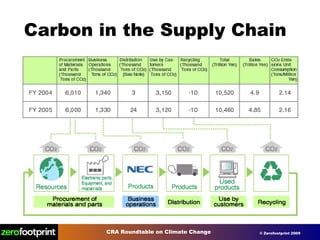
Carbon in the Supply Chain
We can use technology to   optimize appliance use
We can use technology to   engage employees around climate change
 
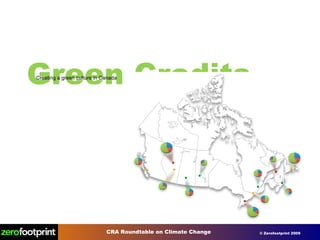
Green Credits  Creating a green culture in Canada
The world.. … .is thinking only in terms of Cap and Trade systems or Carbon Tax regimes as a means of reducing carbon in our economies.  These make sense for large emitters. These are either too difficult for most consumers and are simply punitive ways of seeking to price carbon.

An alternative… For every  verified action  that a citizen takes to reduce his or her footprint he/she is awarded   Green Credits .  The credits are   redeemable as tax deductions . E.G. one Green Credit for one tax dollar
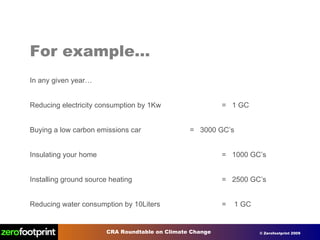
For example… In any given year… Reducing electricity consumption by 1Kw  =  1 GC Buying a low carbon emissions car  =  3000 GC’s Insulating your home =  1000 GC’s Installing ground source heating   =  2500 GC’s Reducing water consumption by 10Liters  =  1 GC etc .
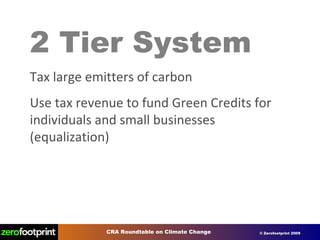
2 Tier System Tax large emitters of carbon Use tax revenue to fund Green Credits for individuals and small businesses (equalization)
Think Frequent Flyer Miles! Here it is how it works…..
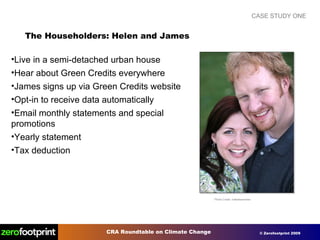
CASE STUDY ONE The Householders: Helen and James Photo Credit: makelessnoise Live in a semi-detached urban house Hear about Green Credits everywhere James signs up via Green Credits website Opt-in to receive data automatically Email monthly statements and special promotions Yearly statement Tax deduction
CASE STUDY TWO The Service Provider: Mike Photo Credit: Unhindered by Talent Family plumbing and heating business Learns about Green Credits at industry event Enrolls and validates via website Welcome package and credentials Registers new work on Green Credits website Client receives automated confirmation email
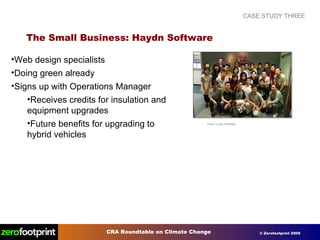
CASE STUDY THREE The Small Business: Haydn Software Photo Credit: KitKitNet Web design specialists Doing green already Signs up with Operations Manager Receives credits for insulation and equipment upgrades Future benefits for upgrading to hybrid vehicles
CASE STUDY FOUR Green Credits Trading: Joe and Al Photo Credit: Pigliapost Joe pays 40% Credits = $0.40 Al pays 20% Credits = $0.20 Joe buys from Al at $0.30 Photo Credit: Special*Dark
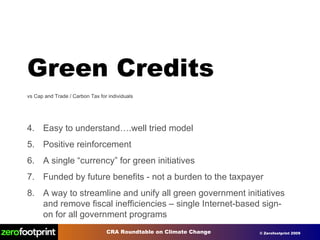
Green Credits  vs Cap and Trade / Carbon Tax for individuals Easy to understand….well tried model Positive reinforcement A single “currency” for green initiatives Funded by future benefits - not a burden to the taxpayer A way to streamline and unify all green government initiatives and remove fiscal inefficiencies – single Internet-based sign-on for all government programs
Offsets
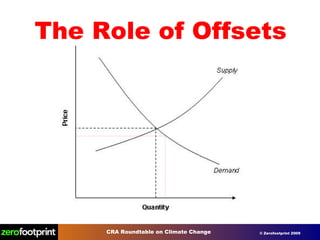
The Role of Offsets
 
Who are   we?
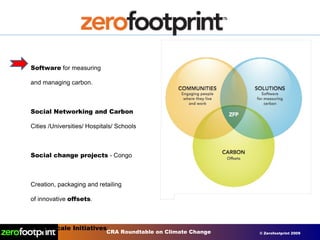
Software  for measuring and managing carbon. Social Networking and Carbon Cities /Universities/ Hospitals/ Schools Social change projects  - Congo Creation, packaging and retailing of innovative  offsets . Large Scale Initiatives :  Green Credits Reskinning the Built Space
Selected   Clients
The End [email_address] www.zerofootprint.net

Cra Round Table.Feb09

  • 1.
    Ron DemboToronto, February24 2009 Our Opportunities in a low footprint economy
  • 2.
    We live ina finite world (Courtesy Ed Burtynsky)
  • 3.
    We don’t payto (ab)use it (Courtesy Ed Burtynsky)
  • 4.
    It didn’t seemto matter in 1950 but...
  • 5.
    Growth in Mylifetime
  • 6.
    U.N. Report, October25, 2007 “ Human activities have become a dominant influence on the planet’s climate and ecosystem”
  • 7.
    U.N. Report, October25, 2007 “ sixth major extinction of species has begun” First 440 million years ago Last 5 due to physical shocks This one is man made
  • 8.
  • 9.
    The world isgetting too small
  • 10.
    5.2 to 2 Hectares More trade More wealth More carbon More land use
  • 11.
    Ecological Footprint byCountry World Sustainability Limit Canada Italy World Avg.
  • 12.
    Why is thisrelevant to us?
  • 13.
    We consume 32 times as much as a person in a developing country!
  • 14.
    Just 16% of the world's population, based in North America, Europe and Japan consumes 2/3 of the world's paper and ½ of its wood.                     
  • 15.
    It’s clear, we have a problem…
  • 16.
    CO2 Concentrations – the last 1000 years
  • 17.
    Not a questionof whether, but when, where and how much
  • 18.
    Carbon Will bea very important commodity in the future!
  • 19.
    Carbon Disclosure Project385 Institutional Investors $57 trillion under management 3000 companies
  • 20.
    Carbon Disclosure Project321 companies out of S&P500 81% see global warming as a risk 33% say they have targets to curb emissions
  • 21.
    Why is thisrelevant to us ?
  • 22.
    Carbon CO2 percapita per country Source Wikimedia
  • 23.
    Canada 14 Sweden 5 Tonnes per capita CO2 Emissions 2002 Which Country would you “short”? China 2 © Zerofootprint 2007 Rotman France 6
  • 24.
  • 25.
  • 26.
  • 27.
    Carbon Sources Source:The Nature Conservancy Coal 26% Deforestation 25% Nat. Gas 15% Petroleum 31% Other 3% Where do we start?
  • 28.
    We cannot ignore poverty and other indicators of sustainability
  • 29.
  • 30.
    How Much isEnough? State of World Forests Source: World Resources Institute / Forest Ethics
  • 31.
    This is one big problem!
  • 32.
    No wonder… mostpeople feel disempowered and don’t know just how they can contribute
  • 33.
  • 34.
  • 35.
    Toronto citizenscover the GTA with a CO 2 blanket 3m thick each year!
  • 36.
    So what canwe do about it?
  • 37.
    We will haveto adapt… all things being equal low carbon footprint countries will outperform high carbon footprint countries
  • 38.
    We will haveto adapt… all things being equal low carbon footprint companies will outperform high carbon footprint companies
  • 39.
    Top Companies ofthe Decade Source Business Week Company 2004 Sales ($ Billions) Metric Tons % Reductions DuPont $ 27.5 65 million 72 Reduced energy consumption 7% below 1990 levels, saving more than $2 billion – including at least $10 million a year by using renewable sources. 2. BP $ 285.1 12.8 million 10 Reached its 2010 GHG reduction target in 2001. Increased valuation by $650 million through improvements in operating efficiency and energy management 3. Bayer $ 36.7 4.9 million 63 Boosting energy efficiency also avoided $850 million in investments that otherwise would have been required, because production grew 22%
  • 40.
    Top Companies ofthe Decade Source Business Week Company 2004 Sales ($ Billions) Metric Tons % Reductions 4. BT $ 18.5 1.6 million 71 Low-carbon and renewable sources provide 98% of its electricity in Britain, saving $1.1 billion. Adding 38% reduction in vehicle emissions almost doubles savings 5. Alcoa $ 23.5 8.9 million 26 Slashed emissions of perfluorocarbon (PFC) gas from aluminum smelters by 80%. Expects annual cost savings to reach $100 million next year 6. IBM $ 96.3 1.7 million 38 Tonnage cuts are from just higher energy efficiency. The reduction triples if other CO2 and PFC cleaning-solvent emissions are included. Total savings: $791 million
  • 41.
    Must act inthe best financial interest of all beneficiaries Since climate change is a financial issue it is therefore a fiduciary issue Implies : we must consider climate change scenarios when assessing risk Climate Change is Integral to The Firm Fiduciary Duty of Trustees Source: Mercer Consulting
  • 42.
    The carbon we produce, the energy we use is Invisible!
  • 43.
    We can usetechnology to make the invisible visible!
  • 44.
  • 45.
    It’s about measuring so that we can manage
  • 46.
    We need tobe able to measure carbon everywhere products / supply-chain / operations This is: Enterprise Carbon Management (ECM)
  • 47.
  • 48.
  • 49.
  • 50.
  • 51.
    Some facts… Source:Cisco,CUD08 What world do you want to live in?
  • 52.
    450 500 23 4 10% of species lost 15 - 40% of species lost 1 – 4 billion people face water shortages 20 – 50% species lost Some Large cites submerged Source: IPCC Choose your target Average Temperature Rise ( 0 C) What Happens Model Prediction 550 600 Stabilizing at 500ppm means a 50% chance of exceeding 3 0 C
  • 53.
    How to stabilizeat 500 ppm ? > 2 o C for sure > 4 o C unlikely
  • 54.
    j j 26 tons/person 1 ton/person 2008 2050 ? Our challenge j 2100 2 tons/person Source: Stern 2008
  • 55.
    This is one big problem!
  • 56.
    So what canwe do about it?
  • 57.
    The way weuse electricity is dumb!
  • 58.
    Source Forbes Nov2007 What Happens When we get Smart? 50% reduction in peak demand
  • 59.
    ICT ispart of the problem today (>2%) but also a big part of the solution
  • 60.
    We can usetechnology to change the way we work
  • 61.
    3.3 TonnesCO2e My recent talk “in Vancouver”
  • 62.
    %GHG emissionsfrom the operations of buildings Toronto 63% New York 79% London 52% Hong Kong 73%
  • 63.
    40% oftotal US energy consumption and GHG can be attributed to operating buildings heat; light; cooling; hot water Another 8% to the materials used All SUV’s in North America = 3% Source: Mazria SUV’s = 3%
  • 64.
    The Built SpaceToronto Source: Towerrenewal.com
  • 65.
    Skin Renewal Source:Towerrenewal.com
  • 66.
    We can re-skinour cities
  • 67.
    63% of Toronto’s GHG emissions are from operating buildings Zerofootprint’s Skin Renewal Award
  • 68.
    The application of over-cladding, ground-source heating and cooling, solar and other renewable energy initiatives can cut energy use and carbon output by 70% or more. Source: Ted Kesik Solution
  • 69.
  • 70.
    Skin Renewal Upto 70% reduction in GHG + Aesthetics!
  • 71.
    Examples ofSkin Renewal
  • 72.
    Examples ofSkin Renewal
  • 73.
    The Mayor’s TowerRenewal Project in Toronto 1000 buildings!
  • 74.
    The Zerofootprint re-skinningCompetition Worldwide Focus on existing buildings in Ontario OCAD, Waterloo, Tridel, City
  • 75.
    5 Criteria AestheticsReproducibility Cost Energy Smarts
  • 76.
  • 77.
    This car has more smarts than our cleverest building!
  • 78.
    We can usetechnology to make our buildings smart
  • 79.
    Lots of buildings,Lots of appliances… Source:Regenenergy … but none of them communicate !
  • 80.
    Communication enables efficient energy use Source:Regenenergy
  • 81.
    Electricity Gas 3Essential Utilities of past Information New Utility Water © 2006 Cisco Systems, Inc. All rights reserved. Cisco Confidential 2007 WW UCPS Source : Cisco A New Utility
  • 82.
    Unified Infrastructure High-Speed Internet IP Telephony Audio and Video Conferencing Interactive media Visitor management VPN Wireless Digital signage Tenant Services and Technologies HVAC- Sensors Energy Mgmt Building Services and Technologies Physical Security Source:Cisco Fire 24/7 Monitor Elevators Lighting
  • 83.
    Measuring Carbon Emissionsw/ Zerofootprint ZFP-GUI Service bus / Internet – Network is the Platform Information visualization Emission Factors Carbon Engine Emissions Offsets Client Data Carbon Intelligence Data Collection Connected Real Estate REGENenergy Triacta Richards-Zeta Smart Building Technical Architecture Source:Cisco
  • 84.
    We can influence our supply chain
  • 85.
    Carbon in theSupply Chain
  • 86.
    We can usetechnology to optimize appliance use
  • 87.
    We can usetechnology to engage employees around climate change
  • 88.
  • 89.
    Green Credits Creating a green culture in Canada
  • 90.
    The world.. ….is thinking only in terms of Cap and Trade systems or Carbon Tax regimes as a means of reducing carbon in our economies. These make sense for large emitters. These are either too difficult for most consumers and are simply punitive ways of seeking to price carbon.
  • 91.
    An alternative… Forevery verified action that a citizen takes to reduce his or her footprint he/she is awarded Green Credits . The credits are redeemable as tax deductions . E.G. one Green Credit for one tax dollar
  • 92.
    For example… Inany given year… Reducing electricity consumption by 1Kw = 1 GC Buying a low carbon emissions car = 3000 GC’s Insulating your home = 1000 GC’s Installing ground source heating = 2500 GC’s Reducing water consumption by 10Liters = 1 GC etc .
  • 93.
    2 Tier SystemTax large emitters of carbon Use tax revenue to fund Green Credits for individuals and small businesses (equalization)
  • 94.
    Think Frequent FlyerMiles! Here it is how it works…..
  • 95.
    CASE STUDY ONEThe Householders: Helen and James Photo Credit: makelessnoise Live in a semi-detached urban house Hear about Green Credits everywhere James signs up via Green Credits website Opt-in to receive data automatically Email monthly statements and special promotions Yearly statement Tax deduction
  • 96.
    CASE STUDY TWOThe Service Provider: Mike Photo Credit: Unhindered by Talent Family plumbing and heating business Learns about Green Credits at industry event Enrolls and validates via website Welcome package and credentials Registers new work on Green Credits website Client receives automated confirmation email
  • 97.
    CASE STUDY THREEThe Small Business: Haydn Software Photo Credit: KitKitNet Web design specialists Doing green already Signs up with Operations Manager Receives credits for insulation and equipment upgrades Future benefits for upgrading to hybrid vehicles
  • 98.
    CASE STUDY FOURGreen Credits Trading: Joe and Al Photo Credit: Pigliapost Joe pays 40% Credits = $0.40 Al pays 20% Credits = $0.20 Joe buys from Al at $0.30 Photo Credit: Special*Dark
  • 99.
    Green Credits vs Cap and Trade / Carbon Tax for individuals Easy to understand….well tried model Positive reinforcement A single “currency” for green initiatives Funded by future benefits - not a burden to the taxpayer A way to streamline and unify all green government initiatives and remove fiscal inefficiencies – single Internet-based sign-on for all government programs
  • 100.
  • 101.
    The Role ofOffsets
  • 102.
  • 103.
  • 104.
    Software formeasuring and managing carbon. Social Networking and Carbon Cities /Universities/ Hospitals/ Schools Social change projects - Congo Creation, packaging and retailing of innovative offsets . Large Scale Initiatives : Green Credits Reskinning the Built Space
  • 105.
    Selected Clients
  • 106.
    The End [email_address]www.zerofootprint.net