CHEMISTRY OF
BIOMOLECULE
S
CARBOHYDRATE
S
CARBOHYDRATES
Definition: Carbohydrates are defined chemically as
 Aldehyde or ketone derivatives of the higher polyhydric alcohols, or
compounds which yield these derivatives on hydrolysis.
 Polyhydroxy aldehyde or ketone compounds which produce them on
hydrolysis are called as carbohydrates.
 carbohydrates are polyhydroxy compounds with at least 3 carbon atoms,
essentially containing potentially active carbonyl carbon either that of
aldehyde and ketone.
 Polyhydroxy compounds (poly-alcohols) that contain a carbonyl (C=O)
group.
CHEMICAL DEFINITION OF CARBOHYDRATES
Polyhydroxyl: Having more than one hydroxyl group. (-OH)
Functional Group: It is a specific group of atoms or bonds which
are part of a larger hydrocarbon chain.(Provide a specific
chemical behaviour).
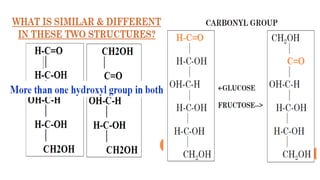
For carbohydrates, the functional group is the carbonyl group
which may be either
Aldehyde Group (H-C=O)
Or
Keto Group (C=O)
Biomedical Importance of Carbohydrates
• Chief source of energy.
• Constituents of compound lipids and conjugated proteins.
• Degradation products act as “promoters” or ‘catalysts’.
• Certain carbohydrate derivatives are used as drugs like cardiac glycosides/antibiotics.
• Lactose principal sugar of milk—in lactating mammary gland.
• Degradation products utilized for synthesis of other substances such as fatty acids, cholesterol,
amino acid, etc.
• Constituents of mucopolysaccharides which form the ground substance of mesenchymal tissues.
 Inherited deficiency of certain enzymes in metabolic pathways of different carbohydrates can
cause diseases, e.g. galactosemia, glycogen storage diseases (GSDs), lactose intolerance, etc.
 Derangement of glucose metabolism is seen in diabetes mellitus.

carbohydrates part 1.pptx

  • 1.
  • 2.
    CARBOHYDRATES Definition: Carbohydrates aredefined chemically as  Aldehyde or ketone derivatives of the higher polyhydric alcohols, or compounds which yield these derivatives on hydrolysis.  Polyhydroxy aldehyde or ketone compounds which produce them on hydrolysis are called as carbohydrates.  carbohydrates are polyhydroxy compounds with at least 3 carbon atoms, essentially containing potentially active carbonyl carbon either that of aldehyde and ketone.  Polyhydroxy compounds (poly-alcohols) that contain a carbonyl (C=O) group.
  • 3.
    CHEMICAL DEFINITION OFCARBOHYDRATES Polyhydroxyl: Having more than one hydroxyl group. (-OH) Functional Group: It is a specific group of atoms or bonds which are part of a larger hydrocarbon chain.(Provide a specific chemical behaviour). For carbohydrates, the functional group is the carbonyl group which may be either Aldehyde Group (H-C=O) Or Keto Group (C=O)
  • 5.
    Biomedical Importance ofCarbohydrates • Chief source of energy. • Constituents of compound lipids and conjugated proteins. • Degradation products act as “promoters” or ‘catalysts’. • Certain carbohydrate derivatives are used as drugs like cardiac glycosides/antibiotics. • Lactose principal sugar of milk—in lactating mammary gland. • Degradation products utilized for synthesis of other substances such as fatty acids, cholesterol, amino acid, etc. • Constituents of mucopolysaccharides which form the ground substance of mesenchymal tissues.  Inherited deficiency of certain enzymes in metabolic pathways of different carbohydrates can cause diseases, e.g. galactosemia, glycogen storage diseases (GSDs), lactose intolerance, etc.  Derangement of glucose metabolism is seen in diabetes mellitus.