
PUBLIC INTEREST
LITIGATION
Compiled and Edited By
Ajita Gupta
Research Scholar
Dayalbagh Educational Institute
PUBLIC INTEREST
LITIGATION
 A powerful tool for seeking judicial assistance and
dealing with various issues affecting the public.
 PIL in broad terms means litigation filed in a court of
law for the protection of “Public Interest” on a wide
variety of subjects concerning citizen.
Purpose:
To make justice accessible to economically & socially
disadvantaged sections of public specially in matters
concerning environment, pollution and labor.
IMPORTANCE OF PUBLIC
INTEREST LITIGATION
• It gives a wider description to the right to equality,
life and personality which is guaranteed under part
III of the Constitution of India.
• It has introduced some kinds of reliefs or remedies
under the writ jurisdiction.
• It also functions as an effective instrument for
changes in the society or social welfare.
• Through PIL, any public or person can seek remedy
on behalf of the oppressed class by introducing a
PIL.
WHO CAN FILE A PIL
• Member of public acting bona fide and having sufficient
interest in instituting an action for redressal of public
wrong or public injury.
• He is not a mere busy body or a meddlesome interloper.
• His action is not motivated by personal gain or any other
oblique consideration.
AGAINST WHOM PIL CAN BE
FILED
People can file a PIL against:
Indian Government
State Pollution Control Board
Also against Private Factory (But PIL can Not file against
only private party without concerning state govt. or central
govt.
WHEN CAN A PIL BE FILED:
 Where a factory / industrial unit is causing air pollution,
& people nearby are getting effected.
 Where in area/street there are no streetlights causing
inconvenience to commuters.
 Where some “Banquet Hall” plays a loud music in night
causing noise pollution.
 For abolishing child labor.
Cont.…..
Where some construction company is cutting down
trees, causing environmental pollution.
Where rights of working women are affected by
sexual harassment.
For maintaining Roads, Sewer etc. in good condition.
Where poor people are affected because of State
Govt.’s arbitrary decisions to impose heavy “tax”.
For removal of Big Hoarding & signboards from the
busy road to avoid traffic problem.
WHERE A PIL CAN BE FILED
• PIL is Just like a writ petition which is file in high court
and supreme court under the article 226 for High court
and article 32 for Supreme court.
Some possible areas where PIL can be filed :
• Violation of basic human rights of the poor
• Content or conduct of Government Policy
• Compel municipal authorities to perform a public duty
• Violation of religious rights or other fundamental rights
Court Fees:
A Court fee of RS. 50, per respondent has to be affixed
on the petition.
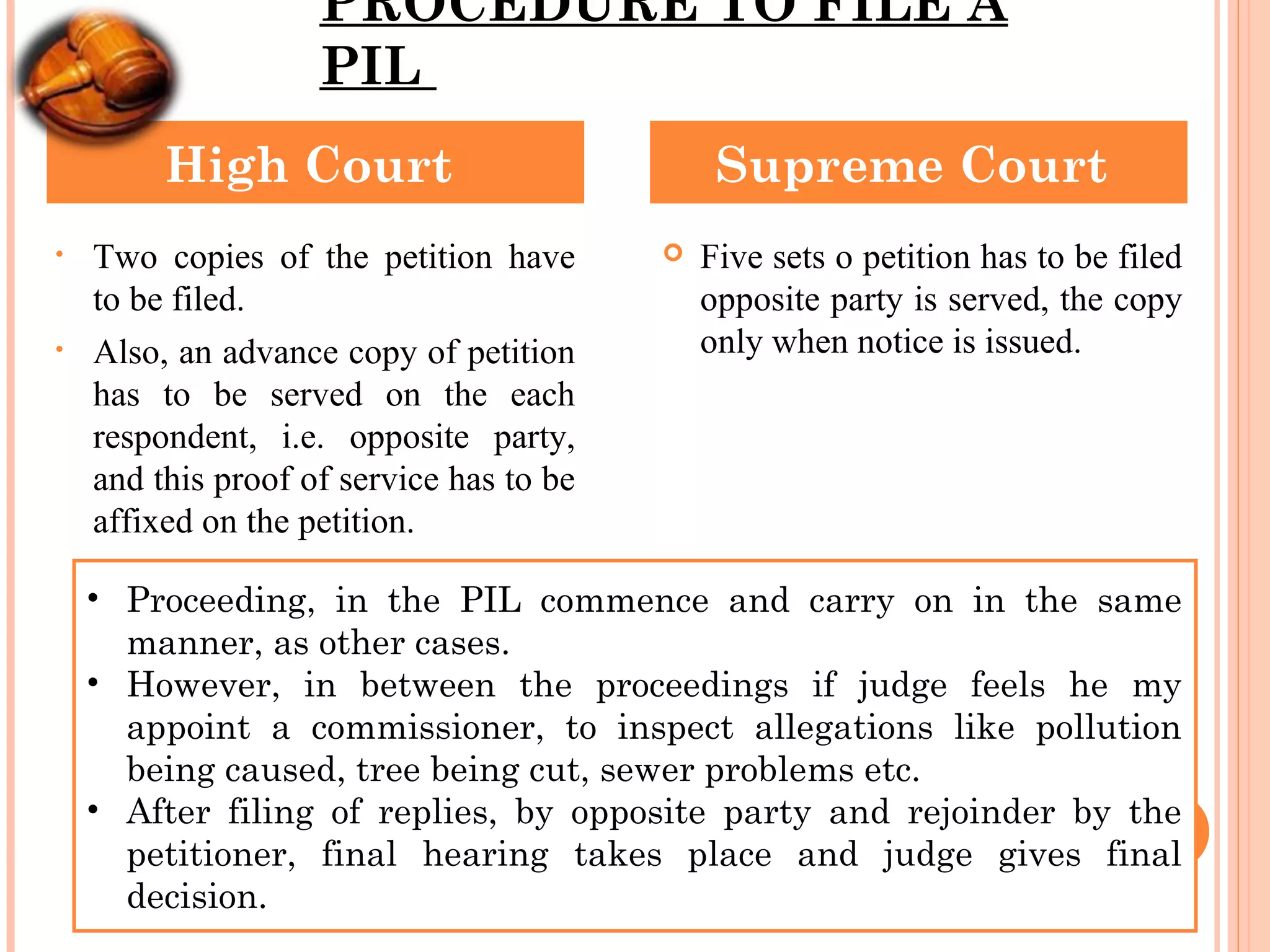
PROCEDURE TO FILE A
PIL
• Two copies of the petition have
to be filed.
• Also, an advance copy of petition
has to be served on the each
respondent, i.e. opposite party,
and this proof of service has to be
affixed on the petition.
 Five sets o petition has to be filed
opposite party is served, the copy
only when notice is issued.
High Court Supreme Court
• Proceeding, in the PIL commence and carry on in the same
manner, as other cases.
• However, in between the proceedings if judge feels he my
appoint a commissioner, to inspect allegations like pollution
being caused, tree being cut, sewer problems etc.
• After filing of replies, by opposite party and rejoinder by the
petitioner, final hearing takes place and judge gives final
decision.
RELIEFS AVAILABLE
BY PIL
Interim Measures
The court can afford an early interim measure to protect
the public interest till the final order.
Appointing A Committee
The court may appoint a committee or commissioner to
look into the matter.
Final Orders
The court may also give final orders by way of direction
to comply within a stipulated time.
THANK YOU

Public Interest Litigation

  • 1.
    PUBLIC INTEREST LITIGATION Compiled andEdited By Ajita Gupta Research Scholar Dayalbagh Educational Institute
  • 2.
    PUBLIC INTEREST LITIGATION  Apowerful tool for seeking judicial assistance and dealing with various issues affecting the public.  PIL in broad terms means litigation filed in a court of law for the protection of “Public Interest” on a wide variety of subjects concerning citizen. Purpose: To make justice accessible to economically & socially disadvantaged sections of public specially in matters concerning environment, pollution and labor.
  • 3.
    IMPORTANCE OF PUBLIC INTERESTLITIGATION • It gives a wider description to the right to equality, life and personality which is guaranteed under part III of the Constitution of India. • It has introduced some kinds of reliefs or remedies under the writ jurisdiction. • It also functions as an effective instrument for changes in the society or social welfare. • Through PIL, any public or person can seek remedy on behalf of the oppressed class by introducing a PIL.
  • 4.
    WHO CAN FILEA PIL • Member of public acting bona fide and having sufficient interest in instituting an action for redressal of public wrong or public injury. • He is not a mere busy body or a meddlesome interloper. • His action is not motivated by personal gain or any other oblique consideration. AGAINST WHOM PIL CAN BE FILED People can file a PIL against: Indian Government State Pollution Control Board Also against Private Factory (But PIL can Not file against only private party without concerning state govt. or central govt.
  • 5.
    WHEN CAN APIL BE FILED:  Where a factory / industrial unit is causing air pollution, & people nearby are getting effected.  Where in area/street there are no streetlights causing inconvenience to commuters.  Where some “Banquet Hall” plays a loud music in night causing noise pollution.  For abolishing child labor.
  • 6.
    Cont.….. Where some constructioncompany is cutting down trees, causing environmental pollution. Where rights of working women are affected by sexual harassment. For maintaining Roads, Sewer etc. in good condition. Where poor people are affected because of State Govt.’s arbitrary decisions to impose heavy “tax”. For removal of Big Hoarding & signboards from the busy road to avoid traffic problem.
  • 7.
    WHERE A PILCAN BE FILED • PIL is Just like a writ petition which is file in high court and supreme court under the article 226 for High court and article 32 for Supreme court. Some possible areas where PIL can be filed : • Violation of basic human rights of the poor • Content or conduct of Government Policy • Compel municipal authorities to perform a public duty • Violation of religious rights or other fundamental rights Court Fees: A Court fee of RS. 50, per respondent has to be affixed on the petition.
  • 8.
    PROCEDURE TO FILEA PIL • Two copies of the petition have to be filed. • Also, an advance copy of petition has to be served on the each respondent, i.e. opposite party, and this proof of service has to be affixed on the petition.  Five sets o petition has to be filed opposite party is served, the copy only when notice is issued. High Court Supreme Court • Proceeding, in the PIL commence and carry on in the same manner, as other cases. • However, in between the proceedings if judge feels he my appoint a commissioner, to inspect allegations like pollution being caused, tree being cut, sewer problems etc. • After filing of replies, by opposite party and rejoinder by the petitioner, final hearing takes place and judge gives final decision.
  • 9.
    RELIEFS AVAILABLE BY PIL InterimMeasures The court can afford an early interim measure to protect the public interest till the final order. Appointing A Committee The court may appoint a committee or commissioner to look into the matter. Final Orders The court may also give final orders by way of direction to comply within a stipulated time.
  • 10.