CARBAMAZEPINE: Medication
      Presentation
CARBAMAZEPINE: Other names for the
     medication and med facts
• Pronounced: kar-ba-MAZ-e-peen
• Other names: Carbatrol, Epitol, Equetro,
  Novo-Carbamaz, Tegretol, Tegretol CR,
  Tegretol-XR, Teril
• Pharmacologic class: iminostilbene derivative
• Pregnancy risk category: D
CARBAMAZEPINE : Chemical structure
• Carbamazepine is an iminostilbene derivative that
  is
   related chemically to the tricyclic antidepressants
  and is structurally similar to phenytoin.
• Chemical name: 5H-Dibenz[b,f]azepine-5-
  carboxamide; 5-carbamoyl-5H-dibenz[b,f]azepine
• Molecular formula of carbamazepine: C15H12N2O.
• Molecular weight: 236.26.
CARBAMAZEPINE: Available forms
• Capsules (extended-release): 100mg, 200mg,
  300mg
• Oral suspension: 100mg/5ml
• Tablets: 200mg
• Tablets (chewable): 100mg, 200mg
• Tablets (extended-release): 100mg, 200mg,
  300mg
CARBAMAZEPINE: Indications and
            Dosages
• Indicated in the treatment of Generalized tonic-
  clonic and complex partial seizures, mixed
  seizure patterns (except Carbatrol)
• Adults and children older than age 12: Initially,
  200mg po BID (conventional or extended-release
  tablets), or 100mg po QID of suspension with
  meals
• May be increased weekly by 200mg po daily in
  divided doses and 12 hr. intervals for extended
  release, 6 to 8 hr. doses for conventional tablets
  or suspension.
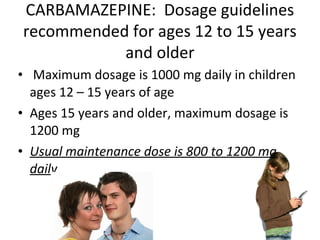
CARBAMAZEPINE: Dosage guidelines
recommended for ages 12 to 15 years
           and older
• Maximum dosage is 1000 mg daily in children
  ages 12 – 15 years of age
• Ages 15 years and older, maximum dosage is
  1200 mg
• Usual maintenance dose is 800 to 1200 mg
  daily
CARBAMAZEPINE: Dosage
   guidelines recommended 6 to 12
              years of age
• Children ages 6 to 12: Initially 100 mg po BID
  (conventional or extended release) or 50mg
  suspension po QID with meals
• Increased at weekly intervals up to 100mg po
  TID or QID in divided dosages (BID for
  extended release) Maximum is 1000mg daily
• Usual maintenance dose is 400-800 mg daily
  or 20/30mg/kg in divided doses TID or QID
CARBAMAZEPINE: Dosage guidelines
recommended for ages 6 and younger

• Recommended dosages are 10 to 20 mg/kg
  BID or TID in divided doses (conventional
  tablets) or QID (suspension).
• Maximum dosage is 35 mg/kg in 24 hours
CARBAMAZEPINE: Secondary usages
• Acute manic and mixed episodes associated
  with bipolar I disorder
• Trigeminal Neuralgia
• Restless Leg Syndrome
• Alcohol Withdrawal
CARBAMAZEPINE: Bipolar Disorder
• Given for manic episodes
• Usual dosage is 200mg po BID initially, then
  increase by 200mg daily until therapeutic
  response is achieved
• Maximum dosage is 1600 mg daily
CARBAMAZEPINE: Trigeminal
      Neuralgia (except Carbatrol)
• Initially 100 mg po BID tablets (conventional
  or extended release) or 50mg suspension QID
  with meals
• Increased by 100mg q 12 hrs. for all tablets or
  50mg for suspension until pain is relieved
• Maximum dose is 1200 mg daily
• Maintenance dose is usually 200mg – 400mg
  po BID
• Carbatrol follows different guidelines
CARBAMAZEPINE: Restless Leg
  Syndrome and Alcohol Withdrawal
• RLS: Adults 100 to 600mg po daily for up to
  six weeks
• Alcohol Withdrawal: Adults 600 to 1200 mg
  on day 1 with a taper to “0” over 5 to 10 days.
CARBAMAZEPINE: Administration
• Shake suspension well before administering
• Contents of extended release may be
  sprinkled over applesauce if difficulty
  swallowing
• Only tablets labeled “chewable” should be
  crushed or chewed
• Never crush or split tablets/capsules or given
  broken or chipped tablets
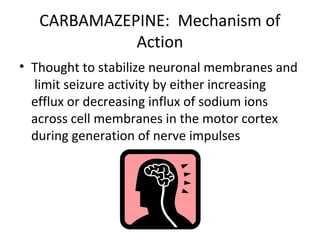
CARBAMAZEPINE: Mechanism of
             Action
• Thought to stabilize neuronal membranes and
  limit seizure activity by either increasing
  efflux or decreasing influx of sodium ions
  across cell membranes in the motor cortex
  during generation of nerve impulses
PHARMACOKINETICS
       Absorption by route of exposure

Absorption of carbamazepine from the
gastrointestinal tract is slow and erratic but
almost complete. Oral absorption is more rapid
on a full stomach and slower from tablets than
from solution.
CARBAMAZEPINE:
Pharmacodyamics/Pharmacotherapeutics
• Pharmacodyamics: Very similar to Phenytoin
  in the fact that the anticonvulsant action of
  the drug can occur because of its ability to
  inhibit the spread of seizure activity or
  neuromuscular transmission in general
• Pharmacotherapeutics: Drug of choice in
  adults as well as children for the treatment f
  generalized tonic-clonic seizures as well as
  simple and complex partial seizures
CARBAMAZEPINE: Peak and Half-life
             time
• Onset time for all routes is unknown
• Peak time for PO, conventional tablets is 1.5 –
  12 hrs. with duration unknown
• Peak time for PO, extended release is 4 – 8
  hrs.
• Half-life is 25 to 65 hours with a single dose, 8
  to 29 hours with long-term use
CARBAMAZEPINE: Adverse Reactions
•   CNS: ataxia, dizziness, drowsiness, vertigo, worsening of seizures, confusion,
    fatigue, fever, headache, syncope
•   CV: arrhythmias, AV Block, heart failure, aggravation of coronary artery
    disease, hypertension, hypotension
•   EENT: blurred vision, conjunctivitis, diplopia, dry pharynx, nystagmus
•   GI: nausea, vomiting, abdominal pain, anorexia, diarrhea, dry mouth, glossitis,
    stomatitis
•   GU: albuminuria, glycosaria, impotence, urinary frequency, urine retention
•   Hematologic: agranulocytosis, aplastic anemia, thrombocytopenia,
    eosinphils, leukocytosis
•   Hepatic: Hepatitis
•   Metabolic: hyponatremia, SIADH
•   Respiratory: pulmonary hypersensitivity
•   Skin: erythema multiforme, Stevens-Johnson Syndrome, excessive
    diaphoresis, rash, urticaria,
•   Other: chills
CARBAMAZEPINE: Drug to Drug
            Interactions
• Atracurium, Cisatracturium, Pancuronium,
  Rocuronium, Vecuronium: May decrease the effects
  of nondepolarizating muscle relaxant, causing it to be
  less-effective
• Cimetidine, Danazol, Diltiazem, Fluoxetine,
  Fluvoxamine, Isoniazid, Macrolides, Propoxyphene,
  Valproic Acid, Verapamil: May increase
  Carbamazepine levels, use together cautiously
• Doxycycline, felbate, Haloperidol, Hormonal
  contraceptives, Phenytoin, Theophylline, Tiagabine,
  Topiramate, Valproate, Warfarin: May decrease levels
  of these drugs, watch for decreased effect closely
CARBAMAZEPINE: Specific Drug to
        Drug interactions
• Lamotrigine: May decrease level and increase
  Carbamazepine level. Monitor closely for clinical
  effects and toxicity.
• Lithium: May increase CNS toxicity of Lithium.
  Avoid using together
• MAO Inhibitors: May increase depressant and
  anti-cholinergic effects. Avoid using together.
• Nefazodone: May increase Carbamazepine levels
  and toxicity while reducing Nefazodone levels
  and therapeutic benefit. Use together is
  contraindicated
CARBAMAZEPINE: Effects on Lab
            Testing
 PATIENTS MUST HAVE TESTING DONE ROUTINELY
           TO MONITOR THE FOLLOWING:
• May increase BUN level
• May decrease hemoglobin and hematocrit
• May increase Liver function tests
• Increase eosinophil and white blood cell count
• Decrease thyroid function test
• Decrease granulocyte and platelet counts
• May cause false pregnancy test results
CARBAMAZEPINE: Research
In cats, carbamazepine depresses thalamic
potential and bulbar and polysynaptic
reflexes. Its capacity to increase discharges of
noradrenergic neurones may contribute to its
anti-epileptic actions (Rall & Schleifer, 1985).
CARBAMAZEPINE: Contraindications
          and general cautions
                     Contraindicated
•   Hypersensitivity to this drug or tricyclic
    antidepressants
•   History of bone marrow suppression
•   MAO inhibitor use within 14 days
                    Use with caution
•   Mixed seizure disorder diagnosis (may experience
    increase in seizures)
•   Hepatic dysfunction
CARBAMAZEPINE: Considerations
• Asian patients at greater risk for serious skin
  reactions. Screen for HLA-B*1502 allele
  before beginning treatment
• Watch for worsening of seizures, especially in
  patients with mixed seizure disorders,
  including atypical absence seizures
• Watch for worsening of depression, anxiety,
  suicidal thoughts or behavior.
CARBAMAZEPINE: Black box warning
    Aplastic anemia and Agranulocytosis
have
 been reported in association with
Carbamazepine therapy. Must obtain
complete pretreatment hematologic testing as
a baseline. If during treatment, patient
exhibits low or decreased WBC or
 platelet counts, i.e. any evidence of
suppressed bone marrow,
CONSIDER DISCONTINUING THERAPY
CARBAMAZEPINE: Patient assessment
• Assess seizure disorder or trigeminal neuralgia prior to
  initiation of medication and routinely during course of
  treatment
• Obtain baseline urinalysis, blood urea nitrogen level, liver
  function, CBC, platelet and reticulocyte counts, iron levels and
  reassess routinely.
• Monitor drug level and drug effects closely, therapeutic level
  ranges from 4 to 12 mcg/ml. Toxic level is >15 mcg/ml.
• Monitor the patient’s response to the prescribed drug and
  serum levels as indicated.
• Monitor the patient for adverse reactions
• Assess the patients compliance with therapy at each follow-
  up visit
CARBAMAZEPINE: Patient
             teaching
• Take with food to decrease GI distress
• Shake suspension prior to administration
• Never crush or chew extended release form or take broken
  or chipped tablets
• Tegretol-XR may appear in stool since it is not absorbed
• Keep medication in original container, tightly sealed, away
  from moisture to ensure full effectiveness
• Notify MD immediately if fever, sore throat, mouth ulcers,
  excess bruising or bleeding occurs.
• Avoid taking while completing activities that require
  alertness (drowsiness is side effect)
• Regular eye exams are recommended to ensure eye health
CARBAMAZEPINE: Pharmacy Handout
        Per “Medicine Shoppe”, Crossville, TN
•   Medication name
•   Instruction on how to use handout
•   Common brand names
•   Warning: May cause fatal skin reaction in
    certain ethic groups. Testing for HLA-B 1502
    indicated for Asian descent.
•   No research listed
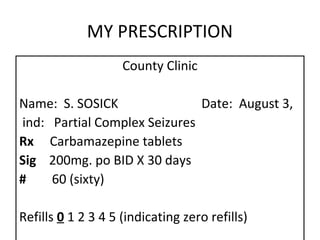
MY PRESCRIPTION
                    County Clinic

Name: S. SOSICK               Date: August 3,
ind: Partial Complex Seizures
Rx Carbamazepine tablets
Sig 200mg. po BID X 30 days
#    60 (sixty)

Refills 0 1 2 3 4 5 (indicating zero refills)
REFERENCES
• International Program on Chemical Safety, Chemical Safety
  Information from Intergovernmental Organizations,
  “CARBAMAZEPINE” August 3, 2012 retrieved from
  http://www.inchem.org/documents/pims/pharm/pim100.ht
  m#PartTitle:1.%20%20NAME
• Medicine Shoppe, (2012, July) “Carbamazepine, Patient
  Information”
• Nursing 2010 Drug Handbook (2010) Wolters Kluwer,
  Lippincott Williams & Wilkins
• Nursing Pharmacology Made Incredibly Easy, 2nd Ed. (2009) )
  Wolters Kluwer, Lippincott Williams & Wilkins

Carbamazepine public

  • 1.
  • 2.
    CARBAMAZEPINE: Other namesfor the medication and med facts • Pronounced: kar-ba-MAZ-e-peen • Other names: Carbatrol, Epitol, Equetro, Novo-Carbamaz, Tegretol, Tegretol CR, Tegretol-XR, Teril • Pharmacologic class: iminostilbene derivative • Pregnancy risk category: D
  • 3.
    CARBAMAZEPINE : Chemicalstructure • Carbamazepine is an iminostilbene derivative that is related chemically to the tricyclic antidepressants and is structurally similar to phenytoin. • Chemical name: 5H-Dibenz[b,f]azepine-5- carboxamide; 5-carbamoyl-5H-dibenz[b,f]azepine • Molecular formula of carbamazepine: C15H12N2O. • Molecular weight: 236.26.
  • 4.
    CARBAMAZEPINE: Available forms •Capsules (extended-release): 100mg, 200mg, 300mg • Oral suspension: 100mg/5ml • Tablets: 200mg • Tablets (chewable): 100mg, 200mg • Tablets (extended-release): 100mg, 200mg, 300mg
  • 5.
    CARBAMAZEPINE: Indications and Dosages • Indicated in the treatment of Generalized tonic- clonic and complex partial seizures, mixed seizure patterns (except Carbatrol) • Adults and children older than age 12: Initially, 200mg po BID (conventional or extended-release tablets), or 100mg po QID of suspension with meals • May be increased weekly by 200mg po daily in divided doses and 12 hr. intervals for extended release, 6 to 8 hr. doses for conventional tablets or suspension.
  • 6.
    CARBAMAZEPINE: Dosage guidelines recommendedfor ages 12 to 15 years and older • Maximum dosage is 1000 mg daily in children ages 12 – 15 years of age • Ages 15 years and older, maximum dosage is 1200 mg • Usual maintenance dose is 800 to 1200 mg daily
  • 7.
    CARBAMAZEPINE: Dosage guidelines recommended 6 to 12 years of age • Children ages 6 to 12: Initially 100 mg po BID (conventional or extended release) or 50mg suspension po QID with meals • Increased at weekly intervals up to 100mg po TID or QID in divided dosages (BID for extended release) Maximum is 1000mg daily • Usual maintenance dose is 400-800 mg daily or 20/30mg/kg in divided doses TID or QID
  • 8.
    CARBAMAZEPINE: Dosage guidelines recommendedfor ages 6 and younger • Recommended dosages are 10 to 20 mg/kg BID or TID in divided doses (conventional tablets) or QID (suspension). • Maximum dosage is 35 mg/kg in 24 hours
  • 9.
    CARBAMAZEPINE: Secondary usages •Acute manic and mixed episodes associated with bipolar I disorder • Trigeminal Neuralgia • Restless Leg Syndrome • Alcohol Withdrawal
  • 10.
    CARBAMAZEPINE: Bipolar Disorder •Given for manic episodes • Usual dosage is 200mg po BID initially, then increase by 200mg daily until therapeutic response is achieved • Maximum dosage is 1600 mg daily
  • 11.
    CARBAMAZEPINE: Trigeminal Neuralgia (except Carbatrol) • Initially 100 mg po BID tablets (conventional or extended release) or 50mg suspension QID with meals • Increased by 100mg q 12 hrs. for all tablets or 50mg for suspension until pain is relieved • Maximum dose is 1200 mg daily • Maintenance dose is usually 200mg – 400mg po BID • Carbatrol follows different guidelines
  • 12.
    CARBAMAZEPINE: Restless Leg Syndrome and Alcohol Withdrawal • RLS: Adults 100 to 600mg po daily for up to six weeks • Alcohol Withdrawal: Adults 600 to 1200 mg on day 1 with a taper to “0” over 5 to 10 days.
  • 13.
    CARBAMAZEPINE: Administration • Shakesuspension well before administering • Contents of extended release may be sprinkled over applesauce if difficulty swallowing • Only tablets labeled “chewable” should be crushed or chewed • Never crush or split tablets/capsules or given broken or chipped tablets
  • 14.
    CARBAMAZEPINE: Mechanism of Action • Thought to stabilize neuronal membranes and limit seizure activity by either increasing efflux or decreasing influx of sodium ions across cell membranes in the motor cortex during generation of nerve impulses
  • 15.
    PHARMACOKINETICS Absorption by route of exposure Absorption of carbamazepine from the gastrointestinal tract is slow and erratic but almost complete. Oral absorption is more rapid on a full stomach and slower from tablets than from solution.
  • 16.
    CARBAMAZEPINE: Pharmacodyamics/Pharmacotherapeutics • Pharmacodyamics: Verysimilar to Phenytoin in the fact that the anticonvulsant action of the drug can occur because of its ability to inhibit the spread of seizure activity or neuromuscular transmission in general • Pharmacotherapeutics: Drug of choice in adults as well as children for the treatment f generalized tonic-clonic seizures as well as simple and complex partial seizures
  • 17.
    CARBAMAZEPINE: Peak andHalf-life time • Onset time for all routes is unknown • Peak time for PO, conventional tablets is 1.5 – 12 hrs. with duration unknown • Peak time for PO, extended release is 4 – 8 hrs. • Half-life is 25 to 65 hours with a single dose, 8 to 29 hours with long-term use
  • 18.
    CARBAMAZEPINE: Adverse Reactions • CNS: ataxia, dizziness, drowsiness, vertigo, worsening of seizures, confusion, fatigue, fever, headache, syncope • CV: arrhythmias, AV Block, heart failure, aggravation of coronary artery disease, hypertension, hypotension • EENT: blurred vision, conjunctivitis, diplopia, dry pharynx, nystagmus • GI: nausea, vomiting, abdominal pain, anorexia, diarrhea, dry mouth, glossitis, stomatitis • GU: albuminuria, glycosaria, impotence, urinary frequency, urine retention • Hematologic: agranulocytosis, aplastic anemia, thrombocytopenia, eosinphils, leukocytosis • Hepatic: Hepatitis • Metabolic: hyponatremia, SIADH • Respiratory: pulmonary hypersensitivity • Skin: erythema multiforme, Stevens-Johnson Syndrome, excessive diaphoresis, rash, urticaria, • Other: chills
  • 19.
    CARBAMAZEPINE: Drug toDrug Interactions • Atracurium, Cisatracturium, Pancuronium, Rocuronium, Vecuronium: May decrease the effects of nondepolarizating muscle relaxant, causing it to be less-effective • Cimetidine, Danazol, Diltiazem, Fluoxetine, Fluvoxamine, Isoniazid, Macrolides, Propoxyphene, Valproic Acid, Verapamil: May increase Carbamazepine levels, use together cautiously • Doxycycline, felbate, Haloperidol, Hormonal contraceptives, Phenytoin, Theophylline, Tiagabine, Topiramate, Valproate, Warfarin: May decrease levels of these drugs, watch for decreased effect closely
  • 20.
    CARBAMAZEPINE: Specific Drugto Drug interactions • Lamotrigine: May decrease level and increase Carbamazepine level. Monitor closely for clinical effects and toxicity. • Lithium: May increase CNS toxicity of Lithium. Avoid using together • MAO Inhibitors: May increase depressant and anti-cholinergic effects. Avoid using together. • Nefazodone: May increase Carbamazepine levels and toxicity while reducing Nefazodone levels and therapeutic benefit. Use together is contraindicated
  • 21.
    CARBAMAZEPINE: Effects onLab Testing PATIENTS MUST HAVE TESTING DONE ROUTINELY TO MONITOR THE FOLLOWING: • May increase BUN level • May decrease hemoglobin and hematocrit • May increase Liver function tests • Increase eosinophil and white blood cell count • Decrease thyroid function test • Decrease granulocyte and platelet counts • May cause false pregnancy test results
  • 22.
    CARBAMAZEPINE: Research In cats,carbamazepine depresses thalamic potential and bulbar and polysynaptic reflexes. Its capacity to increase discharges of noradrenergic neurones may contribute to its anti-epileptic actions (Rall & Schleifer, 1985).
  • 23.
    CARBAMAZEPINE: Contraindications and general cautions Contraindicated • Hypersensitivity to this drug or tricyclic antidepressants • History of bone marrow suppression • MAO inhibitor use within 14 days Use with caution • Mixed seizure disorder diagnosis (may experience increase in seizures) • Hepatic dysfunction
  • 24.
    CARBAMAZEPINE: Considerations • Asianpatients at greater risk for serious skin reactions. Screen for HLA-B*1502 allele before beginning treatment • Watch for worsening of seizures, especially in patients with mixed seizure disorders, including atypical absence seizures • Watch for worsening of depression, anxiety, suicidal thoughts or behavior.
  • 25.
    CARBAMAZEPINE: Black boxwarning Aplastic anemia and Agranulocytosis have been reported in association with Carbamazepine therapy. Must obtain complete pretreatment hematologic testing as a baseline. If during treatment, patient exhibits low or decreased WBC or platelet counts, i.e. any evidence of suppressed bone marrow, CONSIDER DISCONTINUING THERAPY
  • 26.
    CARBAMAZEPINE: Patient assessment •Assess seizure disorder or trigeminal neuralgia prior to initiation of medication and routinely during course of treatment • Obtain baseline urinalysis, blood urea nitrogen level, liver function, CBC, platelet and reticulocyte counts, iron levels and reassess routinely. • Monitor drug level and drug effects closely, therapeutic level ranges from 4 to 12 mcg/ml. Toxic level is >15 mcg/ml. • Monitor the patient’s response to the prescribed drug and serum levels as indicated. • Monitor the patient for adverse reactions • Assess the patients compliance with therapy at each follow- up visit
  • 27.
    CARBAMAZEPINE: Patient teaching • Take with food to decrease GI distress • Shake suspension prior to administration • Never crush or chew extended release form or take broken or chipped tablets • Tegretol-XR may appear in stool since it is not absorbed • Keep medication in original container, tightly sealed, away from moisture to ensure full effectiveness • Notify MD immediately if fever, sore throat, mouth ulcers, excess bruising or bleeding occurs. • Avoid taking while completing activities that require alertness (drowsiness is side effect) • Regular eye exams are recommended to ensure eye health
  • 28.
    CARBAMAZEPINE: Pharmacy Handout Per “Medicine Shoppe”, Crossville, TN • Medication name • Instruction on how to use handout • Common brand names • Warning: May cause fatal skin reaction in certain ethic groups. Testing for HLA-B 1502 indicated for Asian descent. • No research listed
  • 29.
    MY PRESCRIPTION County Clinic Name: S. SOSICK Date: August 3, ind: Partial Complex Seizures Rx Carbamazepine tablets Sig 200mg. po BID X 30 days # 60 (sixty) Refills 0 1 2 3 4 5 (indicating zero refills)
  • 30.
    REFERENCES • International Programon Chemical Safety, Chemical Safety Information from Intergovernmental Organizations, “CARBAMAZEPINE” August 3, 2012 retrieved from http://www.inchem.org/documents/pims/pharm/pim100.ht m#PartTitle:1.%20%20NAME • Medicine Shoppe, (2012, July) “Carbamazepine, Patient Information” • Nursing 2010 Drug Handbook (2010) Wolters Kluwer, Lippincott Williams & Wilkins • Nursing Pharmacology Made Incredibly Easy, 2nd Ed. (2009) ) Wolters Kluwer, Lippincott Williams & Wilkins