Carbamazepine
poisoning
Outlines
• INTRODUCTION ON CASE PRESENTATION
 HISTORY
 PHYSICAL EXAMINATION
 INVESTIGATION
 MANAGEMENT
• MECHANISM OF ACTION KINETICS,OVERDOSE AND TOXICITY
• CLINICAL APPROACH
• SPECIFIC SELECTED DRUG DISCUSSION
• OPTIONS OF MANAGEMENT
• COMMENT ON THE CASE
• REFERENCE
9/12/2022
HISTORY
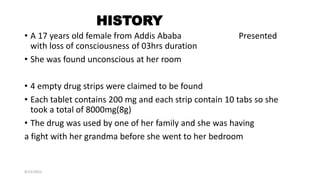
• A 17 years old female from Addis Ababa Presented
with loss of consciousness of 03hrs duration
• She was found unconscious at her room
• 4 empty drug strips were claimed to be found
• Each tablet contains 200 mg and each strip contain 10 tabs so she
took a total of 8000mg(8g)
• The drug was used by one of her family and she was having
a fight with her grandma before she went to her bedroom
9/12/2022
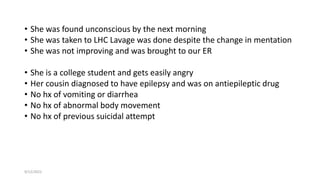
• She was found unconscious by the next morning
• She was taken to LHC Lavage was done despite the change in mentation
• She was not improving and was brought to our ER
• She is a college student and gets easily angry
• Her cousin diagnosed to have epilepsy and was on antiepileptic drug
• No hx of vomiting or diarrhea
• No hx of abnormal body movement
• No hx of previous suicidal attempt
9/12/2022
Physical examination
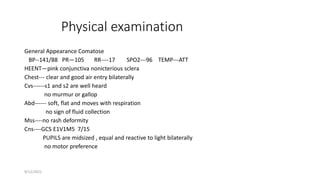
General Appearance Comatose
BP--141/88 PR—105 RR----17 SPO2---96 TEMP---ATT
HEENT—pink conjunctiva nonicterious sclera
Chest--- clear and good air entry bilaterally
Cvs------s1 and s2 are well heard
no murmur or gallop
Abd------ soft, flat and moves with respiration
no sign of fluid collection
Mss----no rash deformity
Cns----GCS E1V1M5 7/15
PUPILS are midsized , equal and reactive to light bilaterally
no motor preference
9/12/2022
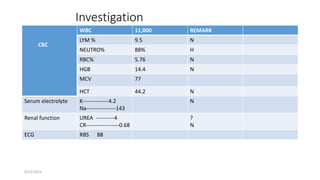
Investigation
CBC
WBC 11,000 REMARK
LYM % 9.5 N
NEUTRO% 88% H
RBC% 5.76 N
HGB 14.4 N
MCV 77
HCT 44.2 N
Serum electrolyte K--------------4.2
Na----------------143
N
Renal function UREA ----------4
CR------------------0.68
?
N
ECG RBS 88
9/12/2022
9/12/2022
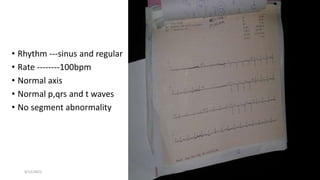
• Rhythm ---sinus and regular
• Rate --------100bpm
• Normal axis
• Normal p,qrs and t waves
• No segment abnormality
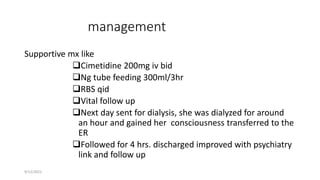
management
Supportive mx like
Cimetidine 200mg iv bid
Ng tube feeding 300ml/3hr
RBS qid
Vital follow up
Next day sent for dialysis, she was dialyzed for around
an hour and gained her consciousness transferred to the
ER
Followed for 4 hrs. discharged improved with psychiatry
link and follow up
9/12/2022
Carbamazepine toxicity
9/12/2022
carbamazepine
• Carbamazepine, an iminostilbene compound
• introduced in the United States in 1974 for the treatment of
trigeminal neuralgia and is specific analgesic for trigeminal neuralgia
• It has become a first-line drug for the
treatment of generalized and partial complex seizure disorders
• expanded use for pain syndromes, psychiatric illnesses, and
drug withdrawal reactions.
9/12/2022
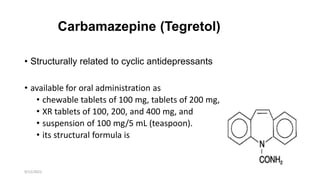
• Structurally related to cyclic antidepressants
• available for oral administration as
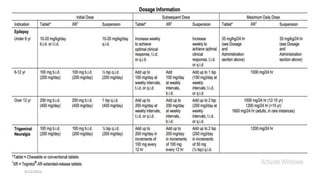
• chewable tablets of 100 mg, tablets of 200 mg,
• XR tablets of 100, 200, and 400 mg, and
• suspension of 100 mg/5 mL (teaspoon).
• its structural formula is
Carbamazepine (Tegretol)
9/12/2022
9/12/2022
pharmacokinetics
• suspension, conventional tablets, and XR tablets delivered equivalent amounts of drug to the systemic
circulation.
• suspension was absorbed somewhat faster, and the XR tablet slightly slower, than the
• conventional tablet.
• bioavailability of the XR tablet was 89% compared to suspension
• Usual adult therapeutic levels are between 4 and 12 µg/mL
• In polytherapy, the concentration of it and concomitant drugs may be increased or decreased
• chronic oral administration of suspension, plasma levels peak at approximately 1.5 hours
• 4-5 peak hours after administration of conventional Tegretol tablets
• 3-12 hours after administration of Tegretol-XR tablets
• After oral carbamazepine, 72% of the administered radioactivity was found in the urine and 28% in the
feces 3% of unchanged
9/12/2022
Cont….
• Carbamazepine is slowly and erratically absorbed from GI
• peak levels may be delayed for 6–24 hours,
• It is 75–78% protein bound with a volume of distribution (Vd) of approximately 1.4
L/kg (up to 3 L/kg after overdose
• Has enterohepatic recycling
• The parent drug is metabolized by cytochrome P-450, and 40% is converted to its
10,11-epoxide, which is as active as the parent compound
• The elimination half-life is variable and is subject to autoinduction of P-450
• the half-life of carbamazepine is approximately 18–55 hours (initially) to 5–26
hours (with chronic use). The half-life of the epoxide metabolite is approximately
5–10 hours.
9/12/2022
TOXICICTY
• Acute ingestion of more than 10 mg/kg could result in a blood
level
above the therapeutic range of 4–12 mg/L
• The recommended maximum daily dose is 1.6–2.4 g in adults
(35 mg/kg/day in children).
• Death has occurred after adult ingestion of 3.2–60 g, but
survival has been reported after an 80-g ingestion.
• Life-threatening toxicity occurs after ingestion of 5.8–10 g in
adults and 2g (148 mg/kg)
9/12/2022
signs and Symptoms of toxicity
• The first signs and symptoms appear after 1-3 hours
• Neuromuscular disturbances are the most prominent
• Cardiovascular disorders are generally milder, and severe cardiac complications occur only when
very high doses (>60 g)have been ingested.
Respiration: Irregular breathing, respiratory depression.
•
Cardiovascular System
• conduction disorders like Atrioventricular (AV) block and bradycardia
• Based on its structural similarity to tricyclic antidepressants may cause QRS and QT interval prolongation
and myocardial depression,Tachycardia, hypotension or hypertension, shock
• Nervous System Ataxia, nystagmus, ophthalmoplegia, movement disorders (dyskinesia,
adiadochokinesia dystonia) Motor restlessness, muscular twitching, tremor, athetoid
movements, opisthotonos drowsiness, dizziness, mydriasis,, ballism, psychomotor disturbances,
dysmetria. Initial hyperreflexia, followed by hyporeflexia.
Gastrointestinal Tract: Nausea, vomiting.
Kidneys and Bladder: Anuria or oliguria, urinary retention.
9/12/2022
Cont…
• After an acute overdose, manifestations of intoxication may be delayed for
several hours because of erratic absorption.
• Cyclic coma and rebound relapse of symptoms may be caused by continued absorption
from a tablet mass as well as enterohepatic circulation of the drug.
• Chronic use has been associated with bone marrow depression, hepatitis,
renal disease, cardiomyopathy, hyponatremia, and exfoliative dermatitis
• Carbamazepine has also been implicated in rigidity-hyperthermia syndromes (eg,
neuroleptic malignant syndrome and serotonin syndrome) in combination with other drug
9/12/2022
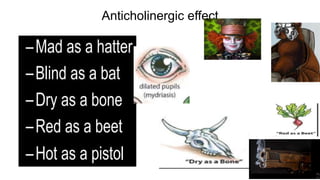
Anticholinergic effect
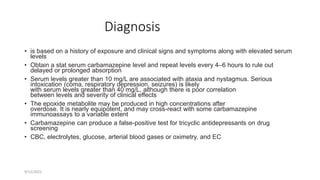
Diagnosis
• is based on a history of exposure and clinical signs and symptoms along with elevated serum
levels
• Obtain a stat serum carbamazepine level and repeat levels every 4–6 hours to rule out
delayed or prolonged absorption
• Serum levels greater than 10 mg/L are associated with ataxia and nystagmus. Serious
intoxication (coma, respiratory depression, seizures) is likely
with serum levels greater than 40 mg/L, although there is poor correlation
between levels and severity of clinical effects
• The epoxide metabolite may be produced in high concentrations after
overdose. It is nearly equipotent, and may cross-react with some carbamazepine
immunoassays to a variable extent
• Carbamazepine can produce a false-positive test for tricyclic antidepressants on drug
screening
• CBC, electrolytes, glucose, arterial blood gases or oximetry, and EC
9/12/2022
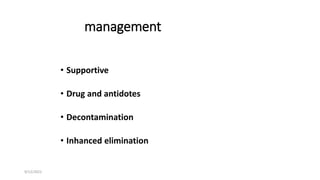
management
• Supportive
• Drug and antidotes
• Decontamination
• Inhanced elimination
9/12/2022
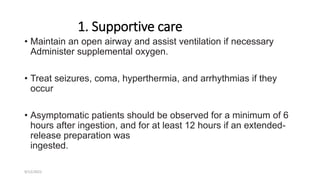
1. Supportive care
• Maintain an open airway and assist ventilation if necessary
Administer supplemental oxygen.
• Treat seizures, coma, hyperthermia, and arrhythmias if they
occur
• Asymptomatic patients should be observed for a minimum of 6
hours after ingestion, and for at least 12 hours if an extended-
release preparation was
ingested.
9/12/2022
Clinical approach
• Airway → Endotracheal intubation Check gag/cough reflex
• Position patient
• Clear/suction airway
• ??c-collar
• •Breathing → ventilatory failure, hypoxia, bronchospasm
Obtain arterial blood gases
• Give supplemental oxygen
•Circulation → bradycardia, tachycardia, arrhythmias, hypotension, hypertension
• Measure blood pressure/pulse
• Monitor electrocardiogram
• Start 1-2 IV lines
• Obtain routine bloodwork
• Disability →GCS
• PUPILARY REACTION
9/12/2022
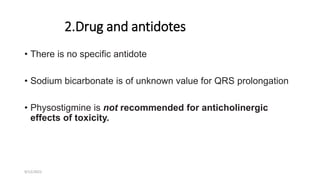
2.Drug and antidotes
• There is no specific antidote
• Sodium bicarbonate is of unknown value for QRS prolongation
• Physostigmine is not recommended for anticholinergic
effects of toxicity.
9/12/2022
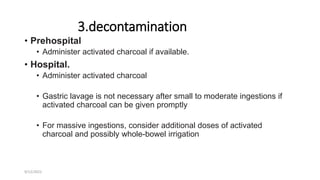
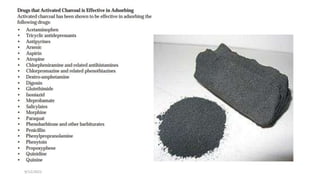
3.decontamination
• Prehospital
• Administer activated charcoal if available.
• Hospital.
• Administer activated charcoal
• Gastric lavage is not necessary after small to moderate ingestions if
activated charcoal can be given promptly
• For massive ingestions, consider additional doses of activated
charcoal and possibly whole-bowel irrigation
9/12/2022
9/12/2022
9/12/2022
4.Inhanced Elimination
• Repeat or multi dose activated charcoal is effective and may increase clearance by up to
50%
• with obtundation and ileus, and there is no demonstrated benefit on morbidity or mortality.
• Charcoal haemoperfusion, haemodiafiltration is highly effective and may be indicated for
severe intoxication (eg, status epilepticus, cardiotoxicity, serum level > 60mg/L) unresponsive
to standard treatment
• High-flux (more porous noncellulosic membranes with increased permeability,
particularly to larger molecules) and high efficiency (a standard cellulosic
membranes with a larger surface area ) hemodialysis is also reportedly effective
• Peritoneal dialysis does not effectively remove carbamazepine.
• Plasma exchange has been used in children
9/12/2022
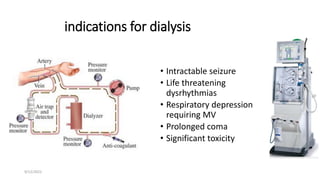
indications for dialysis
• Intractable seizure
• Life threatening
dysrhythmias
• Respiratory depression
requiring MV
• Prolonged coma
• Significant toxicity
9/12/2022
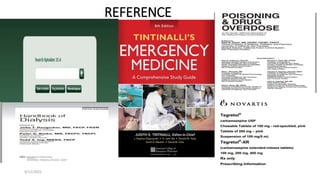
REFERENCE
9/12/2022
9/12/2022

carbamazepine.pptx

  • 1.
  • 2.
    Outlines • INTRODUCTION ONCASE PRESENTATION  HISTORY  PHYSICAL EXAMINATION  INVESTIGATION  MANAGEMENT • MECHANISM OF ACTION KINETICS,OVERDOSE AND TOXICITY • CLINICAL APPROACH • SPECIFIC SELECTED DRUG DISCUSSION • OPTIONS OF MANAGEMENT • COMMENT ON THE CASE • REFERENCE 9/12/2022
  • 3.
    HISTORY • A 17years old female from Addis Ababa Presented with loss of consciousness of 03hrs duration • She was found unconscious at her room • 4 empty drug strips were claimed to be found • Each tablet contains 200 mg and each strip contain 10 tabs so she took a total of 8000mg(8g) • The drug was used by one of her family and she was having a fight with her grandma before she went to her bedroom 9/12/2022
  • 4.
    • She wasfound unconscious by the next morning • She was taken to LHC Lavage was done despite the change in mentation • She was not improving and was brought to our ER • She is a college student and gets easily angry • Her cousin diagnosed to have epilepsy and was on antiepileptic drug • No hx of vomiting or diarrhea • No hx of abnormal body movement • No hx of previous suicidal attempt 9/12/2022
  • 5.
    Physical examination General AppearanceComatose BP--141/88 PR—105 RR----17 SPO2---96 TEMP---ATT HEENT—pink conjunctiva nonicterious sclera Chest--- clear and good air entry bilaterally Cvs------s1 and s2 are well heard no murmur or gallop Abd------ soft, flat and moves with respiration no sign of fluid collection Mss----no rash deformity Cns----GCS E1V1M5 7/15 PUPILS are midsized , equal and reactive to light bilaterally no motor preference 9/12/2022
  • 6.
    Investigation CBC WBC 11,000 REMARK LYM% 9.5 N NEUTRO% 88% H RBC% 5.76 N HGB 14.4 N MCV 77 HCT 44.2 N Serum electrolyte K--------------4.2 Na----------------143 N Renal function UREA ----------4 CR------------------0.68 ? N ECG RBS 88 9/12/2022
  • 7.
    9/12/2022 • Rhythm ---sinusand regular • Rate --------100bpm • Normal axis • Normal p,qrs and t waves • No segment abnormality
  • 8.
    management Supportive mx like Cimetidine200mg iv bid Ng tube feeding 300ml/3hr RBS qid Vital follow up Next day sent for dialysis, she was dialyzed for around an hour and gained her consciousness transferred to the ER Followed for 4 hrs. discharged improved with psychiatry link and follow up 9/12/2022
  • 9.
  • 10.
    carbamazepine • Carbamazepine, animinostilbene compound • introduced in the United States in 1974 for the treatment of trigeminal neuralgia and is specific analgesic for trigeminal neuralgia • It has become a first-line drug for the treatment of generalized and partial complex seizure disorders • expanded use for pain syndromes, psychiatric illnesses, and drug withdrawal reactions. 9/12/2022
  • 11.
    • Structurally relatedto cyclic antidepressants • available for oral administration as • chewable tablets of 100 mg, tablets of 200 mg, • XR tablets of 100, 200, and 400 mg, and • suspension of 100 mg/5 mL (teaspoon). • its structural formula is Carbamazepine (Tegretol) 9/12/2022
  • 12.
  • 13.
    pharmacokinetics • suspension, conventionaltablets, and XR tablets delivered equivalent amounts of drug to the systemic circulation. • suspension was absorbed somewhat faster, and the XR tablet slightly slower, than the • conventional tablet. • bioavailability of the XR tablet was 89% compared to suspension • Usual adult therapeutic levels are between 4 and 12 µg/mL • In polytherapy, the concentration of it and concomitant drugs may be increased or decreased • chronic oral administration of suspension, plasma levels peak at approximately 1.5 hours • 4-5 peak hours after administration of conventional Tegretol tablets • 3-12 hours after administration of Tegretol-XR tablets • After oral carbamazepine, 72% of the administered radioactivity was found in the urine and 28% in the feces 3% of unchanged 9/12/2022
  • 14.
    Cont…. • Carbamazepine isslowly and erratically absorbed from GI • peak levels may be delayed for 6–24 hours, • It is 75–78% protein bound with a volume of distribution (Vd) of approximately 1.4 L/kg (up to 3 L/kg after overdose • Has enterohepatic recycling • The parent drug is metabolized by cytochrome P-450, and 40% is converted to its 10,11-epoxide, which is as active as the parent compound • The elimination half-life is variable and is subject to autoinduction of P-450 • the half-life of carbamazepine is approximately 18–55 hours (initially) to 5–26 hours (with chronic use). The half-life of the epoxide metabolite is approximately 5–10 hours. 9/12/2022
  • 15.
    TOXICICTY • Acute ingestionof more than 10 mg/kg could result in a blood level above the therapeutic range of 4–12 mg/L • The recommended maximum daily dose is 1.6–2.4 g in adults (35 mg/kg/day in children). • Death has occurred after adult ingestion of 3.2–60 g, but survival has been reported after an 80-g ingestion. • Life-threatening toxicity occurs after ingestion of 5.8–10 g in adults and 2g (148 mg/kg) 9/12/2022
  • 16.
    signs and Symptomsof toxicity • The first signs and symptoms appear after 1-3 hours • Neuromuscular disturbances are the most prominent • Cardiovascular disorders are generally milder, and severe cardiac complications occur only when very high doses (>60 g)have been ingested. Respiration: Irregular breathing, respiratory depression. • Cardiovascular System • conduction disorders like Atrioventricular (AV) block and bradycardia • Based on its structural similarity to tricyclic antidepressants may cause QRS and QT interval prolongation and myocardial depression,Tachycardia, hypotension or hypertension, shock • Nervous System Ataxia, nystagmus, ophthalmoplegia, movement disorders (dyskinesia, adiadochokinesia dystonia) Motor restlessness, muscular twitching, tremor, athetoid movements, opisthotonos drowsiness, dizziness, mydriasis,, ballism, psychomotor disturbances, dysmetria. Initial hyperreflexia, followed by hyporeflexia. Gastrointestinal Tract: Nausea, vomiting. Kidneys and Bladder: Anuria or oliguria, urinary retention. 9/12/2022
  • 17.
    Cont… • After anacute overdose, manifestations of intoxication may be delayed for several hours because of erratic absorption. • Cyclic coma and rebound relapse of symptoms may be caused by continued absorption from a tablet mass as well as enterohepatic circulation of the drug. • Chronic use has been associated with bone marrow depression, hepatitis, renal disease, cardiomyopathy, hyponatremia, and exfoliative dermatitis • Carbamazepine has also been implicated in rigidity-hyperthermia syndromes (eg, neuroleptic malignant syndrome and serotonin syndrome) in combination with other drug 9/12/2022
  • 18.
  • 19.
    Diagnosis • is basedon a history of exposure and clinical signs and symptoms along with elevated serum levels • Obtain a stat serum carbamazepine level and repeat levels every 4–6 hours to rule out delayed or prolonged absorption • Serum levels greater than 10 mg/L are associated with ataxia and nystagmus. Serious intoxication (coma, respiratory depression, seizures) is likely with serum levels greater than 40 mg/L, although there is poor correlation between levels and severity of clinical effects • The epoxide metabolite may be produced in high concentrations after overdose. It is nearly equipotent, and may cross-react with some carbamazepine immunoassays to a variable extent • Carbamazepine can produce a false-positive test for tricyclic antidepressants on drug screening • CBC, electrolytes, glucose, arterial blood gases or oximetry, and EC 9/12/2022
  • 20.
    management • Supportive • Drugand antidotes • Decontamination • Inhanced elimination 9/12/2022
  • 21.
    1. Supportive care •Maintain an open airway and assist ventilation if necessary Administer supplemental oxygen. • Treat seizures, coma, hyperthermia, and arrhythmias if they occur • Asymptomatic patients should be observed for a minimum of 6 hours after ingestion, and for at least 12 hours if an extended- release preparation was ingested. 9/12/2022
  • 22.
    Clinical approach • Airway→ Endotracheal intubation Check gag/cough reflex • Position patient • Clear/suction airway • ??c-collar • •Breathing → ventilatory failure, hypoxia, bronchospasm Obtain arterial blood gases • Give supplemental oxygen •Circulation → bradycardia, tachycardia, arrhythmias, hypotension, hypertension • Measure blood pressure/pulse • Monitor electrocardiogram • Start 1-2 IV lines • Obtain routine bloodwork • Disability →GCS • PUPILARY REACTION 9/12/2022
  • 23.
    2.Drug and antidotes •There is no specific antidote • Sodium bicarbonate is of unknown value for QRS prolongation • Physostigmine is not recommended for anticholinergic effects of toxicity. 9/12/2022
  • 24.
    3.decontamination • Prehospital • Administeractivated charcoal if available. • Hospital. • Administer activated charcoal • Gastric lavage is not necessary after small to moderate ingestions if activated charcoal can be given promptly • For massive ingestions, consider additional doses of activated charcoal and possibly whole-bowel irrigation 9/12/2022
  • 25.
  • 26.
  • 27.
    4.Inhanced Elimination • Repeator multi dose activated charcoal is effective and may increase clearance by up to 50% • with obtundation and ileus, and there is no demonstrated benefit on morbidity or mortality. • Charcoal haemoperfusion, haemodiafiltration is highly effective and may be indicated for severe intoxication (eg, status epilepticus, cardiotoxicity, serum level > 60mg/L) unresponsive to standard treatment • High-flux (more porous noncellulosic membranes with increased permeability, particularly to larger molecules) and high efficiency (a standard cellulosic membranes with a larger surface area ) hemodialysis is also reportedly effective • Peritoneal dialysis does not effectively remove carbamazepine. • Plasma exchange has been used in children 9/12/2022
  • 28.
    indications for dialysis •Intractable seizure • Life threatening dysrhythmias • Respiratory depression requiring MV • Prolonged coma • Significant toxicity 9/12/2022
  • 29.
  • 30.