
Efficient 
Authentication for 
Mobile and Pervasive 
Computing 
BASEL ALOMAIR, MEMBER, IEEE AND RADHA POOVENDRAN, SENIOR 
MEMBER, IEEE
Abstract 
With today’s technology, many applications rely on the existence of 
small devices that can exchange information and form 
communication networks. In a significant portion of such applications, 
the confidentiality and integrity of the communicated messages are of 
particular interest. In this work, we propose two novel techniques for 
authenticating short encrypted messages that are directed to meet 
the requirements of mobile and pervasive applications. By taking 
advantage of the fact that the message to be authenticated must 
also be encrypted, we propose provably secure authentication codes 
that are more efficient than any message authentication code in the 
literature. The key idea behind the proposed techniques is to utilize the 
security that the encryption algorithm can provide to design more 
efficient authentication mechanisms, as opposed to using standalone 
authentication primitives.
Existing System 
There are two important observations to make about existing MAC 
algorithms. First, they are designed independently of any other 
operations required to be performed on the message to be 
authenticated. For instance, if the authenticated message must also 
be encrypted, existing MACs are not designed to utilize the 
functionality that can be provided by the underlying encryption 
algorithm. Second, most existing MACs are designed for the general 
computer communication systems, independently of the properties 
that messages can possess. For example, one can find that most 
existing MACs are inefficient when the messages to be authenticated 
are short. (For instance, UMAC, the fastest reported message 
authentication code in the cryptographic literature, has undergone 
large algorithmic changes to increase its speed on short messages ).
Disadvantages of proposed system 
 Existing MACs are not designed to utilize the functionality that can 
be provided by the underlying encryption algorithm. 
 Most existing MACs are designed for the general computer 
communication systems, independently of the properties that 
messages can possess.
Proposed System 
We propose the following research question: if there is an application 
in which messages that need to be exchanged are short and both 
their privacy and integrity need to be preserved, can one do better 
than simply encrypting the messages using an encryption algorithm 
and authenticating them using standard MAC algorithm? We answer 
the question by proposing two new techniques for authenticating short 
encrypted messages that are more efficient than existing approaches. 
In the first technique, we utilize the fact that the message to be 
authenticated is also encrypted, with any secure encryption algorithm, 
to append a short random string to be used in the authentication 
process.
Advantages of proposed system 
 More security, using two concepts one is mobile computing and 
another one is pervasive computing. 
 The random strings used for different operations are independent, 
the authentication algorithm can benefit from the simplicity of 
unconditional secure authentication to allow for faster and more 
efficient authentication, without the difficulty to manage one-time 
keys. In the second technique, we make the extra assumption that 
the used encryption algorithm is block cipher based to further 
improve the computational efficiency of the first technique.
Architecture
Modules 
The proposed system has the following modules: 
 Authenticating Short Encrypted Messages 
 Security Model 
 Data Privacy 
 Security of the Authenticated Encryption Composition
Module Description 
 Authenticating Short Encrypted Messages 
In this module, we describe our first authentication scheme that can 
be used with any IND-CPA secure encryption algorithm .An important 
assumption we make is that messages to be authenticated are no 
longer than a predefined length. This includes applications in which 
messages are of fixed length that is known a priori, such as RFID systems 
in which tags need to authenticate their identifiers, sensor nodes 
reporting events that belong to certain domain or measurements 
within a certain range, etc. The novelty of the proposed scheme is to 
utilize the encryption algorithm to deliver a random string and use it to 
reach the simplicity and efficiency of one-time pad authentication 
without the need to manage impractically long keys.
 Security Model 
A message authentication scheme consists of a signing algorithm S and a verifying 
algorithm V. The signing algorithm might be probabilistic, while the verifying one is usually 
not. Associated with the scheme are parameters and N describing the length of the 
shared key and the resulting authentication tag, respectively. On input an `-bit key k and 
a message m, algorithm S outputs an N-bit string called the authentication tag, or the 
MAC of m. On input an `-bit key k, a message m, and an N-bit tag , algorithm V outputs a 
bit, with 1 standing for accept and 0 for reject. We ask for a basic validity condition, 
namely that authentic tags are accepted with probability one.) for a random but hidden 
choice of k. A can query S to generate a tag for a plaintext of its choice and ask the 
verifier V to verify that _ is a valid tag for the plaintext. Formally, A’s attack on the scheme 
is described by the following experiment: 
1) A random string of length ` is selected as the shared secret. 
2) Suppose A makes a signing query on a message m. Then the oracle computes an 
authentication tag _ = S(k; m)and returns it to A. (Since S may be probabilistic, this step 
requires making the necessary underlying choice of a random string for S, anew for each 
signing query.) 
3) Suppose A makes a verify query (m; _ ). The oracle computes the decision d = V(k; m; 
_ ) and returns it to A.
 Data Privacy 
Recall that two pieces of information are transmitted to the intended 
receiver (the cipher text and the authentication tag),both of which are 
functions of the private plaintext message. Now, when it comes to the 
authentication tag, observe that then once r serves as a one-time key 
(similar to the role r plays in the construction of Section . 
The formal analysis that the authentication tag does not compromise 
message privacy is the same as the one provided . The cipher text of 
equation ,on the other hand, is a standard CBC encryption and its 
security is well-studied; thus, we give the theorem statement below 
without a formal proof (interested readers may refer to textbooks in 
cryptography.
 Security of the Authenticated 
Encryption Composition 
In this module, it defined two notions of integrity for authenticated 
encryption systems: the first is integrity of plaintext (INT-PTXT) and the 
second is integrity of cipher text (INT-CTXT). Combined with encryption 
algorithms that provide in-distinguish ability under chosen plaintext 
attacks(IND-CPA), the security of different methods for constructing 
generic compositions is analyzed. Note that our construction is an 
instance of the Encrypt-and-Authenticate (E&A) generic composition 
since the plaintext message goes to the encryption algorithm as an 
input, and the same plaintext message goes to the authentication 
algorithm as an input.
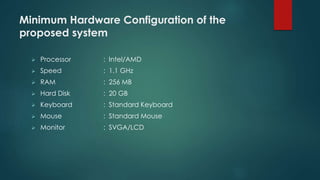
Minimum Hardware Configuration of the 
proposed system 
 Processor : Intel/AMD 
 Speed : 1.1 GHz 
 RAM : 256 MB 
 Hard Disk : 20 GB 
 Keyboard : Standard Keyboard 
 Mouse : Standard Mouse 
 Monitor : SVGA/LCD
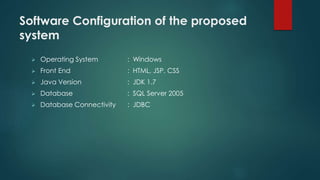
Software Configuration of the proposed 
system 
 Operating System : Windows 
 Front End : HTML, JSP, CSS 
 Java Version : JDK 1.7 
 Database : SQL Server 2005 
 Database Connectivity : JDBC
References 
 J. Carter and M. Wegman, “Universal classes of hash functions,” in 
Proceedings of the ninth annual ACM symposium on Theory of 
computing–STOC’77. ACM, 1977, pp. 106–112. 
 M. Wegman and J. Carter, “New classes and applications of hash 
functions,” in 20th Annual Symposium on Foundations of Computer 
Science–FOCS’79. IEEE, 1979, pp. 175–182. 
 L. Carter and M. Wegman, “Universal hash functions,” Journal of 
Computer and System Sciences, vol. 18, no. 2, pp. 143–154, 1979. 
 M. Wegman and L. Carter, “New hash functions and their use in 
authentication and set equality,” Journal of Computer and System 
Sciences, vol. 22, no. 3, pp. 265–279, 1981. 
 J. Bierbrauer, “A2-codes from universal hash classes,” in Advances in 
Cryptology–EUROCRYPT’95, vol. 921, Lecture Notes in Computer 
Science. Springer, 1995, pp. 311–318.

Efficient authentication for mobile and pervasive computing

  • 1.
    Efficient Authentication for Mobile and Pervasive Computing BASEL ALOMAIR, MEMBER, IEEE AND RADHA POOVENDRAN, SENIOR MEMBER, IEEE
  • 2.
    Abstract With today’stechnology, many applications rely on the existence of small devices that can exchange information and form communication networks. In a significant portion of such applications, the confidentiality and integrity of the communicated messages are of particular interest. In this work, we propose two novel techniques for authenticating short encrypted messages that are directed to meet the requirements of mobile and pervasive applications. By taking advantage of the fact that the message to be authenticated must also be encrypted, we propose provably secure authentication codes that are more efficient than any message authentication code in the literature. The key idea behind the proposed techniques is to utilize the security that the encryption algorithm can provide to design more efficient authentication mechanisms, as opposed to using standalone authentication primitives.
  • 3.
    Existing System Thereare two important observations to make about existing MAC algorithms. First, they are designed independently of any other operations required to be performed on the message to be authenticated. For instance, if the authenticated message must also be encrypted, existing MACs are not designed to utilize the functionality that can be provided by the underlying encryption algorithm. Second, most existing MACs are designed for the general computer communication systems, independently of the properties that messages can possess. For example, one can find that most existing MACs are inefficient when the messages to be authenticated are short. (For instance, UMAC, the fastest reported message authentication code in the cryptographic literature, has undergone large algorithmic changes to increase its speed on short messages ).
  • 4.
    Disadvantages of proposedsystem  Existing MACs are not designed to utilize the functionality that can be provided by the underlying encryption algorithm.  Most existing MACs are designed for the general computer communication systems, independently of the properties that messages can possess.
  • 5.
    Proposed System Wepropose the following research question: if there is an application in which messages that need to be exchanged are short and both their privacy and integrity need to be preserved, can one do better than simply encrypting the messages using an encryption algorithm and authenticating them using standard MAC algorithm? We answer the question by proposing two new techniques for authenticating short encrypted messages that are more efficient than existing approaches. In the first technique, we utilize the fact that the message to be authenticated is also encrypted, with any secure encryption algorithm, to append a short random string to be used in the authentication process.
  • 6.
    Advantages of proposedsystem  More security, using two concepts one is mobile computing and another one is pervasive computing.  The random strings used for different operations are independent, the authentication algorithm can benefit from the simplicity of unconditional secure authentication to allow for faster and more efficient authentication, without the difficulty to manage one-time keys. In the second technique, we make the extra assumption that the used encryption algorithm is block cipher based to further improve the computational efficiency of the first technique.
  • 7.
  • 8.
    Modules The proposedsystem has the following modules:  Authenticating Short Encrypted Messages  Security Model  Data Privacy  Security of the Authenticated Encryption Composition
  • 9.
    Module Description Authenticating Short Encrypted Messages In this module, we describe our first authentication scheme that can be used with any IND-CPA secure encryption algorithm .An important assumption we make is that messages to be authenticated are no longer than a predefined length. This includes applications in which messages are of fixed length that is known a priori, such as RFID systems in which tags need to authenticate their identifiers, sensor nodes reporting events that belong to certain domain or measurements within a certain range, etc. The novelty of the proposed scheme is to utilize the encryption algorithm to deliver a random string and use it to reach the simplicity and efficiency of one-time pad authentication without the need to manage impractically long keys.
  • 10.
     Security Model A message authentication scheme consists of a signing algorithm S and a verifying algorithm V. The signing algorithm might be probabilistic, while the verifying one is usually not. Associated with the scheme are parameters and N describing the length of the shared key and the resulting authentication tag, respectively. On input an `-bit key k and a message m, algorithm S outputs an N-bit string called the authentication tag, or the MAC of m. On input an `-bit key k, a message m, and an N-bit tag , algorithm V outputs a bit, with 1 standing for accept and 0 for reject. We ask for a basic validity condition, namely that authentic tags are accepted with probability one.) for a random but hidden choice of k. A can query S to generate a tag for a plaintext of its choice and ask the verifier V to verify that _ is a valid tag for the plaintext. Formally, A’s attack on the scheme is described by the following experiment: 1) A random string of length ` is selected as the shared secret. 2) Suppose A makes a signing query on a message m. Then the oracle computes an authentication tag _ = S(k; m)and returns it to A. (Since S may be probabilistic, this step requires making the necessary underlying choice of a random string for S, anew for each signing query.) 3) Suppose A makes a verify query (m; _ ). The oracle computes the decision d = V(k; m; _ ) and returns it to A.
  • 11.
     Data Privacy Recall that two pieces of information are transmitted to the intended receiver (the cipher text and the authentication tag),both of which are functions of the private plaintext message. Now, when it comes to the authentication tag, observe that then once r serves as a one-time key (similar to the role r plays in the construction of Section . The formal analysis that the authentication tag does not compromise message privacy is the same as the one provided . The cipher text of equation ,on the other hand, is a standard CBC encryption and its security is well-studied; thus, we give the theorem statement below without a formal proof (interested readers may refer to textbooks in cryptography.
  • 12.
     Security ofthe Authenticated Encryption Composition In this module, it defined two notions of integrity for authenticated encryption systems: the first is integrity of plaintext (INT-PTXT) and the second is integrity of cipher text (INT-CTXT). Combined with encryption algorithms that provide in-distinguish ability under chosen plaintext attacks(IND-CPA), the security of different methods for constructing generic compositions is analyzed. Note that our construction is an instance of the Encrypt-and-Authenticate (E&A) generic composition since the plaintext message goes to the encryption algorithm as an input, and the same plaintext message goes to the authentication algorithm as an input.
  • 13.
    Minimum Hardware Configurationof the proposed system  Processor : Intel/AMD  Speed : 1.1 GHz  RAM : 256 MB  Hard Disk : 20 GB  Keyboard : Standard Keyboard  Mouse : Standard Mouse  Monitor : SVGA/LCD
  • 14.
    Software Configuration ofthe proposed system  Operating System : Windows  Front End : HTML, JSP, CSS  Java Version : JDK 1.7  Database : SQL Server 2005  Database Connectivity : JDBC
  • 15.
    References  J.Carter and M. Wegman, “Universal classes of hash functions,” in Proceedings of the ninth annual ACM symposium on Theory of computing–STOC’77. ACM, 1977, pp. 106–112.  M. Wegman and J. Carter, “New classes and applications of hash functions,” in 20th Annual Symposium on Foundations of Computer Science–FOCS’79. IEEE, 1979, pp. 175–182.  L. Carter and M. Wegman, “Universal hash functions,” Journal of Computer and System Sciences, vol. 18, no. 2, pp. 143–154, 1979.  M. Wegman and L. Carter, “New hash functions and their use in authentication and set equality,” Journal of Computer and System Sciences, vol. 22, no. 3, pp. 265–279, 1981.  J. Bierbrauer, “A2-codes from universal hash classes,” in Advances in Cryptology–EUROCRYPT’95, vol. 921, Lecture Notes in Computer Science. Springer, 1995, pp. 311–318.