Privacy-Preserving Multi-keyword 
Ranked Search 
over Encrypted Cloud Data 
P R I V A C Y - P R E S E R V I N G M U L T I - K E Y W O R D R A N K E D S E A R C H 
O V E R E N C R Y P T E D C L O U D D A T A 
N I N G C A O † , C O N G W A N G ‡ , M I N G L I † , K U I R E N ‡ , A N D W E N J I N G L O U † 
† D E P A R T M E N T O F E C E , W O R C E S T E R P O L Y T E C H N I C I N S T I T U T E , E M A I L : { N C A O , M I N G L I , W J L O U }@ E C E . W P I . E D U , 
‡ D E P A R T M E N T O F E C E , I L L I N O I S I N S T I T U T E O F T E C H N O L O G Y , E M A I L : { C O N G , K R E N }@ E C E . I I T . E D U
Abstract 
With the advent of cloud computing, data owners are motivated to outsource their complex data 
management systems from local sites to the commercial public cloud for great flexibility and 
economic savings. But for protecting data privacy, sensitive data has to be encrypted before 
outsourcing, which obsoletes traditional data utilization based on plaintext keyword search. Thus, 
enabling an encrypted cloud data search service is of paramount importance. Considering the large 
number of data users and documents in the cloud, it is necessary to allow multiple keywords in the 
search request and return documents in the order of their relevance to these keywords. Related 
works on searchable encryption focus on single keyword search or Boolean keyword search, and 
rarely sort the search results. In this paper, for the first time, we define and solve the challenging 
problem of privacy preserving multi-keyword ranked search over encrypted cloud data (MRSE).We 
establish a set of strict privacy requirements for such a secure cloud data utilization system. Among 
various multi keyword semantics, we choose the efficient similarity measure of “coordinate 
matching”, i.e., as many matches as possible, to capture the relevance of data documents to the 
search query. We further use “inner product similarity” to quantitatively evaluate such similarity 
measure. We first propose a basic idea for the MRSE based on secure inner product computation, and 
then give two significantly improved MRSE schemes to achieve various stringent privacy requirements 
in two different threat models. Thorough analysis investigating privacy and efficiency guarantees of 
proposed schemes is given. Experiments on the real-world dataset further show proposed schemes 
indeed introduce low overhead on computation and communication.
Existing System 
The large number of data users and documents in cloud, it is crucial for the search service to 
allow multi-keyword query and provide result similarity ranking to meet the effective data 
retrieval need. The searchable encryption focuses on single keyword search or Boolean keyword 
search, and rarely differentiates the search results.
Disadvantages of Existing System 
Single-keyword search without ranking 
Boolean- keyword search without ranking 
Single-keyword search with ranking
Proposed System 
We define and solve the challenging problem of privacy-preserving multi-keyword ranked search 
over encrypted cloud data (MRSE), and establish a set of strict privacy requirements for such a 
secure cloud data utilization system to become a reality. Among various multi-keyword 
semantics, we choose the efficient principle of “coordinate matching”.
Advantages of Proposed System 
Multi-keyword ranked search over encrypted cloud data (MRSE)
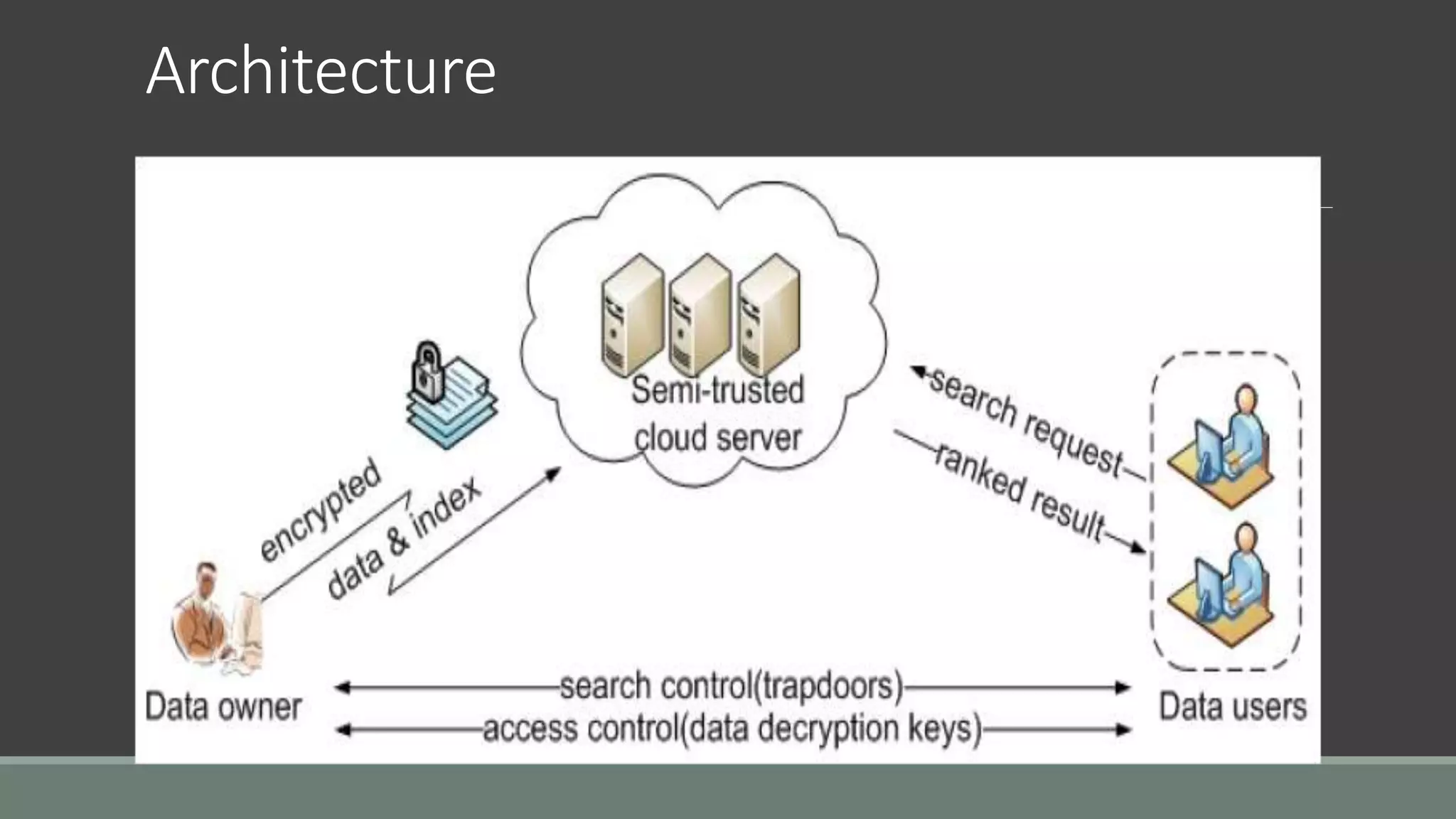
Architecture
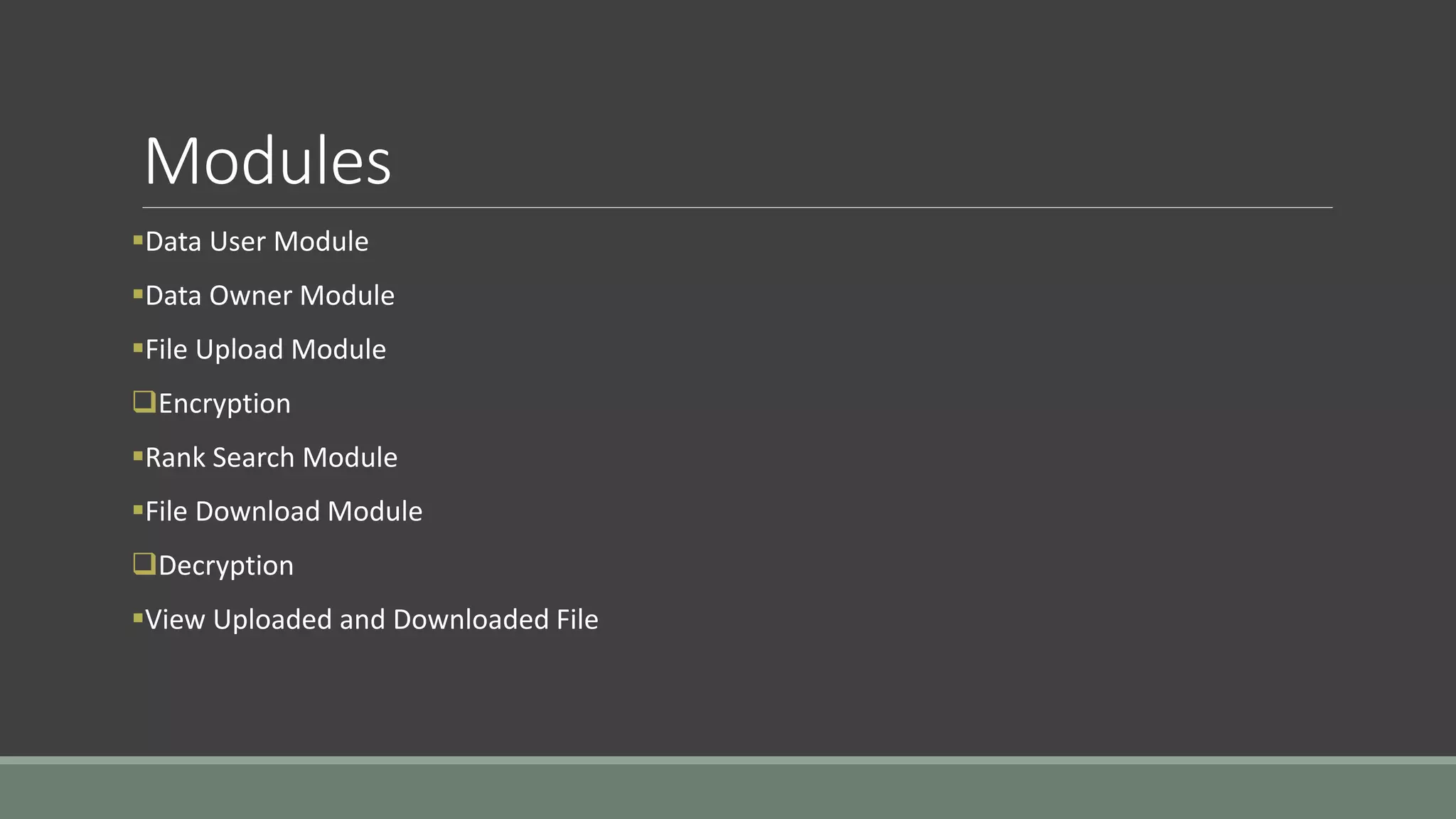
Modules 
Data User Module 
Data Owner Module 
File Upload Module 
Encryption 
Rank Search Module 
File Download Module 
Decryption 
View Uploaded and Downloaded File
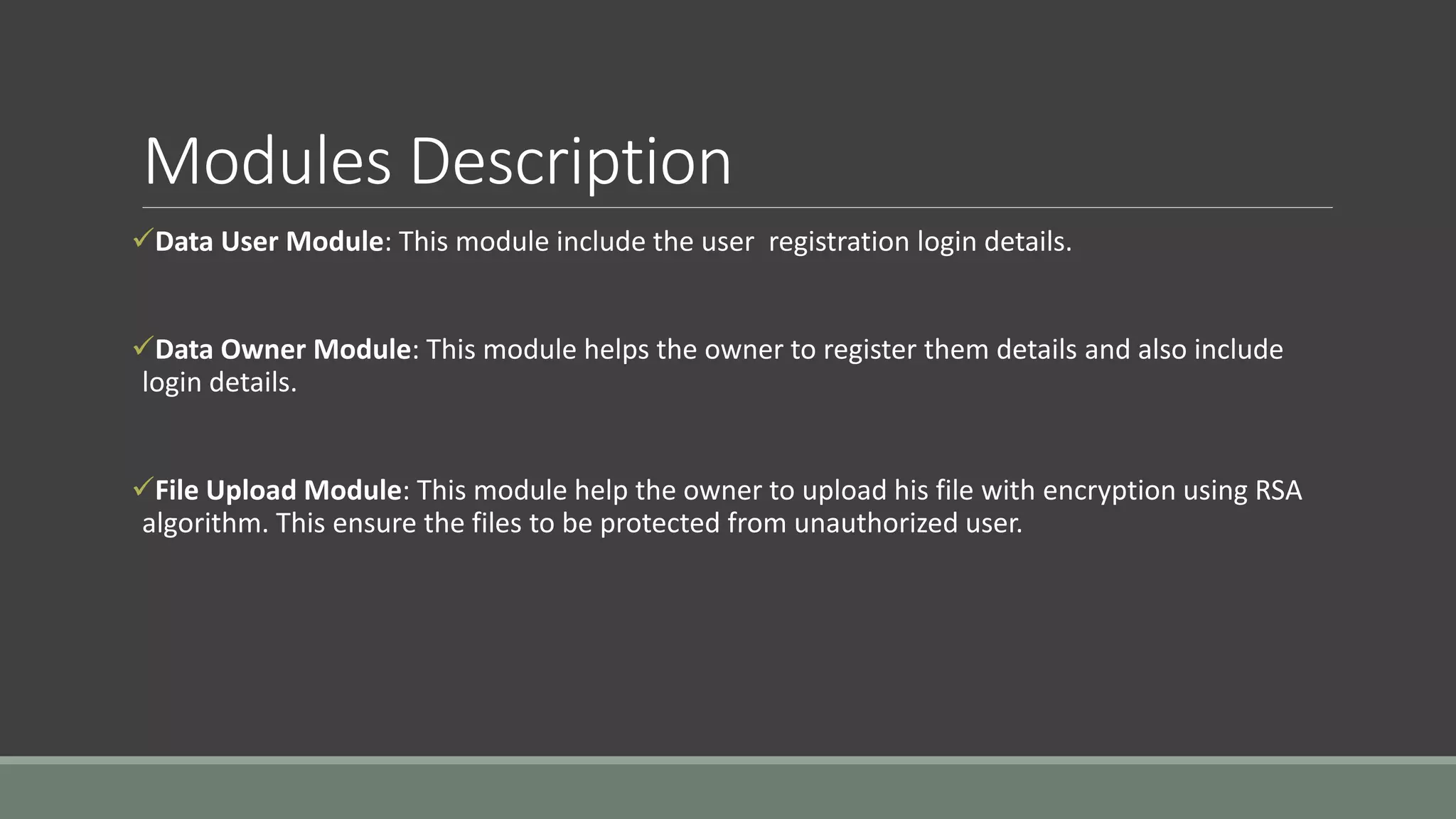
Modules Description 
Data User Module: This module include the user registration login details. 
Data Owner Module: This module helps the owner to register them details and also include 
login details. 
File Upload Module: This module help the owner to upload his file with encryption using RSA 
algorithm. This ensure the files to be protected from unauthorized user.
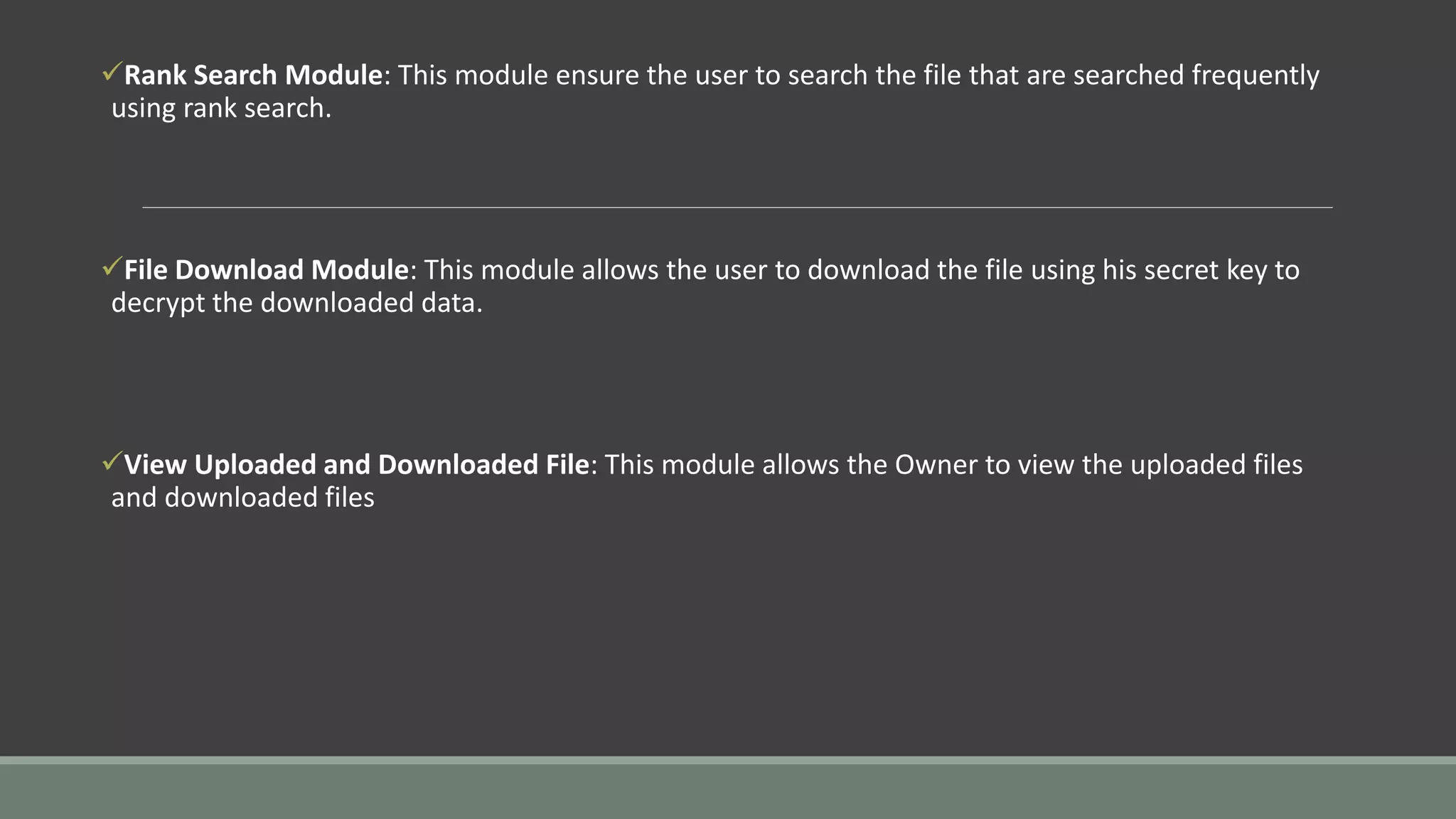
Rank Search Module: This module ensure the user to search the file that are searched frequently 
using rank search. 
File Download Module: This module allows the user to download the file using his secret key to 
decrypt the downloaded data. 
View Uploaded and Downloaded File: This module allows the Owner to view the uploaded files 
and downloaded files
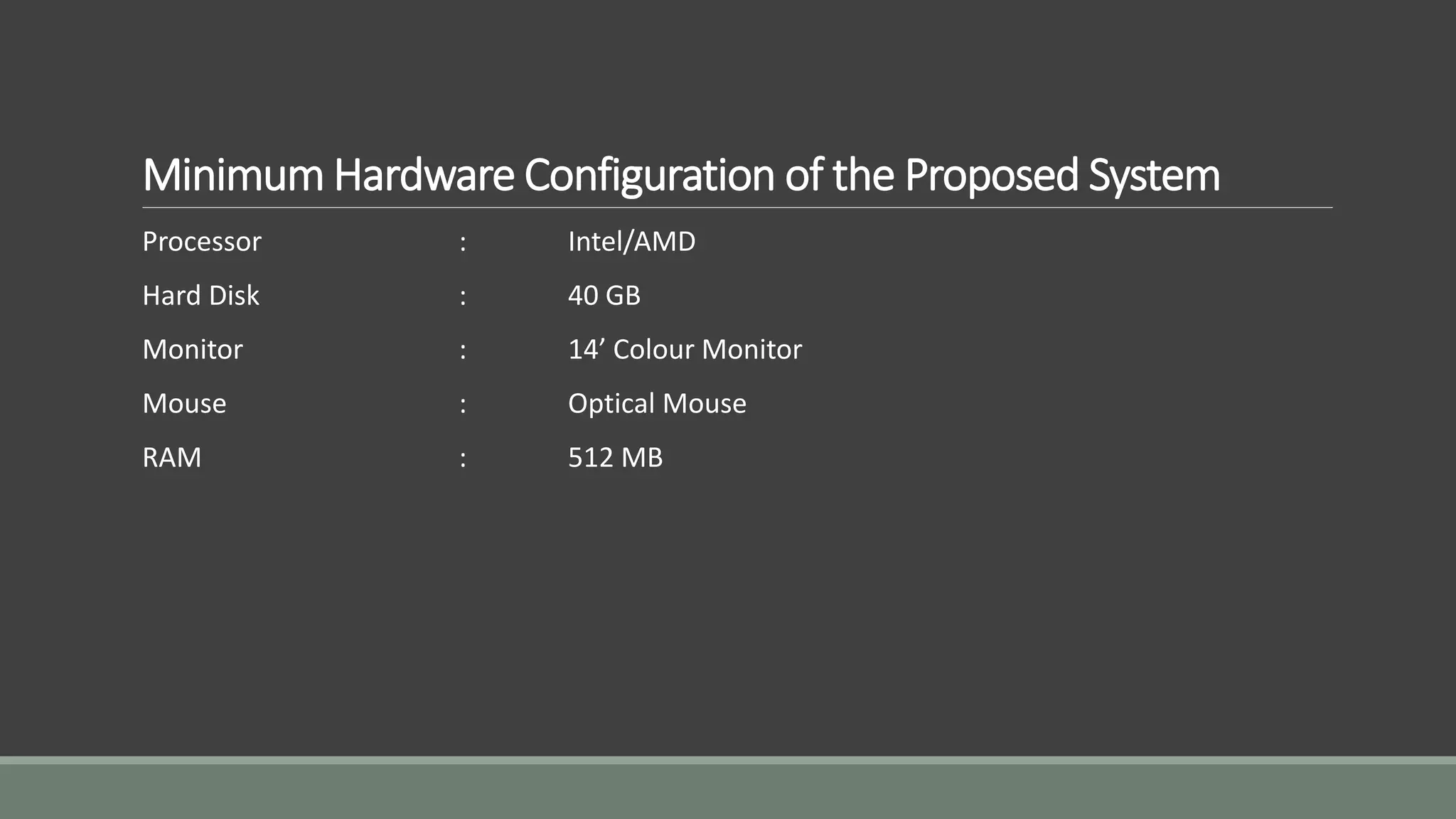
Minimum Hardware Configuration of the Proposed System 
Processor : Intel/AMD 
Hard Disk : 40 GB 
Monitor : 14’ Colour Monitor 
Mouse : Optical Mouse 
RAM : 512 MB
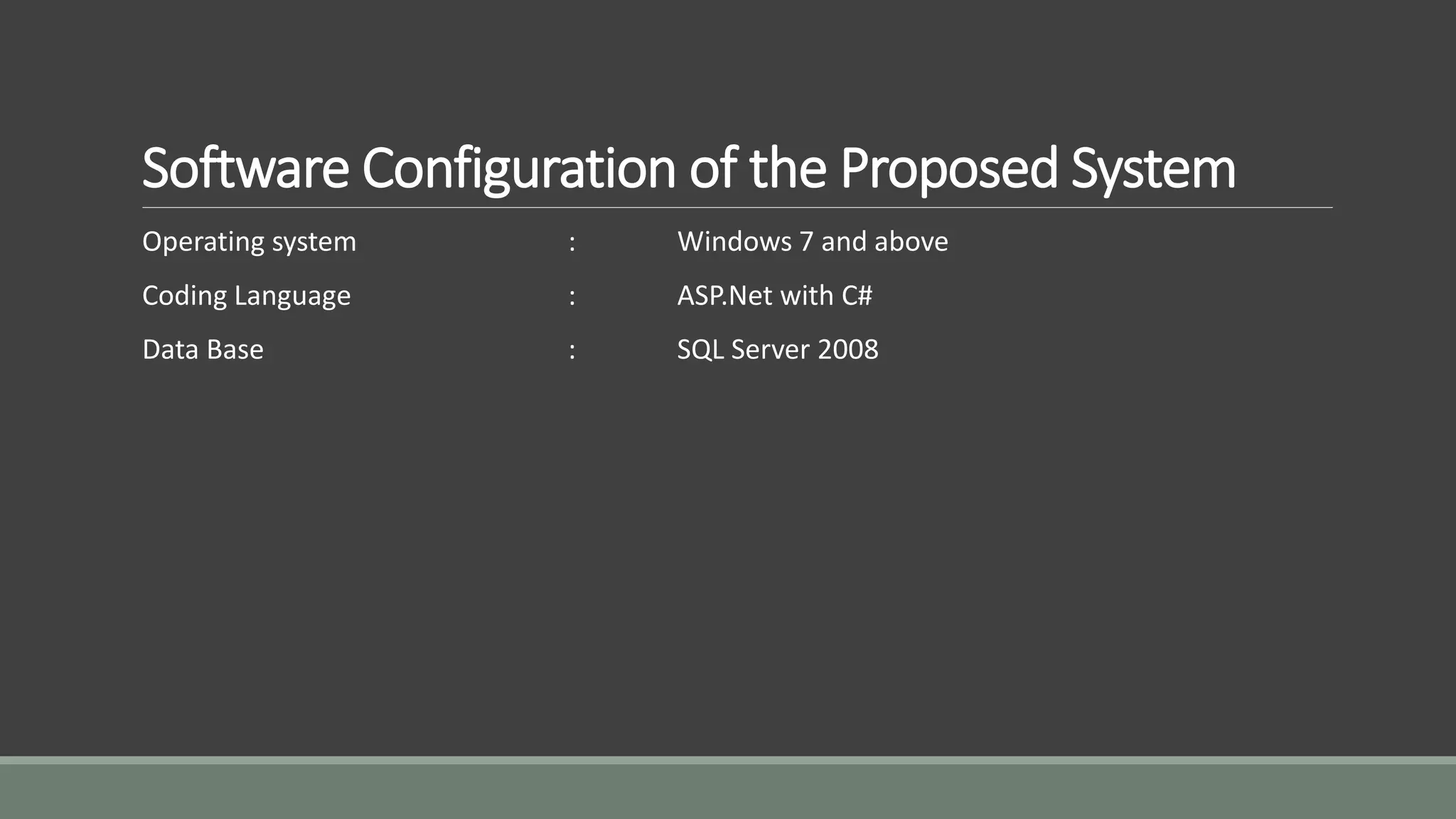
Software Configuration of the Proposed System 
Operating system : Windows 7 and above 
Coding Language : ASP.Net with C# 
Data Base : SQL Server 2008
References 
L. M. Vaquero, L. Rodero-Merino, J. Caceres, and M. Lindner, “A break in the clouds: towards a 
cloud definition,” ACM SIGCOMM Comput. Commun. Rev., vol. 39, no. 1, pp. 50–55, 2009. 
S. Kamara and K. Lauter, “Cryptographic cloud storage,” in RLCPS, January 2010, LNCS. Springer, 
Heidelberg. 
A. Singhal, “Modern information retrieval: A brief overview,” IEEE Data Engineering Bulletin, 
vol. 24, no. 4, pp. 35–43, 2001. 
I. H. Witten, A. Moffat, and T. C. Bell, “Managing gigabytes: Compressing and indexing 
documents and images,” Morgan Kaufmann Publishing, San Francisco, May 1999. 
D. Song, D. Wagner, and A. Perrig, “Practical techniques for searches on encrypted data,” in 
Proc. of S&P, 2000.

Privacy preserving multi-keyword ranked search over encrypted cloud data

  • 1.
    Privacy-Preserving Multi-keyword RankedSearch over Encrypted Cloud Data P R I V A C Y - P R E S E R V I N G M U L T I - K E Y W O R D R A N K E D S E A R C H O V E R E N C R Y P T E D C L O U D D A T A N I N G C A O † , C O N G W A N G ‡ , M I N G L I † , K U I R E N ‡ , A N D W E N J I N G L O U † † D E P A R T M E N T O F E C E , W O R C E S T E R P O L Y T E C H N I C I N S T I T U T E , E M A I L : { N C A O , M I N G L I , W J L O U }@ E C E . W P I . E D U , ‡ D E P A R T M E N T O F E C E , I L L I N O I S I N S T I T U T E O F T E C H N O L O G Y , E M A I L : { C O N G , K R E N }@ E C E . I I T . E D U
  • 2.
    Abstract With theadvent of cloud computing, data owners are motivated to outsource their complex data management systems from local sites to the commercial public cloud for great flexibility and economic savings. But for protecting data privacy, sensitive data has to be encrypted before outsourcing, which obsoletes traditional data utilization based on plaintext keyword search. Thus, enabling an encrypted cloud data search service is of paramount importance. Considering the large number of data users and documents in the cloud, it is necessary to allow multiple keywords in the search request and return documents in the order of their relevance to these keywords. Related works on searchable encryption focus on single keyword search or Boolean keyword search, and rarely sort the search results. In this paper, for the first time, we define and solve the challenging problem of privacy preserving multi-keyword ranked search over encrypted cloud data (MRSE).We establish a set of strict privacy requirements for such a secure cloud data utilization system. Among various multi keyword semantics, we choose the efficient similarity measure of “coordinate matching”, i.e., as many matches as possible, to capture the relevance of data documents to the search query. We further use “inner product similarity” to quantitatively evaluate such similarity measure. We first propose a basic idea for the MRSE based on secure inner product computation, and then give two significantly improved MRSE schemes to achieve various stringent privacy requirements in two different threat models. Thorough analysis investigating privacy and efficiency guarantees of proposed schemes is given. Experiments on the real-world dataset further show proposed schemes indeed introduce low overhead on computation and communication.
  • 3.
    Existing System Thelarge number of data users and documents in cloud, it is crucial for the search service to allow multi-keyword query and provide result similarity ranking to meet the effective data retrieval need. The searchable encryption focuses on single keyword search or Boolean keyword search, and rarely differentiates the search results.
  • 4.
    Disadvantages of ExistingSystem Single-keyword search without ranking Boolean- keyword search without ranking Single-keyword search with ranking
  • 5.
    Proposed System Wedefine and solve the challenging problem of privacy-preserving multi-keyword ranked search over encrypted cloud data (MRSE), and establish a set of strict privacy requirements for such a secure cloud data utilization system to become a reality. Among various multi-keyword semantics, we choose the efficient principle of “coordinate matching”.
  • 6.
    Advantages of ProposedSystem Multi-keyword ranked search over encrypted cloud data (MRSE)
  • 7.
  • 8.
    Modules Data UserModule Data Owner Module File Upload Module Encryption Rank Search Module File Download Module Decryption View Uploaded and Downloaded File
  • 9.
    Modules Description DataUser Module: This module include the user registration login details. Data Owner Module: This module helps the owner to register them details and also include login details. File Upload Module: This module help the owner to upload his file with encryption using RSA algorithm. This ensure the files to be protected from unauthorized user.
  • 10.
    Rank Search Module:This module ensure the user to search the file that are searched frequently using rank search. File Download Module: This module allows the user to download the file using his secret key to decrypt the downloaded data. View Uploaded and Downloaded File: This module allows the Owner to view the uploaded files and downloaded files
  • 11.
    Minimum Hardware Configurationof the Proposed System Processor : Intel/AMD Hard Disk : 40 GB Monitor : 14’ Colour Monitor Mouse : Optical Mouse RAM : 512 MB
  • 12.
    Software Configuration ofthe Proposed System Operating system : Windows 7 and above Coding Language : ASP.Net with C# Data Base : SQL Server 2008
  • 13.
    References L. M.Vaquero, L. Rodero-Merino, J. Caceres, and M. Lindner, “A break in the clouds: towards a cloud definition,” ACM SIGCOMM Comput. Commun. Rev., vol. 39, no. 1, pp. 50–55, 2009. S. Kamara and K. Lauter, “Cryptographic cloud storage,” in RLCPS, January 2010, LNCS. Springer, Heidelberg. A. Singhal, “Modern information retrieval: A brief overview,” IEEE Data Engineering Bulletin, vol. 24, no. 4, pp. 35–43, 2001. I. H. Witten, A. Moffat, and T. C. Bell, “Managing gigabytes: Compressing and indexing documents and images,” Morgan Kaufmann Publishing, San Francisco, May 1999. D. Song, D. Wagner, and A. Perrig, “Practical techniques for searches on encrypted data,” in Proc. of S&P, 2000.