Automated Validation
                           of
Internet Security Protocols and Applications (AVISPA)


       University of Bochum
        Krassen Deltchev
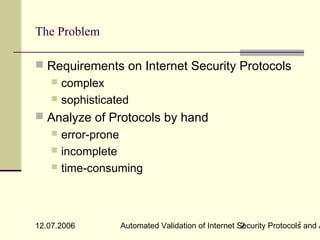
The Problem

 Requirements on Internet Security Protocols
     complex
     sophisticated

 Analyze of Protocols by hand
     error-prone
     incomplete
     time-consuming


                                                                   2
12.07.2006       Automated Validation of Internet Security Protocols and A
                                                   2
Formal Methods for Security Protocol Analysis

 Computational Models
 Formal Models
     Logic-based (e.g., BAN Logic [BAN89] )
     Algebraic-based (e.g., NRL Protocol Analyser)
     Inductive Proofs (Lawrence C. Paulson)
     Model Checking (e.g., AVISPA OFMC)
              Finite-State machines
              Constraint-based


                                                                        3
12.07.2006            Automated Validation of Internet Security Protocols and A
                                                        3
Theoretical approaches : Dolev-Yao Intruder Model

 The Dolev-Yao intruder [DY83]
       Intruder has full controll over the network
       Intruder can play role(s) of (normal) principals
       Intruder cannot break cryptography
       Unsatifying:
           naively enumerates all intruder‘s messages

           leads to enormous branching of the search tree

 Standard Dolev-Yao abstraction lacks
   cryptographic justification
       Some Security Protocols secure in Dolev-Yao
        model, become insecure using some provable crypto-
        primitives

                                                                      4
12.07.2006          Automated Validation of Internet Security Protocols and A
                                                      4
Theoretical approaches: Methodology

 Model Checkers:
   General:
            System behaviour, modelled as a (finite) state transition system
            System properties, expressed by state satisfaction relations
            State space exploration – attack trace
       Safety properties:
            Safety: check, that certain undesirable properties never occur
            Liveness: check, that certain desirable propertis do eventually
             occur
       Verify effective at finding flaws:
            No guarantee for correctness due to ‚artificial‘ finite bounds
            Problem can be probably solved by infinity-state model
             checking; based on symbolic methods and abstractions

                                                                            5
12.07.2006                Automated Validation of Internet Security Protocols and A
                                                            5
Model checkers: Example Implementations

 Maude
       Not exclusively a security protocol model checker
       Instead of, it is an executable specification language, which
        is based on rewriting logic
 Hermes
       check secrecy properties of protocols
       Tested on 15 of the Clark/Jacob library [CJ97]
       Finds attacks on 6 of 8 protocols
 AVISPA
       Uses two languages for protocol specification
       Tested on 46 of 51 protocols of Clark/Jacob library
       Finds attacks on all 32 of the 46 tested protocols


                                                                         6
12.07.2006             Automated Validation of Internet Security Protocols and A
                                                         6
AVISPA
Automated Validation of Internet Security Protocols and Applications


 Developement of automatic analysis
  techniques, based on Model Checking
 Provide tools, capable to solve industrial
  problems
 Compatible to common operating systems
 Web-based Platform independent realisation


    see, http://avispa-project.org/

                                                                              7
12.07.2006                  Automated Validation of Internet Security Protocols and A
                                                              7
AVISPA: Architecture

 HLPSL: High Level Protocol
  Specification Language
 HLPSL2IF: Translator to IF
  Format
 IF: The Intermediate Format
  Language
 Translator to Subtools
       OFMC (On-The-Fly-Model-
        Checker) [MVO05]
       ATSE (CL-based attack
        searcher)
       SATMC (SAT-based Model
        checker)
       TA4SP(Tree Automata-
        based Protocol Analyser)
 OF: The output format

                                                                        8
12.07.2006            Automated Validation of Internet Security Protocols and A
                                                        8
HLPSL
High Level Protocol Specification Language


 Specification
      knowledge required of each agent,
       participating in the protocol
      knowledge and abilities of the intruder
      sequence of messages, required by the
       protocol
      set of sessions (or instantiations) of the
       protocol


                                                                              9
12.07.2006                  Automated Validation of Internet Security Protocols and A
                                                              9
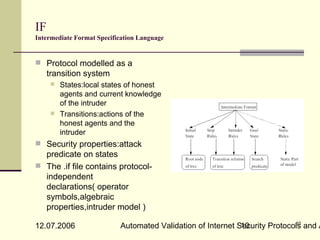
IF
Intermediate Format Specification Language


 Protocol modelled as a
     transition system
         States:local states of honest
          agents and current knowledge
          of the intruder
         Transitions:actions of the
          honest agents and the
          intruder
 Security properties:attack
  predicate on states
 The .if file contains protocol-
  independent
  declarations( operator
  symbols,algebraic
  properties,intruder model )
                                                                            10
12.07.2006                 Automated Validation of Internet Security Protocols and A
                                                             10
Lazy Intruder Model

 represents optimisation search technique
   without excluding any attacks [BMV04]
       exploits the fact, that certain
        parts of the intruder‘s messages are irrelevant
        for the receiver
 Data constructors build data without
  evaluating their arguments
 Allow one to represent and compute with
  infinite data (e.g., streams or infinite
  trees), generating arbitrary prefixes of data on
  demand
                                                                    11
12.07.2006         Automated Validation of Internet Security Protocols and A
                                                     11
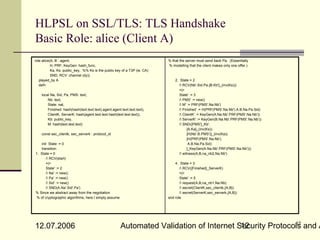
HLPSL on SSL/TLS: TLS Handshake
Basic Role: alice (Client A)
role alice(A, B : agent,                                                   % that the server must send back Pa. (Essentially
           H, PRF, KeyGen: hash_func,                                      % modelling that the client makes only one offer.)
           Ka, Ks: public_key, %% Ks is the public key of a T3P (ie. CA)
           SND, RCV: channel (dy))
   played_by A                                                                 2. State = 2
   def=                                                                           / RCV(Nb'.Sid.Pa.{B.Kb'}_(inv(Ks)))
                                                                                  =|>
    local Na, Sid, Pa, PMS: text,                                                 State' := 3
        Nb: text,                                                                 / PMS' := new()
        State: nat,                                                               / M' := PRF(PMS'.Na.Nb')
        Finished: hash(hash(text.text.text).agent.agent.text.text.text),          / Finished' := H(PRF(PMS'.Na.Nb').A.B.Na.Pa.Sid)
        ClientK, ServerK: hash(agent.text.text.hash(text.text.text)),             / ClientK' := KeyGen(A.Na.Nb'.PRF(PMS'.Na.Nb'))
        Kb: public_key,                                                           / ServerK' := KeyGen(B.Na.Nb'.PRF(PMS'.Na.Nb'))
        M: hash(text.text.text)                                                   / SND({PMS'}_Kb'.
                                                                                        {A.Ka}_(inv(Ks)).
    const sec_clientk, sec_serverk : protocol_id                                        {H(Nb'.B.PMS')}_(inv(Ka)).
                                                                                        {H(PRF(PMS'.Na.Nb').
   init State := 0                                                                       A.B.Na.Pa.Sid)
   transition                                                                           }_KeyGen(A.Na.Nb'.PRF(PMS'.Na.Nb')))
1. State = 0                                                                      / witness(A,B,na_nb2,Na.Nb')
      / RCV(start)
      =|>                                                                      4. State = 3
      State' := 2                                                                 / RCV({Finished}_ServerK)
      / Na' := new()                                                             =|>
      / Pa' := new()                                                             State' := 5
      / Sid' := new()                                                            / request(A,B,na_nb1,Na.Nb)
      / SND(A.Na'.Sid'.Pa')                                                      / secret(ClientK,sec_clientk,{A,B})
% Since we abstract away from the negotiation                                     / secret(ServerK,sec_serverk,{A,B})
 % of cryptographic algorithms, here I simply assume                       end role


                                                                                                         12
12.07.2006                                              Automated Validation of Internet Security Protocols and A
                                                                                          12
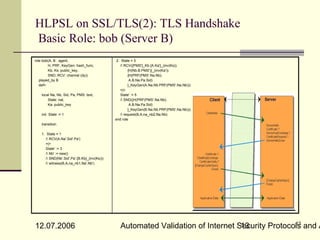
HLPSL on SSL/TLS(2): TLS Handshake
Basic Role: bob (Server B)
role bob(A, B : agent,                          2. State = 3
        H, PRF, KeyGen: hash_func,                 / RCV({PMS'}_Kb.{A.Ka'}_(inv(Ks)).
        Kb, Ks: public_key,                             {H(Nb.B.PMS')}_(inv(Ka')).
        SND, RCV: channel (dy))                         {H(PRF(PMS'.Na.Nb).
   played_by B                                           A.B.Na.Pa.Sid)
   def=                                                 }_KeyGen(A.Na.Nb.PRF(PMS'.Na.Nb)))
                                                   =|>
    local Na, Nb, Sid, Pa, PMS: text,              State' := 5
        State: nat,                                / SND({H(PRF(PMS'.Na.Nb).
        Ka: public_key                                   A.B.Na.Pa.Sid)
                                                        }_KeyGen(B.Na.Nb.PRF(PMS'.Na.Nb)))
    init State := 1                                / request(B,A,na_nb2,Na.Nb)
                                               end role
    transition

    1. State = 1
       / RCV(A.Na'.Sid'.Pa')
       =|>
       State' := 3
       / Nb' := new()
       / SND(Nb'.Sid'.Pa'.{B.Kb}_(inv(Ks)))
       / witness(B,A,na_nb1,Na'.Nb')


                                                                                                  13
12.07.2006                                       Automated Validation of Internet Security Protocols and A
                                                                                   13
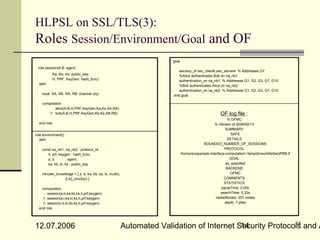
HLPSL on SSL/TLS(3):
Roles Session/Environment/Goal and OF
                                                                          goal
 role session(A,B: agent,
                                                                              secrecy_of sec_clientk,sec_serverk % Addresses G7
             Ka, Kb, Ks: public_key,                                          %Alice authenticates Bob on na_nb1
             H, PRF, KeyGen: hash_func)                                       authentication_on na_nb1 % Addresses G1, G2, G3, G7, G10
  def=                                                                        %Bob authenticates Alice on na_nb2
                                                                              authentication_on na_nb2 % Addresses G1, G2, G3, G7, G10
    local SA, SB, RA, RB: channel (dy)                                     end goal

    composition
           alice(A,B,H,PRF,KeyGen,Ka,Ks,SA,RA)
        / bob(A,B,H,PRF,KeyGen,Kb,Ks,SB,RB)                                                             OF log file :
                                                                                                               % OFMC
  end role                                                                                           % Version of 2006/02/13
                                                                                                             SUMMARY
role environment()                                                                                               SAFE
   def=                                                                                                       DETAILS
                                                                                              BOUNDED_NUMBER_OF_SESSIONS
    const na_nb1, na_nb2 : protocol_id,                                                                     PROTOCOL
       h, prf, keygen : hash_func,                                               /home/avispa/web-interface-computation/./tempdir/workfile5wUPBB.if
       a, b        : agent,                                                                                     GOAL
       ka, kb, ki, ks : public_key                                                                           as_specified
                                                                                                              BACKEND
    intruder_knowledge = { a, b, ka, kb, ks, ki, inv(ki),                                                       OFMC
                  {i.ki}_(inv(ks)) }                                                                        COMMENTS
                                                                                                            STATISTICS
    composition                                                                                            parseTime: 0.00s
        session(a,b,ka,kb,ks,h,prf,keygen)                                                                searchTime: 0.33s
     / session(a,i,ka,ki,ks,h,prf,keygen)                                                            visitedNodes: 201 nodes
     / session(i,b,ki,kb,ks,h,prf,keygen)                                                                   depth: 7 plies
  end role


                                                                                                             14
12.07.2006                                                  Automated Validation of Internet Security Protocols and A
                                                                                              14
Conclusion

 AVISPA tool is still under developement,but shows an
   adequate approach regarding analysing of internet
   security protocols
       especially the implementation of the Lazy-Intruder-Model in the IF-
        Specification and OFMC
       using HLPSL, multisessions can be simulated and well defined
 The AVISPA tool has the following achievements:
       Every protocol can be specified and well modelled in HLPSL and
        dynamically changed / adapted regarding newer security issues
       There is a chance for developing and implementing newer security
        protocols
       Easy-to-use


                                                                         15
12.07.2006              Automated Validation of Internet Security Protocols and A
                                                          15
The End


                 Thank you!


e-mail: Krassen.Deltchev@ruhr-uni-bochum.de
                                                               16
12.07.2006    Automated Validation of Internet Security Protocols and A
                                                16
Automated analysis of Security protocols
References
      [CJ97] John Clark and Jeremy               [MVO05] Automated Validation
       Jacob. A survey of authentication           of Security Protocols(AVASP),
       protocol literature : Version 1.0.,         Mördersheim/Vigano’/Oheimb
       November 1997                               apr. 2005
       http://www-users.cs.york.ac.uk/            [BMV04] OFMC: A symbolic
        jac/papers/drareview.ps.gz                 model checker for security
      [M94] Catherine Meadows: Formal             protocols,
       Verification of Cryptographic               Basin/Mördersheim/Vigano’
       Protocols: A Survey. ASIACRYPT              dec 2004
       1994                                       [BB] Remote Timing Attacks
      [TA02] Servey in Formal Analysis of         are Practical, Brumley/Boneh
       Security Properties of Cryptographic       [CHVV] Password Interception
       Protocols,Tarigan 2002                      in a SSL/TLS Channel,
      [DY83] D. Dolev, A. Yao, On the             Canvel/Hiltgen/Vaudenay/
       Security of Public Key Protocols,           Vuagnoux
       IEEE Trans. on Information Theory,         [KPR] Attacking RSA-based
       1983                                        Sessions in SSL/TLS,
      [BAN89] Michael Burrows, Martin             Klima/Pokorny’/Rosa
       Abadi, and Roger Needham. A logic          [WS] Analysis of the SSL 3.0
       of authentication. Technical                protocol,
       Report 39, Digital Systems                  Wagner/Schneider
       Research Center, february 1989
      [AJ04] Three Tools for Model-
                                                  RFC 2246 "The TLS Protocol
       Checking Security protocols,                Version 1.0" , jan 1999
       Arruda/Juma, jan 2004

                                                                             17
12.07.2006                  Automated Validation of Internet Security Protocols and A
                                                              17

Automated Validation of Internet Security Protocols and Applications (AVISPA) , slides

  • 1.
    Automated Validation of Internet Security Protocols and Applications (AVISPA) University of Bochum Krassen Deltchev
  • 2.
    The Problem  Requirementson Internet Security Protocols  complex  sophisticated  Analyze of Protocols by hand  error-prone  incomplete  time-consuming 2 12.07.2006 Automated Validation of Internet Security Protocols and A 2
  • 3.
    Formal Methods forSecurity Protocol Analysis  Computational Models  Formal Models  Logic-based (e.g., BAN Logic [BAN89] )  Algebraic-based (e.g., NRL Protocol Analyser)  Inductive Proofs (Lawrence C. Paulson)  Model Checking (e.g., AVISPA OFMC)  Finite-State machines  Constraint-based 3 12.07.2006 Automated Validation of Internet Security Protocols and A 3
  • 4.
    Theoretical approaches :Dolev-Yao Intruder Model  The Dolev-Yao intruder [DY83]  Intruder has full controll over the network  Intruder can play role(s) of (normal) principals  Intruder cannot break cryptography  Unsatifying:  naively enumerates all intruder‘s messages  leads to enormous branching of the search tree  Standard Dolev-Yao abstraction lacks cryptographic justification  Some Security Protocols secure in Dolev-Yao model, become insecure using some provable crypto- primitives 4 12.07.2006 Automated Validation of Internet Security Protocols and A 4
  • 5.
    Theoretical approaches: Methodology Model Checkers:  General:  System behaviour, modelled as a (finite) state transition system  System properties, expressed by state satisfaction relations  State space exploration – attack trace  Safety properties:  Safety: check, that certain undesirable properties never occur  Liveness: check, that certain desirable propertis do eventually occur  Verify effective at finding flaws:  No guarantee for correctness due to ‚artificial‘ finite bounds  Problem can be probably solved by infinity-state model checking; based on symbolic methods and abstractions 5 12.07.2006 Automated Validation of Internet Security Protocols and A 5
  • 6.
    Model checkers: ExampleImplementations  Maude  Not exclusively a security protocol model checker  Instead of, it is an executable specification language, which is based on rewriting logic  Hermes  check secrecy properties of protocols  Tested on 15 of the Clark/Jacob library [CJ97]  Finds attacks on 6 of 8 protocols  AVISPA  Uses two languages for protocol specification  Tested on 46 of 51 protocols of Clark/Jacob library  Finds attacks on all 32 of the 46 tested protocols 6 12.07.2006 Automated Validation of Internet Security Protocols and A 6
  • 7.
    AVISPA Automated Validation ofInternet Security Protocols and Applications  Developement of automatic analysis techniques, based on Model Checking  Provide tools, capable to solve industrial problems  Compatible to common operating systems  Web-based Platform independent realisation see, http://avispa-project.org/ 7 12.07.2006 Automated Validation of Internet Security Protocols and A 7
  • 8.
    AVISPA: Architecture  HLPSL:High Level Protocol Specification Language  HLPSL2IF: Translator to IF Format  IF: The Intermediate Format Language  Translator to Subtools  OFMC (On-The-Fly-Model- Checker) [MVO05]  ATSE (CL-based attack searcher)  SATMC (SAT-based Model checker)  TA4SP(Tree Automata- based Protocol Analyser)  OF: The output format 8 12.07.2006 Automated Validation of Internet Security Protocols and A 8
  • 9.
    HLPSL High Level ProtocolSpecification Language  Specification  knowledge required of each agent, participating in the protocol  knowledge and abilities of the intruder  sequence of messages, required by the protocol  set of sessions (or instantiations) of the protocol 9 12.07.2006 Automated Validation of Internet Security Protocols and A 9
  • 10.
    IF Intermediate Format SpecificationLanguage  Protocol modelled as a transition system  States:local states of honest agents and current knowledge of the intruder  Transitions:actions of the honest agents and the intruder  Security properties:attack predicate on states  The .if file contains protocol- independent declarations( operator symbols,algebraic properties,intruder model ) 10 12.07.2006 Automated Validation of Internet Security Protocols and A 10
  • 11.
    Lazy Intruder Model represents optimisation search technique without excluding any attacks [BMV04]  exploits the fact, that certain parts of the intruder‘s messages are irrelevant for the receiver  Data constructors build data without evaluating their arguments  Allow one to represent and compute with infinite data (e.g., streams or infinite trees), generating arbitrary prefixes of data on demand 11 12.07.2006 Automated Validation of Internet Security Protocols and A 11
  • 12.
    HLPSL on SSL/TLS:TLS Handshake Basic Role: alice (Client A) role alice(A, B : agent, % that the server must send back Pa. (Essentially H, PRF, KeyGen: hash_func, % modelling that the client makes only one offer.) Ka, Ks: public_key, %% Ks is the public key of a T3P (ie. CA) SND, RCV: channel (dy)) played_by A 2. State = 2 def= / RCV(Nb'.Sid.Pa.{B.Kb'}_(inv(Ks))) =|> local Na, Sid, Pa, PMS: text, State' := 3 Nb: text, / PMS' := new() State: nat, / M' := PRF(PMS'.Na.Nb') Finished: hash(hash(text.text.text).agent.agent.text.text.text), / Finished' := H(PRF(PMS'.Na.Nb').A.B.Na.Pa.Sid) ClientK, ServerK: hash(agent.text.text.hash(text.text.text)), / ClientK' := KeyGen(A.Na.Nb'.PRF(PMS'.Na.Nb')) Kb: public_key, / ServerK' := KeyGen(B.Na.Nb'.PRF(PMS'.Na.Nb')) M: hash(text.text.text) / SND({PMS'}_Kb'. {A.Ka}_(inv(Ks)). const sec_clientk, sec_serverk : protocol_id {H(Nb'.B.PMS')}_(inv(Ka)). {H(PRF(PMS'.Na.Nb'). init State := 0 A.B.Na.Pa.Sid) transition }_KeyGen(A.Na.Nb'.PRF(PMS'.Na.Nb'))) 1. State = 0 / witness(A,B,na_nb2,Na.Nb') / RCV(start) =|> 4. State = 3 State' := 2 / RCV({Finished}_ServerK) / Na' := new() =|> / Pa' := new() State' := 5 / Sid' := new() / request(A,B,na_nb1,Na.Nb) / SND(A.Na'.Sid'.Pa') / secret(ClientK,sec_clientk,{A,B}) % Since we abstract away from the negotiation / secret(ServerK,sec_serverk,{A,B}) % of cryptographic algorithms, here I simply assume end role 12 12.07.2006 Automated Validation of Internet Security Protocols and A 12
  • 13.
    HLPSL on SSL/TLS(2):TLS Handshake Basic Role: bob (Server B) role bob(A, B : agent, 2. State = 3 H, PRF, KeyGen: hash_func, / RCV({PMS'}_Kb.{A.Ka'}_(inv(Ks)). Kb, Ks: public_key, {H(Nb.B.PMS')}_(inv(Ka')). SND, RCV: channel (dy)) {H(PRF(PMS'.Na.Nb). played_by B A.B.Na.Pa.Sid) def= }_KeyGen(A.Na.Nb.PRF(PMS'.Na.Nb))) =|> local Na, Nb, Sid, Pa, PMS: text, State' := 5 State: nat, / SND({H(PRF(PMS'.Na.Nb). Ka: public_key A.B.Na.Pa.Sid) }_KeyGen(B.Na.Nb.PRF(PMS'.Na.Nb))) init State := 1 / request(B,A,na_nb2,Na.Nb) end role transition 1. State = 1 / RCV(A.Na'.Sid'.Pa') =|> State' := 3 / Nb' := new() / SND(Nb'.Sid'.Pa'.{B.Kb}_(inv(Ks))) / witness(B,A,na_nb1,Na'.Nb') 13 12.07.2006 Automated Validation of Internet Security Protocols and A 13
  • 14.
    HLPSL on SSL/TLS(3): RolesSession/Environment/Goal and OF goal role session(A,B: agent, secrecy_of sec_clientk,sec_serverk % Addresses G7 Ka, Kb, Ks: public_key, %Alice authenticates Bob on na_nb1 H, PRF, KeyGen: hash_func) authentication_on na_nb1 % Addresses G1, G2, G3, G7, G10 def= %Bob authenticates Alice on na_nb2 authentication_on na_nb2 % Addresses G1, G2, G3, G7, G10 local SA, SB, RA, RB: channel (dy) end goal composition alice(A,B,H,PRF,KeyGen,Ka,Ks,SA,RA) / bob(A,B,H,PRF,KeyGen,Kb,Ks,SB,RB) OF log file : % OFMC end role % Version of 2006/02/13 SUMMARY role environment() SAFE def= DETAILS BOUNDED_NUMBER_OF_SESSIONS const na_nb1, na_nb2 : protocol_id, PROTOCOL h, prf, keygen : hash_func, /home/avispa/web-interface-computation/./tempdir/workfile5wUPBB.if a, b : agent, GOAL ka, kb, ki, ks : public_key as_specified BACKEND intruder_knowledge = { a, b, ka, kb, ks, ki, inv(ki), OFMC {i.ki}_(inv(ks)) } COMMENTS STATISTICS composition parseTime: 0.00s session(a,b,ka,kb,ks,h,prf,keygen) searchTime: 0.33s / session(a,i,ka,ki,ks,h,prf,keygen) visitedNodes: 201 nodes / session(i,b,ki,kb,ks,h,prf,keygen) depth: 7 plies end role 14 12.07.2006 Automated Validation of Internet Security Protocols and A 14
  • 15.
    Conclusion  AVISPA toolis still under developement,but shows an adequate approach regarding analysing of internet security protocols  especially the implementation of the Lazy-Intruder-Model in the IF- Specification and OFMC  using HLPSL, multisessions can be simulated and well defined  The AVISPA tool has the following achievements:  Every protocol can be specified and well modelled in HLPSL and dynamically changed / adapted regarding newer security issues  There is a chance for developing and implementing newer security protocols  Easy-to-use 15 12.07.2006 Automated Validation of Internet Security Protocols and A 15
  • 16.
    The End Thank you! e-mail: Krassen.Deltchev@ruhr-uni-bochum.de 16 12.07.2006 Automated Validation of Internet Security Protocols and A 16
  • 17.
    Automated analysis ofSecurity protocols References  [CJ97] John Clark and Jeremy  [MVO05] Automated Validation Jacob. A survey of authentication of Security Protocols(AVASP), protocol literature : Version 1.0., Mördersheim/Vigano’/Oheimb November 1997 apr. 2005 http://www-users.cs.york.ac.uk/  [BMV04] OFMC: A symbolic jac/papers/drareview.ps.gz model checker for security  [M94] Catherine Meadows: Formal protocols, Verification of Cryptographic Basin/Mördersheim/Vigano’ Protocols: A Survey. ASIACRYPT dec 2004 1994  [BB] Remote Timing Attacks  [TA02] Servey in Formal Analysis of are Practical, Brumley/Boneh Security Properties of Cryptographic  [CHVV] Password Interception Protocols,Tarigan 2002 in a SSL/TLS Channel,  [DY83] D. Dolev, A. Yao, On the Canvel/Hiltgen/Vaudenay/ Security of Public Key Protocols, Vuagnoux IEEE Trans. on Information Theory,  [KPR] Attacking RSA-based 1983 Sessions in SSL/TLS,  [BAN89] Michael Burrows, Martin Klima/Pokorny’/Rosa Abadi, and Roger Needham. A logic  [WS] Analysis of the SSL 3.0 of authentication. Technical protocol, Report 39, Digital Systems Wagner/Schneider Research Center, february 1989  [AJ04] Three Tools for Model-  RFC 2246 "The TLS Protocol Checking Security protocols, Version 1.0" , jan 1999 Arruda/Juma, jan 2004 17 12.07.2006 Automated Validation of Internet Security Protocols and A 17