SEMINAR
ON
CAPSULE CAMERA
INTRODUCTION
♦ Patients can now swallow pill-sized, disposable

cameras
♦ This new esophageal capsule endoscope is a
smooth plastic capsule about the size of a large
vitamin pill that has tiny video cameras at each
end.
♦ The pill takes about 2,600 color pictures, which
are transmitted to a recording device worn by the
patient.
♦ The disposable capsule is passed naturally,
usually within 24 hours.
EVOLUTION
♦ The technology available to doctors has evolved

dramatically over the past 40 years.
♦ Basic endoscopy was introduced in the late 1960s,
and about 20 years later, ultrasound was added,
enabling us to look at internal GI structures as
never before.
♦ Now, with EUS, we can determine the extent to
which tumors in the esophagus, stomach,
pancreas, or rectum have spread in a less invasive
way.
♦ One technology that has been available for about
30 years is Endoscopic Retrograde Cholangio
pancreatography (ERCP).
USES OF ERCP:
• ERCP's is used to place stents within bile ducts,

remove difficult bile duct stones, and obtain
biopsy samples.
• Used in motility treatment.
• Motility is the movement of food from one

place to another along the digestive tract.
ASSOCIATED TECHNOLOGIES
• Passive capsule observation endoscopes

•
•
•
•
•
•

compact low-power consumption imaging
technology.
 compact low-power consumption wireless
transmission technology.
Capsule guidance system
Wireless power supply system
Drug delivery system
Body fluid sampling technology
Self-propelled capsule
Ultrasound capsule
TECHNOLOGY
♦ Ultra-Low-Power Wireless Technology is Used

in Swallowable Camera Capsule.

♦ improvement of the signal-to-noise ratio (SNR)

in CMOS detectors,

♦ development of white LEDs, and development

of application-specific integrated circuits
(ASICs).

♦ CMOS detectors have active pixel resolutions

that provide comparable performance to CCDs,
while drawing less power than CCDs
EXAMPLES
• Mrs.Judy Shuhala, a retired school teacher,

had Gastritis,an inflammation of the stomach
lining.
• Mr.Norman Cullen, a 76-year-old Bay Area

resident, Suffering from an undetected GI
bleed.
MARKET VIEW
♦ 01 August 2001Physicians and patients in the

European Union, the United States of America,
Australia, and Israel will now be able to benefit
from a new medical technology .
♦ The Israeli company Given Imaging Ltd., which

manufactures the diagnostic system, has
received official approval to market the video
capsule to physicians within European Union
countries.
♦ the United States Food and Drug Administration

(FDA) cleared the marketing of the cameracapsule in the U.S.
♦ The system is also currently being used in

clinical trials in Belgium, France, Germany, Italy,
and Spain.
♦ The Given system will be available to doctors in

selected markets within 90 days of placing an
order.
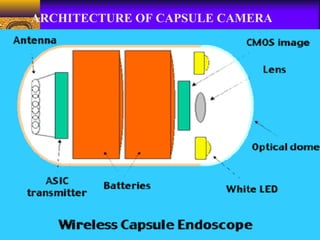
ARCHITECTURE OF CAPSULE CAMERA
♦ The M2A capsule consists of a microchip camera,

light emitting diodes that act as flash, an antenna,
two 1.5 V silver oxide batteries and Zarlink's RF
transmitter chip .
♦ The RF transmitter chip is manufactured in
0.35µm CMOS technology
♦ It re-quires a voltage of 2.6 to 3.2 V and transmits
on a 403, 432 or 434 MHz carrier
♦ This allows a data rate of 2,700 kbit/s over a distance of 1 m while having a power consumption of
5.2 MW.
♦ All this is run by two ultra low-power silver

oxide batteries that will operate for 6-8 hours.
♦ weighs 3.5 grams and can display a 140° field of

view of the patients insides at 1:8 magnification.
♦ This information is then transmitted via an array

of sensors secured to the abdomen, to the Data
Recorder affixed to a belt worn around the
patient's waist.
♦ The silver oxide batteries in the capsule power

the CMOS detector, as well as the LEDs and
transmitter.

♦ white-light LEDs are important because

pathologists distinguish diseased tissue by color.

♦ The developers provided a novel optical design

that uses a wide-angle lens over the imager, and
manages to integrate both the LEDs and imager
under one dome while handling stray light and
reflections.
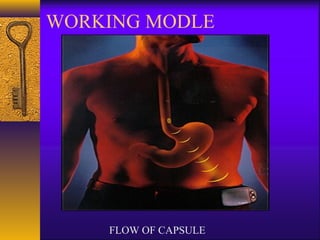
WORKING MODLE

FLOW OF CAPSULE
UTILITIES
♦ Eliminates Procrastination
♦ Views the Entire GI Tract
♦ Traditional endoscopy can view only the upper GI

tract.
♦ Earliest Cancer Detection
♦ Advances Treatment of Irritable Bowel Capsule

endoscopy
APPLICATION DOMAIN
♦ Capsule Endoscopy :

Patient has to swallow a vitamin pill
sized video capsule as an endoscope.
Capsule Endoscopy helps the doctor to determine
the cause for:~
♦ Recurrent abdominal pain
♦
Diarrhea
♦
Bleeding
♦
Anemia
♦ It is useful to detect small bowel tumors
♦ Patients who are on medications for joint

pains etc.
♦ Inflammatory bowel diseases
♦ Irritable bowel
♦ To monitor the therapeutic effects
How should the patient prepare himself or herself
for the study?
♦ Patient will be given written instructions the day

before.
♦ An empty stomach allows better visualization (10
hrs before the examination).
♦ The doctor will inform the time of fasting.
♦ If the patient is on medications inform the doctor.
♦ Cardiac patients have to inform about pace
makers & other devices.
♦ Patient can eat ,4 hrs after ingestion of the
capsule.
RESEARCH AND DEVELOPMENT
SCOPE
• The torpedo-shaped capsule can provide more
than five hours of real-color images.
• The patient need not be in a hospital or clinic

during this time

• The images are transmitted from the capsule using

UHF signals to an antenna array attached to the
patient (much like an ECG test).
♦ The data indicate where in the abdomen the

capsule was at the time.
♦ These promote greater efficiency in medical

institutions and help improve quality of life for
the patients.
♦ Gastrointestinal endoscopes are now recognized

as the only medical devices that can
simultaneously perform observations, diagnoses
(tissue extraction), and treatment.
CONVERGENCE OF TECHNOLOGY
The different technologies used are:
• Telemedicine.
• Electronics.
• Information Technology.
MATHEMATICAL SUPPORT
♦ In an FDA-organized trial conducted in New York, the
♦ Given Imaging Diagnostic System 12 patients, or 60

percent
♦ push enterosc
♦ opy 7 of 20 patients, or 35 percent.

In total, 14 lesions were detected
♦ The Given Imaging Diagnostic System 12 of the 14
lesions, or 86 percent,
♦ push enteroscopy 7 out of 14, or 50 percent.
♦ The FDA also noted that the Given system was able to
identify sources of bleeding in five cases which were
beyond the reach of the traditional enteroscope.
DERIVATION OF RESULTS

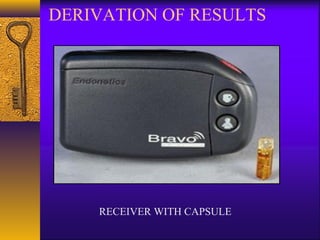
RECEIVER WITH CAPSULE
CONCLUSION
♦ Endoscopy is the most common diagnostic tool

for GI problems; however, the endoscope is not
long enough to view the entire small intestine.

♦ If the patient’s problem lies further down the

intestinal tract, it’s more difficult for the
physician to diagnose and treat.

♦ Now amazing new technology—a wireless,

allowable video capsule— allows physicians to
capture images of the small intestine with no pain
to the patient.
♦ The capsule’s greatest benefit is its ability to

survey the entire GI tract, possibly eliminating
the need for further diagnostic studies.
♦ the Given system is user-friendly and painless,
allowing patients to return to work on the same
day of ingestion
♦ it increases accuracy when compared to some
other endoscopic devices.
♦ this product may also offer cost savings by
reducing the number of diagnostic tests
required to obtain an accurate diagnosis.
FUTURE OF TECHNOLOGY
♦ At this time, the capsule is not a replacement for

colonoscopy.

♦ Photodynamic therapy is one of the new

treatments that will soon be available to patients
with certain types of Barrett's esophagus or GI
tumors.

♦ hotodynamic therapy uses lasers to destroy the

precancerous esophagus cells (identified by a
photosensitive chemical marker), but leaves
normal cells alone.
THANK YOU

Capsule camera

  • 1.
  • 2.
    INTRODUCTION ♦ Patients cannow swallow pill-sized, disposable cameras ♦ This new esophageal capsule endoscope is a smooth plastic capsule about the size of a large vitamin pill that has tiny video cameras at each end. ♦ The pill takes about 2,600 color pictures, which are transmitted to a recording device worn by the patient. ♦ The disposable capsule is passed naturally, usually within 24 hours.
  • 3.
    EVOLUTION ♦ The technologyavailable to doctors has evolved dramatically over the past 40 years. ♦ Basic endoscopy was introduced in the late 1960s, and about 20 years later, ultrasound was added, enabling us to look at internal GI structures as never before. ♦ Now, with EUS, we can determine the extent to which tumors in the esophagus, stomach, pancreas, or rectum have spread in a less invasive way. ♦ One technology that has been available for about 30 years is Endoscopic Retrograde Cholangio pancreatography (ERCP).
  • 4.
    USES OF ERCP: •ERCP's is used to place stents within bile ducts, remove difficult bile duct stones, and obtain biopsy samples. • Used in motility treatment. • Motility is the movement of food from one place to another along the digestive tract.
  • 5.
    ASSOCIATED TECHNOLOGIES • Passivecapsule observation endoscopes • • • • • • compact low-power consumption imaging technology.  compact low-power consumption wireless transmission technology. Capsule guidance system Wireless power supply system Drug delivery system Body fluid sampling technology Self-propelled capsule Ultrasound capsule
  • 6.
    TECHNOLOGY ♦ Ultra-Low-Power WirelessTechnology is Used in Swallowable Camera Capsule. ♦ improvement of the signal-to-noise ratio (SNR) in CMOS detectors, ♦ development of white LEDs, and development of application-specific integrated circuits (ASICs). ♦ CMOS detectors have active pixel resolutions that provide comparable performance to CCDs, while drawing less power than CCDs
  • 7.
    EXAMPLES • Mrs.Judy Shuhala,a retired school teacher, had Gastritis,an inflammation of the stomach lining. • Mr.Norman Cullen, a 76-year-old Bay Area resident, Suffering from an undetected GI bleed.
  • 8.
    MARKET VIEW ♦ 01August 2001Physicians and patients in the European Union, the United States of America, Australia, and Israel will now be able to benefit from a new medical technology . ♦ The Israeli company Given Imaging Ltd., which manufactures the diagnostic system, has received official approval to market the video capsule to physicians within European Union countries.
  • 9.
    ♦ the UnitedStates Food and Drug Administration (FDA) cleared the marketing of the cameracapsule in the U.S. ♦ The system is also currently being used in clinical trials in Belgium, France, Germany, Italy, and Spain. ♦ The Given system will be available to doctors in selected markets within 90 days of placing an order.
  • 10.
  • 11.
    ♦ The M2Acapsule consists of a microchip camera, light emitting diodes that act as flash, an antenna, two 1.5 V silver oxide batteries and Zarlink's RF transmitter chip . ♦ The RF transmitter chip is manufactured in 0.35µm CMOS technology ♦ It re-quires a voltage of 2.6 to 3.2 V and transmits on a 403, 432 or 434 MHz carrier ♦ This allows a data rate of 2,700 kbit/s over a distance of 1 m while having a power consumption of 5.2 MW.
  • 12.
    ♦ All thisis run by two ultra low-power silver oxide batteries that will operate for 6-8 hours. ♦ weighs 3.5 grams and can display a 140° field of view of the patients insides at 1:8 magnification. ♦ This information is then transmitted via an array of sensors secured to the abdomen, to the Data Recorder affixed to a belt worn around the patient's waist.
  • 13.
    ♦ The silveroxide batteries in the capsule power the CMOS detector, as well as the LEDs and transmitter. ♦ white-light LEDs are important because pathologists distinguish diseased tissue by color. ♦ The developers provided a novel optical design that uses a wide-angle lens over the imager, and manages to integrate both the LEDs and imager under one dome while handling stray light and reflections.
  • 14.
  • 15.
    UTILITIES ♦ Eliminates Procrastination ♦Views the Entire GI Tract ♦ Traditional endoscopy can view only the upper GI tract. ♦ Earliest Cancer Detection ♦ Advances Treatment of Irritable Bowel Capsule endoscopy
  • 16.
    APPLICATION DOMAIN ♦ CapsuleEndoscopy : Patient has to swallow a vitamin pill sized video capsule as an endoscope. Capsule Endoscopy helps the doctor to determine the cause for:~ ♦ Recurrent abdominal pain ♦ Diarrhea ♦ Bleeding ♦ Anemia
  • 17.
    ♦ It isuseful to detect small bowel tumors ♦ Patients who are on medications for joint pains etc. ♦ Inflammatory bowel diseases ♦ Irritable bowel ♦ To monitor the therapeutic effects
  • 18.
    How should thepatient prepare himself or herself for the study? ♦ Patient will be given written instructions the day before. ♦ An empty stomach allows better visualization (10 hrs before the examination). ♦ The doctor will inform the time of fasting. ♦ If the patient is on medications inform the doctor. ♦ Cardiac patients have to inform about pace makers & other devices. ♦ Patient can eat ,4 hrs after ingestion of the capsule.
  • 19.
    RESEARCH AND DEVELOPMENT SCOPE •The torpedo-shaped capsule can provide more than five hours of real-color images. • The patient need not be in a hospital or clinic during this time • The images are transmitted from the capsule using UHF signals to an antenna array attached to the patient (much like an ECG test).
  • 20.
    ♦ The dataindicate where in the abdomen the capsule was at the time. ♦ These promote greater efficiency in medical institutions and help improve quality of life for the patients. ♦ Gastrointestinal endoscopes are now recognized as the only medical devices that can simultaneously perform observations, diagnoses (tissue extraction), and treatment.
  • 21.
    CONVERGENCE OF TECHNOLOGY Thedifferent technologies used are: • Telemedicine. • Electronics. • Information Technology.
  • 22.
    MATHEMATICAL SUPPORT ♦ Inan FDA-organized trial conducted in New York, the ♦ Given Imaging Diagnostic System 12 patients, or 60 percent ♦ push enterosc ♦ opy 7 of 20 patients, or 35 percent. In total, 14 lesions were detected ♦ The Given Imaging Diagnostic System 12 of the 14 lesions, or 86 percent, ♦ push enteroscopy 7 out of 14, or 50 percent. ♦ The FDA also noted that the Given system was able to identify sources of bleeding in five cases which were beyond the reach of the traditional enteroscope.
  • 23.
  • 24.
    CONCLUSION ♦ Endoscopy isthe most common diagnostic tool for GI problems; however, the endoscope is not long enough to view the entire small intestine. ♦ If the patient’s problem lies further down the intestinal tract, it’s more difficult for the physician to diagnose and treat. ♦ Now amazing new technology—a wireless, allowable video capsule— allows physicians to capture images of the small intestine with no pain to the patient.
  • 25.
    ♦ The capsule’sgreatest benefit is its ability to survey the entire GI tract, possibly eliminating the need for further diagnostic studies. ♦ the Given system is user-friendly and painless, allowing patients to return to work on the same day of ingestion ♦ it increases accuracy when compared to some other endoscopic devices. ♦ this product may also offer cost savings by reducing the number of diagnostic tests required to obtain an accurate diagnosis.
  • 26.
    FUTURE OF TECHNOLOGY ♦At this time, the capsule is not a replacement for colonoscopy. ♦ Photodynamic therapy is one of the new treatments that will soon be available to patients with certain types of Barrett's esophagus or GI tumors. ♦ hotodynamic therapy uses lasers to destroy the precancerous esophagus cells (identified by a photosensitive chemical marker), but leaves normal cells alone.
  • 27.