HOW DOES
PROJECTORS WORK?


   By-PRADEEP Kr. SHARMA
WHAT IS A PROJECTOR ?

 It’s an electronic device used to project rays
  of light, esp. an apparatus with a system of
  lenses for projecting images or film onto a
  screen.
TYPES OF PROJECTORS
 There are three main types of projectors:-
1. CRT(Cathode Ray Tube)
2. LCD(Liquid Cristal Display)
3. DLP(Digital Light Processing)


*NOTE- A latest technology LCOS (Liquid Crystal On
  Silicon) has entered into the picture which is
  considered as a more recent variant of the LCD
  technology.
HOW DOES A PROJECTOR WORK
 CRT Projectors-:

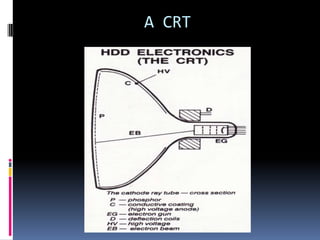
 A CRT, fires a beam of electrons at a phosphor-
  coated screen.
 Every time an electron comes into contact with the
  screen, that point, called a pixel, glows.
 Color CRT use three electron beams and separate
  phosphors for red, green and blue.
 Traditional CRT TV sets are called direct-view
  displays as When you watch, you're looking directly
  at the surface that the TV uses to create the picture
A CRT
LCD Projectors
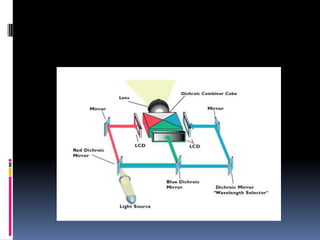
 At the centre of the projector is a halogen bulb,
    which is surrounded by three LCD panels.
   These panels produce light.
   As the halogen bulb heats up, the crystals melt
    and allow more light to pass through.
   Images travel to the tube present inside the
    projector from the DVD player or the satellite box.
   These images hit a surface coated with phosphor.

                                           Contd…
LCD Projectors
 Every fragment of light hitting the screen is called
  as , PIXEL.
 On hitting the screen, the pixel breaks down into
  its color component, ie- is red, blue or green.
 The heat produced by the halogen bulb is
  controlled by the voltage that flows into the LCD
  video projector.
 The 3 LCD panels can produce more than sixteen
  million colors, depending upon the voltage, that
  flows into the LCD video projector, this is what
  enables us to view all the subtle colors of a sunset.
LCD Projectors

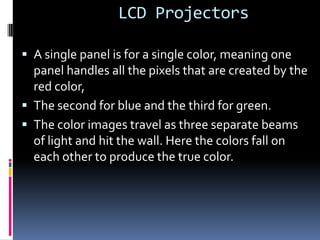
 A single panel is for a single color, meaning one
  panel handles all the pixels that are created by the
  red color,
 The second for blue and the third for green.
 The color images travel as three separate beams
  of light and hit the wall. Here the colors fall on
  each other to produce the true color.
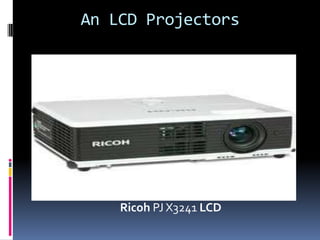
An LCD Projectors


    Ricoh PJ X3241 LCD
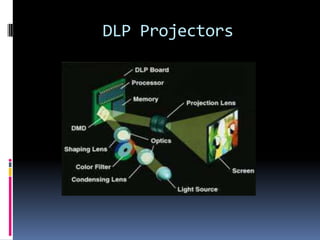
DLP Projectors
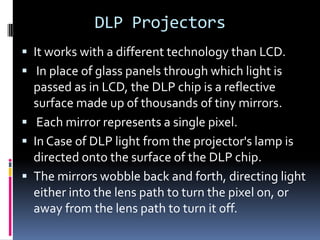
 It works with a different technology than LCD.
 In place of glass panels through which light is
  passed as in LCD, the DLP chip is a reflective
  surface made up of thousands of tiny mirrors.
 Each mirror represents a single pixel.
 In Case of DLP light from the projector's lamp is
  directed onto the surface of the DLP chip.
 The mirrors wobble back and forth, directing light
  either into the lens path to turn the pixel on, or
  away from the lens path to turn it off.
DLP Projectors
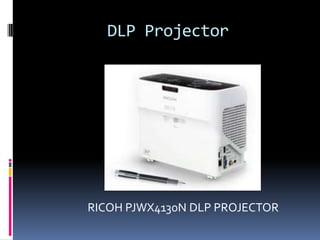
DLP Projector


RICOH PJWX4130N DLP PROJECTOR
LCOS Projector

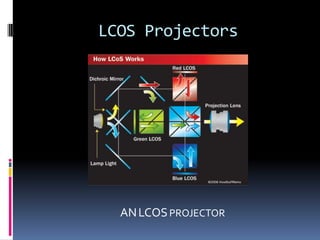
 Just like LCD the LCOS also uses 3 panels of
  Red, Blue & Green;
 However, However, Lcos uses reflexive
  technology as opposed to transmissive;
 LCOS ,allows the pixel structure of LCoS
  projectors to be much less visible than the
  competition (virtually invisible at normal
  seating distance).
 This provides a remedy for "screen door" and
  "rainbow" effects.
LCOS Projectors


  AN LCOS PROJECTOR
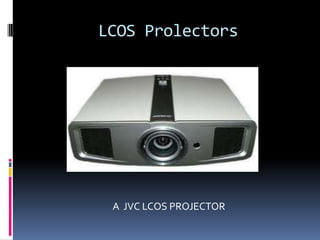
LCOS Prolectors


 A JVC LCOS PROJECTOR
How does a projector works

How does a projector works

  • 1.
    HOW DOES PROJECTORS WORK? By-PRADEEP Kr. SHARMA
  • 2.
    WHAT IS APROJECTOR ?  It’s an electronic device used to project rays of light, esp. an apparatus with a system of lenses for projecting images or film onto a screen.
  • 3.
    TYPES OF PROJECTORS There are three main types of projectors:- 1. CRT(Cathode Ray Tube) 2. LCD(Liquid Cristal Display) 3. DLP(Digital Light Processing) *NOTE- A latest technology LCOS (Liquid Crystal On Silicon) has entered into the picture which is considered as a more recent variant of the LCD technology.
  • 4.
    HOW DOES APROJECTOR WORK  CRT Projectors-:  A CRT, fires a beam of electrons at a phosphor- coated screen.  Every time an electron comes into contact with the screen, that point, called a pixel, glows.  Color CRT use three electron beams and separate phosphors for red, green and blue.  Traditional CRT TV sets are called direct-view displays as When you watch, you're looking directly at the surface that the TV uses to create the picture
  • 5.
  • 6.
    LCD Projectors  Atthe centre of the projector is a halogen bulb, which is surrounded by three LCD panels.  These panels produce light.  As the halogen bulb heats up, the crystals melt and allow more light to pass through.  Images travel to the tube present inside the projector from the DVD player or the satellite box.  These images hit a surface coated with phosphor. Contd…
  • 7.
    LCD Projectors  Everyfragment of light hitting the screen is called as , PIXEL.  On hitting the screen, the pixel breaks down into its color component, ie- is red, blue or green.  The heat produced by the halogen bulb is controlled by the voltage that flows into the LCD video projector.  The 3 LCD panels can produce more than sixteen million colors, depending upon the voltage, that flows into the LCD video projector, this is what enables us to view all the subtle colors of a sunset.
  • 8.
    LCD Projectors  Asingle panel is for a single color, meaning one panel handles all the pixels that are created by the red color,  The second for blue and the third for green.  The color images travel as three separate beams of light and hit the wall. Here the colors fall on each other to produce the true color.
  • 10.
    An LCD Projectors Ricoh PJ X3241 LCD
  • 11.
    DLP Projectors  Itworks with a different technology than LCD.  In place of glass panels through which light is passed as in LCD, the DLP chip is a reflective surface made up of thousands of tiny mirrors.  Each mirror represents a single pixel.  In Case of DLP light from the projector's lamp is directed onto the surface of the DLP chip.  The mirrors wobble back and forth, directing light either into the lens path to turn the pixel on, or away from the lens path to turn it off.
  • 12.
  • 13.
  • 14.
    LCOS Projector  Justlike LCD the LCOS also uses 3 panels of Red, Blue & Green;  However, However, Lcos uses reflexive technology as opposed to transmissive;  LCOS ,allows the pixel structure of LCoS projectors to be much less visible than the competition (virtually invisible at normal seating distance).  This provides a remedy for "screen door" and "rainbow" effects.
  • 15.
    LCOS Projectors AN LCOS PROJECTOR
  • 16.
    LCOS Prolectors AJVC LCOS PROJECTOR