The Relational Model

Shriram Desai,
ramraodesai1991@gmail.com
7411001044
Why Relational Model?
 Currently


Vendors: Oracle, Microsoft, IBM

 Older


models still used

IBM’s IMS (hierarchical model)

 Recent


the most widely used

competitions

Object Oriented Model: ObjectStore

 Implementation



standard for relational Model

SQL (Structured Query Language)
SQL 3: includes object-relational extensions
Relational Model


Structures



Relations (also called Tables)
Attributes (also called Columns or Fields)
 Note:



Every attribute is simple (not composite or
multi-valued)
Constraints




Key and Foreign Key constraints (More constraints later)

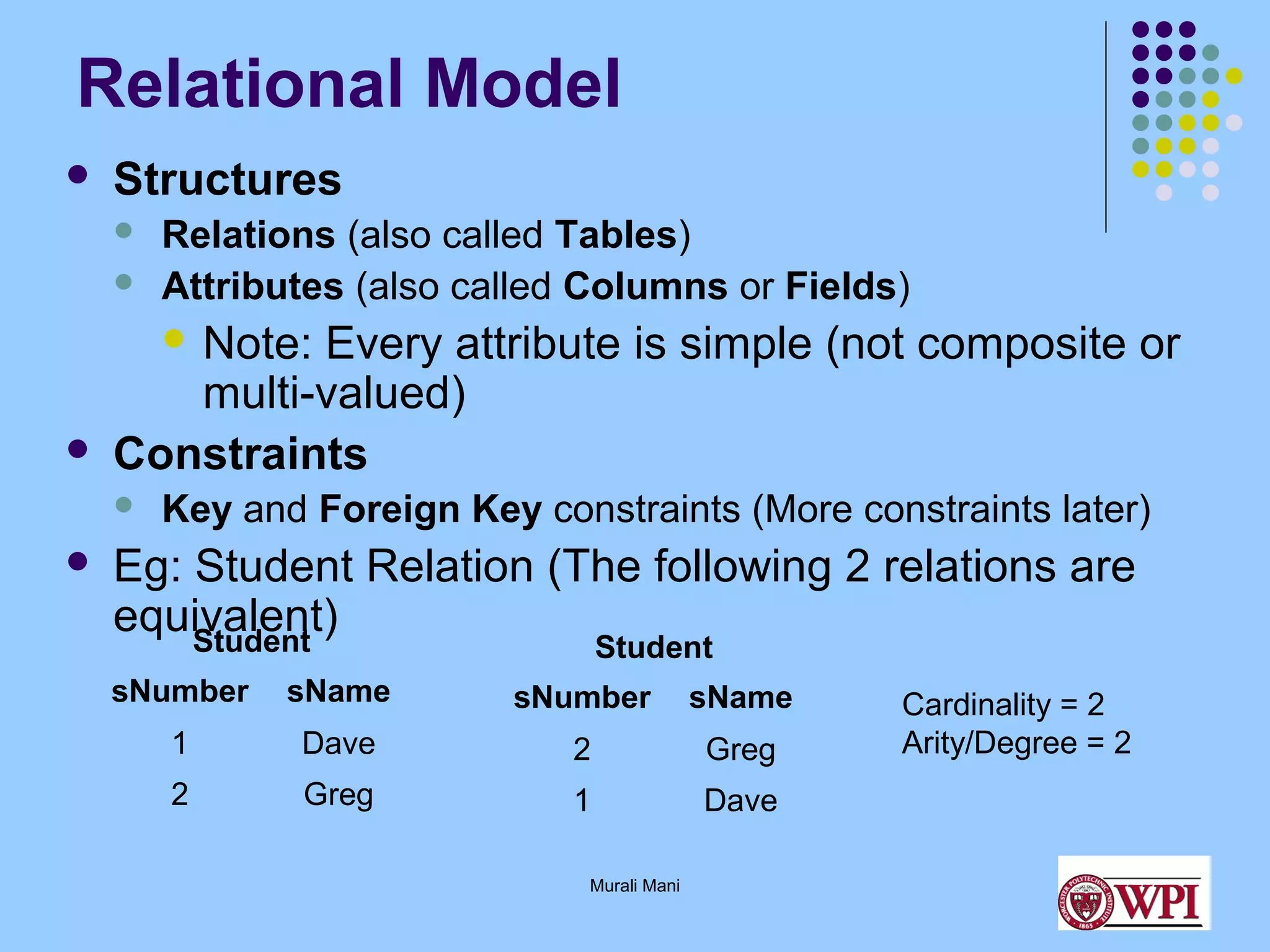
Eg: Student Relation (The following 2 relations are
equivalent)
Student
Student

sNumber

sName

sNumber

sName

1

Dave

2

Greg

2

Greg

1

Dave

Murali Mani

Cardinality = 2
Arity/Degree = 2
Relational Model
 Schema



Eg: Student (sNumber, sName)
PRIMARY KEY (Student) = <sNumber>

 Schema


for a database

Schemas for all relations in the database

 Tuples


for a relation

(Rows)

The set of rows in a relation are the tuples of that
relation

 Note:

Attribute values may be null
Murali Mani
Primary Key Constraints
A



set of attributes is a key for a relation if:
No two distinct tuples can have the same values
in all key fields
A proper subset of the key attributes is not a key.

 Superkey:

A proper subset of a superkey
may be a superkey
 If multiple keys, one of them is chosen to be
the primary key.
 Eg: PRIMARY KEY (Student) = <sNumber>
 Primary key attributes cannot take null values
Murali Mani
Candidate Keys (SQL: Unique)
 Keys

that are not primary keys are candidate

keys.
 Specified in SQL using UNIQUE
 Attribute of unique key may have null values !
 Eg: Student (sNumber, sName)
PRIMARY KEY (Student) = <sNumber>
CANDIDATE KEY (Student) = <sName>
Murali Mani
Violation of key constraints
A

relation violates a primary key constraint if:



There is a row with null values for any attribute of
primary key.
(or) There are 2 rows with same values for all
attributes of primary key



 Consider

R (a, b) where a is unique. R
violates the unique constraint if all of the
following are true


2 rows in R have the same non-null values for a
Murali Mani
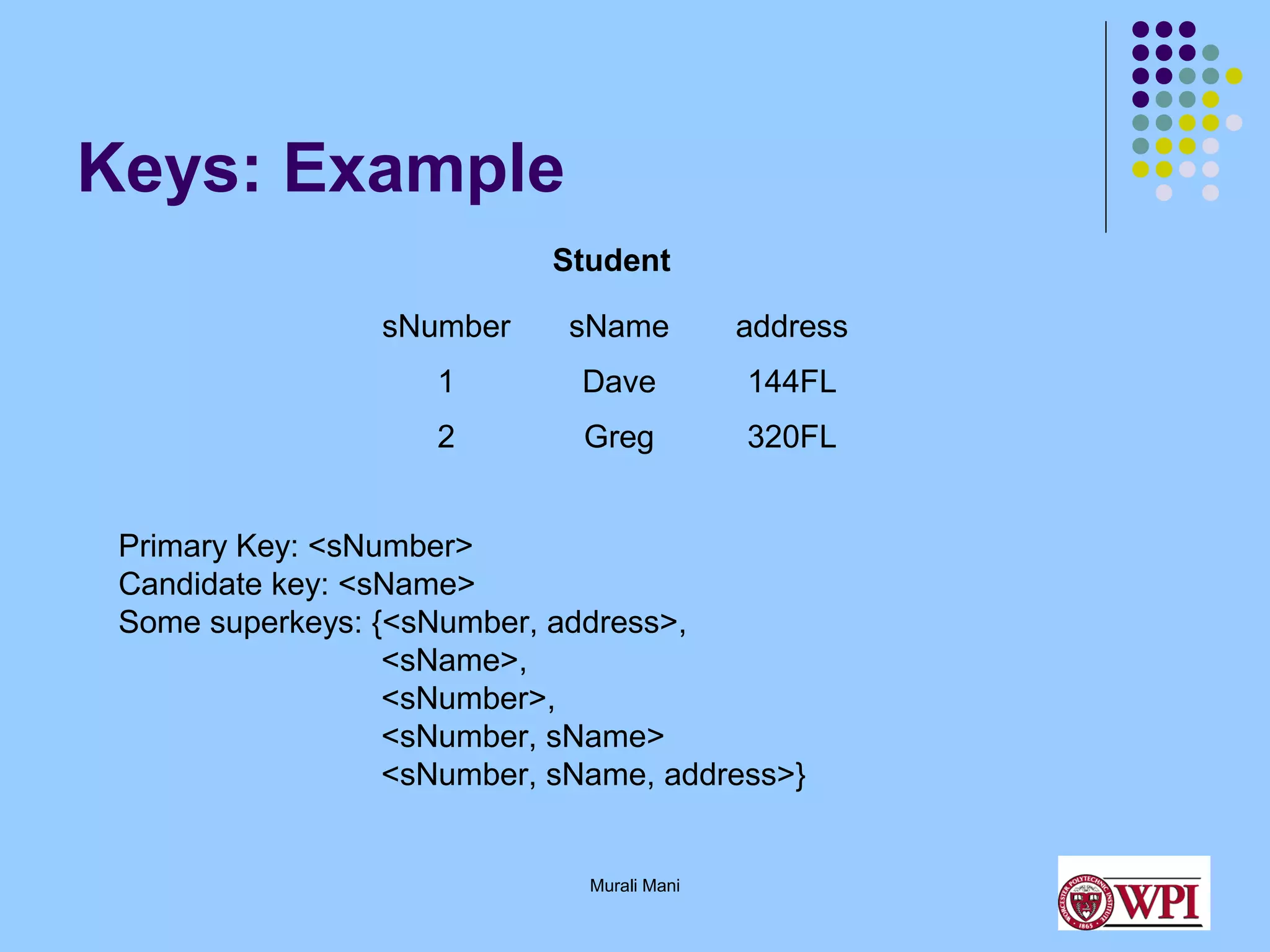
Keys: Example
Student
sNumber

sName

address

1

Dave

144FL

2

Greg

320FL

Primary Key: <sNumber>
Candidate key: <sName>
Some superkeys: {<sNumber, address>,
<sName>,
<sNumber>,
<sNumber, sName>
<sNumber, sName, address>}

Murali Mani
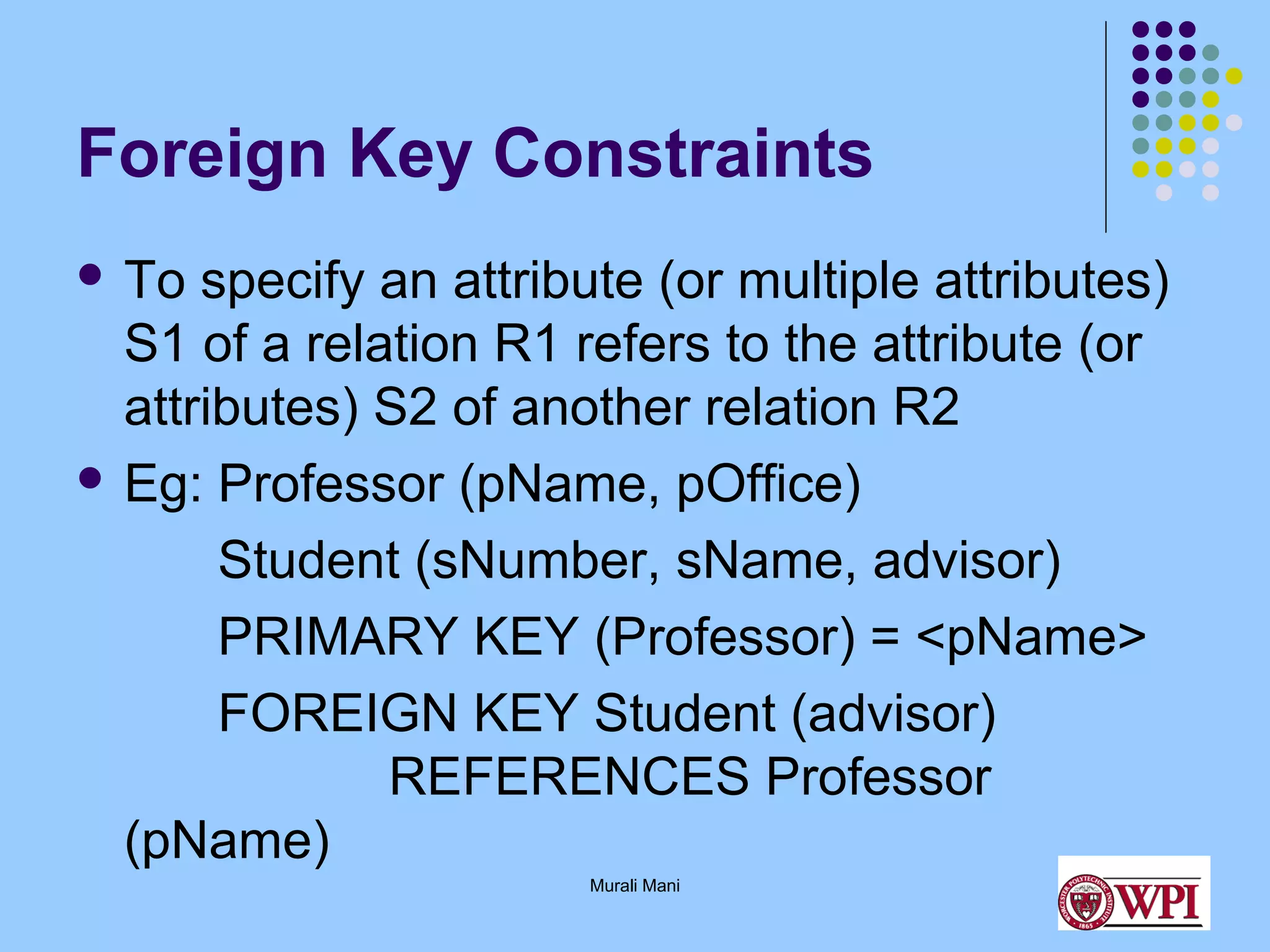
Foreign Key Constraints
 To

specify an attribute (or multiple attributes)
S1 of a relation R1 refers to the attribute (or
attributes) S2 of another relation R2
 Eg: Professor (pName, pOffice)
Student (sNumber, sName, advisor)
PRIMARY KEY (Professor) = <pName>
FOREIGN KEY Student (advisor)
REFERENCES Professor
(pName)
Murali Mani
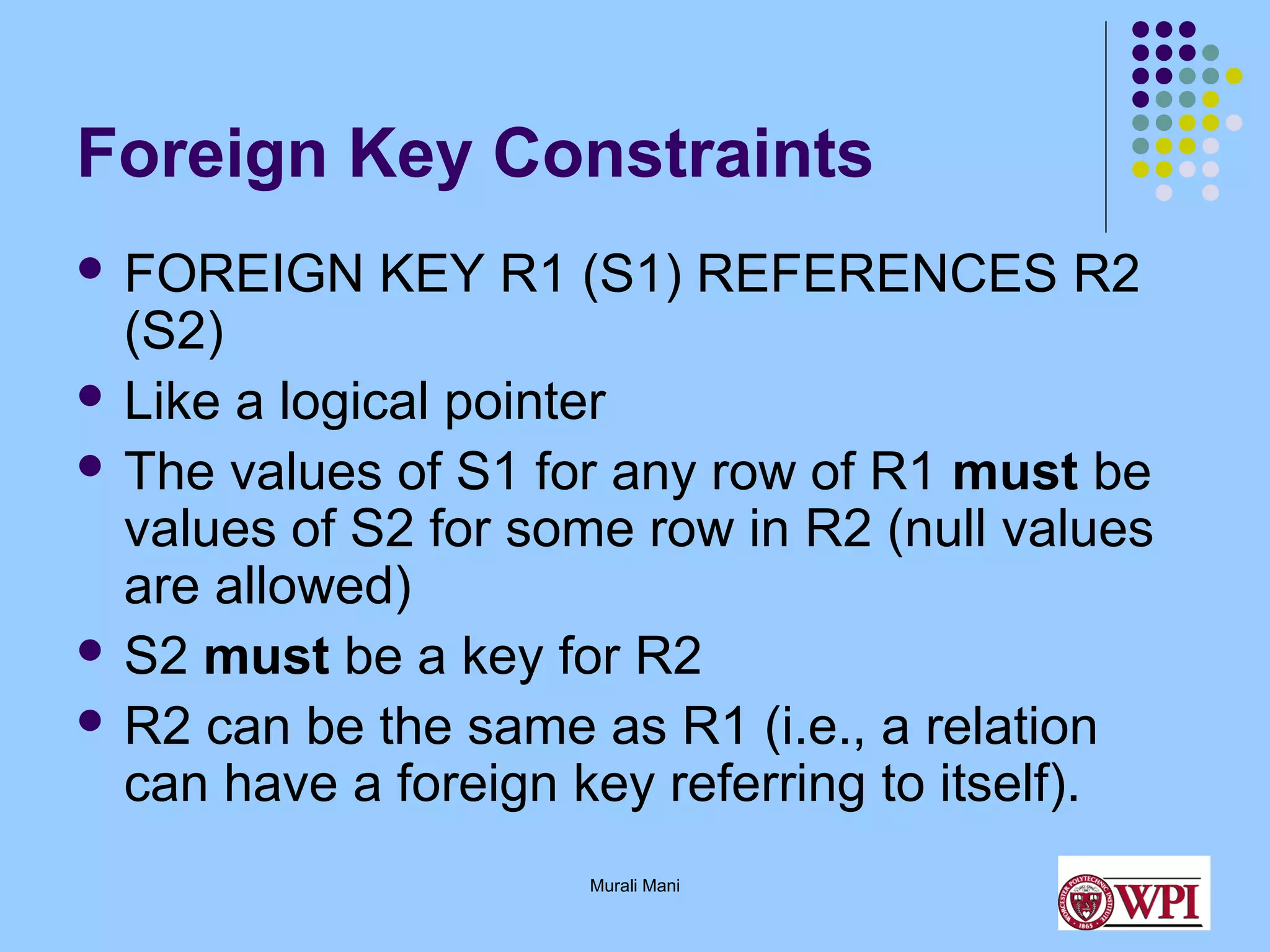
Foreign Key Constraints
 FOREIGN

KEY R1 (S1) REFERENCES R2

(S2)
 Like a logical pointer
 The values of S1 for any row of R1 must be
values of S2 for some row in R2 (null values
are allowed)
 S2 must be a key for R2
 R2 can be the same as R1 (i.e., a relation
can have a foreign key referring to itself).
Murali Mani
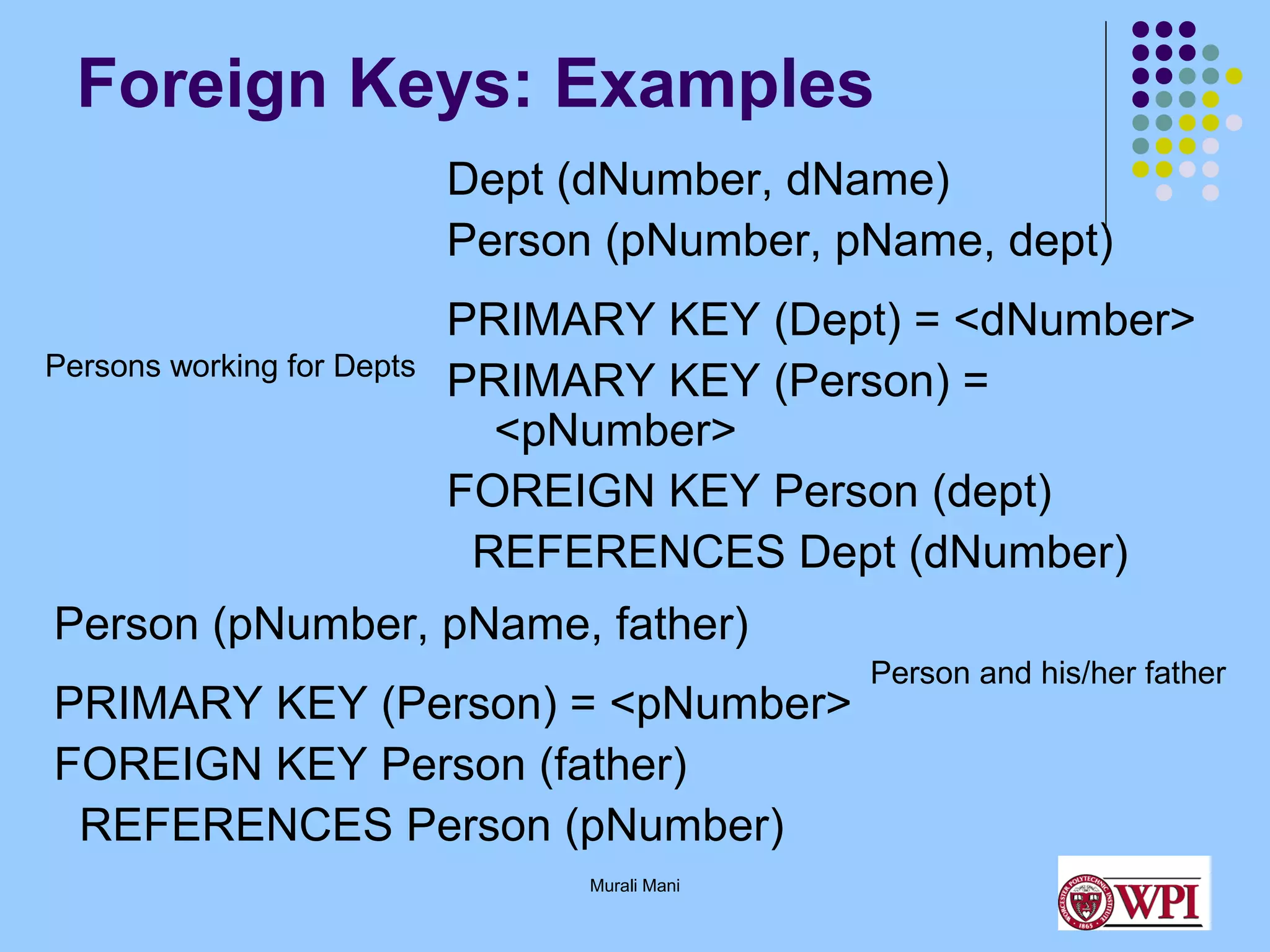
Foreign Keys: Examples
Dept (dNumber, dName)
Person (pNumber, pName, dept)
Persons working for Depts

PRIMARY KEY (Dept) = <dNumber>
PRIMARY KEY (Person) =
<pNumber>
FOREIGN KEY Person (dept)
REFERENCES Dept (dNumber)

Person (pNumber, pName, father)
PRIMARY KEY (Person) = <pNumber>
FOREIGN KEY Person (father)
REFERENCES Person (pNumber)
Murali Mani

Person and his/her father
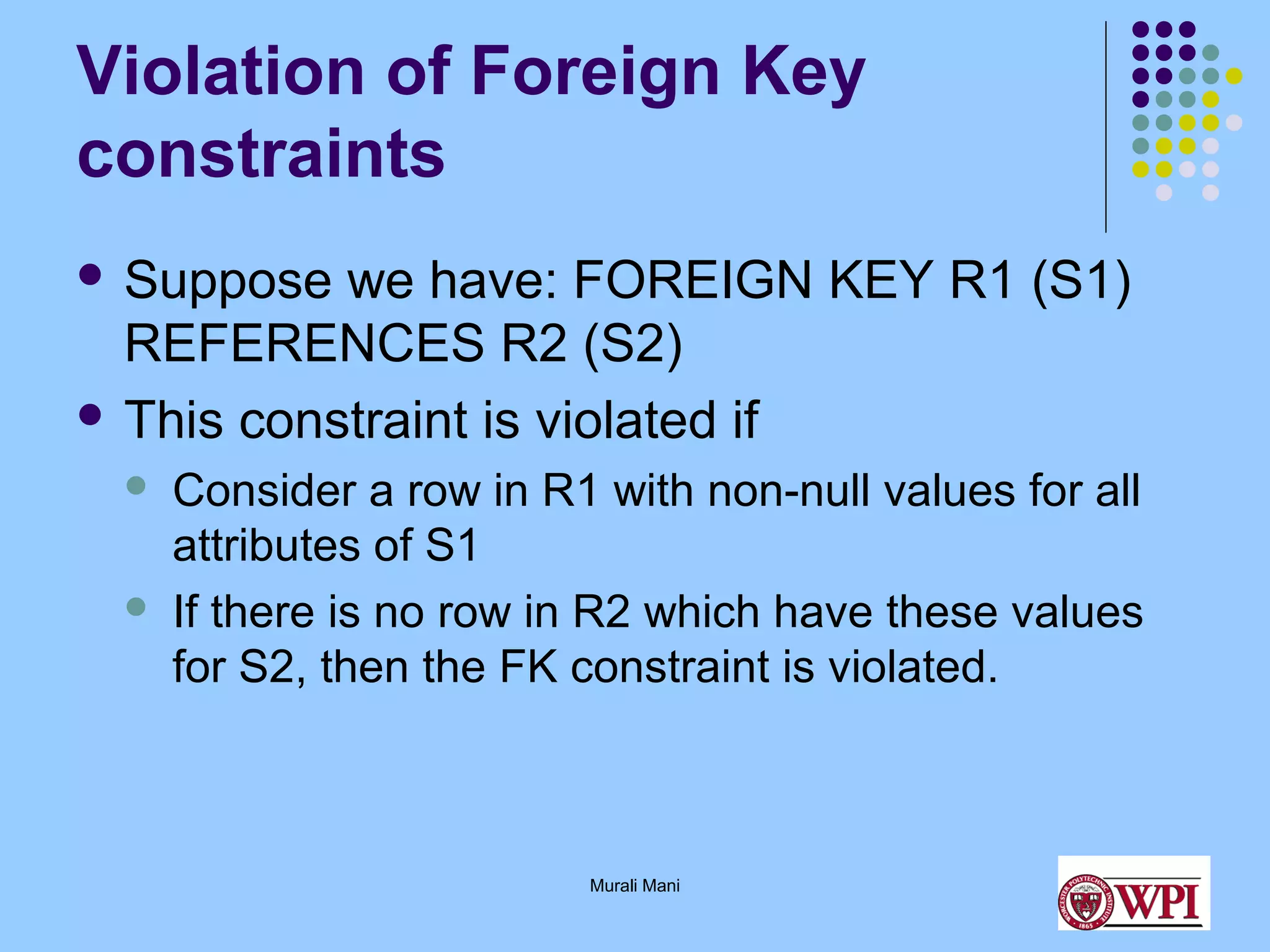
Violation of Foreign Key
constraints
 Suppose

we have: FOREIGN KEY R1 (S1)
REFERENCES R2 (S2)
 This constraint is violated if




Consider a row in R1 with non-null values for all
attributes of S1
If there is no row in R2 which have these values
for S2, then the FK constraint is violated.

Murali Mani
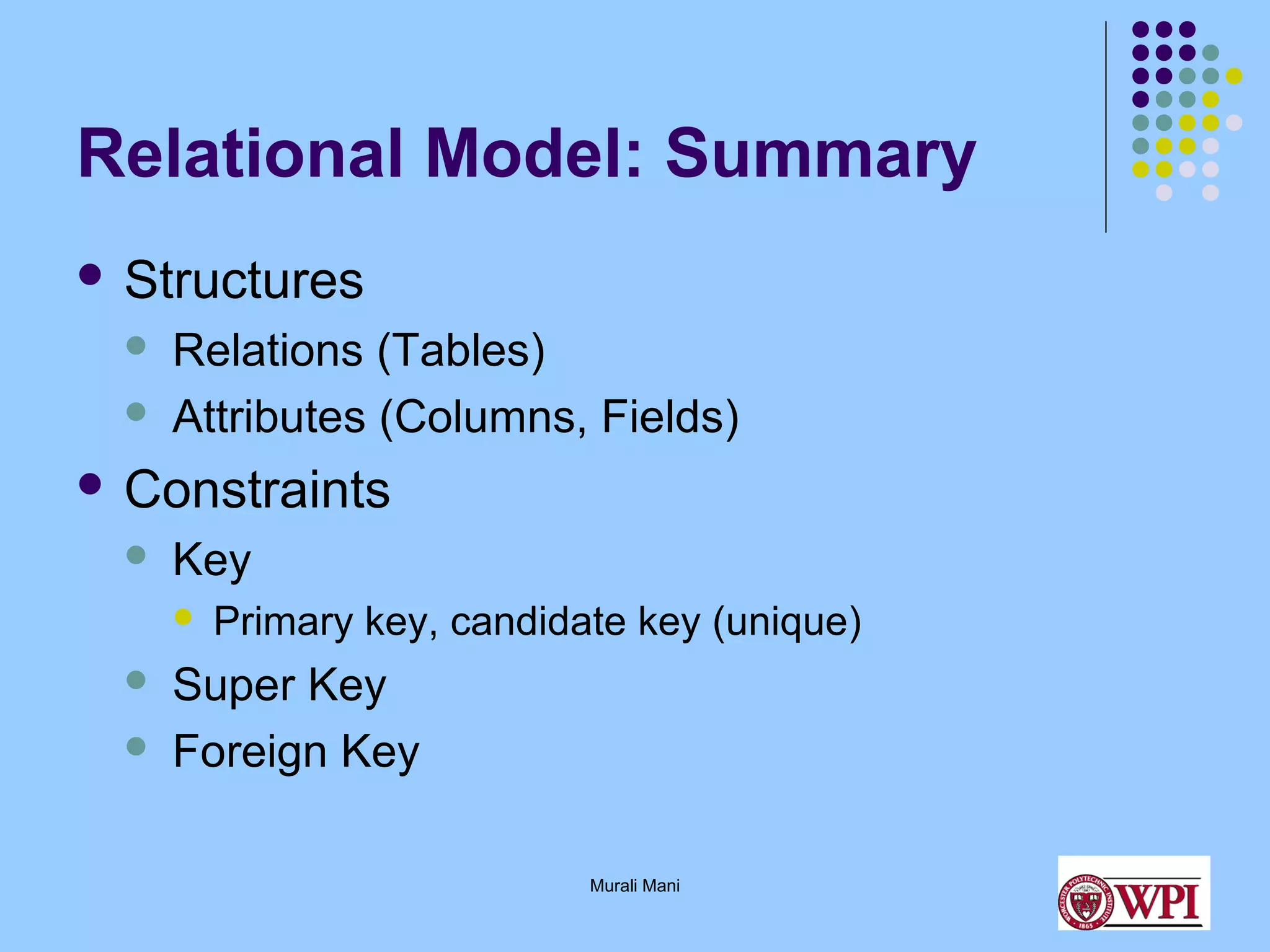
Relational Model: Summary
 Structures



Relations (Tables)
Attributes (Columns, Fields)

 Constraints


Key





Primary key, candidate key (unique)

Super Key
Foreign Key
Murali Mani
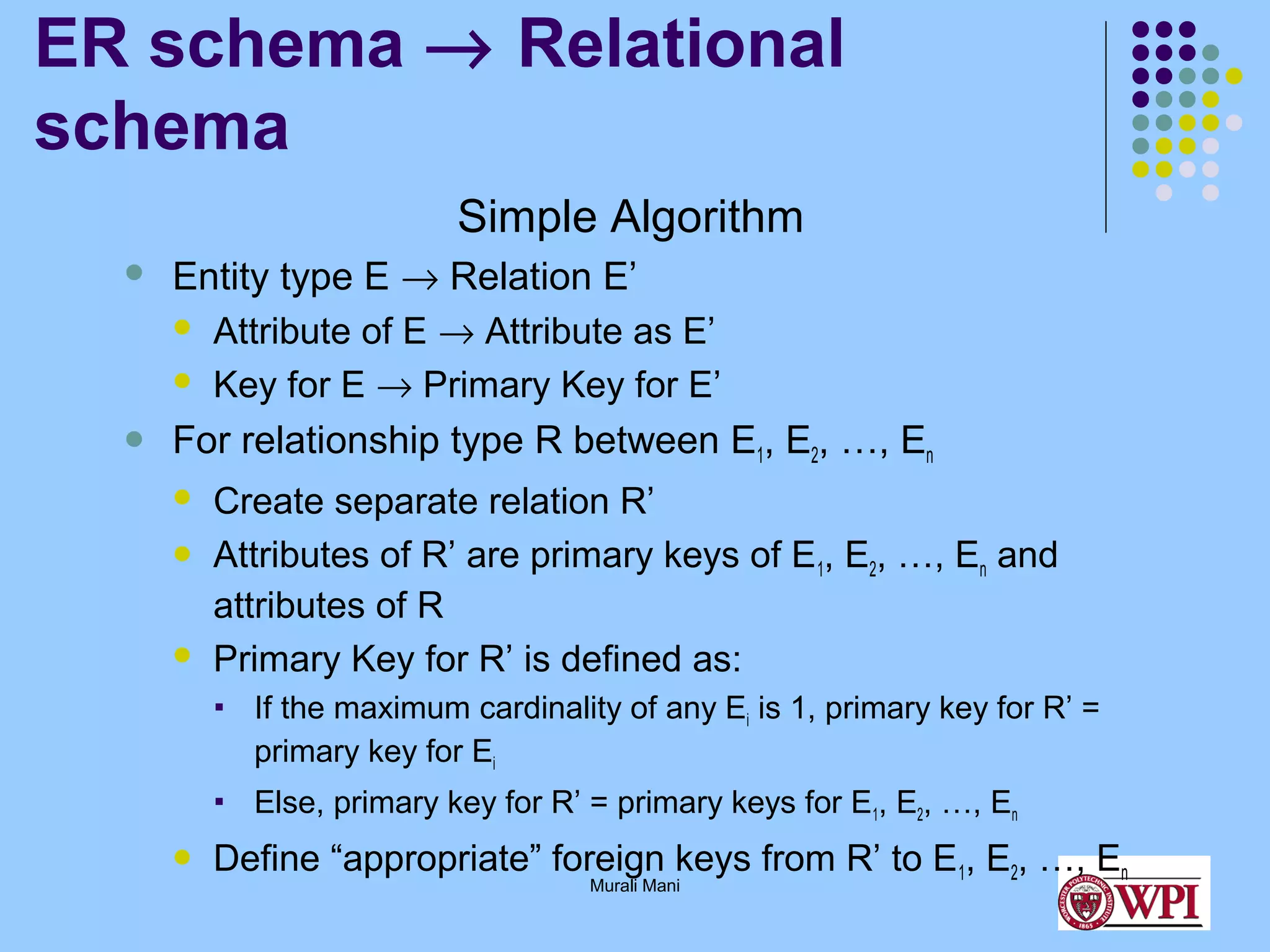
ER schema → Relational
schema
Simple Algorithm




Entity type E → Relation E’
 Attribute of E → Attribute as E’
 Key for E → Primary Key for E’
For relationship type R between E1, E2, …, En





Create separate relation R’
Attributes of R’ are primary keys of E1, E2, …, En and
attributes of R
Primary Key for R’ is defined as:






If the maximum cardinality of any Ei is 1, primary key for R’ =
primary key for Ei
Else, primary key for R’ = primary keys for E1, E2, …, En

Define “appropriate” foreign keys from R’ to E1, E2, …, En
Murali Mani
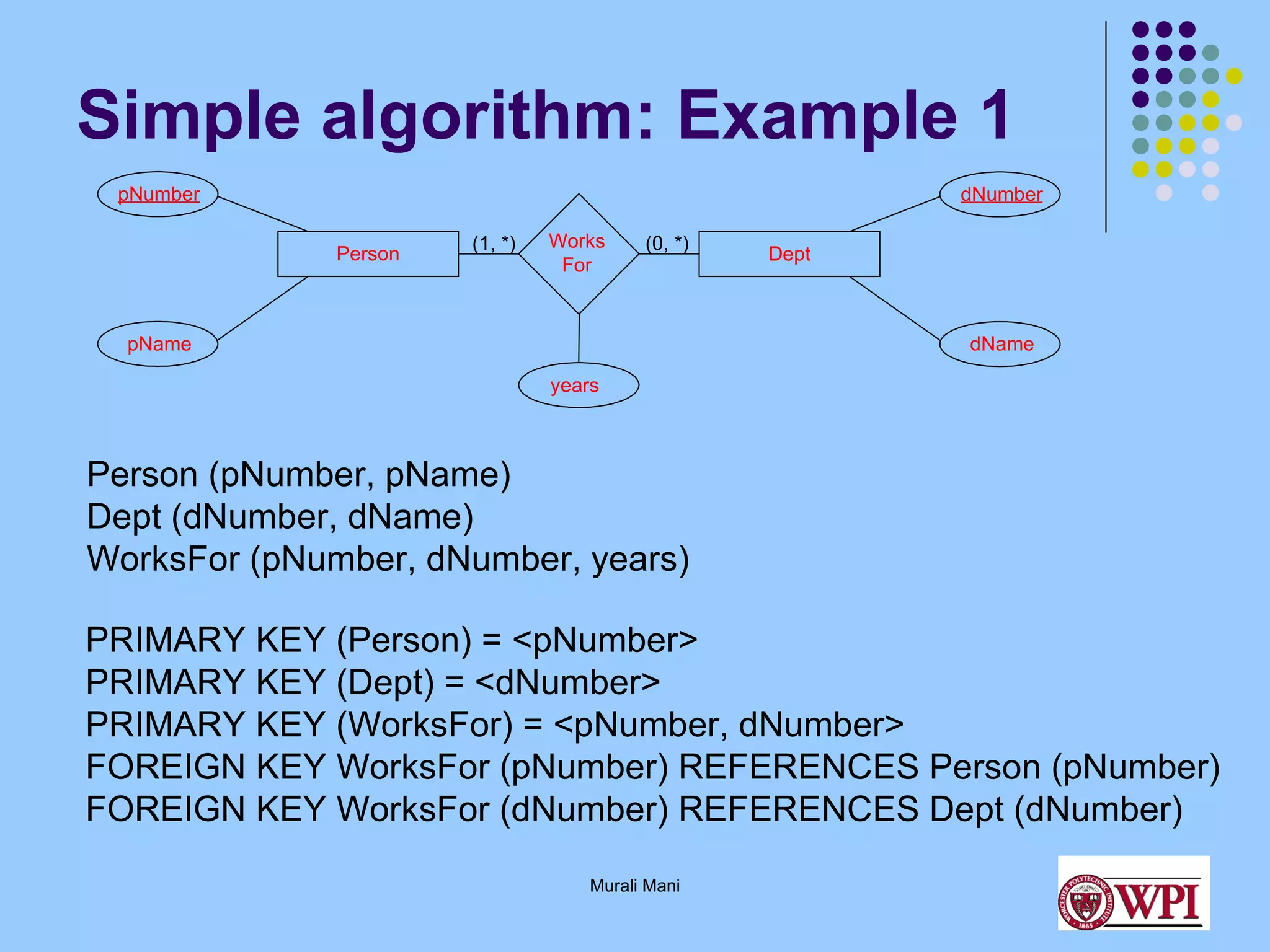
Simple algorithm: Example 1
pNumber

dNumber
Person

(1, *)

Works
For

(0, *)

pName

Dept

dName
years

Person (pNumber, pName)
Dept (dNumber, dName)
WorksFor (pNumber, dNumber, years)
PRIMARY KEY (Person) = <pNumber>
PRIMARY KEY (Dept) = <dNumber>
PRIMARY KEY (WorksFor) = <pNumber, dNumber>
FOREIGN KEY WorksFor (pNumber) REFERENCES Person (pNumber)
FOREIGN KEY WorksFor (dNumber) REFERENCES Dept (dNumber)
Murali Mani
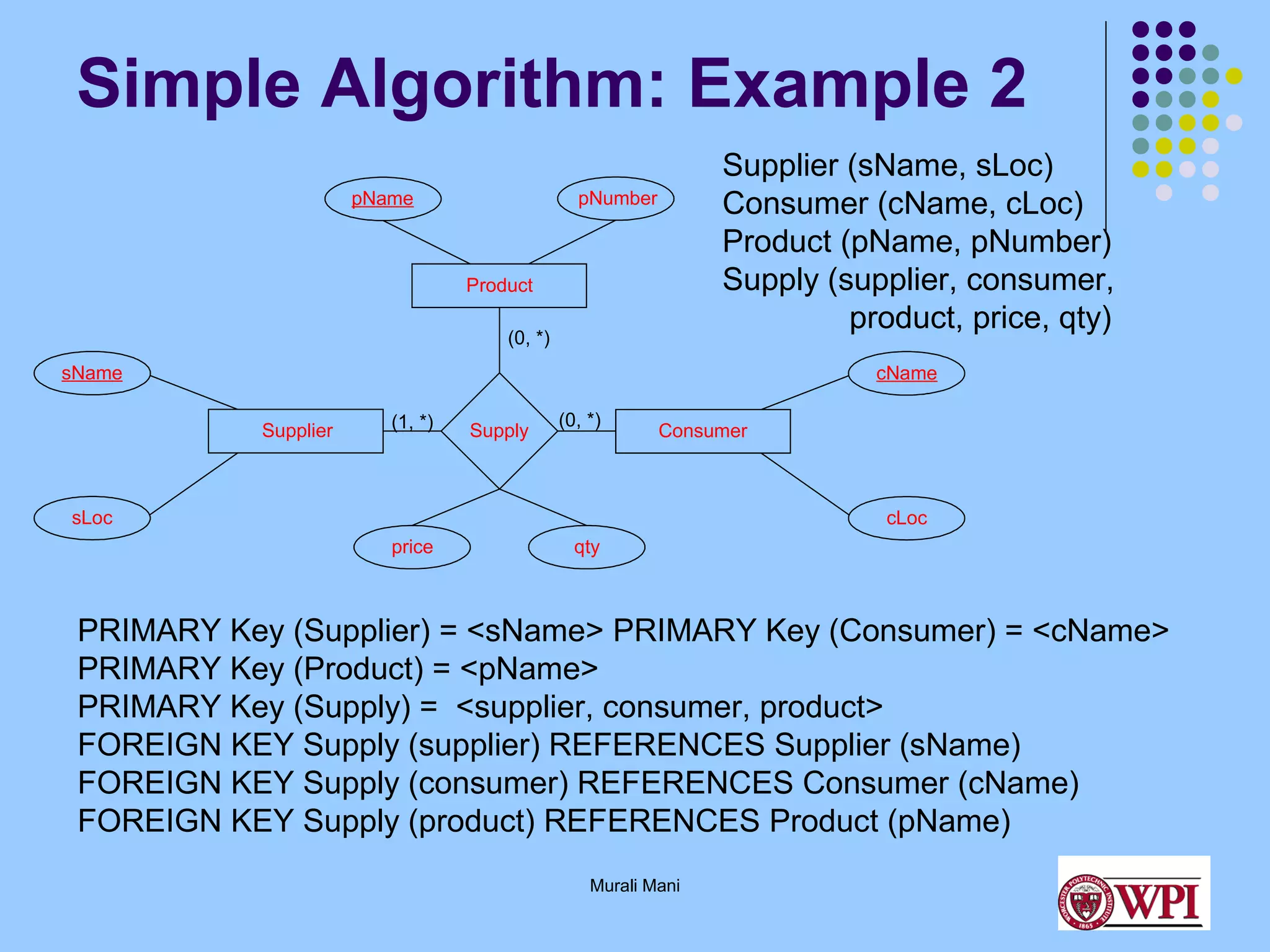
Simple Algorithm: Example 2
Supplier (sName, sLoc)
Consumer (cName, cLoc)
Product (pName, pNumber)
Supply (supplier, consumer,
product, price, qty)

pNumber

pName

Product
(0, *)
sName

cName
Supplier

(1, *)

Supply

(0, *)

Consumer

sLoc

cLoc
price

qty

PRIMARY Key (Supplier) = <sName> PRIMARY Key (Consumer) = <cName>
PRIMARY Key (Product) = <pName>
PRIMARY Key (Supply) = <supplier, consumer, product>
FOREIGN KEY Supply (supplier) REFERENCES Supplier (sName)
FOREIGN KEY Supply (consumer) REFERENCES Consumer (cName)
FOREIGN KEY Supply (product) REFERENCES Product (pName)
Murali Mani
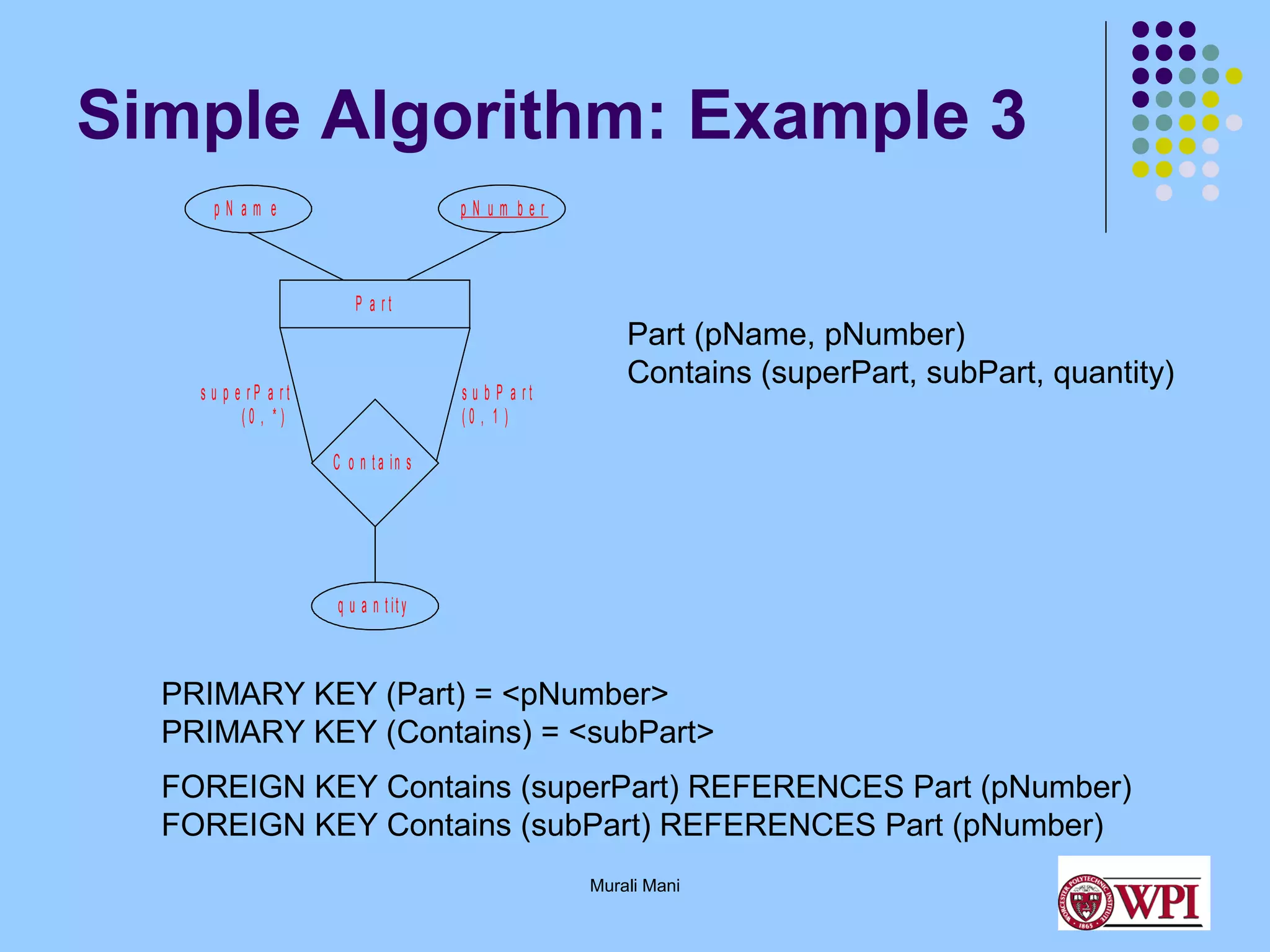
Simple Algorithm: Example 3
pN um ber

pN am e

P a rt

s u p e rP a rt
(0 , *)

s u b P a rt
(0 , 1 )

Part (pName, pNumber)
Contains (superPart, subPart, quantity)

C o n t a in s

q u a n t ity

PRIMARY KEY (Part) = <pNumber>
PRIMARY KEY (Contains) = <subPart>
FOREIGN KEY Contains (superPart) REFERENCES Part (pNumber)
FOREIGN KEY Contains (subPart) REFERENCES Part (pNumber)
Murali Mani
Decreasing the number of
Relations
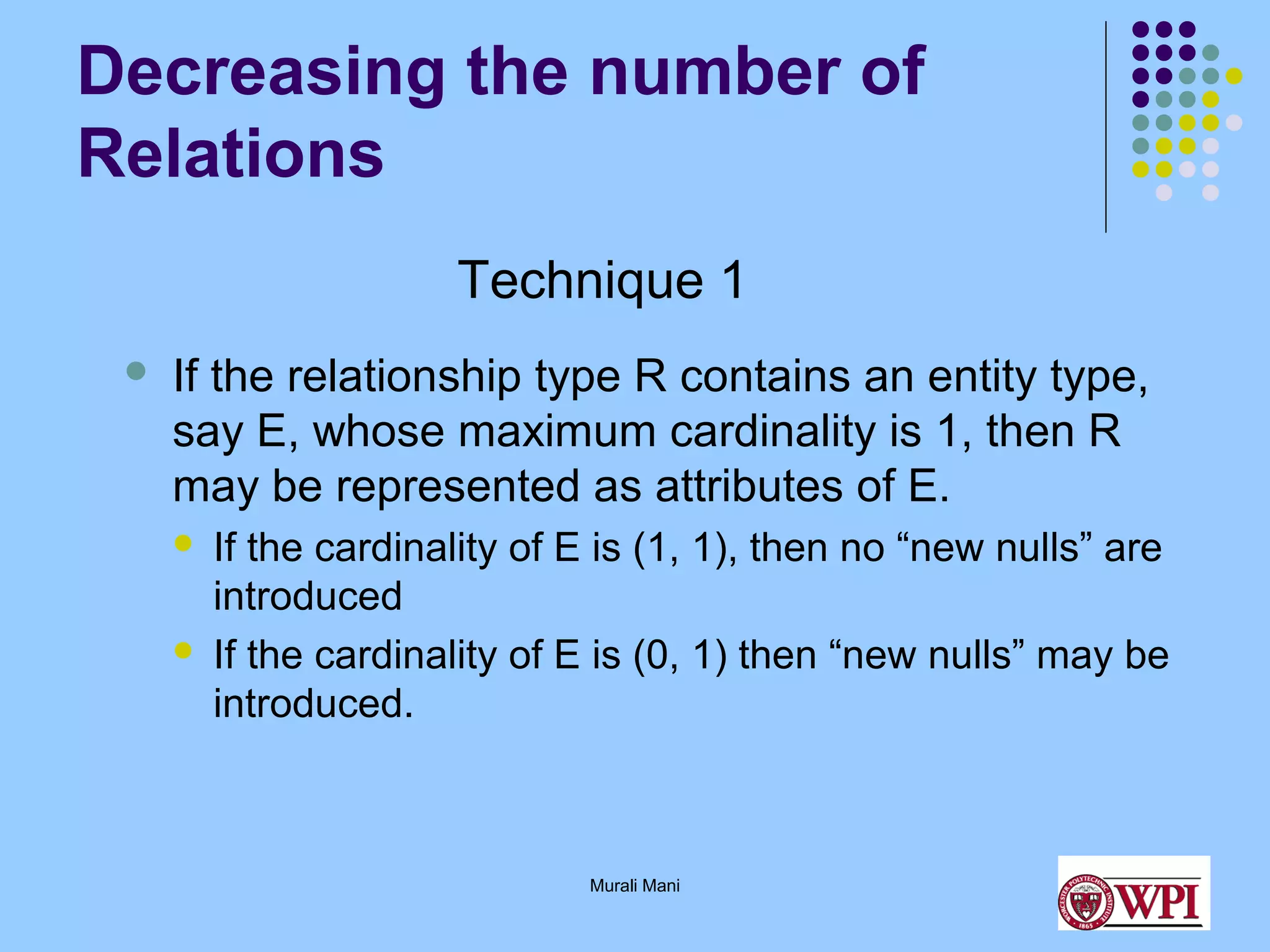
Technique 1


If the relationship type R contains an entity type,
say E, whose maximum cardinality is 1, then R
may be represented as attributes of E.




If the cardinality of E is (1, 1), then no “new nulls” are
introduced
If the cardinality of E is (0, 1) then “new nulls” may be
introduced.

Murali Mani
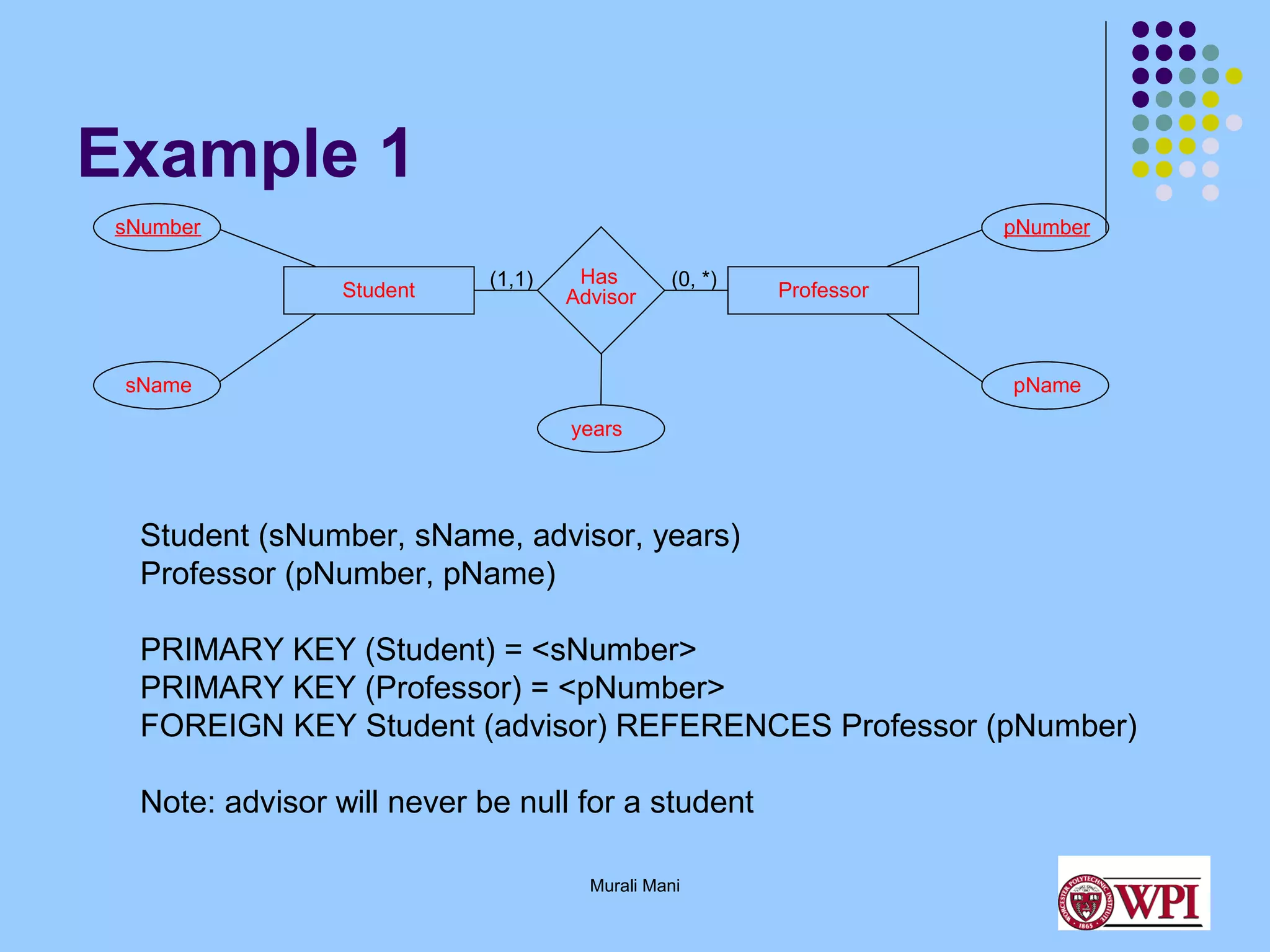
Example 1
sNumber

pNumber
Student

(1,1)

Has
Advisor

(0, *)

sName

Professor

pName
years

Student (sNumber, sName, advisor, years)
Professor (pNumber, pName)
PRIMARY KEY (Student) = <sNumber>
PRIMARY KEY (Professor) = <pNumber>
FOREIGN KEY Student (advisor) REFERENCES Professor (pNumber)
Note: advisor will never be null for a student
Murali Mani
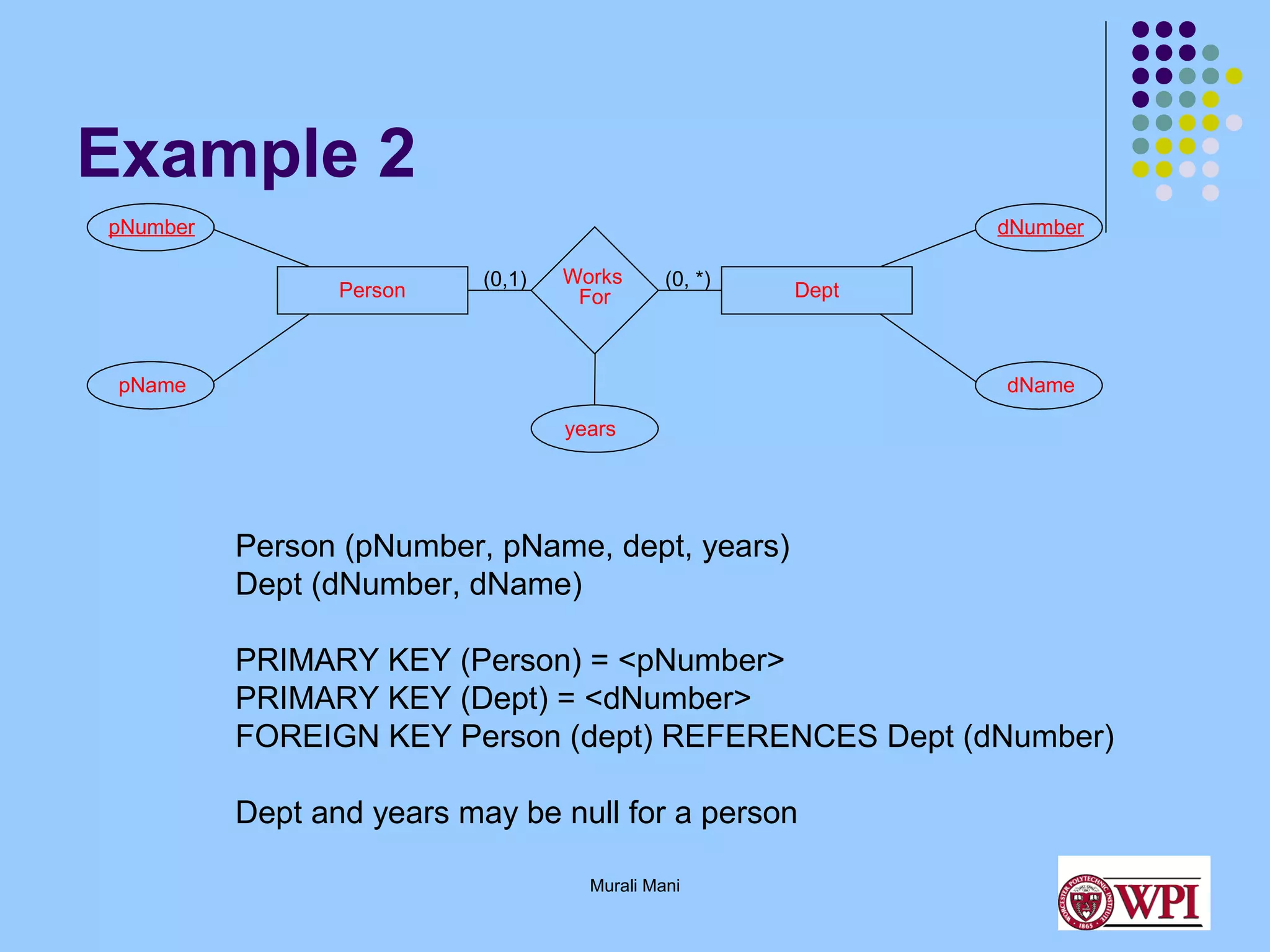
Example 2
pNumber

dNumber
Person

(0,1)

Works
For

(0, *)

Dept

pName

dName
years

Person (pNumber, pName, dept, years)
Dept (dNumber, dName)
PRIMARY KEY (Person) = <pNumber>
PRIMARY KEY (Dept) = <dNumber>
FOREIGN KEY Person (dept) REFERENCES Dept (dNumber)
Dept and years may be null for a person
Murali Mani
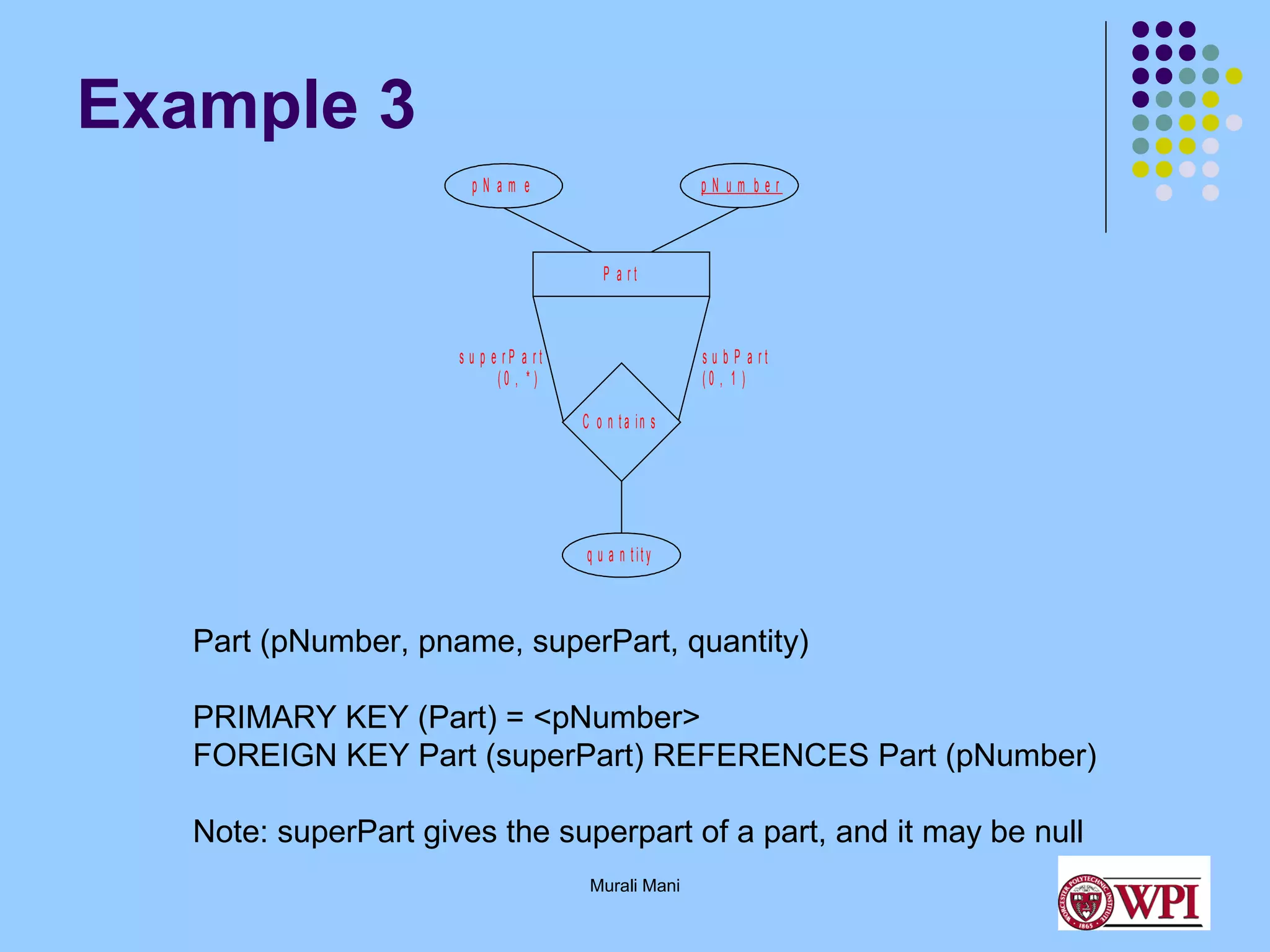
Example 3
pNum ber

pNam e

P a rt

s u p e rP a rt
(0 , *)

s u b P a rt
(0 , 1 )
C o n t a in s

q u a n tity

Part (pNumber, pname, superPart, quantity)
PRIMARY KEY (Part) = <pNumber>
FOREIGN KEY Part (superPart) REFERENCES Part (pNumber)
Note: superPart gives the superpart of a part, and it may be null
Murali Mani
Decreasing the number of
Relations
Technique 2 (not recommended)




If the relationship type R between E1 and E2 is
1:1, and the cardinality of E1 or E2 is (1, 1), then
we can combine everything into 1 relation.
Let us assume the cardinality of E1 is (1, 1). We
have one relation for E2, and move all attributes
of E1 and for R to be attributes of E2.



If the cardinality of E2 is (1, 1), no “new nulls” are
introduced
If the cardinality of E2 is (0, 1) then “new nulls” may
be introduced.
Murali Mani
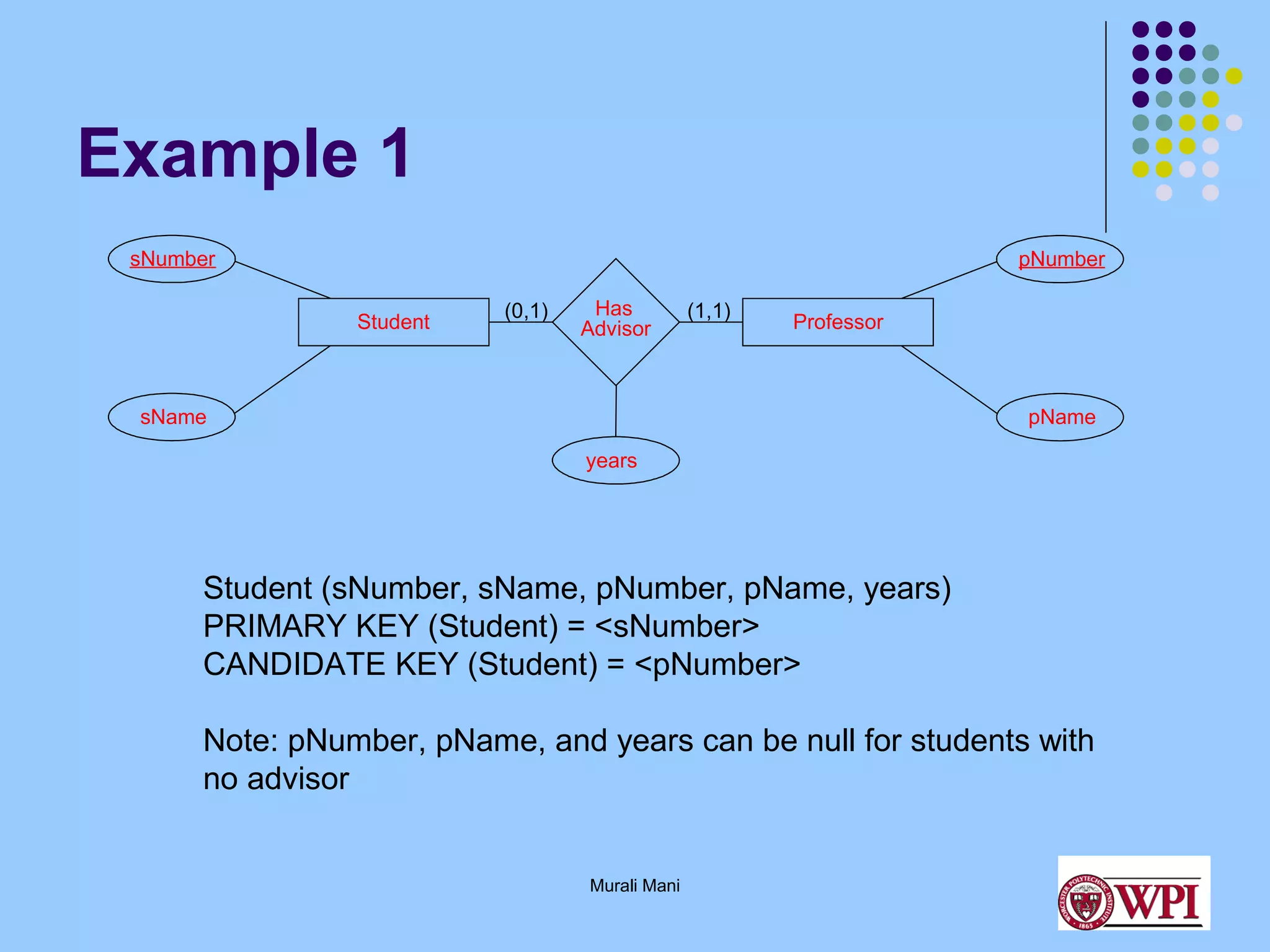
Example 1
sNumber

pNumber
Student

(0,1)

Has
Advisor

(1,1)

Professor

sName

pName
years

Student (sNumber, sName, pNumber, pName, years)
PRIMARY KEY (Student) = <sNumber>
CANDIDATE KEY (Student) = <pNumber>
Note: pNumber, pName, and years can be null for students with
no advisor

Murali Mani
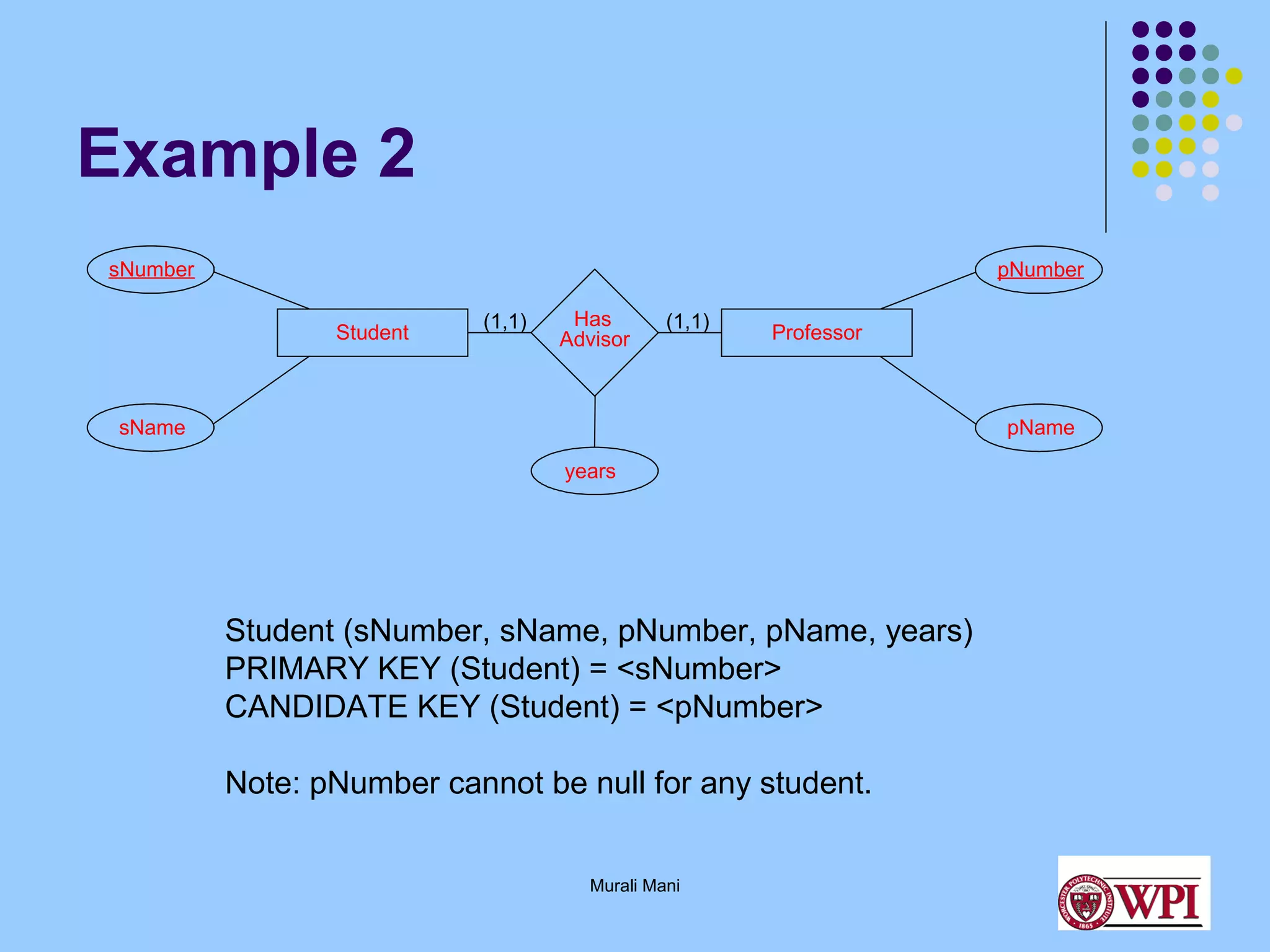
Example 2
sNumber

pNumber
Student

(1,1)

Has
Advisor

(1,1)

Professor

sName

pName
years

Student (sNumber, sName, pNumber, pName, years)
PRIMARY KEY (Student) = <sNumber>
CANDIDATE KEY (Student) = <pNumber>
Note: pNumber cannot be null for any student.
Murali Mani
Other details
 Composite


attribute in ER

Include an attribute for every component of the
composite attribute.

 Multi-valued




attribute in ER

We need a separate relation for any multi-valued
attribute.
Identify appropriate attributes, keys and foreign
key constraints.

Murali Mani
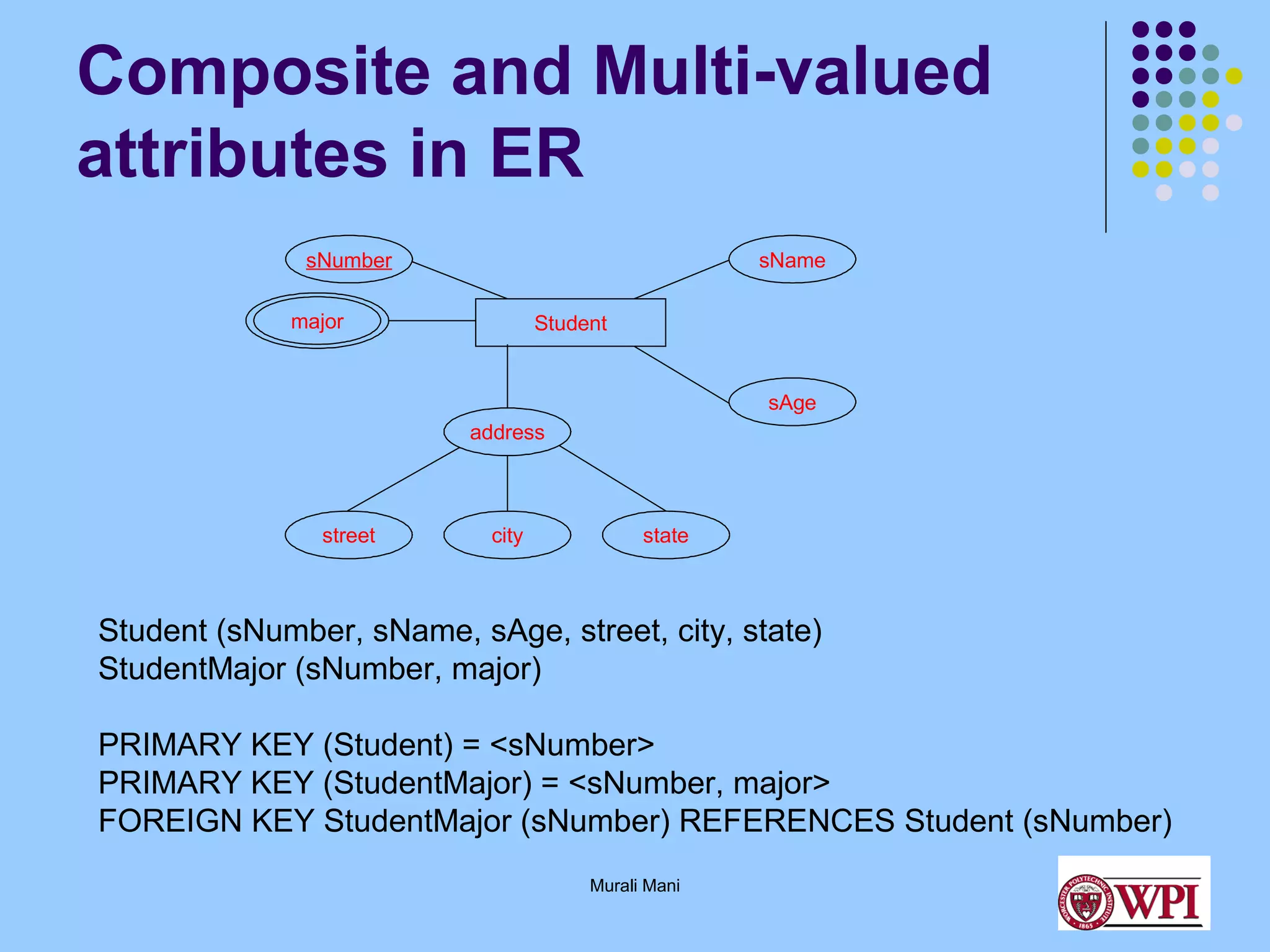
Composite and Multi-valued
attributes in ER
sNumber

sName

major

Student

sAge
address

street

city

state

Student (sNumber, sName, sAge, street, city, state)
StudentMajor (sNumber, major)
PRIMARY KEY (Student) = <sNumber>
PRIMARY KEY (StudentMajor) = <sNumber, major>
FOREIGN KEY StudentMajor (sNumber) REFERENCES Student (sNumber)
Murali Mani
Weak entity types
 Consider







weak entity type E

A relation for E, say E’
Attributes of E’ = attributes of E in ER + keys for
all indentifying entity types.
Key for E’ = the key for E in ER + keys for all the
identifying entity types.
Identify appropriate FKs from E’ to the identifying
entity types.

Murali Mani
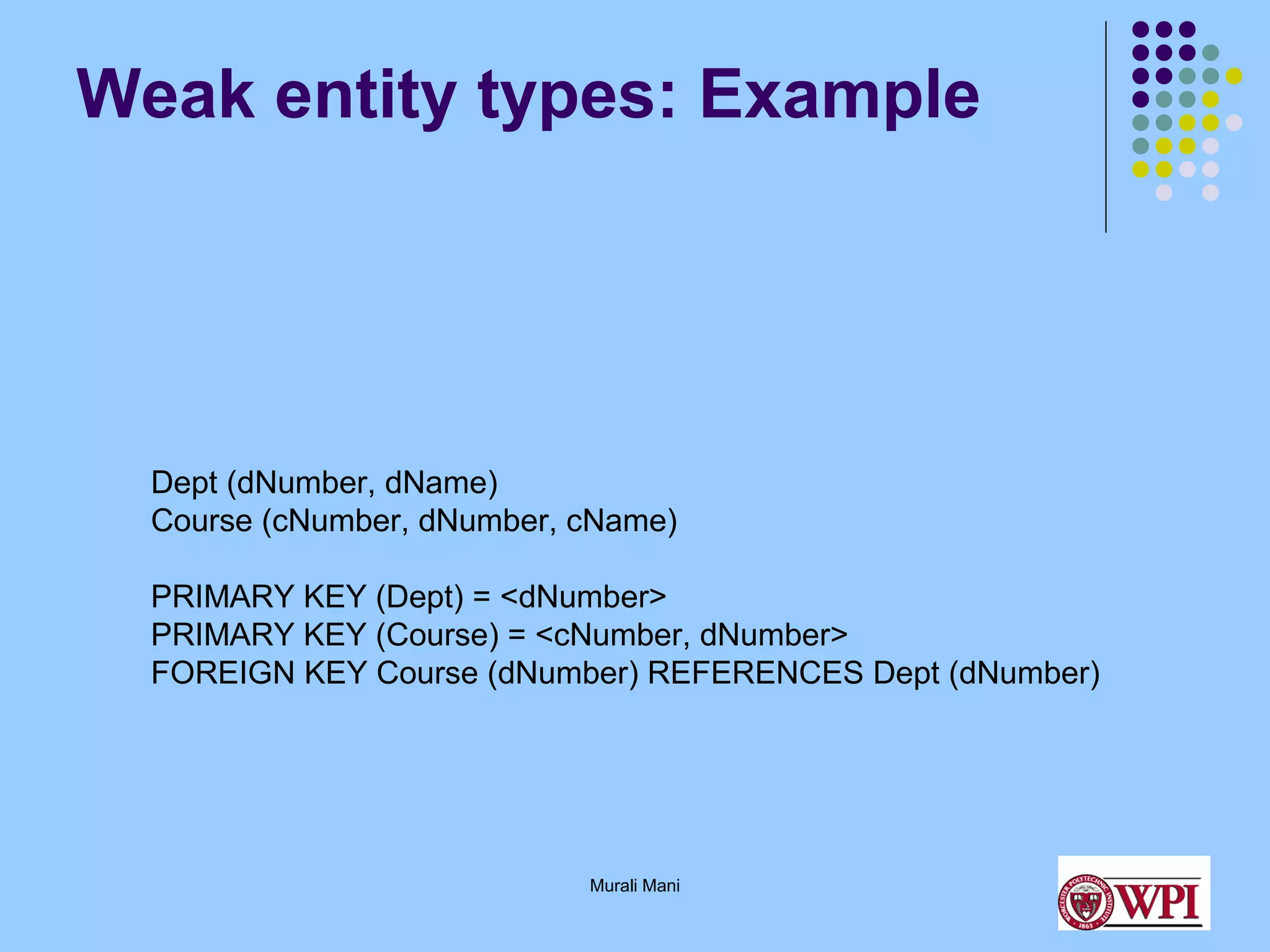
Weak entity types: Example

Dept (dNumber, dName)
Course (cNumber, dNumber, cName)
PRIMARY KEY (Dept) = <dNumber>
PRIMARY KEY (Course) = <cNumber, dNumber>
FOREIGN KEY Course (dNumber) REFERENCES Dept (dNumber)

Murali Mani
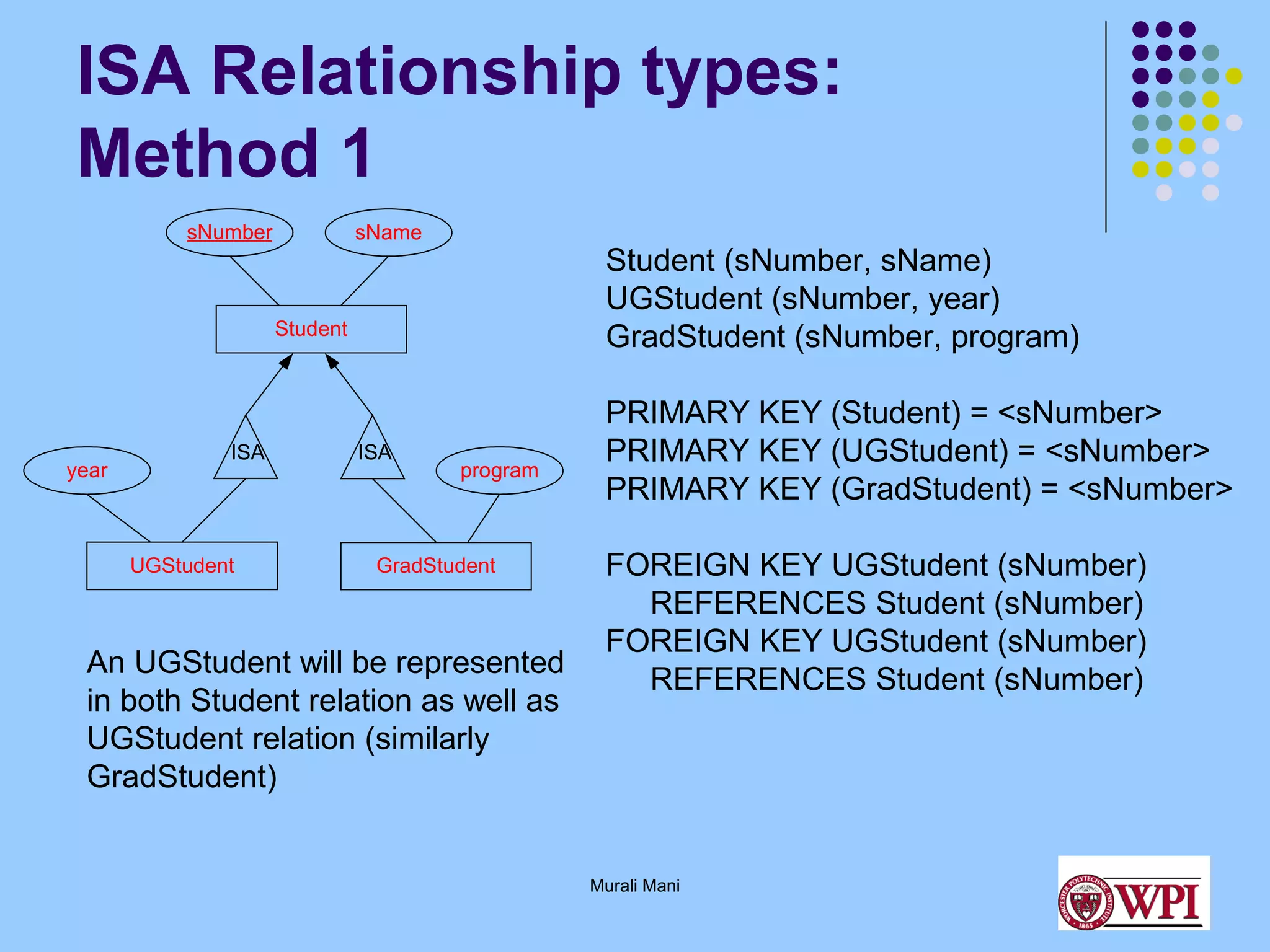
ISA Relationship types:
Method 1
sNumber

sName

Student (sNumber, sName)
UGStudent (sNumber, year)
GradStudent (sNumber, program)

Student

year

ISA

UGStudent

ISA

program

GradStudent

An UGStudent will be represented
in both Student relation as well as
UGStudent relation (similarly
GradStudent)

PRIMARY KEY (Student) = <sNumber>
PRIMARY KEY (UGStudent) = <sNumber>
PRIMARY KEY (GradStudent) = <sNumber>
FOREIGN KEY UGStudent (sNumber)
REFERENCES Student (sNumber)
FOREIGN KEY UGStudent (sNumber)
REFERENCES Student (sNumber)

Murali Mani
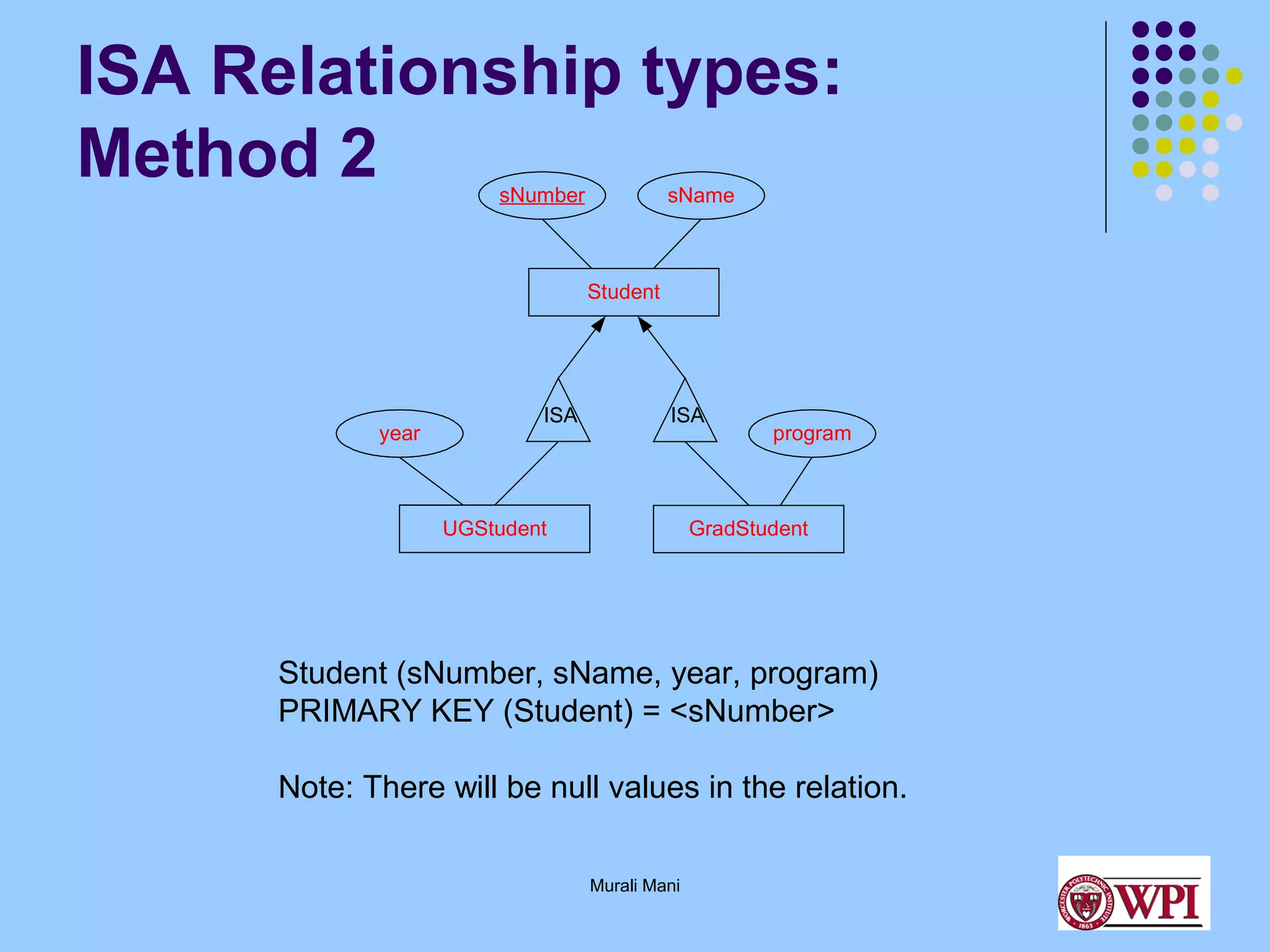
ISA Relationship types:
Method 2
sNumber

sName

Student

year

ISA

ISA

UGStudent

program

GradStudent

Student (sNumber, sName, year, program)
PRIMARY KEY (Student) = <sNumber>
Note: There will be null values in the relation.
Murali Mani
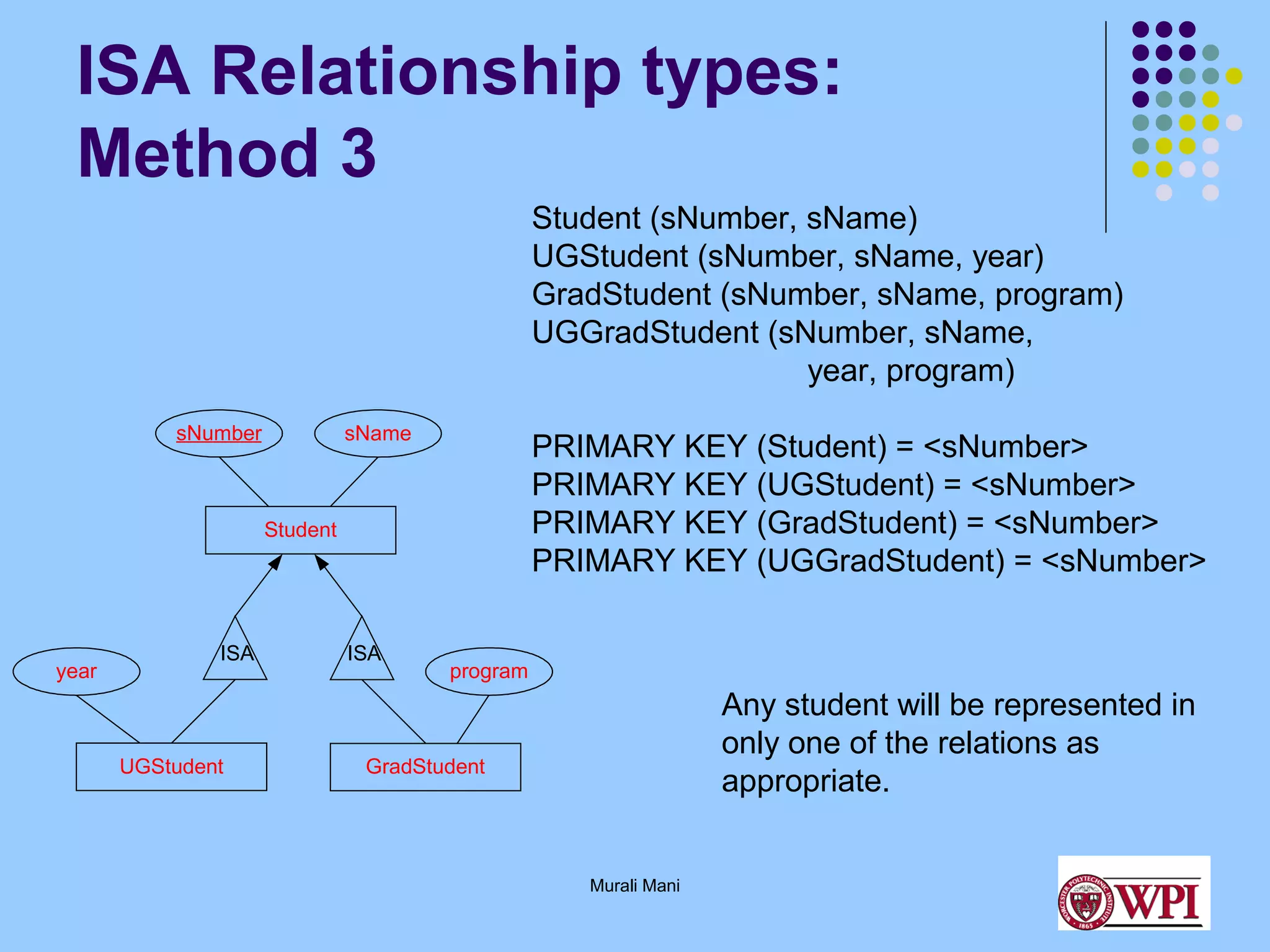
ISA Relationship types:
Method 3
Student (sNumber, sName)
UGStudent (sNumber, sName, year)
GradStudent (sNumber, sName, program)
UGGradStudent (sNumber, sName,
year, program)
sNumber

sName

PRIMARY KEY (Student) = <sNumber>
PRIMARY KEY (UGStudent) = <sNumber>
PRIMARY KEY (GradStudent) = <sNumber>
PRIMARY KEY (UGGradStudent) = <sNumber>

Student

year

ISA

UGStudent

ISA

program

Any student will be represented in
only one of the relations as
appropriate.

GradStudent

Murali Mani

Relational model for Databases

  • 1.
    The Relational Model ShriramDesai, ramraodesai1991@gmail.com 7411001044
  • 2.
    Why Relational Model? Currently  Vendors: Oracle, Microsoft, IBM  Older  models still used IBM’s IMS (hierarchical model)  Recent  the most widely used competitions Object Oriented Model: ObjectStore  Implementation   standard for relational Model SQL (Structured Query Language) SQL 3: includes object-relational extensions
  • 3.
    Relational Model  Structures   Relations (alsocalled Tables) Attributes (also called Columns or Fields)  Note:  Every attribute is simple (not composite or multi-valued) Constraints   Key and Foreign Key constraints (More constraints later) Eg: Student Relation (The following 2 relations are equivalent) Student Student sNumber sName sNumber sName 1 Dave 2 Greg 2 Greg 1 Dave Murali Mani Cardinality = 2 Arity/Degree = 2
  • 4.
    Relational Model  Schema   Eg:Student (sNumber, sName) PRIMARY KEY (Student) = <sNumber>  Schema  for a database Schemas for all relations in the database  Tuples  for a relation (Rows) The set of rows in a relation are the tuples of that relation  Note: Attribute values may be null Murali Mani
  • 5.
    Primary Key Constraints A   setof attributes is a key for a relation if: No two distinct tuples can have the same values in all key fields A proper subset of the key attributes is not a key.  Superkey: A proper subset of a superkey may be a superkey  If multiple keys, one of them is chosen to be the primary key.  Eg: PRIMARY KEY (Student) = <sNumber>  Primary key attributes cannot take null values Murali Mani
  • 6.
    Candidate Keys (SQL:Unique)  Keys that are not primary keys are candidate keys.  Specified in SQL using UNIQUE  Attribute of unique key may have null values !  Eg: Student (sNumber, sName) PRIMARY KEY (Student) = <sNumber> CANDIDATE KEY (Student) = <sName> Murali Mani
  • 7.
    Violation of keyconstraints A relation violates a primary key constraint if:  There is a row with null values for any attribute of primary key. (or) There are 2 rows with same values for all attributes of primary key   Consider R (a, b) where a is unique. R violates the unique constraint if all of the following are true  2 rows in R have the same non-null values for a Murali Mani
  • 8.
    Keys: Example Student sNumber sName address 1 Dave 144FL 2 Greg 320FL Primary Key:<sNumber> Candidate key: <sName> Some superkeys: {<sNumber, address>, <sName>, <sNumber>, <sNumber, sName> <sNumber, sName, address>} Murali Mani
  • 9.
    Foreign Key Constraints To specify an attribute (or multiple attributes) S1 of a relation R1 refers to the attribute (or attributes) S2 of another relation R2  Eg: Professor (pName, pOffice) Student (sNumber, sName, advisor) PRIMARY KEY (Professor) = <pName> FOREIGN KEY Student (advisor) REFERENCES Professor (pName) Murali Mani
  • 10.
    Foreign Key Constraints FOREIGN KEY R1 (S1) REFERENCES R2 (S2)  Like a logical pointer  The values of S1 for any row of R1 must be values of S2 for some row in R2 (null values are allowed)  S2 must be a key for R2  R2 can be the same as R1 (i.e., a relation can have a foreign key referring to itself). Murali Mani
  • 11.
    Foreign Keys: Examples Dept(dNumber, dName) Person (pNumber, pName, dept) Persons working for Depts PRIMARY KEY (Dept) = <dNumber> PRIMARY KEY (Person) = <pNumber> FOREIGN KEY Person (dept) REFERENCES Dept (dNumber) Person (pNumber, pName, father) PRIMARY KEY (Person) = <pNumber> FOREIGN KEY Person (father) REFERENCES Person (pNumber) Murali Mani Person and his/her father
  • 12.
    Violation of ForeignKey constraints  Suppose we have: FOREIGN KEY R1 (S1) REFERENCES R2 (S2)  This constraint is violated if   Consider a row in R1 with non-null values for all attributes of S1 If there is no row in R2 which have these values for S2, then the FK constraint is violated. Murali Mani
  • 13.
    Relational Model: Summary Structures   Relations (Tables) Attributes (Columns, Fields)  Constraints  Key    Primary key, candidate key (unique) Super Key Foreign Key Murali Mani
  • 14.
    ER schema →Relational schema Simple Algorithm   Entity type E → Relation E’  Attribute of E → Attribute as E’  Key for E → Primary Key for E’ For relationship type R between E1, E2, …, En    Create separate relation R’ Attributes of R’ are primary keys of E1, E2, …, En and attributes of R Primary Key for R’ is defined as:    If the maximum cardinality of any Ei is 1, primary key for R’ = primary key for Ei Else, primary key for R’ = primary keys for E1, E2, …, En Define “appropriate” foreign keys from R’ to E1, E2, …, En Murali Mani
  • 15.
    Simple algorithm: Example1 pNumber dNumber Person (1, *) Works For (0, *) pName Dept dName years Person (pNumber, pName) Dept (dNumber, dName) WorksFor (pNumber, dNumber, years) PRIMARY KEY (Person) = <pNumber> PRIMARY KEY (Dept) = <dNumber> PRIMARY KEY (WorksFor) = <pNumber, dNumber> FOREIGN KEY WorksFor (pNumber) REFERENCES Person (pNumber) FOREIGN KEY WorksFor (dNumber) REFERENCES Dept (dNumber) Murali Mani
  • 16.
    Simple Algorithm: Example2 Supplier (sName, sLoc) Consumer (cName, cLoc) Product (pName, pNumber) Supply (supplier, consumer, product, price, qty) pNumber pName Product (0, *) sName cName Supplier (1, *) Supply (0, *) Consumer sLoc cLoc price qty PRIMARY Key (Supplier) = <sName> PRIMARY Key (Consumer) = <cName> PRIMARY Key (Product) = <pName> PRIMARY Key (Supply) = <supplier, consumer, product> FOREIGN KEY Supply (supplier) REFERENCES Supplier (sName) FOREIGN KEY Supply (consumer) REFERENCES Consumer (cName) FOREIGN KEY Supply (product) REFERENCES Product (pName) Murali Mani
  • 17.
    Simple Algorithm: Example3 pN um ber pN am e P a rt s u p e rP a rt (0 , *) s u b P a rt (0 , 1 ) Part (pName, pNumber) Contains (superPart, subPart, quantity) C o n t a in s q u a n t ity PRIMARY KEY (Part) = <pNumber> PRIMARY KEY (Contains) = <subPart> FOREIGN KEY Contains (superPart) REFERENCES Part (pNumber) FOREIGN KEY Contains (subPart) REFERENCES Part (pNumber) Murali Mani
  • 18.
    Decreasing the numberof Relations Technique 1  If the relationship type R contains an entity type, say E, whose maximum cardinality is 1, then R may be represented as attributes of E.   If the cardinality of E is (1, 1), then no “new nulls” are introduced If the cardinality of E is (0, 1) then “new nulls” may be introduced. Murali Mani
  • 19.
    Example 1 sNumber pNumber Student (1,1) Has Advisor (0, *) sName Professor pName years Student(sNumber, sName, advisor, years) Professor (pNumber, pName) PRIMARY KEY (Student) = <sNumber> PRIMARY KEY (Professor) = <pNumber> FOREIGN KEY Student (advisor) REFERENCES Professor (pNumber) Note: advisor will never be null for a student Murali Mani
  • 20.
    Example 2 pNumber dNumber Person (0,1) Works For (0, *) Dept pName dName years Person(pNumber, pName, dept, years) Dept (dNumber, dName) PRIMARY KEY (Person) = <pNumber> PRIMARY KEY (Dept) = <dNumber> FOREIGN KEY Person (dept) REFERENCES Dept (dNumber) Dept and years may be null for a person Murali Mani
  • 21.
    Example 3 pNum ber pName P a rt s u p e rP a rt (0 , *) s u b P a rt (0 , 1 ) C o n t a in s q u a n tity Part (pNumber, pname, superPart, quantity) PRIMARY KEY (Part) = <pNumber> FOREIGN KEY Part (superPart) REFERENCES Part (pNumber) Note: superPart gives the superpart of a part, and it may be null Murali Mani
  • 22.
    Decreasing the numberof Relations Technique 2 (not recommended)   If the relationship type R between E1 and E2 is 1:1, and the cardinality of E1 or E2 is (1, 1), then we can combine everything into 1 relation. Let us assume the cardinality of E1 is (1, 1). We have one relation for E2, and move all attributes of E1 and for R to be attributes of E2.   If the cardinality of E2 is (1, 1), no “new nulls” are introduced If the cardinality of E2 is (0, 1) then “new nulls” may be introduced. Murali Mani
  • 23.
    Example 1 sNumber pNumber Student (0,1) Has Advisor (1,1) Professor sName pName years Student (sNumber,sName, pNumber, pName, years) PRIMARY KEY (Student) = <sNumber> CANDIDATE KEY (Student) = <pNumber> Note: pNumber, pName, and years can be null for students with no advisor Murali Mani
  • 24.
    Example 2 sNumber pNumber Student (1,1) Has Advisor (1,1) Professor sName pName years Student (sNumber,sName, pNumber, pName, years) PRIMARY KEY (Student) = <sNumber> CANDIDATE KEY (Student) = <pNumber> Note: pNumber cannot be null for any student. Murali Mani
  • 25.
    Other details  Composite  attributein ER Include an attribute for every component of the composite attribute.  Multi-valued   attribute in ER We need a separate relation for any multi-valued attribute. Identify appropriate attributes, keys and foreign key constraints. Murali Mani
  • 26.
    Composite and Multi-valued attributesin ER sNumber sName major Student sAge address street city state Student (sNumber, sName, sAge, street, city, state) StudentMajor (sNumber, major) PRIMARY KEY (Student) = <sNumber> PRIMARY KEY (StudentMajor) = <sNumber, major> FOREIGN KEY StudentMajor (sNumber) REFERENCES Student (sNumber) Murali Mani
  • 27.
    Weak entity types Consider     weak entity type E A relation for E, say E’ Attributes of E’ = attributes of E in ER + keys for all indentifying entity types. Key for E’ = the key for E in ER + keys for all the identifying entity types. Identify appropriate FKs from E’ to the identifying entity types. Murali Mani
  • 28.
    Weak entity types:Example Dept (dNumber, dName) Course (cNumber, dNumber, cName) PRIMARY KEY (Dept) = <dNumber> PRIMARY KEY (Course) = <cNumber, dNumber> FOREIGN KEY Course (dNumber) REFERENCES Dept (dNumber) Murali Mani
  • 29.
    ISA Relationship types: Method1 sNumber sName Student (sNumber, sName) UGStudent (sNumber, year) GradStudent (sNumber, program) Student year ISA UGStudent ISA program GradStudent An UGStudent will be represented in both Student relation as well as UGStudent relation (similarly GradStudent) PRIMARY KEY (Student) = <sNumber> PRIMARY KEY (UGStudent) = <sNumber> PRIMARY KEY (GradStudent) = <sNumber> FOREIGN KEY UGStudent (sNumber) REFERENCES Student (sNumber) FOREIGN KEY UGStudent (sNumber) REFERENCES Student (sNumber) Murali Mani
  • 30.
    ISA Relationship types: Method2 sNumber sName Student year ISA ISA UGStudent program GradStudent Student (sNumber, sName, year, program) PRIMARY KEY (Student) = <sNumber> Note: There will be null values in the relation. Murali Mani
  • 31.
    ISA Relationship types: Method3 Student (sNumber, sName) UGStudent (sNumber, sName, year) GradStudent (sNumber, sName, program) UGGradStudent (sNumber, sName, year, program) sNumber sName PRIMARY KEY (Student) = <sNumber> PRIMARY KEY (UGStudent) = <sNumber> PRIMARY KEY (GradStudent) = <sNumber> PRIMARY KEY (UGGradStudent) = <sNumber> Student year ISA UGStudent ISA program Any student will be represented in only one of the relations as appropriate. GradStudent Murali Mani