SA0951a
Enhanced
Entity-Relationship
Modelling
(EERM)
and
Mapping

Reading:
e.g. Connolly/Begg (4th ed): Chapter 12 – Enhanced ERM; Mapping: “Step
6”
Rob et al: Chapter 6.1 (Advanced data modelling), Chapter 11.2 "Step 6".

1
Some limitations of ERMs
 ERM’s

are fine for traditional applications
 But what about complex databases?
–

CAD/CAM, GIS, OIS etc

 Enhanced

concepts
–
–

2

ERM (EERM) supports additional

Specialisation/generalisation
Uses the UML notation
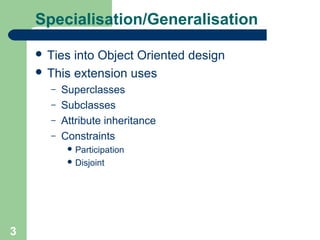
Specialisation/Generalisation
 Ties

into Object Oriented design
 This extension uses
–
–
–
–

Superclasses
Subclasses
Attribute inheritance
Constraints
 Participation
 Disjoint

3
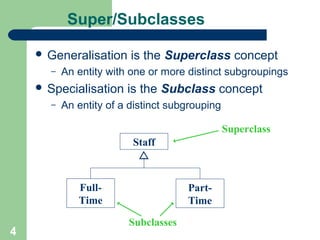
Super/Subclasses
 Generalisation
–

An entity with one or more distinct subgroupings

 Specialisation
–

is the Superclass concept

is the Subclass concept

An entity of a distinct subgrouping
Superclass
Staff

FullTime

4

PartTime
Subclasses
Continued …..
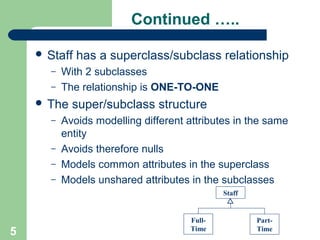
 Staff
–
–

With 2 subclasses
The relationship is ONE-TO-ONE

 The
–
–
–
–

has a superclass/subclass relationship

super/subclass structure

Avoids modelling different attributes in the same
entity
Avoids therefore nulls
Models common attributes in the superclass
Models unshared attributes in the subclasses
Staff


5

FullTime

PartTime
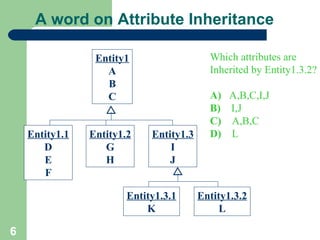
A word on Attribute Inheritance
Which attributes are
Inherited by Entity1.3.2?

Entity1
A
B
C

Entity1.1
D
E
F

Entity1.2
G
H

Entity1.3
I
J


Entity1.3.1
K

6

A) A,B,C,I,J
B) I,J
C) A,B,C
D) L

Entity1.3.2
L
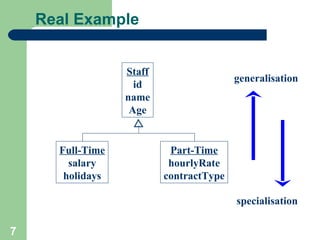
Real Example
Staff
id
name
Age

Full-Time
salary
holidays

generalisation

Part-Time
hourlyRate
contractType
specialisation

7
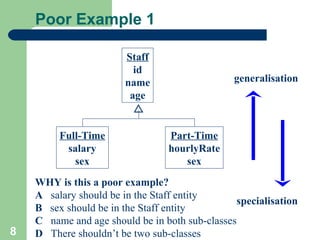
Poor Example 1
Staff
id
name
age

Full-Time
salary
sex

8

generalisation

Part-Time
hourlyRate
sex

WHY is this a poor example?
A salary should be in the Staff entity
specialisation
B sex should be in the Staff entity
C name and age should be in both sub-classes
D There shouldn’t be two sub-classes
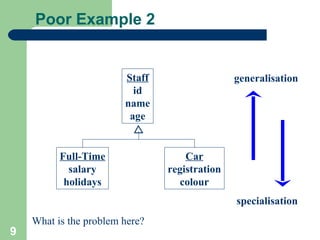
Poor Example 2

Staff
id
name
age

Full-Time
salary
holidays

generalisation

Car
registration
colour
specialisation

9

What is the problem here?
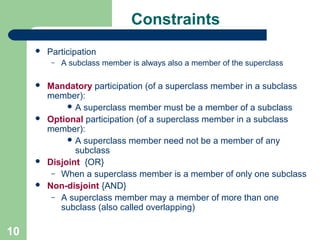
Constraints


Participation
–









10

A subclass member is always also a member of the superclass

Mandatory participation (of a superclass member in a subclass
member):
 A superclass member must be a member of a subclass
Optional participation (of a superclass member in a subclass
member):
 A superclass member need not be a member of any
subclass
Disjoint {OR}
– When a superclass member is a member of only one subclass
Non-disjoint {AND}
– A superclass member may a member of more than one
subclass (also called overlapping)
Constraints continued …





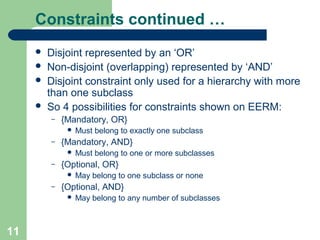
Disjoint represented by an ‘OR’
Non-disjoint (overlapping) represented by ‘AND’
Disjoint constraint only used for a hierarchy with more
than one subclass
So 4 possibilities for constraints shown on EERM:
–

{Mandatory, OR}


–

{Mandatory, AND}


–

May belong to one subclass or none

{Optional, AND}


11

Must belong to one or more subclasses

{Optional, OR}


–

Must belong to exactly one subclass

May belong to any number of subclasses
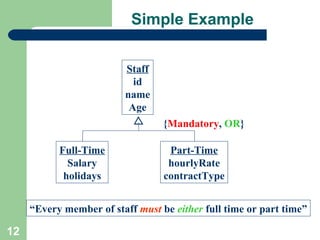
Simple Example
Staff
id
name
Age

Full-Time
Salary
holidays

{Mandatory, OR}
Part-Time
hourlyRate
contractType

“Every member of staff must be either full time or part time”

12
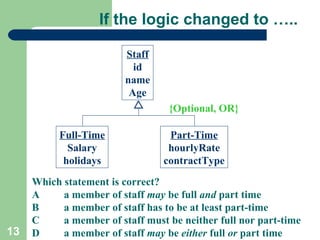
If the logic changed to …..
Staff
id
name
Age

Full-Time
Salary
holidays

13

{Optional, OR}
Part-Time
hourlyRate
contractType

Which statement is correct?
A
a member of staff may be full and part time
B
a member of staff has to be at least part-time
C
a member of staff must be neither full nor part-time
D
a member of staff may be either full or part time
Example
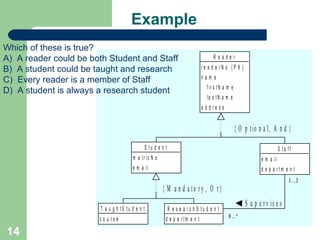
Which of these is true?
A) A reader could be both Student and Staff
B) A student could be taught and research
C) Every reader is a member of Staff
D) A student is always a research student

R eader
re a d e rN o {P K }
nam e
f ir s t N a m e
la s t N a m e
a d d re s s

{ O p t io n a l, A n d }
S tu d e n t

S ta ff

m a t r ic N o

e m a il

e m a il

d e p a rtm e n t
1 ..3

{ M a n d a to ry , O r}
T a u g h tS tu d e n t
c o u rs e

14

R e s e a rc h S tu d e n t
d e p a rtm e n t

S u p e r v is e s
0 ..*
Example ctd
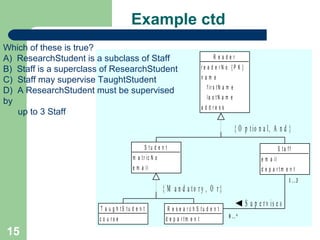
Which of these is true?
A) ResearchStudent is a subclass of Staff
B) Staff is a superclass of ResearchStudent
C) Staff may supervise TaughtStudent
D) A ResearchStudent must be supervised
by
up to 3 Staff

R eader
re a d e rN o {P K }
nam e
f ir s t N a m e
la s t N a m e
a d d re s s

{ O p t io n a l, A n d }
S tu d e n t

S ta ff

m a t r ic N o

e m a il

e m a il

d e p a rtm e n t
1 ..3

{ M a n d a to ry , O r}
T a u g h tS tu d e n t
c o u rs e

15

R e s e a rc h S tu d e n t
d e p a rtm e n t

S u p e r v is e s
0 ..*
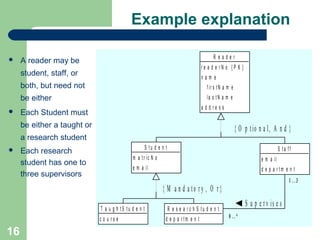
Example explanation


R eader

A reader may be

re a d e rN o {P K }

student, staff, or

nam e

both, but need not

f ir s t N a m e

be either


la s t N a m e
a d d re s s

Each Student must
be either a taught or

{ O p t io n a l, A n d }

a research student


S tu d e n t

Each research
student has one to
three supervisors

S ta ff

m a t r ic N o

e m a il

e m a il

d e p a rtm e n t
1 ..3

{ M a n d a to ry , O r}
T a u g h tS tu d e n t
c o u rs e

16

R e s e a rc h S tu d e n t
d e p a rtm e n t

S u p e r v is e s
0 ..*
Example: Library EERM
Book

BookC opy

H as

IS B N { P K }
a u th o r [1 ..*]
t it le
m a in T it le

1

c o p y ID { P P K }
1 . . 2 0 lo a n T y p e

R eader

B o rro w s
0 ..*

0 ..*

p u r c h a s e D a te

s u b T it le

re tu rn D a te

p u b lis h e r
year

nam e
f ir s t N a m e

d a te O u t

s h e lf

re a d e rN o {P K }

d u e D a te

la s t N a m e
a d d re s s

 f in e

{ O p tio n al, A n d }
S tu d e n t

We have already
mapped most of this –
so how do we map the
super- and
subclasses?

17

S ta ff

m a t r ic N o

e m a il

e m a il

d e p a rtm e n t
1 ..3

{ M an d ato ry , O r}
T a u g h tS tu d e n t

R e s e a r c h S tu d e n t

c o u rs e

d e p a r tm e n t

S u p e rvis e s
0 ..*
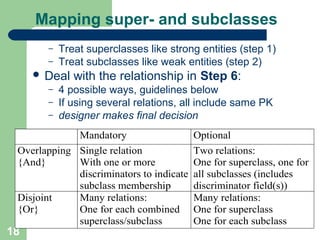
Mapping super- and subclasses
–
–

Treat superclasses like strong entities (step 1)
Treat subclasses like weak entities (step 2)

 Deal
–
–
–

with the relationship in Step 6:

4 possible ways, guidelines below
If using several relations, all include same PK
designer makes final decision
Mandatory

Overlapping Single relation
{And}
With one or more
discriminators to indicate
subclass membership
Disjoint
Many relations:
{Or}
One for each combined
superclass/subclass

18

Optional
Two relations:
One for superclass, one for
all subclasses (includes
discriminator field(s))
Many relations:
One for superclass
One for each subclass
R eader

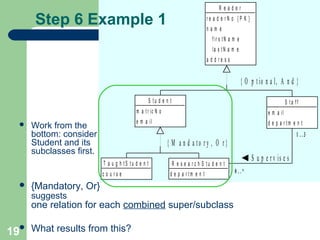
Step 6 Example 1

re a d e rN o {P K }
nam e
f ir s t N a m e
la s t N a m e
a d d re s s

{ O p t io n a l, A n d }
S tu d e n t

S ta ff

m a t r ic N o


e m a il

Work from the
bottom: consider
Student and its
subclasses first.

e m a il
d e p a r tm e n t

{ M a n d a to ry , O r}
T a u g h tS tu d e n t

R e s e a r c h S tu d e n t

c o u rs e



1 ..3

d e p a rtm e n t

{Mandatory, Or}
suggests

one relation for each combined super/subclass

19 What results from this?

S u p e r v is e s
0 ..*
R eader

Step 6 ctd

re a d e rN o {P K }
nam e
f ir s t N a m e
la s t N a m e
a d d re ss

{ O p t io n a l, A n d }
T a u g h tS tu d e n t

R e s e a r c h S tu d e n t

m a t r ic N o
e m a il
c o u rse

m a t r ic N o
e m a il
d e p a rtm e n t

S ta ff
e m a il
d e p a rtm e n t
1 ..3

0 ..*




20

S u p e r v is e s

Now deal with Reader superclass
From previous work, this currently has three subclasses:
Staff,
TaughtStudent,
ResearchStudent
R eader

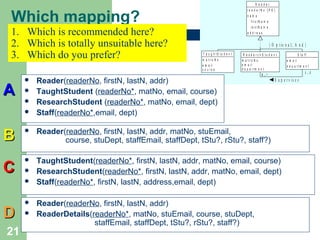
Which mapping?
1. Which is recommended here?
2. Which is totally unsuitable here?
3. Which do you prefer?

A






re a d e rN o {P K }
nam e
f ir s t N a m e
la s t N a m e
a d d re s s

{ O p t io n a l, A n d }
T a u g h tS tu d e n t

R e s e a rc h S tu d e n t

m a t r ic N o
e m a il
c o u rs e

m a t r ic N o
e m a il
d e p a r tm e n t

Reader(readerNo, firstN, lastN, addr)
TaughtStudent (readerNo*, matNo, email, course)
ResearchStudent (readerNo*, matNo, email, dept)
Staff(readerNo*,email, dept)

d e p a rtm e n t
1 ..3

0 ..*

S u p e r v is e s

B



Reader(readerNo, firstN, lastN, addr, matNo, stuEmail,
course, stuDept, staffEmail, staffDept, tStu?, rStu?, staff?)

C



TaughtStudent(readerNo*, firstN, lastN, addr, matNo, email, course)
ResearchStudent(readerNo*, firstN, lastN, addr, matNo, email, dept)
Staff(readerNo*, firstN, lastN, address,email, dept)




D
21




Reader(readerNo, firstN, lastN, addr)
ReaderDetails(readerNo*, matNo, stuEmail, course, stuDept,
staffEmail, staffDept, tStu?, rStu?, staff?)

S ta ff
e m a il
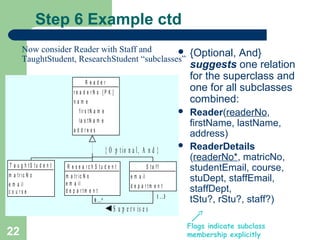
Step 6 Example ctd
Now consider Reader with Staff and

TaughtStudent, ResearchStudent “subclasses”
R eader
re a d e rN o {P K }
nam e
f ir s t N a m e



la s t N a m e
a d d re s s

{ O p t io n a l, A n d }
T a u g h tS tu d e n t

R e s e a rc h S tu d e n t

m a t r ic N o
e m a il
c o u rs e

m a t r ic N o
e m a il
d e p a rtm e n t

S ta ff
e m a il
d e p a r tm e n t
1 ..3

0 ..*

S u p e r v is e s

22



{Optional, And}
suggests one relation
for the superclass and
one for all subclasses
combined:
Reader(readerNo,
firstName, lastName,
address)
ReaderDetails
(readerNo*, matricNo,
studentEmail, course,
stuDept, staffEmail,
staffDept,
tStu?, rStu?, staff?)
Flags indicate subclass
membership explicitly
Step 6 Example ctd



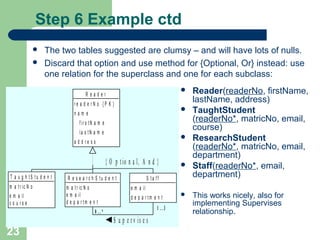
The two tables suggested are clumsy – and will have lots of nulls.
Discard that option and use method for {Optional, Or} instead: use
one relation for the superclass and one for each subclass:


Reader
re a d e rN o {P K }



nam e
f ir s t N a m e
la s t N a m e



a d d re s s

{ O p t io n a l, A n d }
T a u g h tS tu d e n t

R e s e a r c h S tu d e n t

m a t r ic N o
e m a il
c o u rs e

m a t r ic N o
e m a il
d e p a rtm e n t

S ta ff
e m a il
d e p a rtm e n t
1 ..3

0 ..*

23



S u p e r v is e s



Reader(readerNo, firstName,
lastName, address)
TaughtStudent
(readerNo*, matricNo, email,
course)
ResearchStudent
(readerNo*, matricNo, email,
department)
Staff(readerNo*, email,
department)
This works nicely, also for
implementing Supervises
relationship.
Example Summary
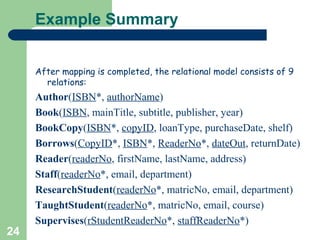
After mapping is completed, the relational model consists of 9
relations:

24

Author(ISBN*, authorName)
Book(ISBN, mainTitle, subtitle, publisher, year)
BookCopy(ISBN*, copyID, loanType, purchaseDate, shelf)
Borrows(CopyID*, ISBN*, ReaderNo*, dateOut, returnDate)
Reader(readerNo, firstName, lastName, address)
Staff(readerNo*, email, department)
ResearchStudent(readerNo*, matricNo, email, department)
TaughtStudent(readerNo*, matricNo, email, course)
Supervises(rStudentReaderNo*, staffReaderNo*)
Key Points


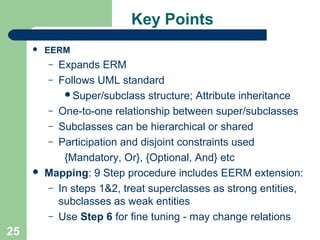
EERM

Expands ERM
– Follows UML standard
Super/subclass structure; Attribute inheritance
– One-to-one relationship between super/subclasses
– Subclasses can be hierarchical or shared
– Participation and disjoint constraints used
{Mandatory, Or}, {Optional, And} etc
Mapping: 9 Step procedure includes EERM extension:
– In steps 1&2, treat superclasses as strong entities,
subclasses as weak entities
– Use Step 6 for fine tuning - may change relations
–



25
Reading
 Connolly
–
–

Chapter 7 for ERM
Chapter 11 for Enhanced ERM

 Connolly
–
–
–



–
–

26

and Begg “Database Systems”

Chapter 11 for ERM
Chapter 12 for Enhanced ERM
Chapter 16 for mapping

Rob et al "Database Systems"
–



and Begg “Database Solutions”

Chapter 5 for ERM
Chapter 6 for EERM
Chapter 11.2 for mapping

Any other database main text book will offer help but will use a
slightly different notation
What’s coming up?
 After
–

completing (E)ERM modelling ….

We look at Normalisation
 Any

database textbook will have a chapter on this

 We

shall then go back into Oracle
 And really start learning SQL
 Coming up later:
–

–

27

There will be a class test covering modelling,
mapping and normalisation held either just before or
just after Christmas
You will be allowed to bring one A4 sheet of notes
(double-sided)

Eerm mapping c++

  • 1.
    SA0951a Enhanced Entity-Relationship Modelling (EERM) and Mapping Reading: e.g. Connolly/Begg (4thed): Chapter 12 – Enhanced ERM; Mapping: “Step 6” Rob et al: Chapter 6.1 (Advanced data modelling), Chapter 11.2 "Step 6". 1
  • 2.
    Some limitations ofERMs  ERM’s are fine for traditional applications  But what about complex databases? – CAD/CAM, GIS, OIS etc  Enhanced concepts – – 2 ERM (EERM) supports additional Specialisation/generalisation Uses the UML notation
  • 3.
    Specialisation/Generalisation  Ties into ObjectOriented design  This extension uses – – – – Superclasses Subclasses Attribute inheritance Constraints  Participation  Disjoint 3
  • 4.
    Super/Subclasses  Generalisation – An entitywith one or more distinct subgroupings  Specialisation – is the Superclass concept is the Subclass concept An entity of a distinct subgrouping Superclass Staff  FullTime 4 PartTime Subclasses
  • 5.
    Continued …..  Staff – – With2 subclasses The relationship is ONE-TO-ONE  The – – – – has a superclass/subclass relationship super/subclass structure Avoids modelling different attributes in the same entity Avoids therefore nulls Models common attributes in the superclass Models unshared attributes in the subclasses Staff  5 FullTime PartTime
  • 6.
    A word onAttribute Inheritance Which attributes are Inherited by Entity1.3.2? Entity1 A B C  Entity1.1 D E F Entity1.2 G H Entity1.3 I J  Entity1.3.1 K 6 A) A,B,C,I,J B) I,J C) A,B,C D) L Entity1.3.2 L
  • 7.
  • 8.
    Poor Example 1 Staff id name age  Full-Time salary sex 8 generalisation Part-Time hourlyRate sex WHYis this a poor example? A salary should be in the Staff entity specialisation B sex should be in the Staff entity C name and age should be in both sub-classes D There shouldn’t be two sub-classes
  • 9.
  • 10.
    Constraints  Participation –     10 A subclass memberis always also a member of the superclass Mandatory participation (of a superclass member in a subclass member):  A superclass member must be a member of a subclass Optional participation (of a superclass member in a subclass member):  A superclass member need not be a member of any subclass Disjoint {OR} – When a superclass member is a member of only one subclass Non-disjoint {AND} – A superclass member may a member of more than one subclass (also called overlapping)
  • 11.
    Constraints continued …     Disjointrepresented by an ‘OR’ Non-disjoint (overlapping) represented by ‘AND’ Disjoint constraint only used for a hierarchy with more than one subclass So 4 possibilities for constraints shown on EERM: – {Mandatory, OR}  – {Mandatory, AND}  – May belong to one subclass or none {Optional, AND}  11 Must belong to one or more subclasses {Optional, OR}  – Must belong to exactly one subclass May belong to any number of subclasses
  • 12.
  • 13.
    If the logicchanged to ….. Staff id name Age  Full-Time Salary holidays 13 {Optional, OR} Part-Time hourlyRate contractType Which statement is correct? A a member of staff may be full and part time B a member of staff has to be at least part-time C a member of staff must be neither full nor part-time D a member of staff may be either full or part time
  • 14.
    Example Which of theseis true? A) A reader could be both Student and Staff B) A student could be taught and research C) Every reader is a member of Staff D) A student is always a research student R eader re a d e rN o {P K } nam e f ir s t N a m e la s t N a m e a d d re s s { O p t io n a l, A n d } S tu d e n t S ta ff m a t r ic N o e m a il e m a il d e p a rtm e n t 1 ..3 { M a n d a to ry , O r} T a u g h tS tu d e n t c o u rs e 14 R e s e a rc h S tu d e n t d e p a rtm e n t S u p e r v is e s 0 ..*
  • 15.
    Example ctd Which ofthese is true? A) ResearchStudent is a subclass of Staff B) Staff is a superclass of ResearchStudent C) Staff may supervise TaughtStudent D) A ResearchStudent must be supervised by up to 3 Staff R eader re a d e rN o {P K } nam e f ir s t N a m e la s t N a m e a d d re s s { O p t io n a l, A n d } S tu d e n t S ta ff m a t r ic N o e m a il e m a il d e p a rtm e n t 1 ..3 { M a n d a to ry , O r} T a u g h tS tu d e n t c o u rs e 15 R e s e a rc h S tu d e n t d e p a rtm e n t S u p e r v is e s 0 ..*
  • 16.
    Example explanation  R eader Areader may be re a d e rN o {P K } student, staff, or nam e both, but need not f ir s t N a m e be either  la s t N a m e a d d re s s Each Student must be either a taught or { O p t io n a l, A n d } a research student  S tu d e n t Each research student has one to three supervisors S ta ff m a t r ic N o e m a il e m a il d e p a rtm e n t 1 ..3 { M a n d a to ry , O r} T a u g h tS tu d e n t c o u rs e 16 R e s e a rc h S tu d e n t d e p a rtm e n t S u p e r v is e s 0 ..*
  • 17.
    Example: Library EERM Book BookCopy H as IS B N { P K } a u th o r [1 ..*] t it le m a in T it le 1 c o p y ID { P P K } 1 . . 2 0 lo a n T y p e R eader B o rro w s 0 ..* 0 ..* p u r c h a s e D a te s u b T it le re tu rn D a te p u b lis h e r year nam e f ir s t N a m e d a te O u t s h e lf re a d e rN o {P K } d u e D a te la s t N a m e a d d re s s f in e { O p tio n al, A n d } S tu d e n t We have already mapped most of this – so how do we map the super- and subclasses? 17 S ta ff m a t r ic N o e m a il e m a il d e p a rtm e n t 1 ..3 { M an d ato ry , O r} T a u g h tS tu d e n t R e s e a r c h S tu d e n t c o u rs e d e p a r tm e n t S u p e rvis e s 0 ..*
  • 18.
    Mapping super- andsubclasses – – Treat superclasses like strong entities (step 1) Treat subclasses like weak entities (step 2)  Deal – – – with the relationship in Step 6: 4 possible ways, guidelines below If using several relations, all include same PK designer makes final decision Mandatory Overlapping Single relation {And} With one or more discriminators to indicate subclass membership Disjoint Many relations: {Or} One for each combined superclass/subclass 18 Optional Two relations: One for superclass, one for all subclasses (includes discriminator field(s)) Many relations: One for superclass One for each subclass
  • 19.
    R eader Step 6Example 1 re a d e rN o {P K } nam e f ir s t N a m e la s t N a m e a d d re s s { O p t io n a l, A n d } S tu d e n t S ta ff m a t r ic N o  e m a il Work from the bottom: consider Student and its subclasses first. e m a il d e p a r tm e n t { M a n d a to ry , O r} T a u g h tS tu d e n t R e s e a r c h S tu d e n t c o u rs e  1 ..3 d e p a rtm e n t {Mandatory, Or} suggests one relation for each combined super/subclass 19 What results from this? S u p e r v is e s 0 ..*
  • 20.
    R eader Step 6ctd re a d e rN o {P K } nam e f ir s t N a m e la s t N a m e a d d re ss { O p t io n a l, A n d } T a u g h tS tu d e n t R e s e a r c h S tu d e n t m a t r ic N o e m a il c o u rse m a t r ic N o e m a il d e p a rtm e n t S ta ff e m a il d e p a rtm e n t 1 ..3 0 ..*    20 S u p e r v is e s Now deal with Reader superclass From previous work, this currently has three subclasses: Staff, TaughtStudent, ResearchStudent
  • 21.
    R eader Which mapping? 1.Which is recommended here? 2. Which is totally unsuitable here? 3. Which do you prefer? A     re a d e rN o {P K } nam e f ir s t N a m e la s t N a m e a d d re s s { O p t io n a l, A n d } T a u g h tS tu d e n t R e s e a rc h S tu d e n t m a t r ic N o e m a il c o u rs e m a t r ic N o e m a il d e p a r tm e n t Reader(readerNo, firstN, lastN, addr) TaughtStudent (readerNo*, matNo, email, course) ResearchStudent (readerNo*, matNo, email, dept) Staff(readerNo*,email, dept) d e p a rtm e n t 1 ..3 0 ..* S u p e r v is e s B  Reader(readerNo, firstN, lastN, addr, matNo, stuEmail, course, stuDept, staffEmail, staffDept, tStu?, rStu?, staff?) C  TaughtStudent(readerNo*, firstN, lastN, addr, matNo, email, course) ResearchStudent(readerNo*, firstN, lastN, addr, matNo, email, dept) Staff(readerNo*, firstN, lastN, address,email, dept)   D 21   Reader(readerNo, firstN, lastN, addr) ReaderDetails(readerNo*, matNo, stuEmail, course, stuDept, staffEmail, staffDept, tStu?, rStu?, staff?) S ta ff e m a il
  • 22.
    Step 6 Examplectd Now consider Reader with Staff and  TaughtStudent, ResearchStudent “subclasses” R eader re a d e rN o {P K } nam e f ir s t N a m e  la s t N a m e a d d re s s { O p t io n a l, A n d } T a u g h tS tu d e n t R e s e a rc h S tu d e n t m a t r ic N o e m a il c o u rs e m a t r ic N o e m a il d e p a rtm e n t S ta ff e m a il d e p a r tm e n t 1 ..3 0 ..* S u p e r v is e s 22  {Optional, And} suggests one relation for the superclass and one for all subclasses combined: Reader(readerNo, firstName, lastName, address) ReaderDetails (readerNo*, matricNo, studentEmail, course, stuDept, staffEmail, staffDept, tStu?, rStu?, staff?) Flags indicate subclass membership explicitly
  • 23.
    Step 6 Examplectd   The two tables suggested are clumsy – and will have lots of nulls. Discard that option and use method for {Optional, Or} instead: use one relation for the superclass and one for each subclass:  Reader re a d e rN o {P K }  nam e f ir s t N a m e la s t N a m e  a d d re s s { O p t io n a l, A n d } T a u g h tS tu d e n t R e s e a r c h S tu d e n t m a t r ic N o e m a il c o u rs e m a t r ic N o e m a il d e p a rtm e n t S ta ff e m a il d e p a rtm e n t 1 ..3 0 ..* 23  S u p e r v is e s  Reader(readerNo, firstName, lastName, address) TaughtStudent (readerNo*, matricNo, email, course) ResearchStudent (readerNo*, matricNo, email, department) Staff(readerNo*, email, department) This works nicely, also for implementing Supervises relationship.
  • 24.
    Example Summary After mappingis completed, the relational model consists of 9 relations: 24 Author(ISBN*, authorName) Book(ISBN, mainTitle, subtitle, publisher, year) BookCopy(ISBN*, copyID, loanType, purchaseDate, shelf) Borrows(CopyID*, ISBN*, ReaderNo*, dateOut, returnDate) Reader(readerNo, firstName, lastName, address) Staff(readerNo*, email, department) ResearchStudent(readerNo*, matricNo, email, department) TaughtStudent(readerNo*, matricNo, email, course) Supervises(rStudentReaderNo*, staffReaderNo*)
  • 25.
    Key Points  EERM Expands ERM –Follows UML standard Super/subclass structure; Attribute inheritance – One-to-one relationship between super/subclasses – Subclasses can be hierarchical or shared – Participation and disjoint constraints used {Mandatory, Or}, {Optional, And} etc Mapping: 9 Step procedure includes EERM extension: – In steps 1&2, treat superclasses as strong entities, subclasses as weak entities – Use Step 6 for fine tuning - may change relations –  25
  • 26.
    Reading  Connolly – – Chapter 7for ERM Chapter 11 for Enhanced ERM  Connolly – – –  – – 26 and Begg “Database Systems” Chapter 11 for ERM Chapter 12 for Enhanced ERM Chapter 16 for mapping Rob et al "Database Systems" –  and Begg “Database Solutions” Chapter 5 for ERM Chapter 6 for EERM Chapter 11.2 for mapping Any other database main text book will offer help but will use a slightly different notation
  • 27.
    What’s coming up? After – completing (E)ERM modelling …. We look at Normalisation  Any database textbook will have a chapter on this  We shall then go back into Oracle  And really start learning SQL  Coming up later: – – 27 There will be a class test covering modelling, mapping and normalisation held either just before or just after Christmas You will be allowed to bring one A4 sheet of notes (double-sided)