LEASE FINANCING


     Prepared By-:
                     A.M.KADARI
Definition:

Definition:
 Leasing is a contractual arrangement , where
 The owner (Lessor) of the Asset(Equipment)
 Transfers the possession / right to use the Asset(Equipment)
  to another(Lessee)
 For an agreed period of time in return for rental.
Essential Elements of Leasing
Parties to a Lease Contract: Essentially two parties
 Lessor – is the owner of the asset that is being Leased.
 Lessee – is the receiver of the services of the asset under a
  Lease contract.
 Lessor and Lessee can be Individual or legally recognised
  party.
 The lessor is either the asset’s manufacturer or an
  independent leasing company
 Lease broker – big ticket Leases use him.
 Major Players in Lease Market:
    Banks- Indian & Foreign /FIs
    subsidiaries of Banks/FIs,
    NBFCs
Essential Elements of Leasing
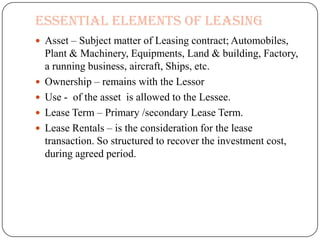
 Asset – Subject matter of Leasing contract; Automobiles,
    Plant & Machinery, Equipments, Land & building, Factory,
    a running business, aircraft, Ships, etc.
   Ownership – remains with the Lessor
   Use - of the asset is allowed to the Lessee.
   Lease Term – Primary /secondary Lease Term.
   Lease Rentals – is the consideration for the lease
    transaction. So structured to recover the investment cost,
    during agreed period.
TYPES OF LEASING

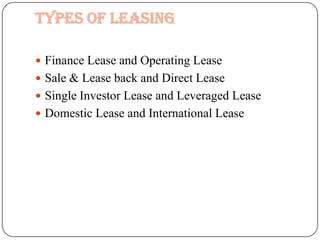
 Finance Lease and Operating Lease
 Sale & Lease back and Direct Lease
 Single Investor Lease and Leveraged Lease
 Domestic Lease and International Lease
Finance Lease
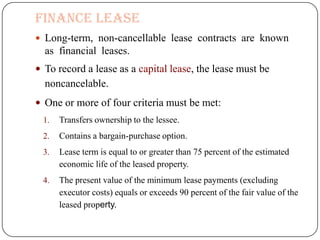
 Long-term, non-cancellable lease contracts are known
  as financial leases.
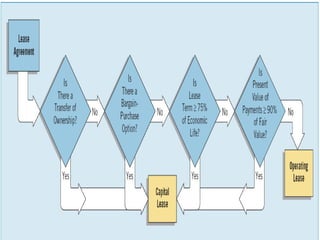
 To record a lease as a capital lease, the lease must be
  noncancelable.
 One or more of four criteria must be met:
 1.   Transfers ownership to the lessee.
 2.   Contains a bargain-purchase option.
 3.   Lease term is equal to or greater than 75 percent of the estimated
      economic life of the leased property.
 4.   The present value of the minimum lease payments (excluding
      executor costs) equals or exceeds 90 percent of the fair value of the
      leased property.
Features of Financial Service
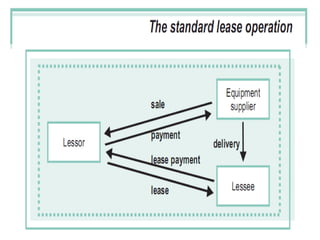
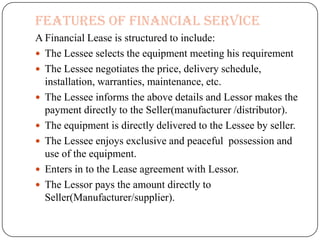
A Financial Lease is structured to include:
 The Lessee selects the equipment meeting his requirement
 The Lessee negotiates the price, delivery schedule,
  installation, warranties, maintenance, etc.
 The Lessee informs the above details and Lessor makes the
  payment directly to the Seller(manufacturer /distributor).
 The equipment is directly delivered to the Lessee by seller.
 The Lessee enjoys exclusive and peaceful possession and
  use of the equipment.
 Enters in to the Lease agreement with Lessor.
 The Lessor pays the amount directly to
  Seller(Manufacturer/supplier).
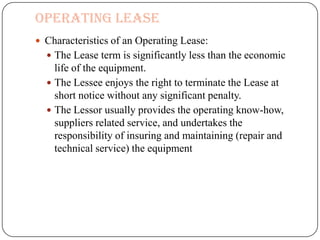
Operating Lease
 Characteristics of an Operating Lease:
   The Lease term is significantly less than the economic
    life of the equipment.
   The Lessee enjoys the right to terminate the Lease at
    short notice without any significant penalty.
   The Lessor usually provides the operating know-how,
    suppliers related service, and undertakes the
    responsibility of insuring and maintaining (repair and
    technical service) the equipment
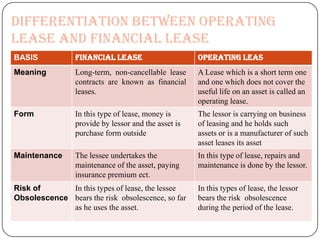
Differentiation Between Operating
lease and Financial lease
BASIS            Financial Lease                      Operating leas
Meaning          Long-term, non-cancellable lease     A Lease which is a short term one
                 contracts are known as financial     and one which does not cover the
                 leases.                              useful life on an asset is called an
                                                      operating lease.
Form             In this type of lease, money is      The lessor is carrying on business
                 provide by lessor and the asset is   of leasing and he holds such
                 purchase form outside                assets or is a manufacturer of such
                                                      asset leases its asset
Maintenance      The lessee undertakes the            In this type of lease, repairs and
                 maintenance of the asset, paying     maintenance is done by the lessor.
                 insurance premium ect.
Risk of      In this types of lease, the lessee       In this types of lease, the lessor
Obsolescence bears the risk obsolescence, so far      bears the risk obsolescence
             as he uses the asset.                    during the period of the lease.
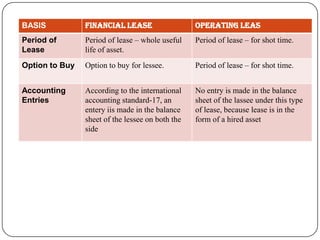
BASIS           Financial Lease                   Operating leas
Period of       Period of lease – whole useful    Period of lease – for shot time.
Lease           life of asset.
Option to Buy   Option to buy for lessee.         Period of lease – for shot time.


Accounting      According to the international    No entry is made in the balance
Entries         accounting standard-17, an        sheet of the lassee under this type
                entery iis made in the balance    of lease, because lease is in the
                sheet of the lessee on both the   form of a hired asset
                side
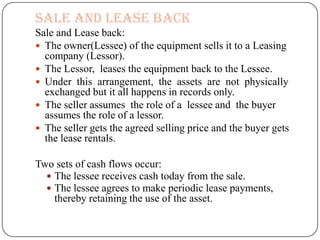
Sale and Lease back
Sale and Lease back:
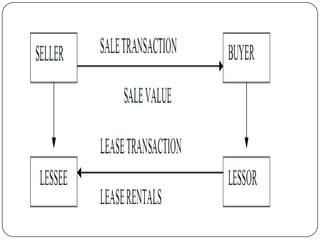
 The owner(Lessee) of the equipment sells it to a Leasing
  company (Lessor).
 The Lessor, leases the equipment back to the Lessee.
 Under this arrangement, the assets are not physically
  exchanged but it all happens in records only.
 The seller assumes the role of a lessee and the buyer
  assumes the role of a lessor.
 The seller gets the agreed selling price and the buyer gets
  the lease rentals.

Two sets of cash flows occur:
   The lessee receives cash today from the sale.
   The lessee agrees to make periodic lease payments,
    thereby retaining the use of the asset.
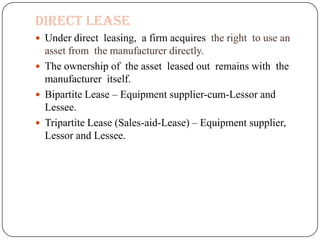
Direct Lease
 Under direct leasing, a firm acquires the right to use an
  asset from the manufacturer directly.
 The ownership of the asset leased out remains with the
  manufacturer itself.
 Bipartite Lease – Equipment supplier-cum-Lessor and
  Lessee.
 Tripartite Lease (Sales-aid-Lease) – Equipment supplier,
  Lessor and Lessee.
Single Investor Lease

 • Only two parties – Lessor and Lessee.
 • Leasing company (Lessor) funds the entire investment,
   having appropriate mix of Equity-cum-Debt.
 • Finance raised by the Lessor, is without recourse to the
   Lessee.
Leveraged Lease
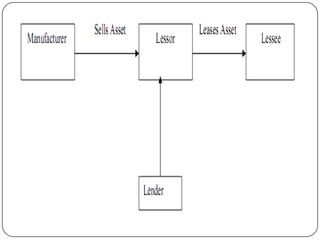
Leveraged Lease:
      3 parties to the transaction.
      Lessor ( Equity investor)
      Lender
      Lessee.
 The Leasing company (Equity investor)
   buys the equipment, through substantial borrowing, and
   with full recourse to the Lessee and without recourse to it.
 The Lender obtains an assignment of the Lease and a first
  mortgage of the equipment.
Domestic Lease and
International Lease


 When a lease agreement is made between citizen of same
  countries, it is called Domestic lease
 When a lease agreement is made between citizen of
  different countries, it is called International lease
Advantages of Leasing
 Provides full Finance
 Flexible
 Saves from Recurring cost of finance
 Absence of restrictions
 Tax Benefits
 Increases the capacity to borrow
 Useful in case of fast changing technology
 Faster and Cheaper credit
Limitations of Leasing

 No Benefit of Residual Value
 High cost of leaseing
 No benefit of ownership
 Not Flexible
 Disputes
Factors affecting Leasing
Decisions
 Availability of cash
 Effect on Borrowing Capacity
 Shifting the Risk of Obsolescence
 Convenient Arrangement
 Less Restrictions on Firm
 Salvage Value
 Tax Benefits
 Leas Expenses
Institutions In the field of
Leaseing
 All India Financial Institutions
 Leasing Companies
 Banks
 Financial Companies
 Industrial Groups having Leasing Companies
Difficulties Faced by Leasing
Companies in India
 Competition
 Lack of Trained Employees
 Proportion of Debt-Equity not maintained
 Lack of Provision for Depreciation
 Low Investment of Promoters
 Shortage of Funds
 Inefficiency of Management
 Government Attitude
LEASING IN INDIA
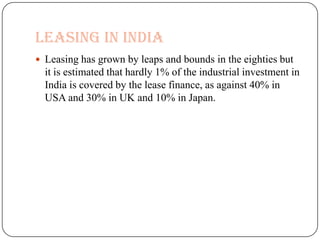
 Leasing has grown by leaps and bounds in the eighties but
  it is estimated that hardly 1% of the industrial investment in
  India is covered by the lease finance, as against 40% in
  USA and 30% in UK and 10% in Japan.
DIFFERENCE BETWEEN LEASE FINANCING
AND HIRE PURCHASE
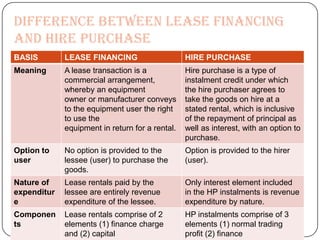
BASIS        LEASE FINANCING                     HIRE PURCHASE
Meaning      A lease transaction is a            Hire purchase is a type of
             commercial arrangement,             instalment credit under which
             whereby an equipment                the hire purchaser agrees to
             owner or manufacturer conveys       take the goods on hire at a
             to the equipment user the right     stated rental, which is inclusive
             to use the                          of the repayment of principal as
             equipment in return for a rental.   well as interest, with an option to
                                                 purchase.
Option to    No option is provided to the        Option is provided to the hirer
user         lessee (user) to purchase the       (user).
             goods.
Nature of    Lease rentals paid by the           Only interest element included
expenditur   lessee are entirely revenue         in the HP instalments is revenue
e            expenditure of the lessee.          expenditure by nature.
Componen     Lease rentals comprise of 2         HP instalments comprise of 3
ts           elements (1) finance charge         elements (1) normal trading
             and (2) capital                     profit (2) finance
Any
 ?
THANK YOU

Leaseing 1

  • 1.
    LEASE FINANCING Prepared By-: A.M.KADARI
  • 2.
    Definition: Definition:  Leasing isa contractual arrangement , where  The owner (Lessor) of the Asset(Equipment)  Transfers the possession / right to use the Asset(Equipment) to another(Lessee)  For an agreed period of time in return for rental.
  • 3.
    Essential Elements ofLeasing Parties to a Lease Contract: Essentially two parties  Lessor – is the owner of the asset that is being Leased.  Lessee – is the receiver of the services of the asset under a Lease contract.  Lessor and Lessee can be Individual or legally recognised party.  The lessor is either the asset’s manufacturer or an independent leasing company  Lease broker – big ticket Leases use him.  Major Players in Lease Market:  Banks- Indian & Foreign /FIs  subsidiaries of Banks/FIs,  NBFCs
  • 4.
    Essential Elements ofLeasing  Asset – Subject matter of Leasing contract; Automobiles, Plant & Machinery, Equipments, Land & building, Factory, a running business, aircraft, Ships, etc.  Ownership – remains with the Lessor  Use - of the asset is allowed to the Lessee.  Lease Term – Primary /secondary Lease Term.  Lease Rentals – is the consideration for the lease transaction. So structured to recover the investment cost, during agreed period.
  • 5.
    TYPES OF LEASING Finance Lease and Operating Lease  Sale & Lease back and Direct Lease  Single Investor Lease and Leveraged Lease  Domestic Lease and International Lease
  • 7.
    Finance Lease  Long-term,non-cancellable lease contracts are known as financial leases.  To record a lease as a capital lease, the lease must be noncancelable.  One or more of four criteria must be met: 1. Transfers ownership to the lessee. 2. Contains a bargain-purchase option. 3. Lease term is equal to or greater than 75 percent of the estimated economic life of the leased property. 4. The present value of the minimum lease payments (excluding executor costs) equals or exceeds 90 percent of the fair value of the leased property.
  • 9.
    Features of FinancialService A Financial Lease is structured to include:  The Lessee selects the equipment meeting his requirement  The Lessee negotiates the price, delivery schedule, installation, warranties, maintenance, etc.  The Lessee informs the above details and Lessor makes the payment directly to the Seller(manufacturer /distributor).  The equipment is directly delivered to the Lessee by seller.  The Lessee enjoys exclusive and peaceful possession and use of the equipment.  Enters in to the Lease agreement with Lessor.  The Lessor pays the amount directly to Seller(Manufacturer/supplier).
  • 10.
    Operating Lease  Characteristicsof an Operating Lease:  The Lease term is significantly less than the economic life of the equipment.  The Lessee enjoys the right to terminate the Lease at short notice without any significant penalty.  The Lessor usually provides the operating know-how, suppliers related service, and undertakes the responsibility of insuring and maintaining (repair and technical service) the equipment
  • 11.
    Differentiation Between Operating leaseand Financial lease BASIS Financial Lease Operating leas Meaning Long-term, non-cancellable lease A Lease which is a short term one contracts are known as financial and one which does not cover the leases. useful life on an asset is called an operating lease. Form In this type of lease, money is The lessor is carrying on business provide by lessor and the asset is of leasing and he holds such purchase form outside assets or is a manufacturer of such asset leases its asset Maintenance The lessee undertakes the In this type of lease, repairs and maintenance of the asset, paying maintenance is done by the lessor. insurance premium ect. Risk of In this types of lease, the lessee In this types of lease, the lessor Obsolescence bears the risk obsolescence, so far bears the risk obsolescence as he uses the asset. during the period of the lease.
  • 12.
    BASIS Financial Lease Operating leas Period of Period of lease – whole useful Period of lease – for shot time. Lease life of asset. Option to Buy Option to buy for lessee. Period of lease – for shot time. Accounting According to the international No entry is made in the balance Entries accounting standard-17, an sheet of the lassee under this type entery iis made in the balance of lease, because lease is in the sheet of the lessee on both the form of a hired asset side
  • 13.
    Sale and Leaseback Sale and Lease back:  The owner(Lessee) of the equipment sells it to a Leasing company (Lessor).  The Lessor, leases the equipment back to the Lessee.  Under this arrangement, the assets are not physically exchanged but it all happens in records only.  The seller assumes the role of a lessee and the buyer assumes the role of a lessor.  The seller gets the agreed selling price and the buyer gets the lease rentals. Two sets of cash flows occur:  The lessee receives cash today from the sale.  The lessee agrees to make periodic lease payments, thereby retaining the use of the asset.
  • 15.
    Direct Lease  Underdirect leasing, a firm acquires the right to use an asset from the manufacturer directly.  The ownership of the asset leased out remains with the manufacturer itself.  Bipartite Lease – Equipment supplier-cum-Lessor and Lessee.  Tripartite Lease (Sales-aid-Lease) – Equipment supplier, Lessor and Lessee.
  • 16.
    Single Investor Lease • Only two parties – Lessor and Lessee. • Leasing company (Lessor) funds the entire investment, having appropriate mix of Equity-cum-Debt. • Finance raised by the Lessor, is without recourse to the Lessee.
  • 17.
    Leveraged Lease Leveraged Lease:  3 parties to the transaction.  Lessor ( Equity investor)  Lender  Lessee.  The Leasing company (Equity investor)  buys the equipment, through substantial borrowing, and  with full recourse to the Lessee and without recourse to it.  The Lender obtains an assignment of the Lease and a first mortgage of the equipment.
  • 19.
    Domestic Lease and InternationalLease  When a lease agreement is made between citizen of same countries, it is called Domestic lease  When a lease agreement is made between citizen of different countries, it is called International lease
  • 20.
    Advantages of Leasing Provides full Finance  Flexible  Saves from Recurring cost of finance  Absence of restrictions  Tax Benefits  Increases the capacity to borrow  Useful in case of fast changing technology  Faster and Cheaper credit
  • 21.
    Limitations of Leasing No Benefit of Residual Value  High cost of leaseing  No benefit of ownership  Not Flexible  Disputes
  • 22.
    Factors affecting Leasing Decisions Availability of cash  Effect on Borrowing Capacity  Shifting the Risk of Obsolescence  Convenient Arrangement  Less Restrictions on Firm  Salvage Value  Tax Benefits  Leas Expenses
  • 23.
    Institutions In thefield of Leaseing  All India Financial Institutions  Leasing Companies  Banks  Financial Companies  Industrial Groups having Leasing Companies
  • 24.
    Difficulties Faced byLeasing Companies in India  Competition  Lack of Trained Employees  Proportion of Debt-Equity not maintained  Lack of Provision for Depreciation  Low Investment of Promoters  Shortage of Funds  Inefficiency of Management  Government Attitude
  • 25.
    LEASING IN INDIA Leasing has grown by leaps and bounds in the eighties but it is estimated that hardly 1% of the industrial investment in India is covered by the lease finance, as against 40% in USA and 30% in UK and 10% in Japan.
  • 26.
    DIFFERENCE BETWEEN LEASEFINANCING AND HIRE PURCHASE BASIS LEASE FINANCING HIRE PURCHASE Meaning A lease transaction is a Hire purchase is a type of commercial arrangement, instalment credit under which whereby an equipment the hire purchaser agrees to owner or manufacturer conveys take the goods on hire at a to the equipment user the right stated rental, which is inclusive to use the of the repayment of principal as equipment in return for a rental. well as interest, with an option to purchase. Option to No option is provided to the Option is provided to the hirer user lessee (user) to purchase the (user). goods. Nature of Lease rentals paid by the Only interest element included expenditur lessee are entirely revenue in the HP instalments is revenue e expenditure of the lessee. expenditure by nature. Componen Lease rentals comprise of 2 HP instalments comprise of 3 ts elements (1) finance charge elements (1) normal trading and (2) capital profit (2) finance
  • 27.
  • 28.