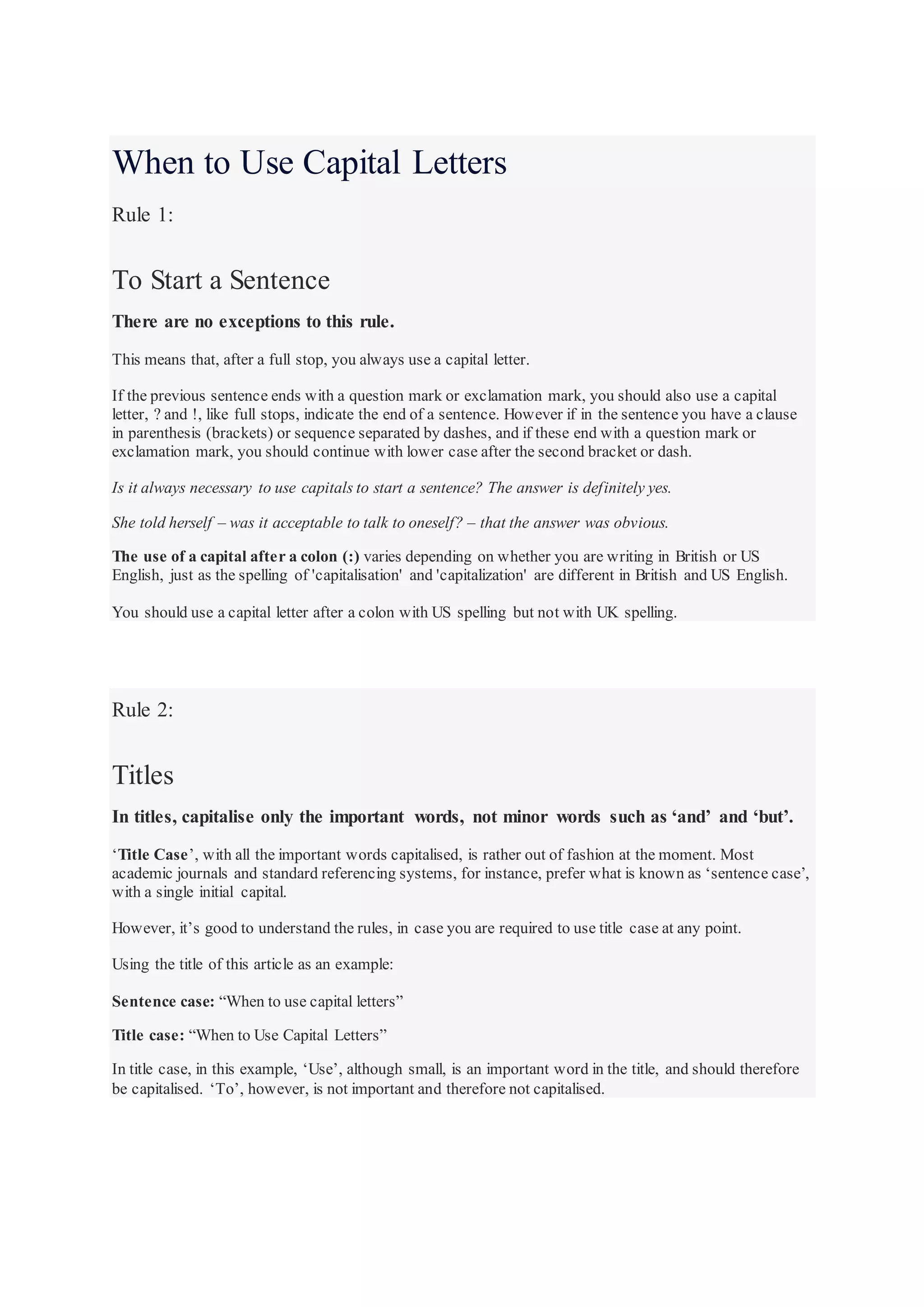
When to Use Capital Letters
Rule 1:
To Start a Sentence
There are no exceptions to this rule.
This means that, after a full stop, you always use a capital letter.
If the previous sentence ends with a question mark or exclamation mark, you should also use a capital
letter, ? and !, like full stops, indicate the end of a sentence. However if in the sentence you have a clause
in parenthesis (brackets) or sequence separated by dashes, and if these end with a question mark or
exclamation mark, you should continue with lower case after the second bracket or dash.
Is it always necessary to use capitals to start a sentence? The answer is definitely yes.
She told herself – was it acceptable to talk to oneself? – that the answer was obvious.
The use of a capital after a colon (:) varies depending on whether you are writing in British or US
English, just as the spelling of 'capitalisation' and 'capitalization' are different in British and US English.
You should use a capital letter after a colon with US spelling but not with UK spelling.
Rule 2:
Titles
In titles, capitalise only the important words, not minor words such as ‘and’ and ‘but’.
‘Title Case’, with all the important words capitalised, is rather out of fashion at the moment. Most
academic journals and standard referencing systems, for instance, prefer what is known as ‘sentence case’,
with a single initial capital.
However, it’s good to understand the rules, in case you are required to use title case at any point.
Using the title of this article as an example:
Sentence case: “When to use capital letters”
Title case: “When to Use Capital Letters”
In title case, in this example, ‘Use’, although small, is an important word in the title, and should therefore
be capitalised. ‘To’, however, is not important and therefore not capitalised.
Rule 3:
For Proper Nouns
Proper nouns name something specific, for example, Jane, John, Oxford University,
Denver, Qantas, Microsoft, Everest, Sahara. See our pages on Grammar for more
information.
Proper nouns (nearly) always start with a capital letter. There are exceptions to this rule and in
marketing sometimes lower-case characters are purposefully used for some proper nouns. Examples
include iPhone, eBay and oneworld Alliance. However, in most cases, proper nouns start with a capital
letter.
Caution is needed however, even when you are referring to a specific place or thing. If you use the more
general noun rather than the proper noun, this should not be capitalised.
Read more at: https://www.skillsyouneed.com/write/capital-letters.html
Further examples:
“I went to the University of Oxford today.”
“I went to Oxford today and had a look at the university.”
Capitalising is correct in both sentences. In the first the proper noun 'University of Oxford' is used.
In the second sentence, the more general noun ‘university’ is used and so it is not capitalised.
The word 'I' is not a proper noun, it's a pronoun. In English 'I' is always capitalised. In many other
languages the equivalent word is not capitalised.
Rule 4:
Acronyms
Acronyms generally work like title case: you capitalise the important words, and not
‘and’, ‘of’, ‘for’ and so on.
The easiest way to work this out is to write out the full title, and then you can see which words don’t need
to be capitalised.
To make this clear, here are some examples:
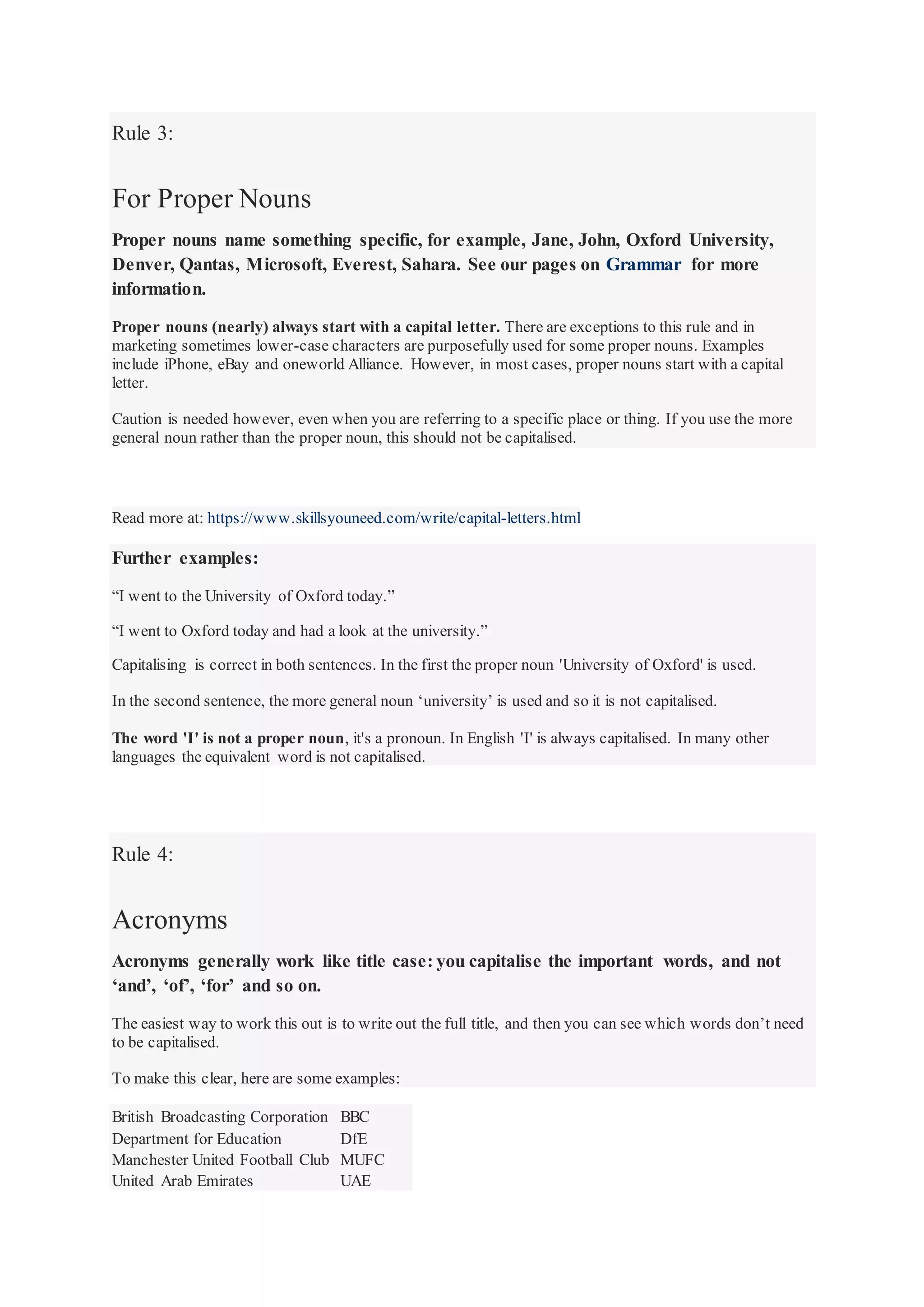
British Broadcasting Corporation BBC
Department for Education DfE
Manchester United Football Club MUFC
United Arab Emirates UAE
Ministry of Transport [test] MoT [test]
Head of Department HoD
World of Warcraft WoW
Rule 5:
Contractions
For contractions, capitalise the initial letters of words, but not subsequent letters within
the same word.
Contractions are like acronyms, but also include one or more letters from within the same word. Examples
of this include HiFi, which is short for ‘High Fidelity’, and SciFi, short for science fiction.
The way to deal with these is to write out the phrase and have a look. Although the words that are
abbreviated may not be capitalised, as in ‘science fiction’, the abbreviation always contains capitals for the
start of each new word to make the word boundaries and pronunciation clear. We frequently use
SkillsYouNeed, contracting the spaces but making the phrase easier to read.
WiFi
Many people wrongly assume that WiFi is a contraction of Wireless Fidelity. In
fact the word WiFi is an entirely made up word - a marketing invention and does
not stand for anything. It is, however, officially written as WiFi.
Rule 6:
Overusing Capitals is Rude
WRITING ENTIRELY IN BLOCK CAPITALS IS SHOUTING, and it’s rude.
We’ve all done it: left the Caps Lock on while typing. But in email etiquette, online chats and/or forum
posts, writing in capitals is the online equivalent of shouting. It’s rude, so best not to do it unless you really
do want to shout at someone. Even then, consider whether you’d really do it if that person was in front of
you, and also whether it will get you anywhere.
Although it’s usually best to avoid writing in capitals, it can be useful to write odd words in capitals to give
them emphasis. HELP! You're going to LOVE the surprise.
It’s also much harder to read block capitals as all the letters are the same height, so you will make your
point much more easily if you use lower case.
Sometimes, especially when completing a handwritten form, BLOCK CAPITALS are preferred since this
can make data entry or automatic computer recognition of handwriting easier and more accurate.
Some Computer Specifics
Email addresses (hello@skillsyouneed.com) and domain names
(skillsyouneed.com) never include capital letters. Most computer applications will
correct capital letters in email address or domain names to lower-case.
Web addresses, URLs, can however be case sensitive - although usual convention
is to use only lower case letters.
Passwords
It is usually a good idea to use both upper and lower case characters in computer
passwords as this makes them more secure. Passwords are usually case sensitive so
they need to be exactly right, hence paSSword is different to pAsswoRd. It is a
good idea to use numbers and special characters in passwords to make them even
more secure, for example - p@55w0r|].
One Final Word of Advice
Following these rules will generally help you to work out when to use capital letters.
If, however, you are still in doubt, Google the exact phrase, including capitals, and see what comes up.
Although some of what you find may be wrong, you can see the general consensus and that will probably
be acceptable.
Read more at: https://www.skillsyouneed.com/write/capital-letters.html

Use of capital letters

  • 1.
    When to UseCapital Letters Rule 1: To Start a Sentence There are no exceptions to this rule. This means that, after a full stop, you always use a capital letter. If the previous sentence ends with a question mark or exclamation mark, you should also use a capital letter, ? and !, like full stops, indicate the end of a sentence. However if in the sentence you have a clause in parenthesis (brackets) or sequence separated by dashes, and if these end with a question mark or exclamation mark, you should continue with lower case after the second bracket or dash. Is it always necessary to use capitals to start a sentence? The answer is definitely yes. She told herself – was it acceptable to talk to oneself? – that the answer was obvious. The use of a capital after a colon (:) varies depending on whether you are writing in British or US English, just as the spelling of 'capitalisation' and 'capitalization' are different in British and US English. You should use a capital letter after a colon with US spelling but not with UK spelling. Rule 2: Titles In titles, capitalise only the important words, not minor words such as ‘and’ and ‘but’. ‘Title Case’, with all the important words capitalised, is rather out of fashion at the moment. Most academic journals and standard referencing systems, for instance, prefer what is known as ‘sentence case’, with a single initial capital. However, it’s good to understand the rules, in case you are required to use title case at any point. Using the title of this article as an example: Sentence case: “When to use capital letters” Title case: “When to Use Capital Letters” In title case, in this example, ‘Use’, although small, is an important word in the title, and should therefore be capitalised. ‘To’, however, is not important and therefore not capitalised.
  • 2.
    Rule 3: For ProperNouns Proper nouns name something specific, for example, Jane, John, Oxford University, Denver, Qantas, Microsoft, Everest, Sahara. See our pages on Grammar for more information. Proper nouns (nearly) always start with a capital letter. There are exceptions to this rule and in marketing sometimes lower-case characters are purposefully used for some proper nouns. Examples include iPhone, eBay and oneworld Alliance. However, in most cases, proper nouns start with a capital letter. Caution is needed however, even when you are referring to a specific place or thing. If you use the more general noun rather than the proper noun, this should not be capitalised. Read more at: https://www.skillsyouneed.com/write/capital-letters.html Further examples: “I went to the University of Oxford today.” “I went to Oxford today and had a look at the university.” Capitalising is correct in both sentences. In the first the proper noun 'University of Oxford' is used. In the second sentence, the more general noun ‘university’ is used and so it is not capitalised. The word 'I' is not a proper noun, it's a pronoun. In English 'I' is always capitalised. In many other languages the equivalent word is not capitalised. Rule 4: Acronyms Acronyms generally work like title case: you capitalise the important words, and not ‘and’, ‘of’, ‘for’ and so on. The easiest way to work this out is to write out the full title, and then you can see which words don’t need to be capitalised. To make this clear, here are some examples: British Broadcasting Corporation BBC Department for Education DfE Manchester United Football Club MUFC United Arab Emirates UAE
  • 3.
    Ministry of Transport[test] MoT [test] Head of Department HoD World of Warcraft WoW Rule 5: Contractions For contractions, capitalise the initial letters of words, but not subsequent letters within the same word. Contractions are like acronyms, but also include one or more letters from within the same word. Examples of this include HiFi, which is short for ‘High Fidelity’, and SciFi, short for science fiction. The way to deal with these is to write out the phrase and have a look. Although the words that are abbreviated may not be capitalised, as in ‘science fiction’, the abbreviation always contains capitals for the start of each new word to make the word boundaries and pronunciation clear. We frequently use SkillsYouNeed, contracting the spaces but making the phrase easier to read. WiFi Many people wrongly assume that WiFi is a contraction of Wireless Fidelity. In fact the word WiFi is an entirely made up word - a marketing invention and does not stand for anything. It is, however, officially written as WiFi. Rule 6: Overusing Capitals is Rude WRITING ENTIRELY IN BLOCK CAPITALS IS SHOUTING, and it’s rude. We’ve all done it: left the Caps Lock on while typing. But in email etiquette, online chats and/or forum posts, writing in capitals is the online equivalent of shouting. It’s rude, so best not to do it unless you really do want to shout at someone. Even then, consider whether you’d really do it if that person was in front of you, and also whether it will get you anywhere. Although it’s usually best to avoid writing in capitals, it can be useful to write odd words in capitals to give them emphasis. HELP! You're going to LOVE the surprise. It’s also much harder to read block capitals as all the letters are the same height, so you will make your point much more easily if you use lower case.
  • 4.
    Sometimes, especially whencompleting a handwritten form, BLOCK CAPITALS are preferred since this can make data entry or automatic computer recognition of handwriting easier and more accurate. Some Computer Specifics Email addresses (hello@skillsyouneed.com) and domain names (skillsyouneed.com) never include capital letters. Most computer applications will correct capital letters in email address or domain names to lower-case. Web addresses, URLs, can however be case sensitive - although usual convention is to use only lower case letters. Passwords It is usually a good idea to use both upper and lower case characters in computer passwords as this makes them more secure. Passwords are usually case sensitive so they need to be exactly right, hence paSSword is different to pAsswoRd. It is a good idea to use numbers and special characters in passwords to make them even more secure, for example - p@55w0r|]. One Final Word of Advice Following these rules will generally help you to work out when to use capital letters. If, however, you are still in doubt, Google the exact phrase, including capitals, and see what comes up. Although some of what you find may be wrong, you can see the general consensus and that will probably be acceptable. Read more at: https://www.skillsyouneed.com/write/capital-letters.html