Basel III and its implications for
banks’ treasurers
B. Mahapatra
Reserve Bank of India
Outline
• Introduction
• Enhancement to Basel II
• Building blocks of Basel III
• Elements of Basel III relevant for banks’
treasurers
• Implications of Basel III
• Impact on Indian banks
• Conclusion
Introduction
• The Basel I – 1988 – capital charge for credit
risk – a simple “broad-brush” approach
• Amendment to Basel I – 1996 – to
incorporate capital charge for market risk
– Standardized Measurement Method (SMM)
– Internal Models Approach (IMA)
• Market risk capital framework
– Capital charge for general market risk
– Capital charge for specific risk (credit risk)
• The Basel II – 2004
– Enhanced risk coverage
• Credit
• Market and
• Operational risks
– A menu of approaches – standardized to model based
with increasing complexity
– Three pillar approach
• The Basel II of 2004 copied and pasted the
capital charge for market risk of Basel I
amendment of 1996
• As a result, the capital charge framework for
market risk did not keep pace with new
market developments and practices
• Capital charge for market risk in trading book
calibrated much lower compared to banking
book positions on the assumption that
markets are liquid and positions can be wound
up or hedged quickly
• Capital charge for specific risk (credit risk) in
market risk framework (trading book) was lower
than capital charge for credit risk in banking
book
• Lower capital charge for trading book led to
scope for capital arbitrage
• Capital charge for counterparty credit risk for
derivative positions also covered only the default
risk and migration risk was not captured
• The global financial crisis mostly happened in
the areas of trading book /off balance sheet
derivatives / market risk and inadequate
liquidity risk management
• Banks suffered heavy losses in their trading
book
• Banks did not have adequate capital to cover
the losses
• There was heavy reliance on short term
wholesale funding
• Unsustainable maturity mismatch
• Insufficient liquidity assets to raise finance
during stressed period
Enhancement to Basel II
• Post- crisis, global initiatives to strengthen the
financial regulatory system
• July 2009 Enhancement to Basel II – mostly in
trading book
• Pillar 1 – Standardized approach
– Higher risk weights for CRE securitization and other
re-securitization exposures – almost doubled
– Bank not permitted to use any external rating of
ABCP program where it had provided liquidity facility
or credit enhancement – treated as unrated
– Operational criteria for using external ratings
prescribed
– CCF for all eligible liquidity facilities made uniform at
50%, irrespective of maturity (earlier 20% CCF for
maturity less than one year)
• Pillar 1 – Internal models approach
– Capital based on normal VaR and stressed VaR
– Incremental Risk Charge (IRC) for interest rate
instruments introduced which will capture default
as well as migration risk
• Pillar 2 guidance
– firm wide governance and risk management;
– capturing risk of off balance sheet exposures and
securitization activities;
– managing risk concentrations;
– managing reputation risk and liquidity risk;
– improving valuation practices; and
– implementing sound stress testing practices
• Pillar 3
– appropriate additional disclosures completing
enhancements in Pillars 1 and 2
• Securitization exposures in trading book
• Sponsorship of off balance sheet vehicles
• Re-securitization exposures; and
• Pipeline and warehousing risks with regard to
securitization exposures
The Basel III
• December 17, 2009 Basel Committee issued
two consultative documents:
– Strengthening the resilience of the banking sector
– International framework for liquidity risk
measurement, standards and monitoring
• The proposals were finalized and published
on December 16, 2010:
– Basel III: A global regulatory framework for more
resilient banks and banking systems
– Basel III: International framework for liquidity risk
measurement, standards and monitoring
• Objectives
– Improving banking sector’s ability to absorb
shocks
– Reducing risk spillover to the real economy
• Fundamental reforms proposed in the areas
of
– Micro prudential regulation – at individual bank
level
– Macro prudential regulation – at system wide
basis
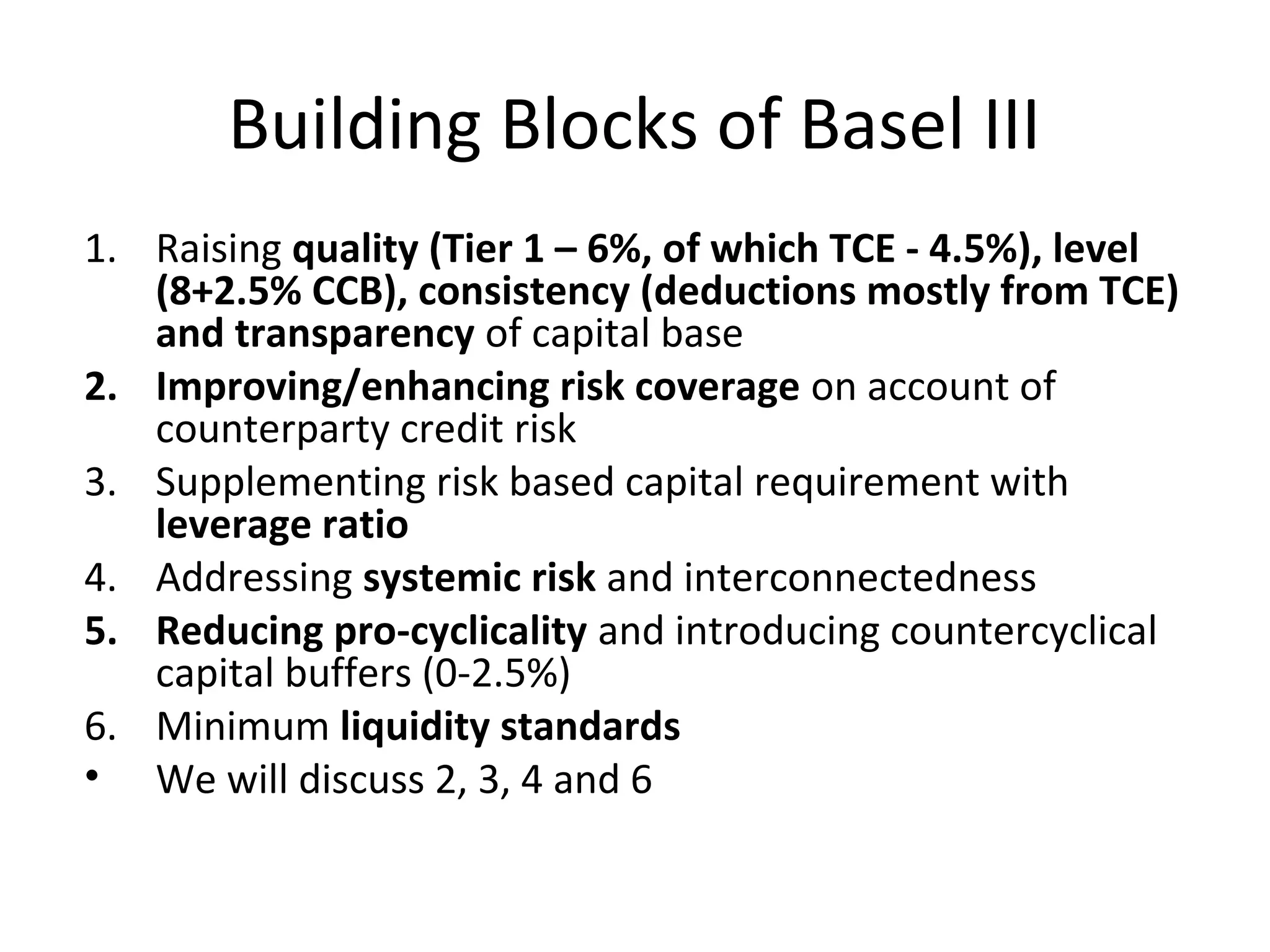
Building Blocks of Basel III
1. Raising quality (Tier 1 – 6%, of which TCE - 4.5%), level
(8+2.5% CCB), consistency (deductions mostly from TCE)
and transparency of capital base
2. Improving/enhancing risk coverage on account of
counterparty credit risk
3. Supplementing risk based capital requirement with
leverage ratio
4. Addressing systemic risk and interconnectedness
5. Reducing pro-cyclicality and introducing countercyclical
capital buffers (0-2.5%)
6. Minimum liquidity standards
• We will discuss 2, 3, 4 and 6
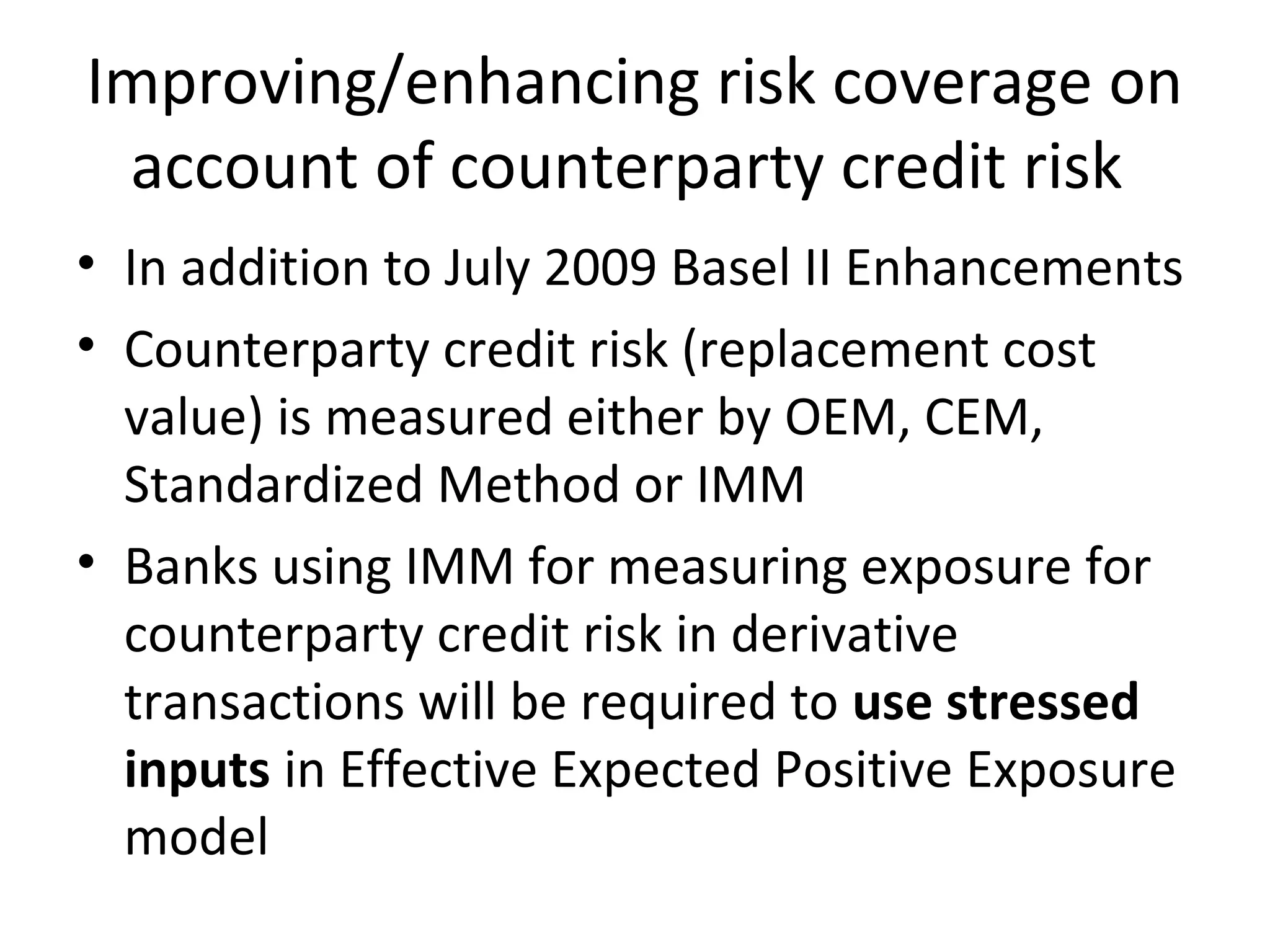
Improving/enhancing risk coverage on
account of counterparty credit risk
• In addition to July 2009 Basel II Enhancements
• Counterparty credit risk (replacement cost
value) is measured either by OEM, CEM,
Standardized Method or IMM
• Banks using IMM for measuring exposure for
counterparty credit risk in derivative
transactions will be required to use stressed
inputs in Effective Expected Positive Exposure
model
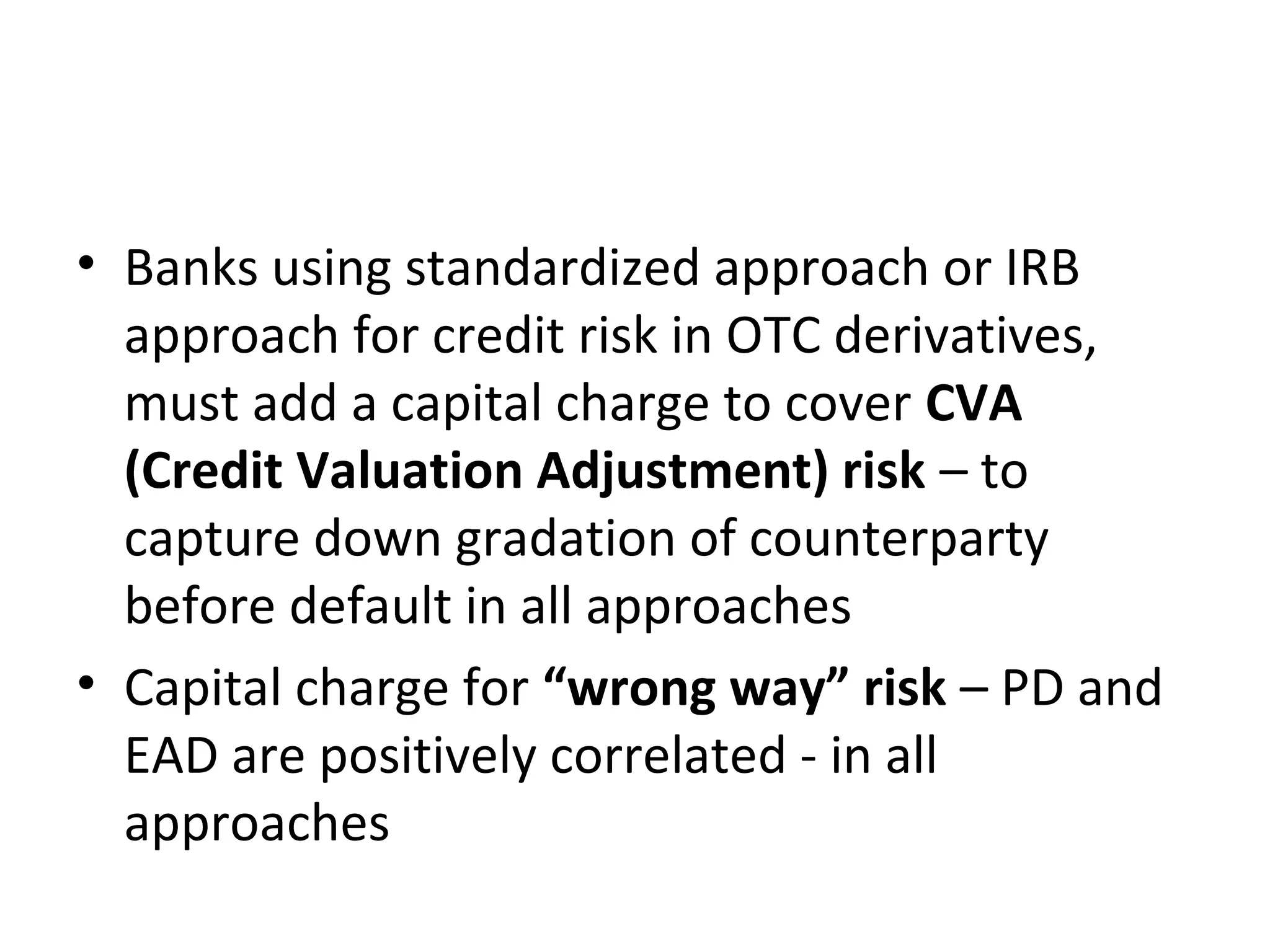
• Banks using standardized approach or IRB
approach for credit risk in OTC derivatives,
must add a capital charge to cover CVA
(Credit Valuation Adjustment) risk – to
capture down gradation of counterparty
before default in all approaches
• Capital charge for “wrong way” risk – PD and
EAD are positively correlated - in all
approaches
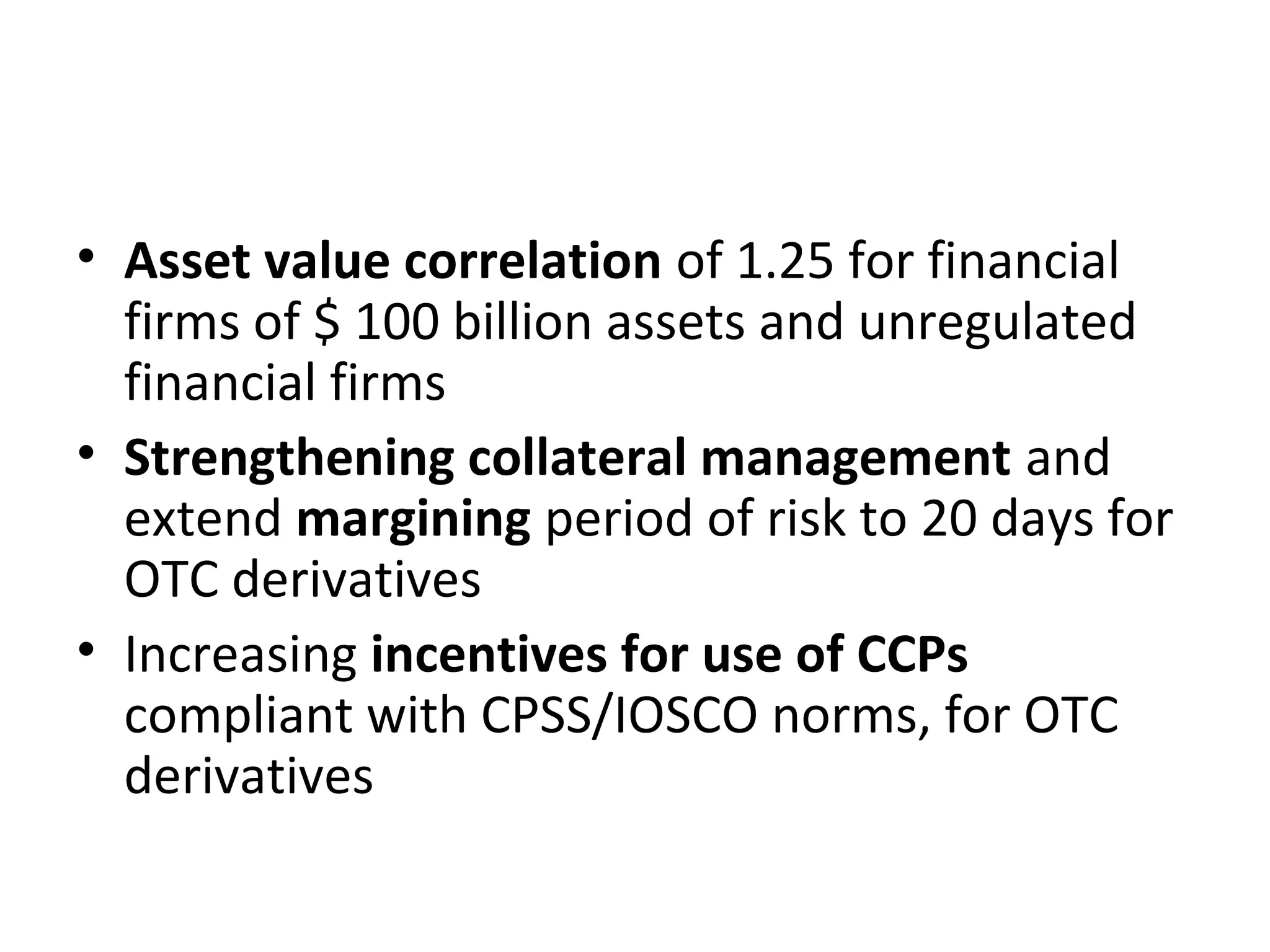
• Asset value correlation of 1.25 for financial
firms of $ 100 billion assets and unregulated
financial firms
• Strengthening collateral management and
extend margining period of risk to 20 days for
OTC derivatives
• Increasing incentives for use of CCPs
compliant with CPSS/IOSCO norms, for OTC
derivatives
Supplementing risk based capital
requirement with leverage ratio
• Objectives – to supplement capital ratio in
capturing risk
• Numerator – Tier 1 capital
• Denominator – on and off balance sheet
exposure credit equivalent with 100% CCF,
except 10% CCF for unconditionally cancellable
OBS commitments
• Derivatives on CEM and Basel II netting basis
• Collateral, guarantees or credit risk mitigation
will not reduce on balance sheet exposures
• Ratio – 3%
• As a Pillar 2 measure to start with but will be
integrated with Pillar 1
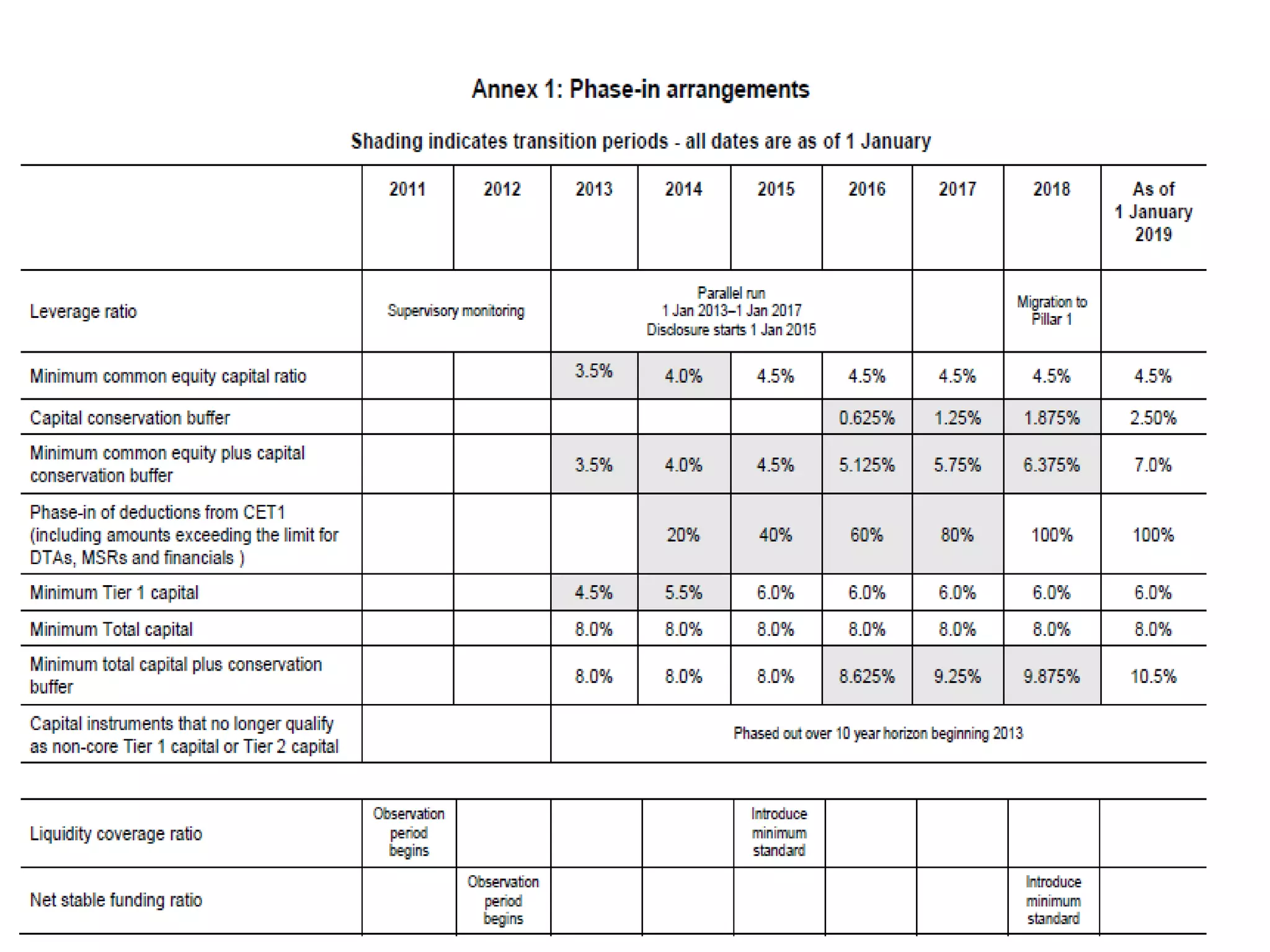
• Leverage ratio will be tracked from January 1,
2011 to see the result of the above definition
and parallel run from January 1, 2013 to 2017
and final adjustment in 2017 – Disclosure from
January 2015
• As Pillar 1 ratio from January 1, 2018
Addressing systemic risk and
interconnectedness
• Capital and liquidity surcharge on SIBs/SIFIs
• Activity restriction/exposure on SIBs/SIFIs
• Intensive supervision of SIBs/SIFIs
• Asset value correlation of 1.25 for exposures
to large financial institutions and unregulated
institutions
• Stricter treatment of OTC derivatives not
cleared through CCPs
• Improving loss-absorbing capacity of SIBs/SIFIs
- Contingent capital and bail-in-able debt
• Orderly unwinding of SIBs/SIFIs – improving
resolvability – “living wills”
International framework for liquidity
risk measurement, standards and
monitoring
• Key characteristic of the financial crisis was
inaccurate and ineffective management of
liquidity risk
• Two standards/ratios proposed
– Liquidity Coverage Ratio (LCR) for short term (30
days) liquidity risk management under stress
scenario
– Net Stable Funding Ratio (NSFR) for longer term
structural liquidity mismatches
• Liquidity Coverage Ratio (LCR)
– Ensuring enough liquid assets to survive an acute
stress scenario lasting for 30 days
– Defined as stock of high quality liquid assets / Net
cash outflow over 30 days > 100%
– Stock of high quality liquid assets – cash + central
bank reserves + high quality sovereign paper (also in
foreign currency supporting bank’s operation) + state
govt., & PSE assets and high rated corporate/covered
bonds at a discount of 15% - (A)
– Level 2 liquid assets with a cap of 40%
• Fundamental characteristics of liquid assets
– Low credit and market risk
– Ease and certainty of valuation
– Low correlation with risky assets
– Listed in a developed and recognized exchange
• Market-related characteristics
– Active and sizable market
– Presence of committed market makers
– Low market concentration
– Flight to quality
• Net Stable Funding Ratio (NSFR)
– To promote medium to long term structural
funding of assets and activities
– Defined as Available amount of stable funding /
Required amount of stable funding > 100%
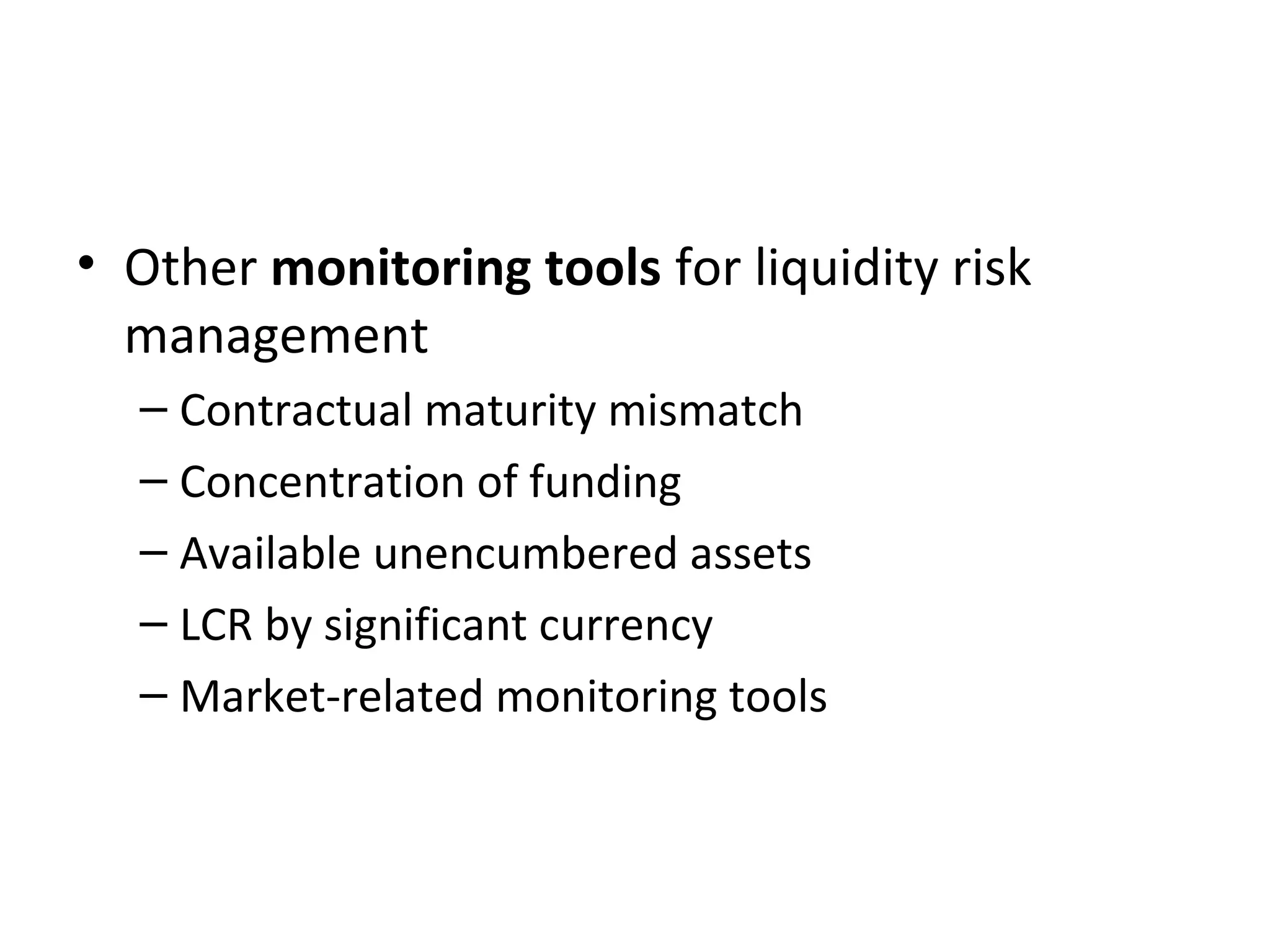
• Other monitoring tools for liquidity risk
management
– Contractual maturity mismatch
– Concentration of funding
– Available unencumbered assets
– LCR by significant currency
– Market-related monitoring tools
Implications of Basel III
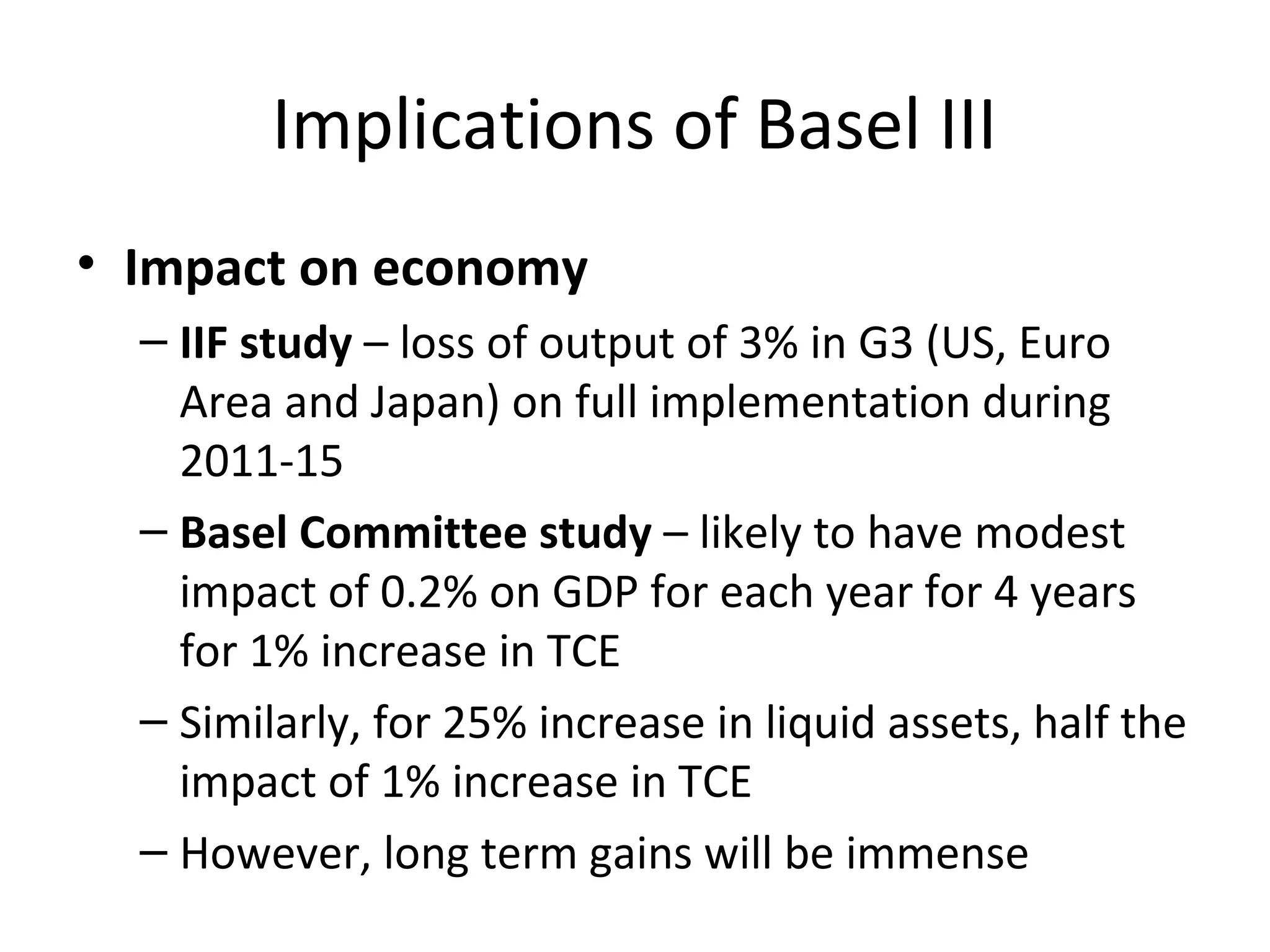
• Impact on economy
– IIF study – loss of output of 3% in G3 (US, Euro
Area and Japan) on full implementation during
2011-15
– Basel Committee study – likely to have modest
impact of 0.2% on GDP for each year for 4 years
for 1% increase in TCE
– Similarly, for 25% increase in liquid assets, half the
impact of 1% increase in TCE
– However, long term gains will be immense
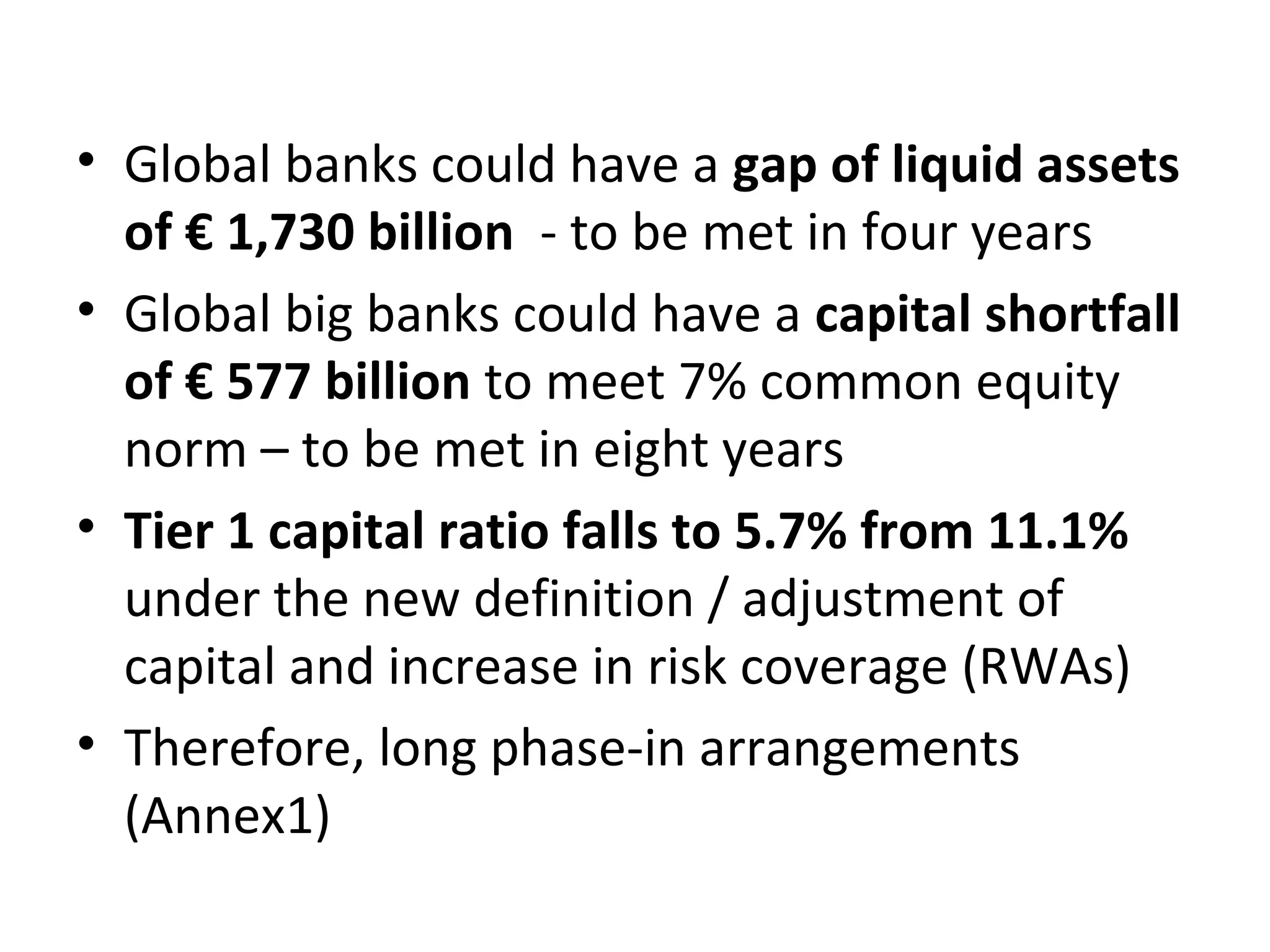
• Global banks could have a gap of liquid assets
of € 1,730 billion - to be met in four years
• Global big banks could have a capital shortfall
of € 577 billion to meet 7% common equity
norm – to be met in eight years
• Tier 1 capital ratio falls to 5.7% from 11.1%
under the new definition / adjustment of
capital and increase in risk coverage (RWAs)
• Therefore, long phase-in arrangements
(Annex1)
Impact on Indian banks
• High capital ratios at 14.4% in June 2010
which will fall to 11.7%. Tier 1 will fall from
10% to 9% and common equity from 8.5% to
7.4%
• Most of deductions are already mandated by
RBI, so little impact
• Most of our banks are not trading banks, so
not much increase in enhanced risk coverage
for counterparty credit risk
• Banks mostly follow a retail business model
and do not depend on wholesale funds
• Whether our SLR securities can be part of
liquid assets?
• Whether our liquid assets will stand the
scrutiny of fundamental characteristics and
market-related characteristics?
• Indian banks are generally not as highly
leveraged as their global counterparts
• The leverage ratio of Indian banks would be
comfortable
• Banks having a huge trading book and off
balance sheet derivative exposures may be
impacted due to increased risk coverage
(capital) on account of counterparty credit
risk
• Similarly, banks having huge off balance sheet
exposures - derivatives and others - may be
impacted on account of leverage ratio
• Banks depending heavily on wholesale funds
may be impacted due to the new liquidity
standards
• SIBs may have further implications for capital
and liquidity surcharges and activity
restrictions
• Whether our banks can attract capital in the
form of contingent capital and bail-in able
debt at the point of non-viability or whether
our capital market will support such
instruments?
Conclusion
• Basel Committee is undertaking a
fundamental review of the trading book –
whether a particular position to be covered in
trading book or banking book and capital
requirement
• Not only sluggish growth, high unemployment
and low returns, but also more resolution will
be the “New Normal”
• Thank You

Mr.mahapatra

  • 1.
    Basel III andits implications for banks’ treasurers B. Mahapatra Reserve Bank of India
  • 2.
    Outline • Introduction • Enhancementto Basel II • Building blocks of Basel III • Elements of Basel III relevant for banks’ treasurers • Implications of Basel III • Impact on Indian banks • Conclusion
  • 3.
    Introduction • The BaselI – 1988 – capital charge for credit risk – a simple “broad-brush” approach • Amendment to Basel I – 1996 – to incorporate capital charge for market risk – Standardized Measurement Method (SMM) – Internal Models Approach (IMA) • Market risk capital framework – Capital charge for general market risk – Capital charge for specific risk (credit risk)
  • 4.
    • The BaselII – 2004 – Enhanced risk coverage • Credit • Market and • Operational risks – A menu of approaches – standardized to model based with increasing complexity – Three pillar approach • The Basel II of 2004 copied and pasted the capital charge for market risk of Basel I amendment of 1996
  • 5.
    • As aresult, the capital charge framework for market risk did not keep pace with new market developments and practices • Capital charge for market risk in trading book calibrated much lower compared to banking book positions on the assumption that markets are liquid and positions can be wound up or hedged quickly
  • 6.
    • Capital chargefor specific risk (credit risk) in market risk framework (trading book) was lower than capital charge for credit risk in banking book • Lower capital charge for trading book led to scope for capital arbitrage • Capital charge for counterparty credit risk for derivative positions also covered only the default risk and migration risk was not captured
  • 7.
    • The globalfinancial crisis mostly happened in the areas of trading book /off balance sheet derivatives / market risk and inadequate liquidity risk management • Banks suffered heavy losses in their trading book • Banks did not have adequate capital to cover the losses
  • 8.
    • There washeavy reliance on short term wholesale funding • Unsustainable maturity mismatch • Insufficient liquidity assets to raise finance during stressed period
  • 9.
    Enhancement to BaselII • Post- crisis, global initiatives to strengthen the financial regulatory system • July 2009 Enhancement to Basel II – mostly in trading book
  • 10.
    • Pillar 1– Standardized approach – Higher risk weights for CRE securitization and other re-securitization exposures – almost doubled – Bank not permitted to use any external rating of ABCP program where it had provided liquidity facility or credit enhancement – treated as unrated – Operational criteria for using external ratings prescribed – CCF for all eligible liquidity facilities made uniform at 50%, irrespective of maturity (earlier 20% CCF for maturity less than one year)
  • 11.
    • Pillar 1– Internal models approach – Capital based on normal VaR and stressed VaR – Incremental Risk Charge (IRC) for interest rate instruments introduced which will capture default as well as migration risk
  • 12.
    • Pillar 2guidance – firm wide governance and risk management; – capturing risk of off balance sheet exposures and securitization activities; – managing risk concentrations; – managing reputation risk and liquidity risk; – improving valuation practices; and – implementing sound stress testing practices
  • 13.
    • Pillar 3 –appropriate additional disclosures completing enhancements in Pillars 1 and 2 • Securitization exposures in trading book • Sponsorship of off balance sheet vehicles • Re-securitization exposures; and • Pipeline and warehousing risks with regard to securitization exposures
  • 14.
    The Basel III •December 17, 2009 Basel Committee issued two consultative documents: – Strengthening the resilience of the banking sector – International framework for liquidity risk measurement, standards and monitoring
  • 15.
    • The proposalswere finalized and published on December 16, 2010: – Basel III: A global regulatory framework for more resilient banks and banking systems – Basel III: International framework for liquidity risk measurement, standards and monitoring
  • 16.
    • Objectives – Improvingbanking sector’s ability to absorb shocks – Reducing risk spillover to the real economy • Fundamental reforms proposed in the areas of – Micro prudential regulation – at individual bank level – Macro prudential regulation – at system wide basis
  • 17.
    Building Blocks ofBasel III 1. Raising quality (Tier 1 – 6%, of which TCE - 4.5%), level (8+2.5% CCB), consistency (deductions mostly from TCE) and transparency of capital base 2. Improving/enhancing risk coverage on account of counterparty credit risk 3. Supplementing risk based capital requirement with leverage ratio 4. Addressing systemic risk and interconnectedness 5. Reducing pro-cyclicality and introducing countercyclical capital buffers (0-2.5%) 6. Minimum liquidity standards • We will discuss 2, 3, 4 and 6
  • 18.
    Improving/enhancing risk coverageon account of counterparty credit risk • In addition to July 2009 Basel II Enhancements • Counterparty credit risk (replacement cost value) is measured either by OEM, CEM, Standardized Method or IMM • Banks using IMM for measuring exposure for counterparty credit risk in derivative transactions will be required to use stressed inputs in Effective Expected Positive Exposure model
  • 19.
    • Banks usingstandardized approach or IRB approach for credit risk in OTC derivatives, must add a capital charge to cover CVA (Credit Valuation Adjustment) risk – to capture down gradation of counterparty before default in all approaches • Capital charge for “wrong way” risk – PD and EAD are positively correlated - in all approaches
  • 20.
    • Asset valuecorrelation of 1.25 for financial firms of $ 100 billion assets and unregulated financial firms • Strengthening collateral management and extend margining period of risk to 20 days for OTC derivatives • Increasing incentives for use of CCPs compliant with CPSS/IOSCO norms, for OTC derivatives
  • 21.
    Supplementing risk basedcapital requirement with leverage ratio • Objectives – to supplement capital ratio in capturing risk • Numerator – Tier 1 capital • Denominator – on and off balance sheet exposure credit equivalent with 100% CCF, except 10% CCF for unconditionally cancellable OBS commitments • Derivatives on CEM and Basel II netting basis • Collateral, guarantees or credit risk mitigation will not reduce on balance sheet exposures
  • 22.
    • Ratio –3% • As a Pillar 2 measure to start with but will be integrated with Pillar 1 • Leverage ratio will be tracked from January 1, 2011 to see the result of the above definition and parallel run from January 1, 2013 to 2017 and final adjustment in 2017 – Disclosure from January 2015 • As Pillar 1 ratio from January 1, 2018
  • 23.
    Addressing systemic riskand interconnectedness • Capital and liquidity surcharge on SIBs/SIFIs • Activity restriction/exposure on SIBs/SIFIs • Intensive supervision of SIBs/SIFIs • Asset value correlation of 1.25 for exposures to large financial institutions and unregulated institutions • Stricter treatment of OTC derivatives not cleared through CCPs
  • 24.
    • Improving loss-absorbingcapacity of SIBs/SIFIs - Contingent capital and bail-in-able debt • Orderly unwinding of SIBs/SIFIs – improving resolvability – “living wills”
  • 25.
    International framework forliquidity risk measurement, standards and monitoring • Key characteristic of the financial crisis was inaccurate and ineffective management of liquidity risk • Two standards/ratios proposed – Liquidity Coverage Ratio (LCR) for short term (30 days) liquidity risk management under stress scenario – Net Stable Funding Ratio (NSFR) for longer term structural liquidity mismatches
  • 26.
    • Liquidity CoverageRatio (LCR) – Ensuring enough liquid assets to survive an acute stress scenario lasting for 30 days – Defined as stock of high quality liquid assets / Net cash outflow over 30 days > 100% – Stock of high quality liquid assets – cash + central bank reserves + high quality sovereign paper (also in foreign currency supporting bank’s operation) + state govt., & PSE assets and high rated corporate/covered bonds at a discount of 15% - (A) – Level 2 liquid assets with a cap of 40%
  • 27.
    • Fundamental characteristicsof liquid assets – Low credit and market risk – Ease and certainty of valuation – Low correlation with risky assets – Listed in a developed and recognized exchange • Market-related characteristics – Active and sizable market – Presence of committed market makers – Low market concentration – Flight to quality
  • 28.
    • Net StableFunding Ratio (NSFR) – To promote medium to long term structural funding of assets and activities – Defined as Available amount of stable funding / Required amount of stable funding > 100%
  • 29.
    • Other monitoringtools for liquidity risk management – Contractual maturity mismatch – Concentration of funding – Available unencumbered assets – LCR by significant currency – Market-related monitoring tools
  • 30.
    Implications of BaselIII • Impact on economy – IIF study – loss of output of 3% in G3 (US, Euro Area and Japan) on full implementation during 2011-15 – Basel Committee study – likely to have modest impact of 0.2% on GDP for each year for 4 years for 1% increase in TCE – Similarly, for 25% increase in liquid assets, half the impact of 1% increase in TCE – However, long term gains will be immense
  • 31.
    • Global bankscould have a gap of liquid assets of € 1,730 billion - to be met in four years • Global big banks could have a capital shortfall of € 577 billion to meet 7% common equity norm – to be met in eight years • Tier 1 capital ratio falls to 5.7% from 11.1% under the new definition / adjustment of capital and increase in risk coverage (RWAs) • Therefore, long phase-in arrangements (Annex1)
  • 33.
    Impact on Indianbanks • High capital ratios at 14.4% in June 2010 which will fall to 11.7%. Tier 1 will fall from 10% to 9% and common equity from 8.5% to 7.4% • Most of deductions are already mandated by RBI, so little impact • Most of our banks are not trading banks, so not much increase in enhanced risk coverage for counterparty credit risk
  • 34.
    • Banks mostlyfollow a retail business model and do not depend on wholesale funds • Whether our SLR securities can be part of liquid assets? • Whether our liquid assets will stand the scrutiny of fundamental characteristics and market-related characteristics?
  • 35.
    • Indian banksare generally not as highly leveraged as their global counterparts • The leverage ratio of Indian banks would be comfortable
  • 36.
    • Banks havinga huge trading book and off balance sheet derivative exposures may be impacted due to increased risk coverage (capital) on account of counterparty credit risk
  • 37.
    • Similarly, bankshaving huge off balance sheet exposures - derivatives and others - may be impacted on account of leverage ratio • Banks depending heavily on wholesale funds may be impacted due to the new liquidity standards • SIBs may have further implications for capital and liquidity surcharges and activity restrictions
  • 38.
    • Whether ourbanks can attract capital in the form of contingent capital and bail-in able debt at the point of non-viability or whether our capital market will support such instruments?
  • 39.
    Conclusion • Basel Committeeis undertaking a fundamental review of the trading book – whether a particular position to be covered in trading book or banking book and capital requirement • Not only sluggish growth, high unemployment and low returns, but also more resolution will be the “New Normal”
  • 40.