Capability Maps
The Next Generation
Wolfgang Goebl
We help people create better enterprises.
INTERSECTION GROUP
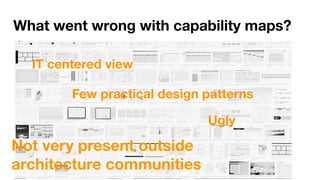
What went wrong with capability maps?
Ugly
Not very present outside
architecture communities
Few practical design patterns
IT centered view
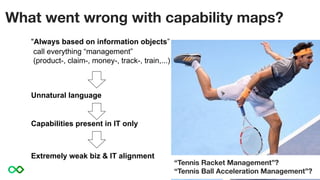
What went wrong with capability maps?
"Always based on information objects”
call everything “management”
(product-, claim-, money-, track-, train,...)
“Tennis Racket Management”?
“Tennis Ball Acceleration Management”?
Unnatural language
Capabilities present in IT only
Extremely weak biz & IT alignment
What we want to change…
"Always based on business objects”
Serve
Unnatural language
Capabilities present in IT only
Extremely weak biz & IT alignment
Based on highest cohesion
common
everywhere
Seamless busIT co-design
Capabilities are
business components
used as a modular “master structure”
of the enterprise.
Organisational- and IT structures
can be derived from this
master structure.
“Modular business components.”
Designed for Digital, J.Ross et.al
What we want to change…
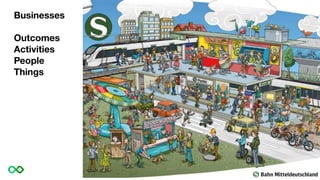
Businesses
Outcomes
Activities
People
Things
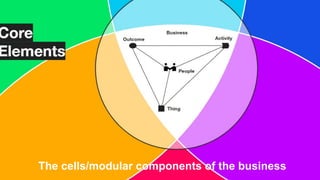
The cells/modular components of the business
Buildings
People
Software Assets
Information
Raw Material
Machine
Output
(= product or
intermediate
output)
“What we can do by orchestrating people and assets.
Capability Definition
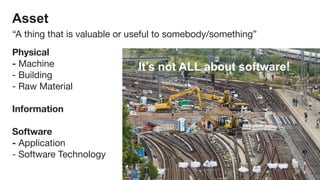
“A thing that is valuable or useful to somebody/something”
Physical
- Machine
- Building
- Raw Material
Information
Software
- Application
- Software Technology
It’s not ALL about software!
Asset
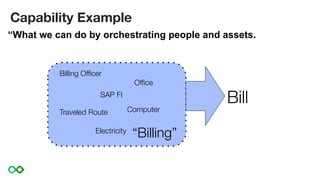
Office
Billing Officer
SAP FI
Traveled Route
Electricity
Computer
Bill
“Billing”
“What we can do by orchestrating people and assets.
Capability Example
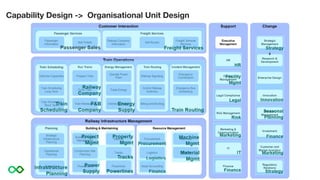
Capability Map Example
Capability Design -> Organisational Unit Design
Org Units? Activity?
Business Functions? Processes?
The team “billing” has the capability to do the
“billing” and performs the processes/activities
“billing”.
Org Units? Activity? Business Functions?
“Organisational Units have business functions capabilities”.
“Organisational Units perform activities”
“Activities are actually performed capabilities”
Only ONE master structure of the business!
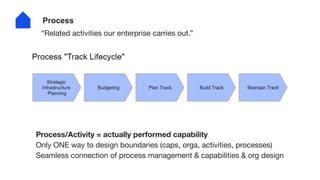
Connect process management & capability based design
“Related activities our enterprise carries out.”
Process
Process/Activity = actually performed capability
Only ONE way to design boundaries (caps, orga, activities, processes)
Seamless connection of process management & capabilities & org design
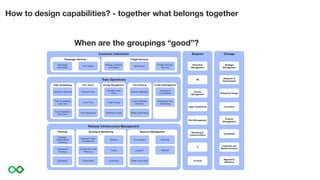
How to design capabilities? - together what belongs together
When are the groupings “good”?
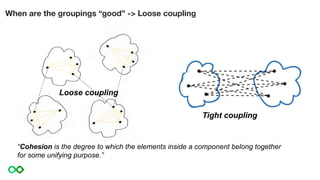
When are the groupings “good” -> Loose coupling
“Cohesion is the degree to which the elements inside a component belong together
for some unifying purpose.”
Loose coupling
Tight coupling
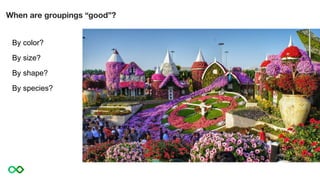
When are groupings “good”?
By color?
By size?
By shape?
By species?
Example: “Build and Maintain Tracks”
Flattening machine team
Sensor
software
Gravel
Flattening train
Flatten tracks
The asset (flattening train) drives the
capability boundary.
Specialization leads to a thick stable
boundary of the capability
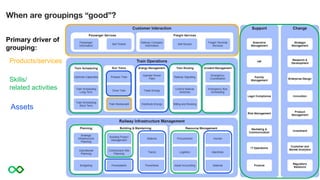
When are groupings “good”?
Products/services
Skills/
related activities
Assets
Primary driver of
grouping:
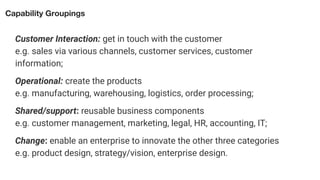
Customer Interaction: get in touch with the customer
e.g. sales via various channels, customer services, customer
information;
Operational: create the products
e.g. manufacturing, warehousing, logistics, order processing;
Shared/support: reusable business components
e.g. customer management, marketing, legal, HR, accounting, IT;
Change: enable an enterprise to innovate the other three categories
e.g. product design, strategy/vision, enterprise design.
Capability Groupings
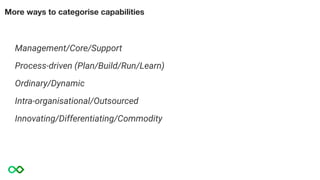
More ways to categorise capabilities
Management/Core/Support
Process-driven (Plan/Build/Run/Learn)
Ordinary/Dynamic
Intra-organisational/Outsourced
Innovating/Differentiating/Commodity
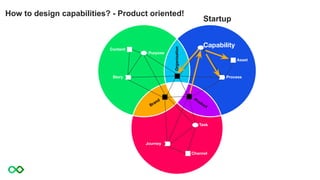
Brand Product
Organisation
Story
Purpose
Process
Capability
Journey
Task
Channel
Asset
Content
How to design capabilities? - Product oriented!
Startup
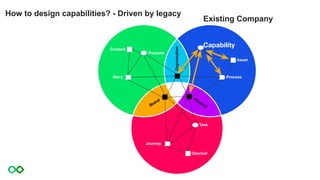
Brand Product
Organisation
Story
Purpose
Process
Capability
Journey
Task
Channel
Asset
Content
How to design capabilities? - Driven by legacy
Existing Company
How to model capability maps
● Use sound categories
● Make products visible
● Group around what offers highest cohesion (e.g. an Object, a Process, related Skills)
● Limit redundancy
● Embrace specialization & reuse
● Use their language (e.g. HR instead of “Manage Human Resources”)
● Focus on essence (~5 level 1, 10-20 level 2, 50-75 level 3)
Buildings
People
Software Assets
Information
Raw Material
Machine
Output
(= product or
intermediate
output)
Broad Elicitation Process
Existing Orgchart
Existing
Process/Product
Model
Capability Model
Executive
Board Application
Owners
Business
Experts
B-Level
Executives
Connect bottom-up with top-down design
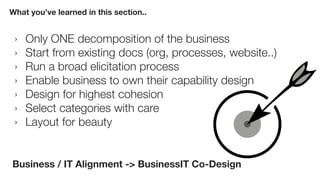
What you’ve learned in this section..
› Only ONE decomposition of the business
› Start from existing docs (org, processes, website..)
› Run a broad elicitation process
› Enable business to own their capability design
› Design for highest cohesion
› Select categories with care
› Layout for beauty
Business / IT Alignment -> BusinessIT Co-Design
3 association board members
7 core team members
80+ advising members
5 development partners
860+ people on Slack
5000+ newsletter subscribers
Various backgrounds:
About 30% Enterprise and Business Architects
About 30% Experience, Service and Business
Designers
A diverse group of about 20% other, related
profiles:
Business Analysts, Founders and Executives,
Innovation or Change Agents, Operations and
Process Designers, Organisation Designers and
Developers, Branding and Marketing Experts,
Agilists and Digital/IT Experts, Product Owners,
Industry Experts…
Our community
Intersection Group is a Non Profit Association
Intersection
Toolkit
A set of connected Open
Source tools for your
Enterprise Design practice
Community
and Events
Events for a global
community of thinkers
and practitioners
Learning and
Knowledge
Publications, content,
courses and digital
tools with our partners
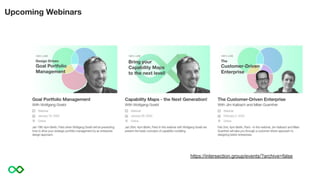
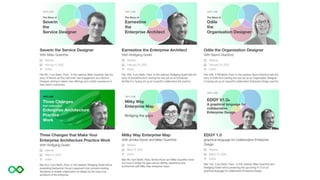
https://intersection.group/events/?archive=false
Upcoming Webinars
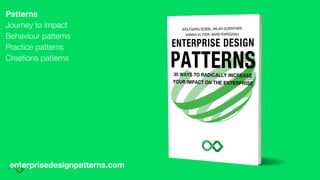
enterprisedesignpatterns.com
Patterns
Journey to impact
Behaviour patterns
Practice patterns
Creations patterns
Thank you!
Wolfgang Goebl
wolfgang@intersection.group
www.intersection.group

Capability Webinar January 2022

  • 1.
    Capability Maps The NextGeneration Wolfgang Goebl
  • 2.
    We help peoplecreate better enterprises. INTERSECTION GROUP
  • 3.
    What went wrongwith capability maps?
  • 4.
    What went wrongwith capability maps? Ugly Not very present outside architecture communities Few practical design patterns IT centered view
  • 5.
    What went wrongwith capability maps? "Always based on information objects” call everything “management” (product-, claim-, money-, track-, train,...) “Tennis Racket Management”? “Tennis Ball Acceleration Management”? Unnatural language Capabilities present in IT only Extremely weak biz & IT alignment
  • 6.
    What we wantto change… "Always based on business objects” Serve Unnatural language Capabilities present in IT only Extremely weak biz & IT alignment Based on highest cohesion common everywhere Seamless busIT co-design
  • 7.
    Capabilities are business components usedas a modular “master structure” of the enterprise. Organisational- and IT structures can be derived from this master structure. “Modular business components.” Designed for Digital, J.Ross et.al What we want to change…
  • 8.
  • 9.
  • 10.
    Buildings People Software Assets Information Raw Material Machine Output (=product or intermediate output) “What we can do by orchestrating people and assets. Capability Definition
  • 11.
    “A thing thatis valuable or useful to somebody/something” Physical - Machine - Building - Raw Material Information Software - Application - Software Technology It’s not ALL about software! Asset
  • 12.
    Office Billing Officer SAP FI TraveledRoute Electricity Computer Bill “Billing” “What we can do by orchestrating people and assets. Capability Example
  • 13.
  • 14.
    Capability Design ->Organisational Unit Design
  • 15.
    Org Units? Activity? BusinessFunctions? Processes? The team “billing” has the capability to do the “billing” and performs the processes/activities “billing”.
  • 16.
    Org Units? Activity?Business Functions? “Organisational Units have business functions capabilities”. “Organisational Units perform activities” “Activities are actually performed capabilities” Only ONE master structure of the business! Connect process management & capability based design
  • 17.
    “Related activities ourenterprise carries out.” Process Process/Activity = actually performed capability Only ONE way to design boundaries (caps, orga, activities, processes) Seamless connection of process management & capabilities & org design
  • 18.
    How to designcapabilities? - together what belongs together When are the groupings “good”?
  • 19.
    When are thegroupings “good” -> Loose coupling “Cohesion is the degree to which the elements inside a component belong together for some unifying purpose.” Loose coupling Tight coupling
  • 20.
    When are groupings“good”? By color? By size? By shape? By species?
  • 21.
    Example: “Build andMaintain Tracks” Flattening machine team Sensor software Gravel Flattening train Flatten tracks The asset (flattening train) drives the capability boundary. Specialization leads to a thick stable boundary of the capability
  • 22.
    When are groupings“good”? Products/services Skills/ related activities Assets Primary driver of grouping:
  • 23.
    Customer Interaction: getin touch with the customer e.g. sales via various channels, customer services, customer information; Operational: create the products e.g. manufacturing, warehousing, logistics, order processing; Shared/support: reusable business components e.g. customer management, marketing, legal, HR, accounting, IT; Change: enable an enterprise to innovate the other three categories e.g. product design, strategy/vision, enterprise design. Capability Groupings
  • 24.
    More ways tocategorise capabilities Management/Core/Support Process-driven (Plan/Build/Run/Learn) Ordinary/Dynamic Intra-organisational/Outsourced Innovating/Differentiating/Commodity
  • 25.
  • 26.
  • 27.
    How to modelcapability maps ● Use sound categories ● Make products visible ● Group around what offers highest cohesion (e.g. an Object, a Process, related Skills) ● Limit redundancy ● Embrace specialization & reuse ● Use their language (e.g. HR instead of “Manage Human Resources”) ● Focus on essence (~5 level 1, 10-20 level 2, 50-75 level 3) Buildings People Software Assets Information Raw Material Machine Output (= product or intermediate output)
  • 28.
    Broad Elicitation Process ExistingOrgchart Existing Process/Product Model Capability Model Executive Board Application Owners Business Experts B-Level Executives Connect bottom-up with top-down design
  • 29.
    What you’ve learnedin this section.. › Only ONE decomposition of the business › Start from existing docs (org, processes, website..) › Run a broad elicitation process › Enable business to own their capability design › Design for highest cohesion › Select categories with care › Layout for beauty Business / IT Alignment -> BusinessIT Co-Design
  • 30.
    3 association boardmembers 7 core team members 80+ advising members 5 development partners 860+ people on Slack 5000+ newsletter subscribers Various backgrounds: About 30% Enterprise and Business Architects About 30% Experience, Service and Business Designers A diverse group of about 20% other, related profiles: Business Analysts, Founders and Executives, Innovation or Change Agents, Operations and Process Designers, Organisation Designers and Developers, Branding and Marketing Experts, Agilists and Digital/IT Experts, Product Owners, Industry Experts… Our community
  • 31.
    Intersection Group isa Non Profit Association Intersection Toolkit A set of connected Open Source tools for your Enterprise Design practice Community and Events Events for a global community of thinkers and practitioners Learning and Knowledge Publications, content, courses and digital tools with our partners
  • 32.
  • 34.
    enterprisedesignpatterns.com Patterns Journey to impact Behaviourpatterns Practice patterns Creations patterns
  • 35.