Wardley
Mapping
explained.
Introduction
Practical guide to
Enterprise Orchestration
Siarhei Tuzik, 2020
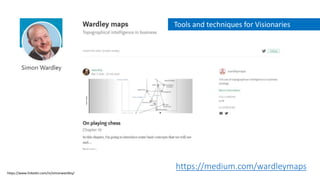
https://medium.com/wardleymaps
Tools and techniques for Visionaries
https://www.linkedin.com/in/simonwardley/
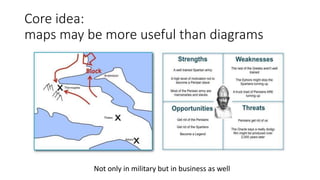
Core idea:
maps may be more useful than diagrams
Not only in military but in business as well
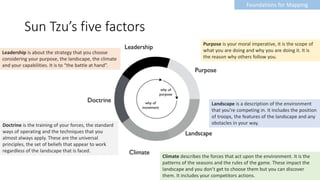
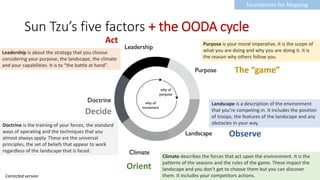
Sun Tzu’s five factors
Purpose is your moral imperative, it is the scope of
what you are doing and why you are doing it. It is
the reason why others follow you.
Landscape is a description of the environment
that you’re competing in. It includes the position
of troops, the features of the landscape and any
obstacles in your way.
Climate describes the forces that act upon the environment. It is the
patterns of the seasons and the rules of the game. These impact the
landscape and you don’t get to choose them but you can discover
them. It includes your competitors actions.
Doctrine is the training of your forces, the standard
ways of operating and the techniques that you
almost always apply. These are the universal
principles, the set of beliefs that appear to work
regardless of the landscape that is faced.
Leadership is about the strategy that you choose
considering your purpose, the landscape, the climate
and your capabilities. It is to “the battle at hand”.
Foundations for Mapping
Sun Tzu’s five factors + the OODA cycle
Purpose is your moral imperative, it is the scope of
what you are doing and why you are doing it. It is
the reason why others follow you.
Landscape is a description of the environment
that you’re competing in. It includes the position
of troops, the features of the landscape and any
obstacles in your way.
Climate describes the forces that act upon the environment. It is the
patterns of the seasons and the rules of the game. These impact the
landscape and you don’t get to choose them but you can discover
them. It includes your competitors actions.
Doctrine is the training of your forces, the standard
ways of operating and the techniques that you
almost always apply. These are the universal
principles, the set of beliefs that appear to work
regardless of the landscape that is faced.
Leadership is about the strategy that you choose
considering your purpose, the landscape, the climate
and your capabilities. It is to “the battle at hand”.
The “game”
Observe
Orient
Decide
Act
Foundations for Mapping
Corrected version
What is a map?
Landscape:
The image of
the environment
Climate:
The forces that impact
the landscape;
you don’t get to choose them
but you can discover them.
Purpose:
The scope +
your aspiration
[Your] Doctrine:
the training of your forces,
the standard ways
of operating and
the techniques that you
almost always apply.
Options you choose from.
[Your] Leadership:
Your choices and
applying your capabilities
to get them implemented
The map
The scope of the map
and its type
The arrows on the map
Your arrows on the map
Five Elements
Context =
Purpose
+ Your World
[Landscape
+ Climate]
+ You
[Your Doctrine
+ Your Capability]Your Intelligence
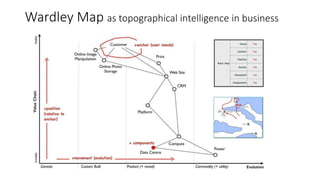
Wardley Map as topographical intelligence in business
Value Chains
Enterprise Orchestration view
Basic Palette of Strategy Types and Org layers
 Classical Top-Down  Smart Solutions  Ecosystem and Platform
Participants
BOSS-DRIVEN performers /
REQUIREMENT-DRIVEN customer
EXPERIENCE-DRIVEN experts /
PROBLEM-DRIVEN customer
INDEPENDENT PARTICIPANTS:
Producers and Consumers
Engagement
principles
PROCESS and instructions,
Long-term, Hierarchy, STABLE
Research and ARCHITECTURE,
Mid-term, Service, VARIABLE
Platform MATCHING,
Short-term, Platform, ADAPTIVE
Engagement
criteria
Skills fit job position,
Job ASSIGNMENT
Expert status is confirmed,
INVOLVEMENT into service pool
ENGAGEMENT, if ecosystem curation
principles fit personal preferences
Goal /Value type
Tangible RESULT,
Up-to-date skills & capabilities
Problem SOLVING,
Proven knowledge & expertise
New OPPORTUNITY,
Successful value exchange
Motivation
Follow technology processes and
best practices, master SKILLS
Invent, validate and implement
solutions, enrich EXPERTISE
QUICK WIN WITH NEW
OPPORTUNITY
Success definition
The work process is completed
(OUTPUT)
The Solution has resolved initial
problem (OUTCOME)
The interaction is initiated and
closed with ACHIEVING PURPOSE
Lifecycle principle
Time to RESULTS ACCEPTANCE
OODA cycle
(Observe<-Orient<-Decide <-Act)
Time from Goal to MARKET
Design Thinking ([Empathize]->
Define->Ideate->Prototype->Learn)
Time from Goal to LEARN
Adaptive Thinking (Shared Purpose->
Trusted Partners-> Quick Wins-> Learn &Adapt)
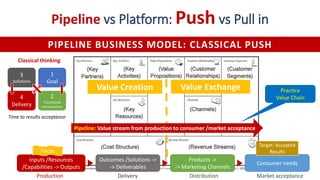
Pipeline vs Platform: Push vs Pull in
PIPELINE BUSINESS MODEL: CLASSICAL PUSH
Practice
Value Chain
Inputs /Resources
/Capabilities -> Outputs
Outcomes /Solutions ->
-> Deliverables
Products ->
-> Marketing Channels
Consumer needs
Production Delivery Distribution Market acceptance
Target: Accepted
ResultsFocus
3
Solutions
4
Delivery
1
Goal
2
Functional
Decomposition
Classical thinking
Time to results acceptance
Value Creation
Pipeline: Value stream from production to consumer /market acceptance
Value Exchange
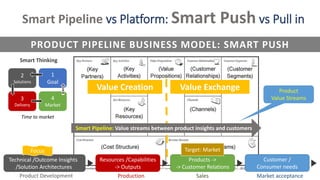
Smart Pipeline vs Platform: Smart Push vs Pull in
PRODUCT PIPELINE BUSINESS MODEL: SMART PUSH
Product
Value Streams
Technical /Outcome Insights
/Solution Architectures
Resources /Capabilities
-> Outputs
Products ->
-> Customer Relations
Customer /
Consumer needs
Product Development Production Sales Market acceptance
Target: MarketFocus
2
Solutions
3
Delivery
1
Goal
4
Market
Smart Thinking
Time to market
Value Creation
Smart Pipeline: Value streams between product insights and customers
Value Exchange
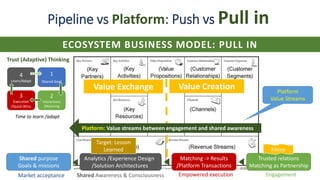
Pipeline vs Platform: Push vs Pull in
ECOSYSTEM BUSINESS MODEL: PULL IN
Platform
Value Streams
Analytics /Experience Design
/Solution Architectures
Matching -> Results
/Platform Transactions
Trusted relations
Matching as Partnership
Shared Awareness & Consciousness Empowered execution Engagement
Shared purpose
Goals & missions
Market acceptance
Target: Lesson
Learned Focus
4
Learn/Adapt
3
Execution
/Quick Wins
1
Shared Goal
2
Interactions
/Matching
Trust (Adaptive) Thinking
Time to learn /adapt
Platform: Value streams between engagement and shared awareness
Value CreationValue Exchange
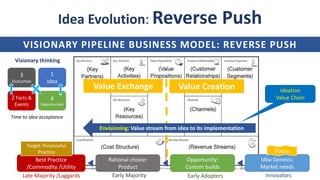
Idea Evolution: Reverse Push
VISIONARY PIPELINE BUSINESS MODEL: REVERSE PUSH
Ideation
Value Chain
Best Practice
/Commodity /Utility
Rational choice:
Product
Opportunity:
Custom builds
Idea Genesis:
Market needs
Late Majority /Laggards Early Majority Early Adopters Innovators
Target: Purposeful
Practice Focus
3
Outcomes
2 Facts &
Events
1
Idea
4
Opportunities
Visionary thinking
Time to idea acceptance
Value Creation
Envisioning: Value stream from idea to its implementation
Value Exchange
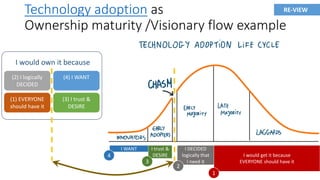
Technology adoption as
Ownership maturity /Visionary flow example
I WANT I trust &
DESIRE
I DECIDED
logically that
I need it
I would get it because
EVERYONE should have it
4
3
2
1
(2) I logically
DECIDED
(4) I WANT
(1) EVERYONE
should have it
(3) I trust &
DESIRE
I would own it because
RE-VIEW
Wardley Maps
in terms of Enterprise Orchestration
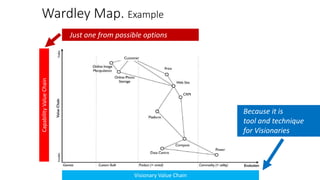
Wardley Map. Example
CapabilityValueChain
Visionary Value Chain
Because it is
tool and technique
for Visionaries
Just one from possible options
Basic Palette of Strategy Types and Org layers
 Classical Top-Down  Smart Solutions  Ecosystem and Platform
Participants
BOSS-DRIVEN performers /
REQUIREMENT-DRIVEN customer
EXPERIENCE-DRIVEN experts /
PROBLEM-DRIVEN customer
INDEPENDENT PARTICIPANTS:
Producers and Consumers
Engagement
principles
PROCESS and instructions,
Long-term, Hierarchy, STABLE
Research and ARCHITECTURE,
Mid-term, Service, VARIABLE
Platform MATCHING,
Short-term, Platform, ADAPTIVE
Engagement
criteria
Skills fit job position,
Job ASSIGNMENT
Expert status is confirmed,
INVOLVEMENT into service pool
ENGAGEMENT, if ecosystem curation
principles fit personal preferences
Goal /Value type
Tangible RESULT,
Up-to-date skills & capabilities
Problem SOLVING,
Proven knowledge & expertise
New OPPORTUNITY,
Successful value exchange
Motivation
Follow technology processes and
best practices, master SKILLS
Invent, validate and implement
solutions, enrich EXPERTISE
QUICK WIN WITH NEW
OPPORTUNITY
Success definition
The work process is completed
(OUTPUT)
The Solution has resolved initial
problem (OUTCOME)
The interaction is initiated and
closed with ACHIEVING PURPOSE
Lifecycle principle
Time to RESULTS ACCEPTANCE
OODA cycle
(Observe<-Orient<-Decide <-Act)
Time from Goal to MARKET
Design Thinking ([Empathize]->
Define->Ideate->Prototype->Learn)
Time from Goal to LEARN
Adaptive Thinking (Shared Purpose->
Trusted Partners-> Quick Wins-> Learn &Adapt)
OODA cycle is important,
but it’s just one of some
that are important
Value Creation
Value Exchange
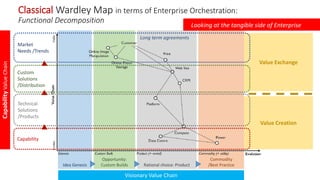
Classical Wardley Map in terms of Enterprise Orchestration:
Functional Decomposition
CapabilityValueChain
Visionary Value Chain
Idea Genesis
Opportunity:
Custom Builds Rational choice: Product
Commodity
/Best Practice
Capability
Technical
Solutions
/Products
Custom
Solutions
/Distribution
Market
Needs /Trends
Long term agreements
Looking at the tangible side of Enterprise
Value Creation
Value Exchange
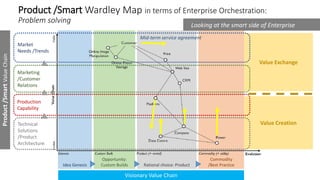
Product /Smart Wardley Map in terms of Enterprise Orchestration:
Problem solving
Product/SmartValueChain
Visionary Value Chain
Idea Genesis
Opportunity:
Custom Builds Rational choice: Product
Commodity
/Best Practice
Production
Capability
Technical
Solutions
/Product
Architecture
Marketing
/Customer
Relations
Market
Needs /Trends
Mid-term service agreement
Looking at the smart side of Enterprise
Value Creation
Value Exchange
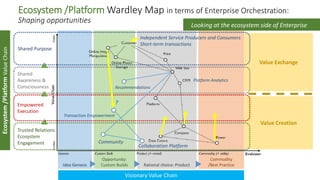
Ecosystem /Platform Wardley Map in terms of Enterprise Orchestration:
Shaping opportunities
Ecosystem/PlatformValueChain
Visionary Value Chain
Idea Genesis
Opportunity:
Custom Builds Rational choice: Product
Commodity
/Best Practice
Empowered
Execution
Shared
Awareness &
Consciousness
Trusted Relations
Ecosystem
Engagement
Shared Purpose
Community
?
Independent Service Producers and Consumers
Short-term transactions
Recommendations
Platform Analytics
Transaction Empowerment
Collaboration Platform
Looking at the ecosystem side of Enterprise
Useful links
• Wardley Maps. Topographical intelligence in business
https://medium.com/wardleymaps
• Enterprise Orchestration (RU, internal resource @EPAM)
https://web.microsoftstream.com/channel/84d746f6-1041-48cb-
9e9d-fe4fb8040d06
• Siarhei Tuzik @ LinkedIn
https://www.linkedin.com/in/siarheituzik/detail/recent-
activity/posts/ (see 2020 posts)

Wardley mapping

  • 1.
  • 2.
    https://medium.com/wardleymaps Tools and techniquesfor Visionaries https://www.linkedin.com/in/simonwardley/
  • 3.
    Core idea: maps maybe more useful than diagrams Not only in military but in business as well
  • 4.
    Sun Tzu’s fivefactors Purpose is your moral imperative, it is the scope of what you are doing and why you are doing it. It is the reason why others follow you. Landscape is a description of the environment that you’re competing in. It includes the position of troops, the features of the landscape and any obstacles in your way. Climate describes the forces that act upon the environment. It is the patterns of the seasons and the rules of the game. These impact the landscape and you don’t get to choose them but you can discover them. It includes your competitors actions. Doctrine is the training of your forces, the standard ways of operating and the techniques that you almost always apply. These are the universal principles, the set of beliefs that appear to work regardless of the landscape that is faced. Leadership is about the strategy that you choose considering your purpose, the landscape, the climate and your capabilities. It is to “the battle at hand”. Foundations for Mapping
  • 5.
    Sun Tzu’s fivefactors + the OODA cycle Purpose is your moral imperative, it is the scope of what you are doing and why you are doing it. It is the reason why others follow you. Landscape is a description of the environment that you’re competing in. It includes the position of troops, the features of the landscape and any obstacles in your way. Climate describes the forces that act upon the environment. It is the patterns of the seasons and the rules of the game. These impact the landscape and you don’t get to choose them but you can discover them. It includes your competitors actions. Doctrine is the training of your forces, the standard ways of operating and the techniques that you almost always apply. These are the universal principles, the set of beliefs that appear to work regardless of the landscape that is faced. Leadership is about the strategy that you choose considering your purpose, the landscape, the climate and your capabilities. It is to “the battle at hand”. The “game” Observe Orient Decide Act Foundations for Mapping Corrected version
  • 6.
    What is amap? Landscape: The image of the environment Climate: The forces that impact the landscape; you don’t get to choose them but you can discover them. Purpose: The scope + your aspiration [Your] Doctrine: the training of your forces, the standard ways of operating and the techniques that you almost always apply. Options you choose from. [Your] Leadership: Your choices and applying your capabilities to get them implemented The map The scope of the map and its type The arrows on the map Your arrows on the map Five Elements Context = Purpose + Your World [Landscape + Climate] + You [Your Doctrine + Your Capability]Your Intelligence
  • 7.
    Wardley Map astopographical intelligence in business
  • 8.
  • 9.
    Basic Palette ofStrategy Types and Org layers  Classical Top-Down  Smart Solutions  Ecosystem and Platform Participants BOSS-DRIVEN performers / REQUIREMENT-DRIVEN customer EXPERIENCE-DRIVEN experts / PROBLEM-DRIVEN customer INDEPENDENT PARTICIPANTS: Producers and Consumers Engagement principles PROCESS and instructions, Long-term, Hierarchy, STABLE Research and ARCHITECTURE, Mid-term, Service, VARIABLE Platform MATCHING, Short-term, Platform, ADAPTIVE Engagement criteria Skills fit job position, Job ASSIGNMENT Expert status is confirmed, INVOLVEMENT into service pool ENGAGEMENT, if ecosystem curation principles fit personal preferences Goal /Value type Tangible RESULT, Up-to-date skills & capabilities Problem SOLVING, Proven knowledge & expertise New OPPORTUNITY, Successful value exchange Motivation Follow technology processes and best practices, master SKILLS Invent, validate and implement solutions, enrich EXPERTISE QUICK WIN WITH NEW OPPORTUNITY Success definition The work process is completed (OUTPUT) The Solution has resolved initial problem (OUTCOME) The interaction is initiated and closed with ACHIEVING PURPOSE Lifecycle principle Time to RESULTS ACCEPTANCE OODA cycle (Observe<-Orient<-Decide <-Act) Time from Goal to MARKET Design Thinking ([Empathize]-> Define->Ideate->Prototype->Learn) Time from Goal to LEARN Adaptive Thinking (Shared Purpose-> Trusted Partners-> Quick Wins-> Learn &Adapt)
  • 10.
    Pipeline vs Platform:Push vs Pull in PIPELINE BUSINESS MODEL: CLASSICAL PUSH Practice Value Chain Inputs /Resources /Capabilities -> Outputs Outcomes /Solutions -> -> Deliverables Products -> -> Marketing Channels Consumer needs Production Delivery Distribution Market acceptance Target: Accepted ResultsFocus 3 Solutions 4 Delivery 1 Goal 2 Functional Decomposition Classical thinking Time to results acceptance Value Creation Pipeline: Value stream from production to consumer /market acceptance Value Exchange
  • 11.
    Smart Pipeline vsPlatform: Smart Push vs Pull in PRODUCT PIPELINE BUSINESS MODEL: SMART PUSH Product Value Streams Technical /Outcome Insights /Solution Architectures Resources /Capabilities -> Outputs Products -> -> Customer Relations Customer / Consumer needs Product Development Production Sales Market acceptance Target: MarketFocus 2 Solutions 3 Delivery 1 Goal 4 Market Smart Thinking Time to market Value Creation Smart Pipeline: Value streams between product insights and customers Value Exchange
  • 12.
    Pipeline vs Platform:Push vs Pull in ECOSYSTEM BUSINESS MODEL: PULL IN Platform Value Streams Analytics /Experience Design /Solution Architectures Matching -> Results /Platform Transactions Trusted relations Matching as Partnership Shared Awareness & Consciousness Empowered execution Engagement Shared purpose Goals & missions Market acceptance Target: Lesson Learned Focus 4 Learn/Adapt 3 Execution /Quick Wins 1 Shared Goal 2 Interactions /Matching Trust (Adaptive) Thinking Time to learn /adapt Platform: Value streams between engagement and shared awareness Value CreationValue Exchange
  • 13.
    Idea Evolution: ReversePush VISIONARY PIPELINE BUSINESS MODEL: REVERSE PUSH Ideation Value Chain Best Practice /Commodity /Utility Rational choice: Product Opportunity: Custom builds Idea Genesis: Market needs Late Majority /Laggards Early Majority Early Adopters Innovators Target: Purposeful Practice Focus 3 Outcomes 2 Facts & Events 1 Idea 4 Opportunities Visionary thinking Time to idea acceptance Value Creation Envisioning: Value stream from idea to its implementation Value Exchange
  • 14.
    Technology adoption as Ownershipmaturity /Visionary flow example I WANT I trust & DESIRE I DECIDED logically that I need it I would get it because EVERYONE should have it 4 3 2 1 (2) I logically DECIDED (4) I WANT (1) EVERYONE should have it (3) I trust & DESIRE I would own it because RE-VIEW
  • 15.
    Wardley Maps in termsof Enterprise Orchestration
  • 16.
    Wardley Map. Example CapabilityValueChain VisionaryValue Chain Because it is tool and technique for Visionaries Just one from possible options
  • 17.
    Basic Palette ofStrategy Types and Org layers  Classical Top-Down  Smart Solutions  Ecosystem and Platform Participants BOSS-DRIVEN performers / REQUIREMENT-DRIVEN customer EXPERIENCE-DRIVEN experts / PROBLEM-DRIVEN customer INDEPENDENT PARTICIPANTS: Producers and Consumers Engagement principles PROCESS and instructions, Long-term, Hierarchy, STABLE Research and ARCHITECTURE, Mid-term, Service, VARIABLE Platform MATCHING, Short-term, Platform, ADAPTIVE Engagement criteria Skills fit job position, Job ASSIGNMENT Expert status is confirmed, INVOLVEMENT into service pool ENGAGEMENT, if ecosystem curation principles fit personal preferences Goal /Value type Tangible RESULT, Up-to-date skills & capabilities Problem SOLVING, Proven knowledge & expertise New OPPORTUNITY, Successful value exchange Motivation Follow technology processes and best practices, master SKILLS Invent, validate and implement solutions, enrich EXPERTISE QUICK WIN WITH NEW OPPORTUNITY Success definition The work process is completed (OUTPUT) The Solution has resolved initial problem (OUTCOME) The interaction is initiated and closed with ACHIEVING PURPOSE Lifecycle principle Time to RESULTS ACCEPTANCE OODA cycle (Observe<-Orient<-Decide <-Act) Time from Goal to MARKET Design Thinking ([Empathize]-> Define->Ideate->Prototype->Learn) Time from Goal to LEARN Adaptive Thinking (Shared Purpose-> Trusted Partners-> Quick Wins-> Learn &Adapt) OODA cycle is important, but it’s just one of some that are important
  • 18.
    Value Creation Value Exchange ClassicalWardley Map in terms of Enterprise Orchestration: Functional Decomposition CapabilityValueChain Visionary Value Chain Idea Genesis Opportunity: Custom Builds Rational choice: Product Commodity /Best Practice Capability Technical Solutions /Products Custom Solutions /Distribution Market Needs /Trends Long term agreements Looking at the tangible side of Enterprise
  • 19.
    Value Creation Value Exchange Product/Smart Wardley Map in terms of Enterprise Orchestration: Problem solving Product/SmartValueChain Visionary Value Chain Idea Genesis Opportunity: Custom Builds Rational choice: Product Commodity /Best Practice Production Capability Technical Solutions /Product Architecture Marketing /Customer Relations Market Needs /Trends Mid-term service agreement Looking at the smart side of Enterprise
  • 20.
    Value Creation Value Exchange Ecosystem/Platform Wardley Map in terms of Enterprise Orchestration: Shaping opportunities Ecosystem/PlatformValueChain Visionary Value Chain Idea Genesis Opportunity: Custom Builds Rational choice: Product Commodity /Best Practice Empowered Execution Shared Awareness & Consciousness Trusted Relations Ecosystem Engagement Shared Purpose Community ? Independent Service Producers and Consumers Short-term transactions Recommendations Platform Analytics Transaction Empowerment Collaboration Platform Looking at the ecosystem side of Enterprise
  • 21.
    Useful links • WardleyMaps. Topographical intelligence in business https://medium.com/wardleymaps • Enterprise Orchestration (RU, internal resource @EPAM) https://web.microsoftstream.com/channel/84d746f6-1041-48cb- 9e9d-fe4fb8040d06 • Siarhei Tuzik @ LinkedIn https://www.linkedin.com/in/siarheituzik/detail/recent- activity/posts/ (see 2020 posts)

Editor's Notes

  • #15 https://www.crazyegg.com/blog/product-adoption-to-transform-marketing/ Understanding The Product Adoption Curve Could Totally Transform Your SaaS Marketing Last Updated on October 23, 2017