Regulatory & Financial
Reporting Offering
January, 2017
2
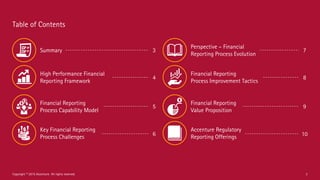
Table of Contents
Copyright © 2017 Accenture All rights reserved.
Key Financial Reporting
Process Challenges
Summary
Financial Reporting
Process Capability Model
High Performance Financial
Reporting Framework
Accenture Regulatory
Reporting Offerings
Perspective – Financial
Reporting Process Evolution
Financial Reporting
Value Proposition
Financial Reporting
Process Improvement Tactics
3
4
5
6
7
8
9
10
With the new and the ever complex external
reporting landscape, financial institutions are
faced with a variety of challenges such as:
Consequently, institutions should consider
strategic solutions that can effectively manage
these associated costs by:
3
Summary
Complex financial reporting frameworks and enhancement process capabilities are being reconsidered across
the financial services industry to address an evolving and dynamic regulatory environment.
Copyright © 2017 Accenture All rights reserved.
• Increased costs to meet regulatory reporting requirements
• Data quality and sourcing issues impacting report accuracy
• Timely and inaccurate report outputs
• Non-compliance costs and reputation risks
• Providing accurate and timely information to internal
and external parties
• Increasing reporting transparency
• Increasing data consistency and management
Accenture offers an internal and external Regulatory Reporting Framework with a wide variety of offerings to help clients address
new and complex challenges with solutions that focus on data quality, data sourcing, and centralizing capabilities to help create
efficiencies within the process.
Note: Please see Legend slide for definition of acronyms
4
High Performance Financial Reporting Framework
Consolidating frameworks, processes, and technology create efficiencies across reporting functions.
Copyright © 2017 Accenture All rights reserved.
Reporting: External / Internal
• Similar data can be used to populate reports across the
regulatory landscape and for internal purposes reducing
redundant activities
Reporting: MIS / Shareholders
• With more accurate reporting results, financials
can be produced faster
Reporting: Functions
• Cross function transparency can be created allowing
for the dynamic integration of new systems
BrokerDealer
AssetManagement
Insurance
CapitalMarkets
Bank
Reporting Regulatory (External)
OCC
FDIC
NCUA
FRB
SEC
CFTC
CFPB
FHFA
FINRA
NAIC
ESFS
Basel
Functions
Risk
Treasury
Finance
Human Resources
Control
Line of Business
External Data (Market)
Legal
Process: Workflow and Requirements
• Straight through processing of information across
all systems to help streamline reporting needs
Support: Organization
• Overarching controls and governance to help manage risk,
with well communicated roles and responsibilities
Support: Technology
• Seamless user experience to investigate, manage risk,
and create new information and data
Benefits of Consolidation
Internal Management Information System (MIS)
and ShareholdersInformational
Sr. Management
Operations
Board Actuals Forecasting
Support Organization Technology
Workflow ModelingPolicy
Training
RCSA
Procedures
Resource Location
Audit
Business Rules Performance Metrics
Calculators Aggregation
Web Services Reporting Engine
Technical Rules Batch Management
Process Workflows and Requirements
Sourcing and
Validation
Reconciliation Adjustments Transformation Distribution
Data
Management
Investigation and Analysis
Security / Audit / Controls
5
Financial Reporting Process Capability Model
Accenture’s standardized regulatory reporting process capability model helps accelerate assessment and change.
Copyright © 2017 Accenture All rights reserved.
Core Workflows and Requirements
Supporting Workflow
and Requirements
Note: Please see Legend slide for definition of acronyms
Level 1
Level 2
Level 3
Level 3 – Sub-Category
Security / Audit /
Control
Sourcing and
Validation
Policy / Procedures
Quality Control
Entitlements
Data Sourcing
Controls
Retention
and Archiving
Validation Rules
Quality Assurance
SecuritySourcing
ControlsBusiness
RCSAException Tracking
SOXMetrics
Operations
Audit
Reconciliation
Break Thresholds
Research
Mapping to
General Ledger
Cross Report
Resolution
Data Management
Data Quality
Metadata
Management
Lineage and
Traceability
Restatement
Data Governance
Data Approval
Controls
Data Accuracy
Rule Conformation
Datasets
Versioning
Report Preparation
External
Drill Down
Variance
Commentary
Internal
Data Mapping
Regulatory Thresholds
Attestation
Escalation Criteria
Escalation Tracking
Report Submission
Capital Thresholds /
Materiality
Adjustments
Transaction
Manual Upload
Adjustment Inventory
Adjustment Approval
Aggregated Data MaskingTechnical
Transformations
Model Definition /
Enhancement
Pro Forma
Formulas
Error Resolution
Report Changes /
Maintenance
Calculations
Derivation Rules
Aggregation
Aggregation Rules
Model Governance
Model Approval
Derivations
Investigation
and Analytics
Canned
Operational Dashboard
Reports
Ad Hoc
Analytics
Performance
Market
Risk
Capital Management
Capital Results
Narrative
6
Key Financial Reporting Process Challenges
The industry is facing three key challenges in regulatory reporting processes.
Copyright © 2017 Accenture All rights reserved.
Accenture SolutionsChallenges
• Predesigned regulatory reporting capability model accelerating
the assessment of risks and accuracy issues
• Preferred practices to clearly define organizational structures
for regulatory reporting
Completeness and Accuracy of Report
• Lack of data transparency
• Undefined roles and responsibilities
• Straight through processing (STP) leveraging central data
repository practices for populating reports
• Standardized metrics to track successful reporting processes
and accurate data outcomes
Time to Report
• Report requires multiple types of data
• Poorly defined data requirements
• Manual reporting processes
• Evolving / changing regulatory environments
• Preferred practices to validate and reconcile upstream data
• Predefined categories of data quality issues
• Prioritization methodologies to remediate data quality issues
Data Quality Issues
• Multiple report adjustments introduce issues
• Poor understanding of data issues
• No operating model to remediate issues
Simplification and STP Focus
Includes the resolution of data quality issues, the development
of key data and reconciliations, and the review of data feeds.
Perspective – Financial Reporting Process Evolution
Current stage of evolution in
the Financial Services Industry
Increasing Value
Centralized system and services
deployed alongside automated
work queuing, prioritization and
automated report population
Low visibility to key controls
Overlapping roles
Separate platforms
Level 1: Basics Simplification
and reconciliation
Consolidation of data
aggregation achieves STP
Level 2: Transformation
Level 3: Improvement
Clearly defined roles
Full internal STP via
complete integration
Level 4+: Transparency
Tailored data to identify
broader trends and drivers
Insight gained allows
risk containment
and issue remediation
Data management structure helps
record and communicate changes
Improve Controls and RiskOrganize Introduce / Enhance Technology
Efficiency and Cost Effectiveness Focus
Includes governance integration and automation
of reporting. Analytics and metrics in place to help
drive greater process efficiency.
As reporting capabilities mature the function changes from simply producing to creating dynamic reporting solutions.
7Copyright © 2017 Accenture All rights reserved.
RenovateOperate Innovate
Regulatory
Reporting
Offerings
8
Financial Reporting Process Improvement Tactics
Assessing the maturity of capabilities within the reporting process and system flow will help firms target key
tactics for improvement.
Copyright © 2017 Accenture All rights reserved.
Data Suppliers
Transaction
Aggregation
Calculations
Reporting
Aggregation
Reporting
System
Flow
Adjustment Transformation DistributionReconciliation
Sourcing /
Validation
Variance
Commentary
Reporting
Process
Attestation
Data Quality to improve the processing of data requiring manual intervention and adjustments
which impact accuracy
Data Sourcing to organize data requirements with clear documentation assisting with the remediation
of data quality and populating reports
Process
System
User Tool Reduction to eliminate manual intervention (Microsoft Excel® files, access databases), creating
transparency into data transformations and limiting multiple human touch points before report population
Process Monitoring to identify issues that create bottlenecks and other inefficiencies
Consolidate System Architecture to create Straight Through Processing of data
9
Financial Reporting Value Proposition
Copyright © 2017 Accenture All rights reserved. Note: Please see Legend slide for definition of acronyms
Expected Outcomes Impact
Enhanced Analytics
• Enhanced analytics on quality assurance, quality control, and key issue areas
• Advanced measurements of data processing
Traceability
• Enhance the data governance and escalation processes
• Improved data access and controls to allow proper entitlements throughout systems
• Identify incomplete or business rule discrepancies
Insight into Purpose and Use
• Faster service-level agreements (SLAs) and timing to report
• Improve collaboration between reporting programs and the line of business
• Better define and communicate strategic improvements to the reporting process
Ownership • Clear ownership and responsibility between populating reports and data providers
Controls • Reduce risk and manage reporting outcomes for accuracy
Decrease Time to Change
• Improve timing to decision around changes
• Quickly communicate changes across consumers and suppliers of information
Improve Data Quality
• Improve timing for root cause analysis
• Proactive response to data issues vs. reactive fixes
Technology Architecture Design
• Reduced estimating costs for architecture design and change
• Identify stale and unused information
• Quicker identification for the reuse of data vs. creating new data
• Improve supplier feeds and streamline data flow removing manual processing
Staffing Improvements • Diversified organizational structure to improve cost to report
Reduce Regulatory Actions (e.g. MRIA/MRA)
• Documented source of information for key financial reports
• Facilitate compliance (e.g. consent orders) with regulators
Improve Report Accuracy • Quicker enhancements to automate reporting and reduce manual intervention
Reduction of Manual Data
• Quicker identification of sources of manual data
• Improved accuracy and reduce adjustments
• Transparency into reporting outcomes and source of data
• Reduction in risk due from manual processingCompliance
Automation
Regulatory Response
Reduced
Operating Cost
Governance
and Oversight
Value Proposition
Benefits
Accenture Regulatory Reporting Offerings
10Copyright © 2017 Accenture All rights reserved.
User Tool
Assessment
Approach
Capability
Design and
Data Sourcing
Regulatory
Reporting
Dashboard
Integrated
Reporting Tool Set
Implementation
Data Quality
Management
Target Operating
Model and
Governance
Regulatory
Reporting Vendor
Implementation
Description
Develop an approach
for the assessment
of manual tools for
determining a tactical
and strategic elimination
strategy.
Develop and design
reporting processes and
capabilities. Document
key steps for data
processing, populating
reports and collecting
key reporting data
attributes.
Standard dashboard
components measuring
the effectiveness of data
processing, improvement
over time and tracking to
key business reporting
objectives.
Framework outlining
the standard process,
capabilities and
technology components
required to streamline
reporting and centralize
finance data for straight
through processing.
Develop standard data
quality management
operating model
(framework) for
the identification,
investigation, and
resolution of data
quality issues.
Create target operating
model and governance
structure for regulatory
reporting capability to
allow for clear roles
and responsibilities,
ownership, process
documentation,
and governance.
Support a client’s
implementation
of regulatory reporting
tools through vendor
selection, business and
functional requirement
gathering, tool
configuration, and
testing / go live support.
• Increase automation
• Improve report
accuracy
• Reduce manual data
• Improve governance
• Increase data
transparency
• Reduce risk
• Improve time to report
• Increase automation
• Improve report
accuracy
• Improve data quality
• Reduce time to change
• Reduce manual data
• Increase automation
• Improve report
accuracy
• Improve staff usage
• Reduce manual data
• Improve data quality
• Improve report
accuracy
• Improve data quality
• Reduce regulatory
actions
• Increase ownership
• Improve governance
• Reduce redundant
processes and controls
• Increase automation
and functionality
• Improve report
accuracy
• Reduce manual
controls
Accenture has developed a set of seven key regulatory offerings to tackle current challenges in regulatory
reporting space.
ValueProposition
11
Legend
Copyright © 2017 Accenture All rights reserved.
CFPB: Consumer Financial Protection Bureau
CFTC: U.S. Commodity Futures Trading Commission
ESFS: European System of Financial Supervision
FDIC: Federal Deposit Insurance Corporation
FHFA: Federal Housing Finance Agency
FINRA: Financial Industry Regulatory Authority
FRB: Federal Reserve Board
MRA: Matters Requiring Attention
MRIA: Matters Requiring Immediate Attention
NAIC: National Association of Insurance Commissioners
NCUA: National Credit Union Administration
OCC: Office of the Comptroller of the Currency
RCSA: Risk Control Self Assessment
SEC: U.S. Securities and Exchange Commission
SOX: Sarbanes-Oxley Act
12
Regulatory & Financial Reporting Offering
Copyright © 2017 Accenture All rights reserved. Accenture, its logo, and High Performance Delivered are trademarks of Accenture.
Disclaimer
This presentation is intended for general informational purposes only and does not take into account the reader’s specific
circumstances, and may not reflect the most current developments. Accenture disclaims, to the fullest extent permitted
by applicable law, any and all liability for the accuracy and completeness of the information in this presentation and for
any acts or omissions made based on such information. Accenture does not provide legal, regulatory, audit, or tax
advice. Readers are responsible for obtaining such advice from their own legal counsel or other licensed professionals.
About Accenture
Accenture is a leading global professional services company, providing a broad range of services and solutions in strategy,
consulting, digital, technology and operations. Combining unmatched experience and specialized skills across more than
40 industries and all business functions—underpinned by the world’s largest delivery network—Accenture works at the
intersection of business and technology to help clients improve their performance and create sustainable value for their
stakeholders. With more than 394,000 people serving clients in more than 120 countries, Accenture drives innovation to
improve the way the world works and lives. Visit us at www.accenture.com

Finance Reporting Offering

  • 1.
    Regulatory & Financial ReportingOffering January, 2017
  • 2.
    2 Table of Contents Copyright© 2017 Accenture All rights reserved. Key Financial Reporting Process Challenges Summary Financial Reporting Process Capability Model High Performance Financial Reporting Framework Accenture Regulatory Reporting Offerings Perspective – Financial Reporting Process Evolution Financial Reporting Value Proposition Financial Reporting Process Improvement Tactics 3 4 5 6 7 8 9 10
  • 3.
    With the newand the ever complex external reporting landscape, financial institutions are faced with a variety of challenges such as: Consequently, institutions should consider strategic solutions that can effectively manage these associated costs by: 3 Summary Complex financial reporting frameworks and enhancement process capabilities are being reconsidered across the financial services industry to address an evolving and dynamic regulatory environment. Copyright © 2017 Accenture All rights reserved. • Increased costs to meet regulatory reporting requirements • Data quality and sourcing issues impacting report accuracy • Timely and inaccurate report outputs • Non-compliance costs and reputation risks • Providing accurate and timely information to internal and external parties • Increasing reporting transparency • Increasing data consistency and management Accenture offers an internal and external Regulatory Reporting Framework with a wide variety of offerings to help clients address new and complex challenges with solutions that focus on data quality, data sourcing, and centralizing capabilities to help create efficiencies within the process.
  • 4.
    Note: Please seeLegend slide for definition of acronyms 4 High Performance Financial Reporting Framework Consolidating frameworks, processes, and technology create efficiencies across reporting functions. Copyright © 2017 Accenture All rights reserved. Reporting: External / Internal • Similar data can be used to populate reports across the regulatory landscape and for internal purposes reducing redundant activities Reporting: MIS / Shareholders • With more accurate reporting results, financials can be produced faster Reporting: Functions • Cross function transparency can be created allowing for the dynamic integration of new systems BrokerDealer AssetManagement Insurance CapitalMarkets Bank Reporting Regulatory (External) OCC FDIC NCUA FRB SEC CFTC CFPB FHFA FINRA NAIC ESFS Basel Functions Risk Treasury Finance Human Resources Control Line of Business External Data (Market) Legal Process: Workflow and Requirements • Straight through processing of information across all systems to help streamline reporting needs Support: Organization • Overarching controls and governance to help manage risk, with well communicated roles and responsibilities Support: Technology • Seamless user experience to investigate, manage risk, and create new information and data Benefits of Consolidation Internal Management Information System (MIS) and ShareholdersInformational Sr. Management Operations Board Actuals Forecasting Support Organization Technology Workflow ModelingPolicy Training RCSA Procedures Resource Location Audit Business Rules Performance Metrics Calculators Aggregation Web Services Reporting Engine Technical Rules Batch Management Process Workflows and Requirements Sourcing and Validation Reconciliation Adjustments Transformation Distribution Data Management Investigation and Analysis Security / Audit / Controls
  • 5.
    5 Financial Reporting ProcessCapability Model Accenture’s standardized regulatory reporting process capability model helps accelerate assessment and change. Copyright © 2017 Accenture All rights reserved. Core Workflows and Requirements Supporting Workflow and Requirements Note: Please see Legend slide for definition of acronyms Level 1 Level 2 Level 3 Level 3 – Sub-Category Security / Audit / Control Sourcing and Validation Policy / Procedures Quality Control Entitlements Data Sourcing Controls Retention and Archiving Validation Rules Quality Assurance SecuritySourcing ControlsBusiness RCSAException Tracking SOXMetrics Operations Audit Reconciliation Break Thresholds Research Mapping to General Ledger Cross Report Resolution Data Management Data Quality Metadata Management Lineage and Traceability Restatement Data Governance Data Approval Controls Data Accuracy Rule Conformation Datasets Versioning Report Preparation External Drill Down Variance Commentary Internal Data Mapping Regulatory Thresholds Attestation Escalation Criteria Escalation Tracking Report Submission Capital Thresholds / Materiality Adjustments Transaction Manual Upload Adjustment Inventory Adjustment Approval Aggregated Data MaskingTechnical Transformations Model Definition / Enhancement Pro Forma Formulas Error Resolution Report Changes / Maintenance Calculations Derivation Rules Aggregation Aggregation Rules Model Governance Model Approval Derivations Investigation and Analytics Canned Operational Dashboard Reports Ad Hoc Analytics Performance Market Risk Capital Management Capital Results Narrative
  • 6.
    6 Key Financial ReportingProcess Challenges The industry is facing three key challenges in regulatory reporting processes. Copyright © 2017 Accenture All rights reserved. Accenture SolutionsChallenges • Predesigned regulatory reporting capability model accelerating the assessment of risks and accuracy issues • Preferred practices to clearly define organizational structures for regulatory reporting Completeness and Accuracy of Report • Lack of data transparency • Undefined roles and responsibilities • Straight through processing (STP) leveraging central data repository practices for populating reports • Standardized metrics to track successful reporting processes and accurate data outcomes Time to Report • Report requires multiple types of data • Poorly defined data requirements • Manual reporting processes • Evolving / changing regulatory environments • Preferred practices to validate and reconcile upstream data • Predefined categories of data quality issues • Prioritization methodologies to remediate data quality issues Data Quality Issues • Multiple report adjustments introduce issues • Poor understanding of data issues • No operating model to remediate issues
  • 7.
    Simplification and STPFocus Includes the resolution of data quality issues, the development of key data and reconciliations, and the review of data feeds. Perspective – Financial Reporting Process Evolution Current stage of evolution in the Financial Services Industry Increasing Value Centralized system and services deployed alongside automated work queuing, prioritization and automated report population Low visibility to key controls Overlapping roles Separate platforms Level 1: Basics Simplification and reconciliation Consolidation of data aggregation achieves STP Level 2: Transformation Level 3: Improvement Clearly defined roles Full internal STP via complete integration Level 4+: Transparency Tailored data to identify broader trends and drivers Insight gained allows risk containment and issue remediation Data management structure helps record and communicate changes Improve Controls and RiskOrganize Introduce / Enhance Technology Efficiency and Cost Effectiveness Focus Includes governance integration and automation of reporting. Analytics and metrics in place to help drive greater process efficiency. As reporting capabilities mature the function changes from simply producing to creating dynamic reporting solutions. 7Copyright © 2017 Accenture All rights reserved. RenovateOperate Innovate
  • 8.
    Regulatory Reporting Offerings 8 Financial Reporting ProcessImprovement Tactics Assessing the maturity of capabilities within the reporting process and system flow will help firms target key tactics for improvement. Copyright © 2017 Accenture All rights reserved. Data Suppliers Transaction Aggregation Calculations Reporting Aggregation Reporting System Flow Adjustment Transformation DistributionReconciliation Sourcing / Validation Variance Commentary Reporting Process Attestation Data Quality to improve the processing of data requiring manual intervention and adjustments which impact accuracy Data Sourcing to organize data requirements with clear documentation assisting with the remediation of data quality and populating reports Process System User Tool Reduction to eliminate manual intervention (Microsoft Excel® files, access databases), creating transparency into data transformations and limiting multiple human touch points before report population Process Monitoring to identify issues that create bottlenecks and other inefficiencies Consolidate System Architecture to create Straight Through Processing of data
  • 9.
    9 Financial Reporting ValueProposition Copyright © 2017 Accenture All rights reserved. Note: Please see Legend slide for definition of acronyms Expected Outcomes Impact Enhanced Analytics • Enhanced analytics on quality assurance, quality control, and key issue areas • Advanced measurements of data processing Traceability • Enhance the data governance and escalation processes • Improved data access and controls to allow proper entitlements throughout systems • Identify incomplete or business rule discrepancies Insight into Purpose and Use • Faster service-level agreements (SLAs) and timing to report • Improve collaboration between reporting programs and the line of business • Better define and communicate strategic improvements to the reporting process Ownership • Clear ownership and responsibility between populating reports and data providers Controls • Reduce risk and manage reporting outcomes for accuracy Decrease Time to Change • Improve timing to decision around changes • Quickly communicate changes across consumers and suppliers of information Improve Data Quality • Improve timing for root cause analysis • Proactive response to data issues vs. reactive fixes Technology Architecture Design • Reduced estimating costs for architecture design and change • Identify stale and unused information • Quicker identification for the reuse of data vs. creating new data • Improve supplier feeds and streamline data flow removing manual processing Staffing Improvements • Diversified organizational structure to improve cost to report Reduce Regulatory Actions (e.g. MRIA/MRA) • Documented source of information for key financial reports • Facilitate compliance (e.g. consent orders) with regulators Improve Report Accuracy • Quicker enhancements to automate reporting and reduce manual intervention Reduction of Manual Data • Quicker identification of sources of manual data • Improved accuracy and reduce adjustments • Transparency into reporting outcomes and source of data • Reduction in risk due from manual processingCompliance Automation Regulatory Response Reduced Operating Cost Governance and Oversight Value Proposition Benefits
  • 10.
    Accenture Regulatory ReportingOfferings 10Copyright © 2017 Accenture All rights reserved. User Tool Assessment Approach Capability Design and Data Sourcing Regulatory Reporting Dashboard Integrated Reporting Tool Set Implementation Data Quality Management Target Operating Model and Governance Regulatory Reporting Vendor Implementation Description Develop an approach for the assessment of manual tools for determining a tactical and strategic elimination strategy. Develop and design reporting processes and capabilities. Document key steps for data processing, populating reports and collecting key reporting data attributes. Standard dashboard components measuring the effectiveness of data processing, improvement over time and tracking to key business reporting objectives. Framework outlining the standard process, capabilities and technology components required to streamline reporting and centralize finance data for straight through processing. Develop standard data quality management operating model (framework) for the identification, investigation, and resolution of data quality issues. Create target operating model and governance structure for regulatory reporting capability to allow for clear roles and responsibilities, ownership, process documentation, and governance. Support a client’s implementation of regulatory reporting tools through vendor selection, business and functional requirement gathering, tool configuration, and testing / go live support. • Increase automation • Improve report accuracy • Reduce manual data • Improve governance • Increase data transparency • Reduce risk • Improve time to report • Increase automation • Improve report accuracy • Improve data quality • Reduce time to change • Reduce manual data • Increase automation • Improve report accuracy • Improve staff usage • Reduce manual data • Improve data quality • Improve report accuracy • Improve data quality • Reduce regulatory actions • Increase ownership • Improve governance • Reduce redundant processes and controls • Increase automation and functionality • Improve report accuracy • Reduce manual controls Accenture has developed a set of seven key regulatory offerings to tackle current challenges in regulatory reporting space. ValueProposition
  • 11.
    11 Legend Copyright © 2017Accenture All rights reserved. CFPB: Consumer Financial Protection Bureau CFTC: U.S. Commodity Futures Trading Commission ESFS: European System of Financial Supervision FDIC: Federal Deposit Insurance Corporation FHFA: Federal Housing Finance Agency FINRA: Financial Industry Regulatory Authority FRB: Federal Reserve Board MRA: Matters Requiring Attention MRIA: Matters Requiring Immediate Attention NAIC: National Association of Insurance Commissioners NCUA: National Credit Union Administration OCC: Office of the Comptroller of the Currency RCSA: Risk Control Self Assessment SEC: U.S. Securities and Exchange Commission SOX: Sarbanes-Oxley Act
  • 12.
    12 Regulatory & FinancialReporting Offering Copyright © 2017 Accenture All rights reserved. Accenture, its logo, and High Performance Delivered are trademarks of Accenture. Disclaimer This presentation is intended for general informational purposes only and does not take into account the reader’s specific circumstances, and may not reflect the most current developments. Accenture disclaims, to the fullest extent permitted by applicable law, any and all liability for the accuracy and completeness of the information in this presentation and for any acts or omissions made based on such information. Accenture does not provide legal, regulatory, audit, or tax advice. Readers are responsible for obtaining such advice from their own legal counsel or other licensed professionals. About Accenture Accenture is a leading global professional services company, providing a broad range of services and solutions in strategy, consulting, digital, technology and operations. Combining unmatched experience and specialized skills across more than 40 industries and all business functions—underpinned by the world’s largest delivery network—Accenture works at the intersection of business and technology to help clients improve their performance and create sustainable value for their stakeholders. With more than 394,000 people serving clients in more than 120 countries, Accenture drives innovation to improve the way the world works and lives. Visit us at www.accenture.com