Emerging capabilities for change
leaders and practitioners
the
high 5
Of
change mastery
WHITE PAPER FROM October 2016
LENA ROSS
BUILDING ENTERPRISE CHANGE CAPABILITY
Staying ahead of the curve
Change leaders and practitioners have an
established set of conventional technical and
behavioural capabilities, such as stakeholder
engagement, influencing skills, communication,
assessing readiness and impacts… to name a
few.
These capabilities and interventions have served
us well for a long time. But now that change
itself is changing, we need to build new
capabilities that will equip us with skills for a
disruptive business environment.
In a climate of relentless change, we need to
ensure our practice remains relevant by taking a
future-forward view. In delivering change, we
need to continue to add value to business
success and benefits realisation.
We need to stay ahead of the curve!
The five emerging capabilities, called the High 5,
outlined in this paper will prepare us, as change
leaders and practitioners, for the new ways of
working.
For each of these capabilities, you will find a
definition along with a brief overview of:
- why it’s important
- how you can use it
There’s also an infographic summary on page 8,
for a quick visual reference.
Now, let’s high five!
2
INTRODUCTION
Future of work | design thinking | agile mindset | digital literacy | human hardwired behaviour
3
01
FUTURE OF WORK
An understanding of the trends and forces that
are shaping the way we work, so we can connect
people to a purpose and the bigger picture
macro-environment.
With a great deal of disruption going on, organisations have
their focus on the external business environment to stay
abreast of what their competitors are doing, and to identify
new markets and emerging customer demands.
By closely watching trends that are disrupting the workplace
around generations, technology, globalisation, learning,
human resources, and mobility, we will be better positioned
to understand how that disruption is affecting the way we
work, inside our own organisations. These same trends are
shaping employee expectations.
Leading and communicating with people is demanding a
new approach to resonate and deeply engage.
With an understanding of the macro environment in the
world of work, we can continuously update our capabilities,
to remain relevant and effective as change leaders and
managers in motivating in retaining talented people.
Why it’s important
How you can use it
Link the objectives of your program or transformation to the bigger
picture on how the workplace is changing, to connect your
people to a higher purpose. This helps your narrative on the WHY.
Embrace the use of disruptive two-way communication channels
in your organisation to promote and model co-creation and
collaboration. Some of these are Working out Loud, Enterprise
Social Networks (ESNs) such as Yammer, and Visual Management.
Future of work | design thinking | agile mindset | digital literacy | human hardwired behaviour
4
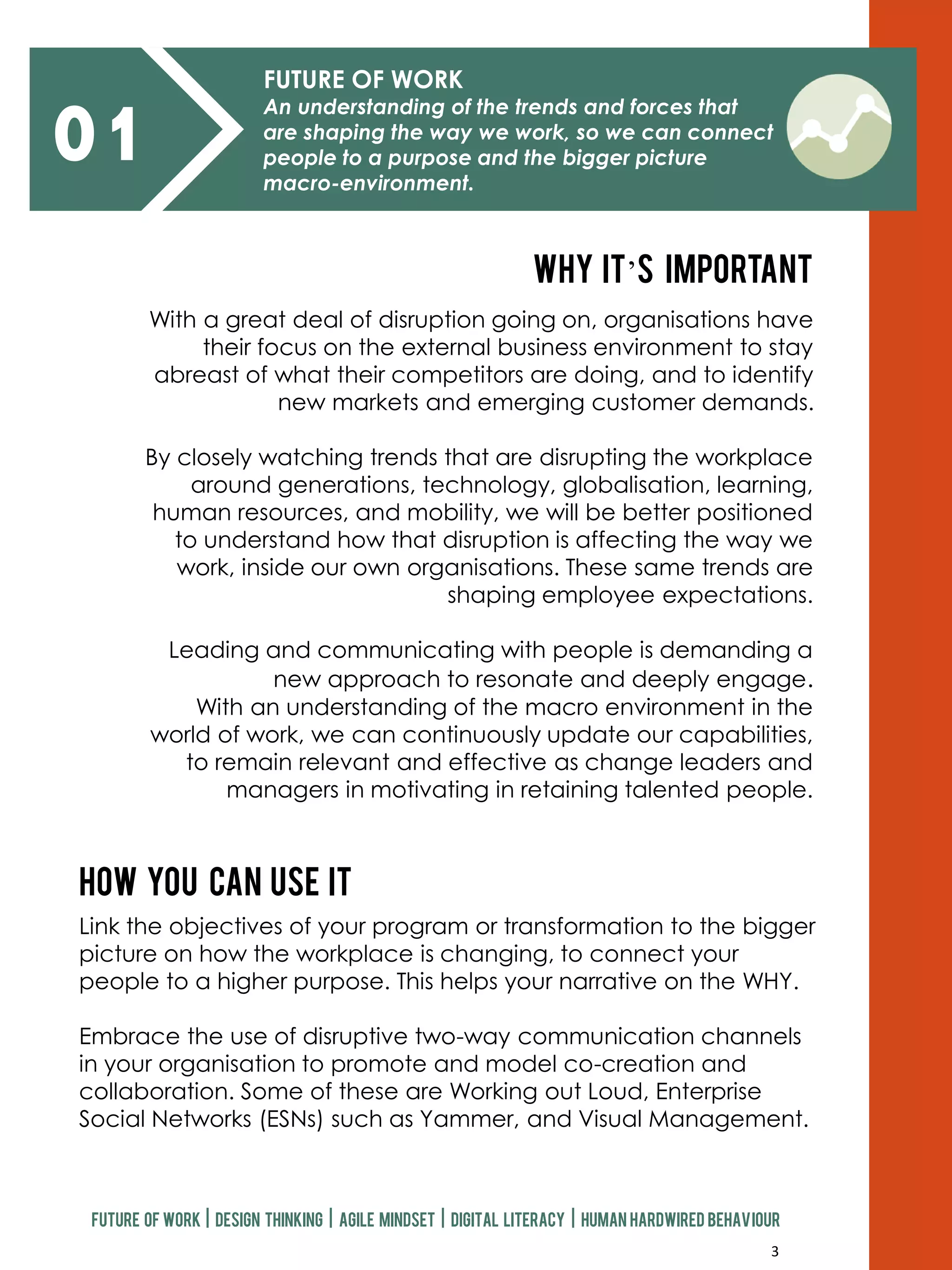
02DESIGN THINKING
A solution focussed and human-centred approach
to create the future for customers and employees.
Why it’s important
How you can use it
Customers are setting a high bar with expectations that are
being met by the disruptors (think Uber, AirBNB, Kogan, Amazon,
Netflix…the list goes on), so the pressure is on all businesses to be
not only nimble and responsive to what the user wants, but also
sufficiently innovative to create new demands.
Design thinking, as a human-centred design practice, is being
used to develop innovative solutions to everyday business
challenges. The approach uncovers current and potential
customer and end-user pain points.
Because a solution or new product usually translates to change,
it’s now a much-needed skill in change management. Applying
a human-centric lens to leading and managing change takes
us to the very heart of what we do – help our people adopt the
change.
Whilst human-centred design (HCD) is often applied developing
empathy and solutions for our customers, the same thinking can
be used to plan and introduce change.
Consider our impacted employees are our internal customers
who can provide deep insights.
Plan your change and identify post-implementation measures
through the lens of what we want our people to do, to think and
how we want them to feel.
Integrate HCD into your change plans and interventions to drive
meaningful conversations with your stakeholders and impacted
employees. Design employee journey maps to create a visual
representation of the current and future state impacts.
Future of work | design thinking | agile mindset | digital literacy | human hardwired behaviour
5
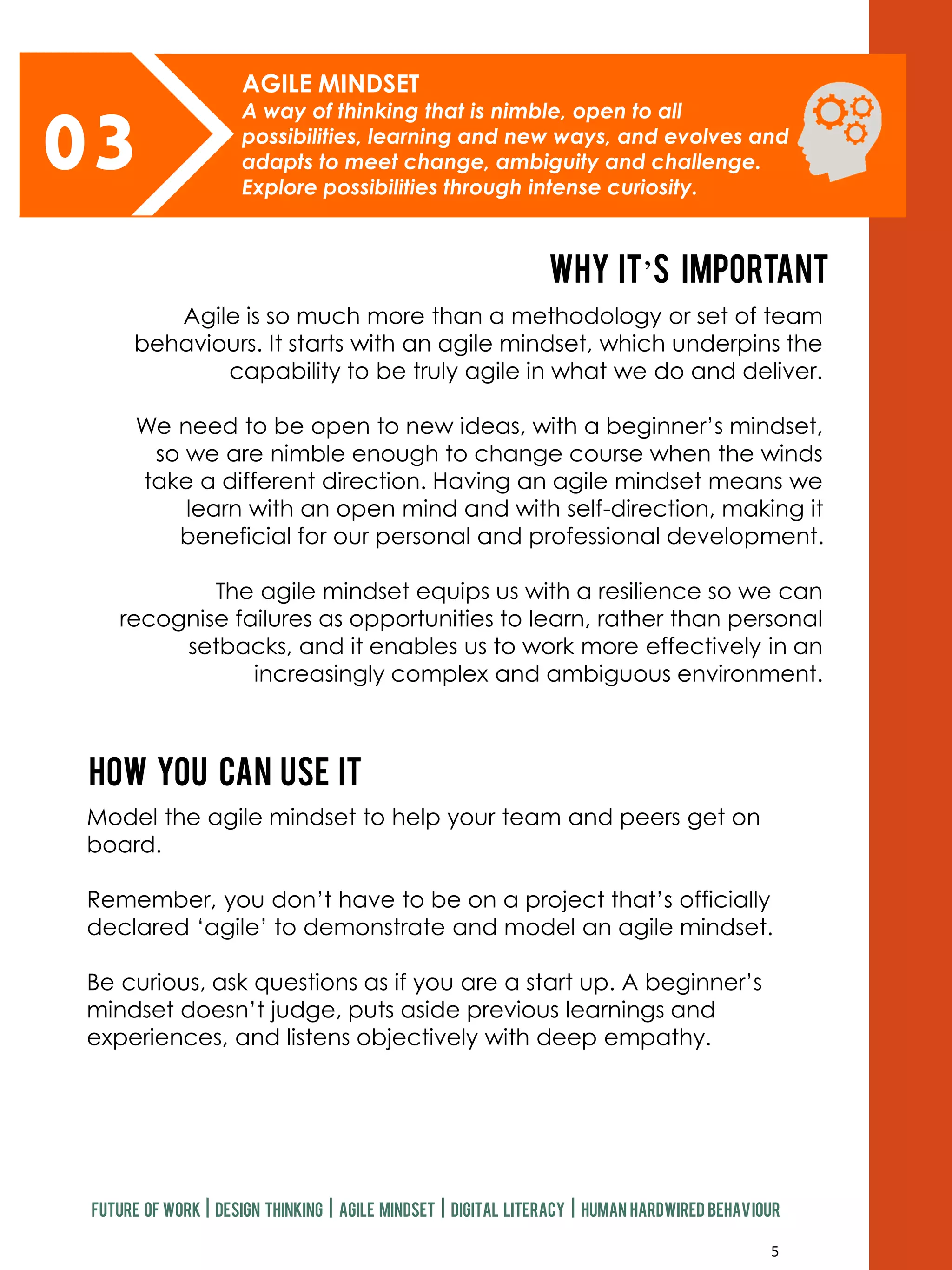
03
AGILE MINDSET
A way of thinking that is nimble, open to all
possibilities, learning and new ways, and evolves and
adapts to meet change, ambiguity and challenge.
Explore possibilities through intense curiosity.
Why it’s important
How you can use it
Future of work | design thinking | agile mindset | digital literacy | human hardwired behaviour
Agile is so much more than a methodology or set of team
behaviours. It starts with an agile mindset, which underpins the
capability to be truly agile in what we do and deliver.
We need to be open to new ideas, with a beginner’s mindset,
so we are nimble enough to change course when the winds
take a different direction. Having an agile mindset means we
learn with an open mind and with self-direction, making it
beneficial for our personal and professional development.
The agile mindset equips us with a resilience so we can
recognise failures as opportunities to learn, rather than personal
setbacks, and it enables us to work more effectively in an
increasingly complex and ambiguous environment.
Model the agile mindset to help your team and peers get on
board.
Remember, you don’t have to be on a project that’s officially
declared ‘agile’ to demonstrate and model an agile mindset.
Be curious, ask questions as if you are a start up. A beginner’s
mindset doesn’t judge, puts aside previous learnings and
experiences, and listens objectively with deep empathy.
6
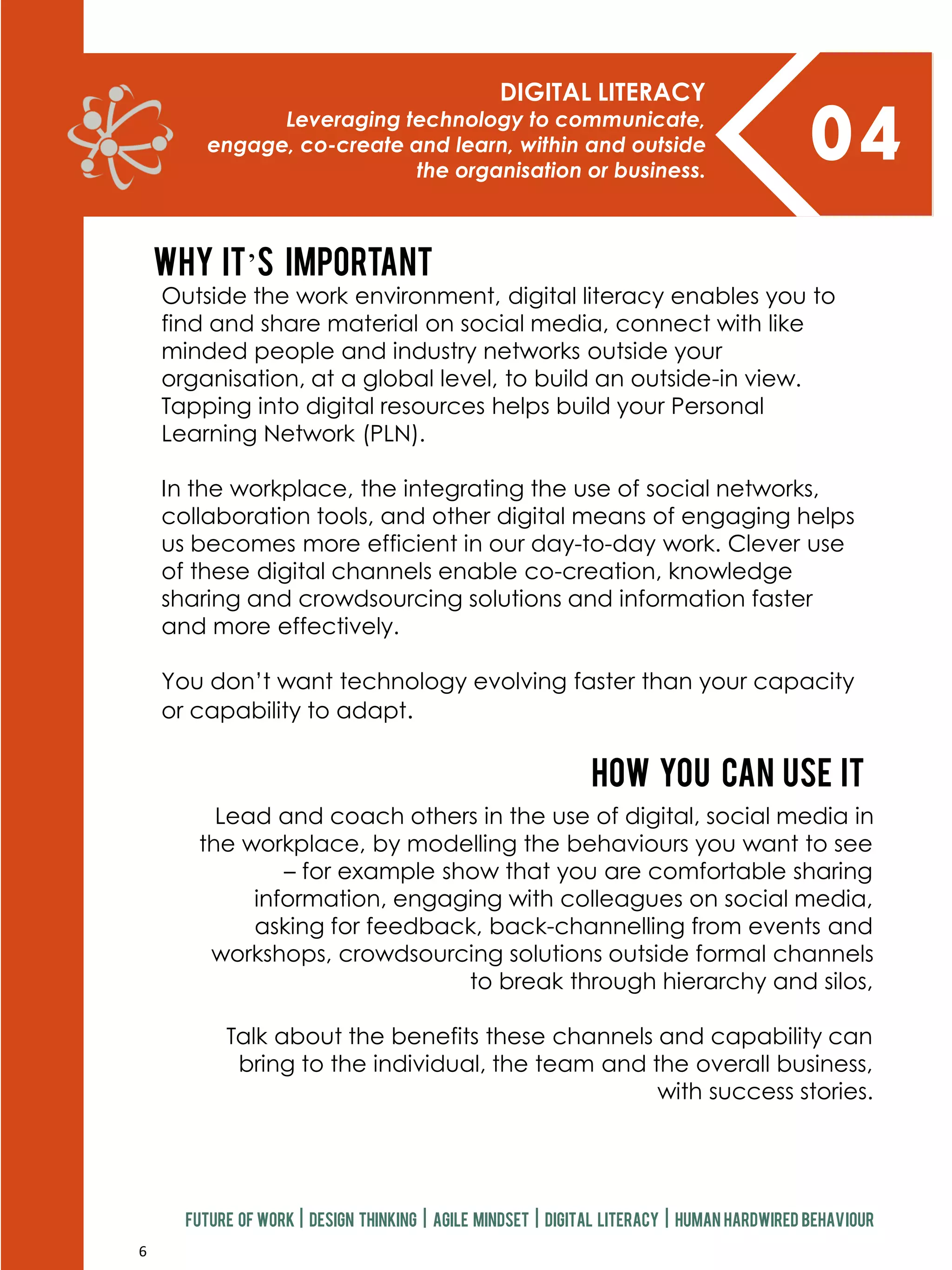
04
DIGITAL LITERACY
Leveraging technology to communicate,
engage, co-create and learn, within and outside
the organisation or business.
Future of work | design thinking | agile mindset | digital literacy | human hardwired behaviour
Lead and coach others in the use of digital, social media in
the workplace, by modelling the behaviours you want to see
– for example show that you are comfortable sharing
information, engaging with colleagues on social media,
asking for feedback, back-channelling from events and
workshops, crowdsourcing solutions outside formal channels
to break through hierarchy and silos,
Talk about the benefits these channels and capability can
bring to the individual, the team and the overall business,
with success stories.
How you can use it
Why it’s important
Outside the work environment, digital literacy enables you to
find and share material on social media, connect with like
minded people and industry networks outside your
organisation, at a global level, to build an outside-in view.
Tapping into digital resources helps build your Personal
Learning Network (PLN).
In the workplace, the integrating the use of social networks,
collaboration tools, and other digital means of engaging helps
us becomes more efficient in our day-to-day work. Clever use
of these digital channels enable co-creation, knowledge
sharing and crowdsourcing solutions and information faster
and more effectively.
You don’t want technology evolving faster than your capacity
or capability to adapt.
7
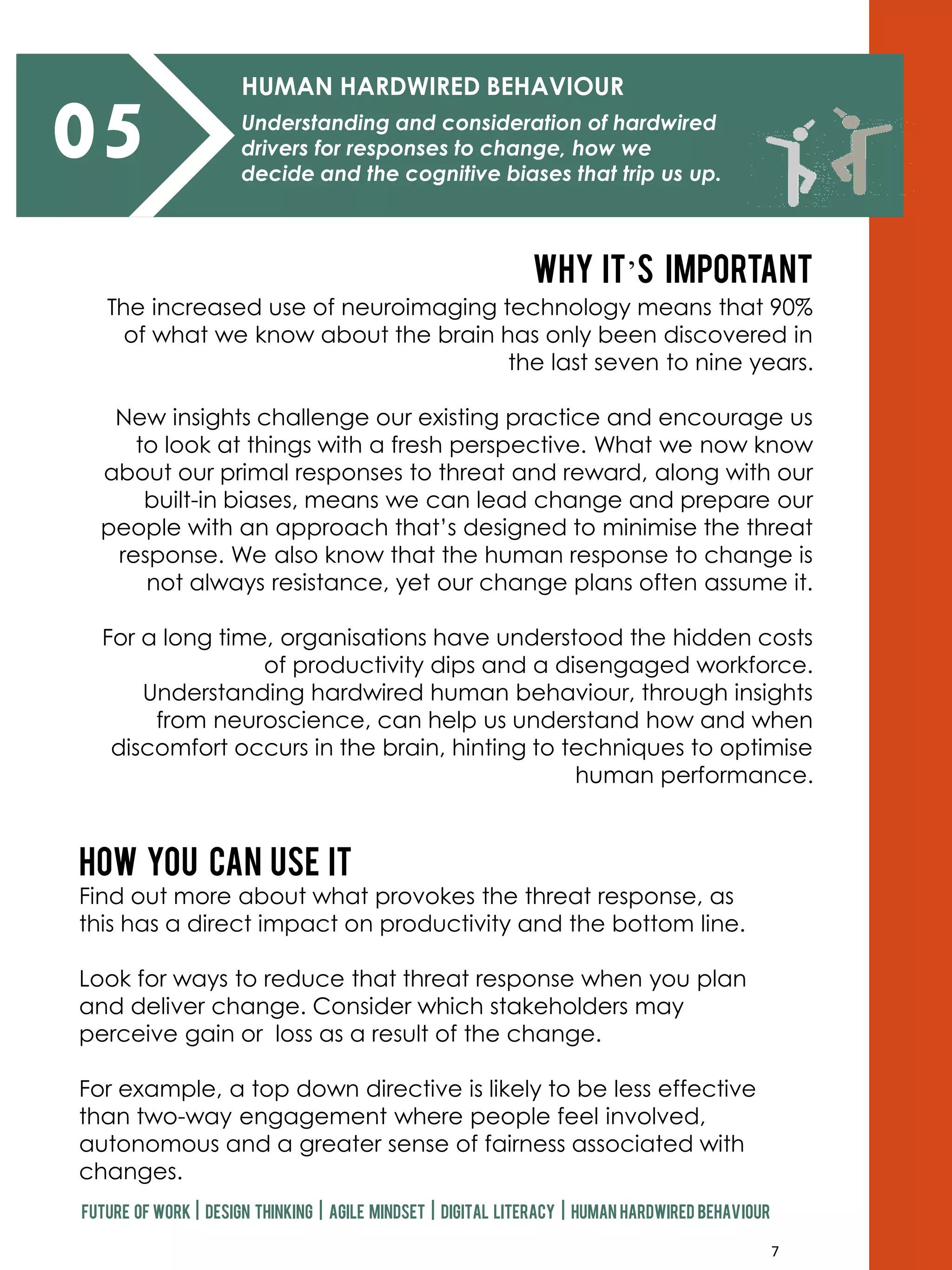
05
HUMAN HARDWIRED BEHAVIOUR
Understanding and consideration of hardwired
drivers for responses to change, how we
decide and the cognitive biases that trip us up.
The increased use of neuroimaging technology means that 90%
of what we know about the brain has only been discovered in
the last seven to nine years.
New insights challenge our existing practice and encourage us
to look at things with a fresh perspective. What we now know
about our primal responses to threat and reward, along with our
built-in biases, means we can lead change and prepare our
people with an approach that’s designed to minimise the threat
response. We also know that the human response to change is
not always resistance, yet our change plans often assume it.
For a long time, organisations have understood the hidden costs
of productivity dips and a disengaged workforce.
Understanding hardwired human behaviour, through insights
from neuroscience, can help us understand how and when
discomfort occurs in the brain, hinting to techniques to optimise
human performance.
Why it’s important
How you can use it
Find out more about what provokes the threat response, as
this has a direct impact on productivity and the bottom line.
Look for ways to reduce that threat response when you plan
and deliver change. Consider which stakeholders may
perceive gain or loss as a result of the change.
For example, a top down directive is likely to be less effective
than two-way engagement where people feel involved,
autonomous and a greater sense of fairness associated with
changes.
Future of work | design thinking | agile mindset | digital literacy | human hardwired behaviour
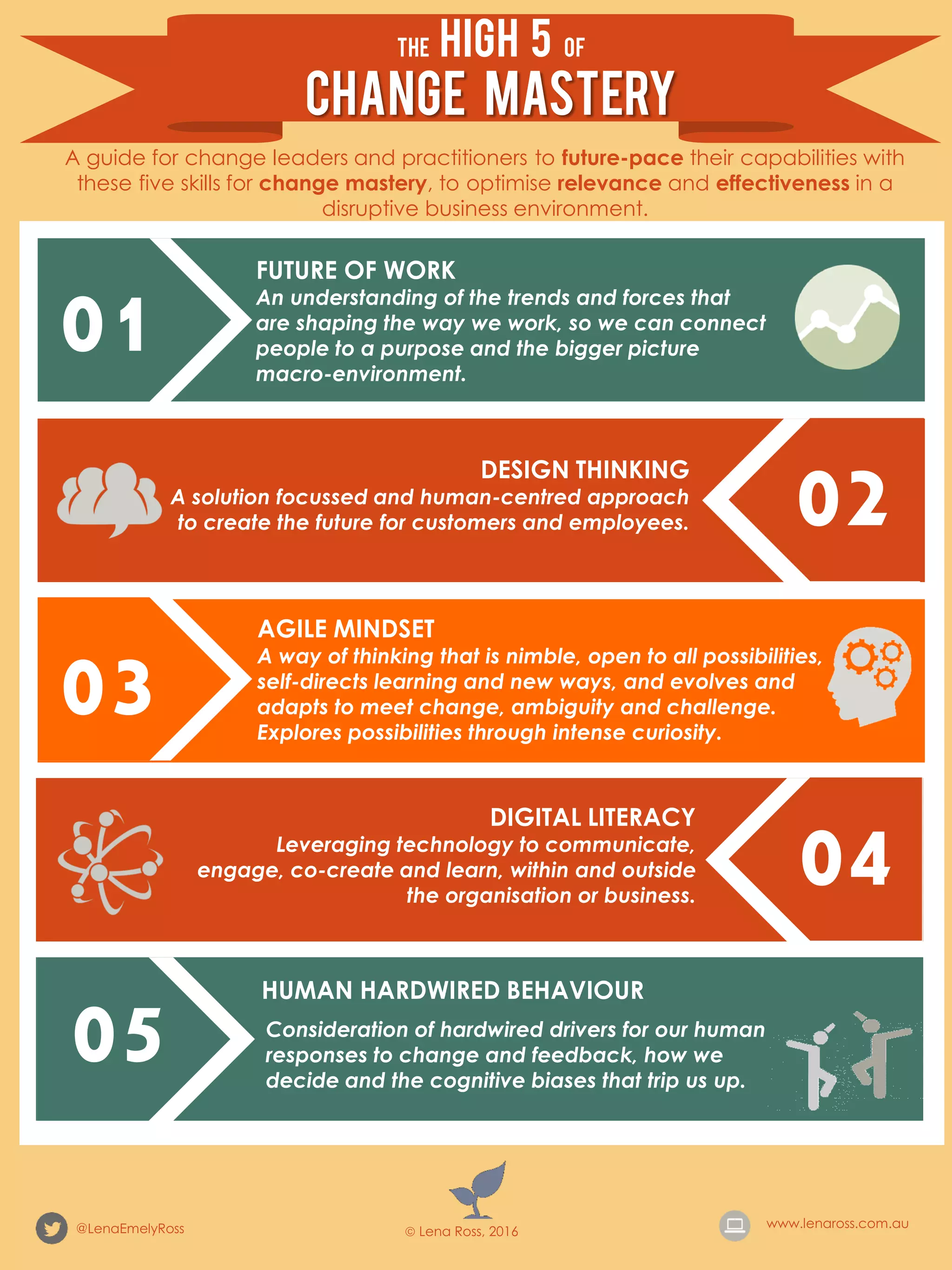
The high 5 Of
change mastery
@LenaEmelyRoss www.lenaross.com.au
 Lena Ross, 2016
01
02
03
05
04
FUTURE OF WORK
An understanding of the trends and forces that
are shaping the way we work, so we can connect
people to a purpose and the bigger picture
macro-environment.
DESIGN THINKING
A solution focussed and human-centred approach
to create the future for customers and employees.
AGILE MINDSET
A way of thinking that is nimble, open to all possibilities,
self-directs learning and new ways, and evolves and
adapts to meet change, ambiguity and challenge.
Explores possibilities through intense curiosity.
DIGITAL LITERACY
Leveraging technology to communicate,
engage, co-create and learn, within and outside
the organisation or business.
HUMAN HARDWIRED BEHAVIOUR
A guide for change leaders and practitioners to future-pace their capabilities with
these five skills for change mastery, to optimise relevance and effectiveness in a
disruptive business environment.
Consideration of hardwired drivers for our human
responses to change and feedback, how we
decide and the cognitive biases that trip us up.
9
So what?
These five emerging capabilities are not mutually exclusive
of one another. For example, you’ve probably worked out
that capability in the future of work will translate to a level
of capability in agile mindset and proficiency in digital and
social media.
The scope and application of these capabilities are
constantly being defined and refined for relevance in a
business context. As information is evolving so quickly, most
printed books and formal, structured learning programs
alone will not provide the answers.
This is where the #changehacks offering is different – the
thought leaders and facilitators in our network operate with
a start-up mindset, so we’re nimble enough to adjust and
refresh our content. We bring you the latest insights with
workshops, coaching and bespoke consulting.
Now what?
Ask yourself:
 How are we defining these capabilities in our business?
 How are we building these capabilities, at an individual,
team and organisational level?
 How will we measure them?
 How will we reward them?
At #changehacks we work with individuals, teams and
organisations to build these capabilities for mastery in change
leadership and delivery.
This is supported by our services in:
Coaching | onsite facilitation | speaking | consulting | masterclass series
10
About the author
#changehacks owner, Lena Ross, is a change management
consultant with decades of experience and research into
how we are hardwired to learn and change. With her
passion for bringing out the best in others, she is able to help
people recognise the AHA moment that is needed to effect
sustainable change.
As an experienced public speaker and facilitator, her
divergent thinking and approach will challenge an audience
just enough to nudge them out of their comfort zone to
devise plans for personal and organisational change.
Lena’s keen eye on emerging trends is well complemented
by her academic qualifications as she is able to apply proven
theory and new information develop practical solutions.
www.lenaross.com.au
lenaemelyross@gmail.com
+61 419 381 711
@LenaEmelyRoss
How to contact
11
Where to find additional resources
If you enjoyed reading this white paper, please
share it with your colleagues and industry peers.
Future of work | design thinking | agile mindset | digital literacy | human hardwired behaviour
There’s more!
Want to find out more?
I’ve developed a few resources that are easy to find..
Website
On my website, you will find piles of free resources:
White papers and infographics can be found in the
resources section.
My blogs are easy to find in the blogs tab.
Youtube channel
A series of lightning talks* about building enterprise change
capability.
*A lightning talk is a very short presentation that lasts for five
minutes or less.
Slideshare
Some of my presentations and infographics can also be
found here, including the very popular:
10 Cracker Quotes for Agile Change Management
10 Red Hot Tips for Yammer Adoption in your Organisation

Capabilities we need now in change management

  • 1.
    Emerging capabilities forchange leaders and practitioners the high 5 Of change mastery WHITE PAPER FROM October 2016 LENA ROSS BUILDING ENTERPRISE CHANGE CAPABILITY
  • 2.
    Staying ahead ofthe curve Change leaders and practitioners have an established set of conventional technical and behavioural capabilities, such as stakeholder engagement, influencing skills, communication, assessing readiness and impacts… to name a few. These capabilities and interventions have served us well for a long time. But now that change itself is changing, we need to build new capabilities that will equip us with skills for a disruptive business environment. In a climate of relentless change, we need to ensure our practice remains relevant by taking a future-forward view. In delivering change, we need to continue to add value to business success and benefits realisation. We need to stay ahead of the curve! The five emerging capabilities, called the High 5, outlined in this paper will prepare us, as change leaders and practitioners, for the new ways of working. For each of these capabilities, you will find a definition along with a brief overview of: - why it’s important - how you can use it There’s also an infographic summary on page 8, for a quick visual reference. Now, let’s high five! 2 INTRODUCTION Future of work | design thinking | agile mindset | digital literacy | human hardwired behaviour
  • 3.
    3 01 FUTURE OF WORK Anunderstanding of the trends and forces that are shaping the way we work, so we can connect people to a purpose and the bigger picture macro-environment. With a great deal of disruption going on, organisations have their focus on the external business environment to stay abreast of what their competitors are doing, and to identify new markets and emerging customer demands. By closely watching trends that are disrupting the workplace around generations, technology, globalisation, learning, human resources, and mobility, we will be better positioned to understand how that disruption is affecting the way we work, inside our own organisations. These same trends are shaping employee expectations. Leading and communicating with people is demanding a new approach to resonate and deeply engage. With an understanding of the macro environment in the world of work, we can continuously update our capabilities, to remain relevant and effective as change leaders and managers in motivating in retaining talented people. Why it’s important How you can use it Link the objectives of your program or transformation to the bigger picture on how the workplace is changing, to connect your people to a higher purpose. This helps your narrative on the WHY. Embrace the use of disruptive two-way communication channels in your organisation to promote and model co-creation and collaboration. Some of these are Working out Loud, Enterprise Social Networks (ESNs) such as Yammer, and Visual Management. Future of work | design thinking | agile mindset | digital literacy | human hardwired behaviour
  • 4.
    4 02DESIGN THINKING A solutionfocussed and human-centred approach to create the future for customers and employees. Why it’s important How you can use it Customers are setting a high bar with expectations that are being met by the disruptors (think Uber, AirBNB, Kogan, Amazon, Netflix…the list goes on), so the pressure is on all businesses to be not only nimble and responsive to what the user wants, but also sufficiently innovative to create new demands. Design thinking, as a human-centred design practice, is being used to develop innovative solutions to everyday business challenges. The approach uncovers current and potential customer and end-user pain points. Because a solution or new product usually translates to change, it’s now a much-needed skill in change management. Applying a human-centric lens to leading and managing change takes us to the very heart of what we do – help our people adopt the change. Whilst human-centred design (HCD) is often applied developing empathy and solutions for our customers, the same thinking can be used to plan and introduce change. Consider our impacted employees are our internal customers who can provide deep insights. Plan your change and identify post-implementation measures through the lens of what we want our people to do, to think and how we want them to feel. Integrate HCD into your change plans and interventions to drive meaningful conversations with your stakeholders and impacted employees. Design employee journey maps to create a visual representation of the current and future state impacts. Future of work | design thinking | agile mindset | digital literacy | human hardwired behaviour
  • 5.
    5 03 AGILE MINDSET A wayof thinking that is nimble, open to all possibilities, learning and new ways, and evolves and adapts to meet change, ambiguity and challenge. Explore possibilities through intense curiosity. Why it’s important How you can use it Future of work | design thinking | agile mindset | digital literacy | human hardwired behaviour Agile is so much more than a methodology or set of team behaviours. It starts with an agile mindset, which underpins the capability to be truly agile in what we do and deliver. We need to be open to new ideas, with a beginner’s mindset, so we are nimble enough to change course when the winds take a different direction. Having an agile mindset means we learn with an open mind and with self-direction, making it beneficial for our personal and professional development. The agile mindset equips us with a resilience so we can recognise failures as opportunities to learn, rather than personal setbacks, and it enables us to work more effectively in an increasingly complex and ambiguous environment. Model the agile mindset to help your team and peers get on board. Remember, you don’t have to be on a project that’s officially declared ‘agile’ to demonstrate and model an agile mindset. Be curious, ask questions as if you are a start up. A beginner’s mindset doesn’t judge, puts aside previous learnings and experiences, and listens objectively with deep empathy.
  • 6.
    6 04 DIGITAL LITERACY Leveraging technologyto communicate, engage, co-create and learn, within and outside the organisation or business. Future of work | design thinking | agile mindset | digital literacy | human hardwired behaviour Lead and coach others in the use of digital, social media in the workplace, by modelling the behaviours you want to see – for example show that you are comfortable sharing information, engaging with colleagues on social media, asking for feedback, back-channelling from events and workshops, crowdsourcing solutions outside formal channels to break through hierarchy and silos, Talk about the benefits these channels and capability can bring to the individual, the team and the overall business, with success stories. How you can use it Why it’s important Outside the work environment, digital literacy enables you to find and share material on social media, connect with like minded people and industry networks outside your organisation, at a global level, to build an outside-in view. Tapping into digital resources helps build your Personal Learning Network (PLN). In the workplace, the integrating the use of social networks, collaboration tools, and other digital means of engaging helps us becomes more efficient in our day-to-day work. Clever use of these digital channels enable co-creation, knowledge sharing and crowdsourcing solutions and information faster and more effectively. You don’t want technology evolving faster than your capacity or capability to adapt.
  • 7.
    7 05 HUMAN HARDWIRED BEHAVIOUR Understandingand consideration of hardwired drivers for responses to change, how we decide and the cognitive biases that trip us up. The increased use of neuroimaging technology means that 90% of what we know about the brain has only been discovered in the last seven to nine years. New insights challenge our existing practice and encourage us to look at things with a fresh perspective. What we now know about our primal responses to threat and reward, along with our built-in biases, means we can lead change and prepare our people with an approach that’s designed to minimise the threat response. We also know that the human response to change is not always resistance, yet our change plans often assume it. For a long time, organisations have understood the hidden costs of productivity dips and a disengaged workforce. Understanding hardwired human behaviour, through insights from neuroscience, can help us understand how and when discomfort occurs in the brain, hinting to techniques to optimise human performance. Why it’s important How you can use it Find out more about what provokes the threat response, as this has a direct impact on productivity and the bottom line. Look for ways to reduce that threat response when you plan and deliver change. Consider which stakeholders may perceive gain or loss as a result of the change. For example, a top down directive is likely to be less effective than two-way engagement where people feel involved, autonomous and a greater sense of fairness associated with changes. Future of work | design thinking | agile mindset | digital literacy | human hardwired behaviour
  • 8.
    The high 5Of change mastery @LenaEmelyRoss www.lenaross.com.au  Lena Ross, 2016 01 02 03 05 04 FUTURE OF WORK An understanding of the trends and forces that are shaping the way we work, so we can connect people to a purpose and the bigger picture macro-environment. DESIGN THINKING A solution focussed and human-centred approach to create the future for customers and employees. AGILE MINDSET A way of thinking that is nimble, open to all possibilities, self-directs learning and new ways, and evolves and adapts to meet change, ambiguity and challenge. Explores possibilities through intense curiosity. DIGITAL LITERACY Leveraging technology to communicate, engage, co-create and learn, within and outside the organisation or business. HUMAN HARDWIRED BEHAVIOUR A guide for change leaders and practitioners to future-pace their capabilities with these five skills for change mastery, to optimise relevance and effectiveness in a disruptive business environment. Consideration of hardwired drivers for our human responses to change and feedback, how we decide and the cognitive biases that trip us up.
  • 9.
    9 So what? These fiveemerging capabilities are not mutually exclusive of one another. For example, you’ve probably worked out that capability in the future of work will translate to a level of capability in agile mindset and proficiency in digital and social media. The scope and application of these capabilities are constantly being defined and refined for relevance in a business context. As information is evolving so quickly, most printed books and formal, structured learning programs alone will not provide the answers. This is where the #changehacks offering is different – the thought leaders and facilitators in our network operate with a start-up mindset, so we’re nimble enough to adjust and refresh our content. We bring you the latest insights with workshops, coaching and bespoke consulting. Now what? Ask yourself:  How are we defining these capabilities in our business?  How are we building these capabilities, at an individual, team and organisational level?  How will we measure them?  How will we reward them? At #changehacks we work with individuals, teams and organisations to build these capabilities for mastery in change leadership and delivery. This is supported by our services in: Coaching | onsite facilitation | speaking | consulting | masterclass series
  • 10.
    10 About the author #changehacksowner, Lena Ross, is a change management consultant with decades of experience and research into how we are hardwired to learn and change. With her passion for bringing out the best in others, she is able to help people recognise the AHA moment that is needed to effect sustainable change. As an experienced public speaker and facilitator, her divergent thinking and approach will challenge an audience just enough to nudge them out of their comfort zone to devise plans for personal and organisational change. Lena’s keen eye on emerging trends is well complemented by her academic qualifications as she is able to apply proven theory and new information develop practical solutions. www.lenaross.com.au lenaemelyross@gmail.com +61 419 381 711 @LenaEmelyRoss How to contact
  • 11.
    11 Where to findadditional resources If you enjoyed reading this white paper, please share it with your colleagues and industry peers. Future of work | design thinking | agile mindset | digital literacy | human hardwired behaviour There’s more! Want to find out more? I’ve developed a few resources that are easy to find.. Website On my website, you will find piles of free resources: White papers and infographics can be found in the resources section. My blogs are easy to find in the blogs tab. Youtube channel A series of lightning talks* about building enterprise change capability. *A lightning talk is a very short presentation that lasts for five minutes or less. Slideshare Some of my presentations and infographics can also be found here, including the very popular: 10 Cracker Quotes for Agile Change Management 10 Red Hot Tips for Yammer Adoption in your Organisation