Egyptian
Canopic Jars


               1
What Are Canopic Jars?
•The ancient Egyptians used Canopic jars during mummification
to hold and preserve what they thought were their most important organs.

•The organs put inside the jars were the liver, lungs, intestines, and stomach.

•The jars were then put in the tomb with the mummy for burial.


                                                                            2
Egyptian Beliefs and Religion
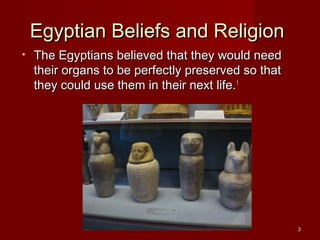
•   The Egyptians believed that they would need
    their organs to be perfectly preserved so that
    they could use them in their next life.1


                                                     3
Egyptian Beliefs and Religion
•The Egyptians did not remove the heart from the
body because they believed it would have to be
weighed entering the afterlife to see if the person
lived a good life or not.1

•They actually disposed of most other organs,
including the brain, because they thought they were
not important and that they wouldn’t need them in the
afterlife.3


                                                        4
EYGPTIAN BOOK OF THE
               DEAD


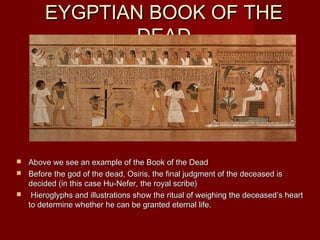
 Above we see an example of the Book of the Dead
 Before the god of the dead, Osiris, the final judgment of the deceased is
  decided (in this case Hu-Nefer, the royal scribe)
 Hieroglyphs and illustrations show the ritual of weighing the deceased’s heart
  to determine whether he can be granted eternal life.
What they looked
           like
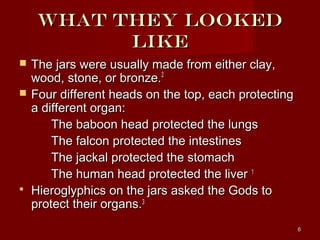
   The jars were usually made from either clay,
    wood, stone, or bronze.2
   Four different heads on the top, each protecting
    a different organ:
        The baboon head protected the lungs
        The falcon protected the intestines
        The jackal protected the stomach
        The human head protected the liver 1
   Hieroglyphics on the jars asked the Gods to
    protect their organs.3
                                                       6
Canopic Jars from 22nd Dynasty (between 924-712 BCE)
                                                       7
8
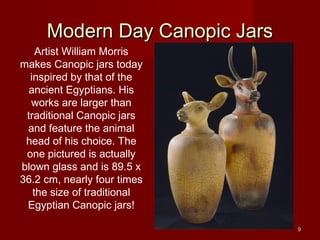
Modern Day Canopic Jars
    Artist William Morris
makes Canopic jars today
  inspired by that of the
 ancient Egyptians. His
  works are larger than
 traditional Canopic jars
 and feature the animal
 head of his choice. The
 one pictured is actually
blown glass and is 89.5 x
36.2 cm, nearly four times
   the size of traditional
 Egyptian Canopic jars!

                               9
Works Cited
1.     Barrow, Mandy. “Canopic Jars – Ancient Egypt for Kids.” [Online] 14, September, 2008.
       <http://www.woodlands-junior.kent.sch.uk/Homework/egypt/canopic.htm>
2.     Gill, N.S. “What Were the Canopic Jars used for?” [Online] 16, September, 2008.
       <http://ancienthistory.about.com/od/mummies/f/CanopicJars.htm>
3.     BBC. “H2g2 Canopic Jars.” [Online] 15, September, 2008.
       <http://www.bbc.co.uk/dna/h2g2/A34088097>


                                       Online Images
Slide 1: The Moonwillow Catalog. “Canopic Jars.” [Online] 15, September, 2008.
        <themoonwillow.com/catalog/images/SC116.JPG>
Slide 5:Kinnear, Jacques. “22nd Dynasty Canopic jars.” [Online] 15, September, 2008. <www.ancient-
        egypt.org/.../canopic_group.jpg>
Slide 6: Top-Anaka, S. “Canopic jars.” [Oniline] 16, September, 2008.
        <www.sd91.bc.ca/webquests/egypt/canopic.jpg>
        Bottom-Thune, Nina A. “19th Dynasty canopic jars of alabaster (Berlin).” 16, September,
        2008. <http://en.wikipedia.org/wiki/Image:Krukkerberlin.jpg>
Slide 7: ArtStor. “Canopic jars.” [Online] 25, September, 2008.
        <http://http://library.artstor.org.proxy2.cl.msu.edu:2047/library/welcome.html#3|search|1|
        canopic20jars|Multiple20Collection20Search|||
        type3D3126kw3Dcanopic20jars26id3Dall26name3D>
                                                                                                 10

Canopic jars

  • 1.
  • 2.
    What Are CanopicJars? •The ancient Egyptians used Canopic jars during mummification to hold and preserve what they thought were their most important organs. •The organs put inside the jars were the liver, lungs, intestines, and stomach. •The jars were then put in the tomb with the mummy for burial. 2
  • 3.
    Egyptian Beliefs andReligion • The Egyptians believed that they would need their organs to be perfectly preserved so that they could use them in their next life.1 3
  • 4.
    Egyptian Beliefs andReligion •The Egyptians did not remove the heart from the body because they believed it would have to be weighed entering the afterlife to see if the person lived a good life or not.1 •They actually disposed of most other organs, including the brain, because they thought they were not important and that they wouldn’t need them in the afterlife.3 4
  • 5.
    EYGPTIAN BOOK OFTHE DEAD  Above we see an example of the Book of the Dead  Before the god of the dead, Osiris, the final judgment of the deceased is decided (in this case Hu-Nefer, the royal scribe)  Hieroglyphs and illustrations show the ritual of weighing the deceased’s heart to determine whether he can be granted eternal life.
  • 6.
    What they looked like  The jars were usually made from either clay, wood, stone, or bronze.2  Four different heads on the top, each protecting a different organ: The baboon head protected the lungs The falcon protected the intestines The jackal protected the stomach The human head protected the liver 1  Hieroglyphics on the jars asked the Gods to protect their organs.3 6
  • 7.
    Canopic Jars from22nd Dynasty (between 924-712 BCE) 7
  • 8.
  • 9.
    Modern Day CanopicJars Artist William Morris makes Canopic jars today inspired by that of the ancient Egyptians. His works are larger than traditional Canopic jars and feature the animal head of his choice. The one pictured is actually blown glass and is 89.5 x 36.2 cm, nearly four times the size of traditional Egyptian Canopic jars! 9
  • 10.
    Works Cited 1. Barrow, Mandy. “Canopic Jars – Ancient Egypt for Kids.” [Online] 14, September, 2008. <http://www.woodlands-junior.kent.sch.uk/Homework/egypt/canopic.htm> 2. Gill, N.S. “What Were the Canopic Jars used for?” [Online] 16, September, 2008. <http://ancienthistory.about.com/od/mummies/f/CanopicJars.htm> 3. BBC. “H2g2 Canopic Jars.” [Online] 15, September, 2008. <http://www.bbc.co.uk/dna/h2g2/A34088097> Online Images Slide 1: The Moonwillow Catalog. “Canopic Jars.” [Online] 15, September, 2008. <themoonwillow.com/catalog/images/SC116.JPG> Slide 5:Kinnear, Jacques. “22nd Dynasty Canopic jars.” [Online] 15, September, 2008. <www.ancient- egypt.org/.../canopic_group.jpg> Slide 6: Top-Anaka, S. “Canopic jars.” [Oniline] 16, September, 2008. <www.sd91.bc.ca/webquests/egypt/canopic.jpg> Bottom-Thune, Nina A. “19th Dynasty canopic jars of alabaster (Berlin).” 16, September, 2008. <http://en.wikipedia.org/wiki/Image:Krukkerberlin.jpg> Slide 7: ArtStor. “Canopic jars.” [Online] 25, September, 2008. <http://http://library.artstor.org.proxy2.cl.msu.edu:2047/library/welcome.html#3|search|1| canopic20jars|Multiple20Collection20Search||| type3D3126kw3Dcanopic20jars26id3Dall26name3D> 10