Candidate Elimination Algorithm | ML LAB 2 |
By V Babu Ravipati
Candidate Elimination Algorithm
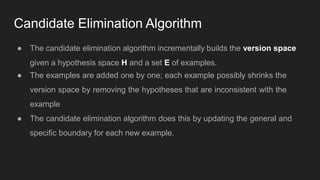
● The candidate elimination algorithm incrementally builds the version space
given a hypothesis space H and a set E of examples.
● The examples are added one by one; each example possibly shrinks the
version space by removing the hypotheses that are inconsistent with the
example
● The candidate elimination algorithm does this by updating the general and
specific boundary for each new example.
Resemblance and contrast with Find S-Algorithm
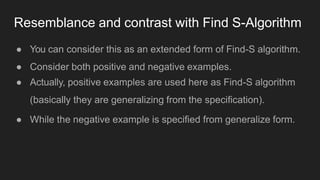
● You can consider this as an extended form of Find-S algorithm.
● Consider both positive and negative examples.
● Actually, positive examples are used here as Find-S algorithm
(basically they are generalizing from the specification).
● While the negative example is specified from generalize form.
Terms used
Concept learning: Concept learning is basically learning task of the machine (Learn
by Train data)
General Hypothesis: Not Specifying features to learn the machine.
G = {‘?’, ‘?’,’?’,’?’…}: Number of attributes
Specific Hypothesis: Specifying features to learn machine (Specific feature)
S= {‘pi’,’pi’,’pi’…}: Number of pi depends on number of attributes.
Version Space: It is intermediate of general hypothesis and Specific hypothesis. It
not only just written one hypothesis but a set of all possible hypothesis based on
training data-set.
Dataset
Steps for our dataset
Initially : G = [[?, ?, ?, ?, ?, ?], [?, ?, ?, ?, ?, ?], [?, ?, ?, ?, ?, ?],
[?, ?, ?, ?, ?, ?], [?, ?, ?, ?, ?, ?], [?, ?, ?, ?, ?, ?]]
S = [Null, Null, Null, Null, Null, Null]
For instance 1 : <'sunny','warm','normal','strong','warm ','same'> and positive
output.
G1 = G
S1 = ['sunny','warm','normal','strong','warm ','same']
For instance 2 : <'sunny','warm','high','strong','warm ','same'> and
positive output.
G2 = G
S2 = ['sunny','warm',?,'strong','warm ','same']
For instance 3 : <'rainy','cold','high','strong','warm ','change'> and
negative output.
G3 = [['sunny', ?, ?, ?, ?, ?], [?, 'warm', ?, ?, ?, ?], [?, ?, ?, ?, ?, ?],
[?, ?, ?, ?, ?, ?], [?, ?, ?, ?, ?, ?], [?, ?, ?, ?, ?, 'same']]
S3 = S2
For instance 4 : <'sunny','warm','high','strong','cool','change'> and positive
output.
G4 = G3
S4 = ['sunny','warm',?,'strong', ?, ? ]
Output
G = [['sunny', ?, ?, ?, ?, ?], [?, 'warm', ?, ?, ?, ?]]
S = ['sunny','warm',?,'strong', ?, ?]
Candidate Elimination Algorithm
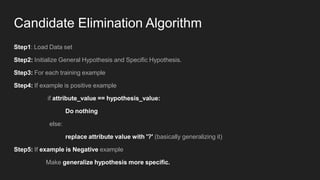
Step1: Load Data set
Step2: Initialize General Hypothesis and Specific Hypothesis.
Step3: For each training example
Step4: If example is positive example
if attribute_value == hypothesis_value:
Do nothing
else:
replace attribute value with '?' (basically generalizing it)
Step5: If example is Negative example
Make generalize hypothesis more specific.

Candidate elimination algorithm in ML Lab

  • 1.
    Candidate Elimination Algorithm| ML LAB 2 | By V Babu Ravipati
  • 2.
    Candidate Elimination Algorithm ●The candidate elimination algorithm incrementally builds the version space given a hypothesis space H and a set E of examples. ● The examples are added one by one; each example possibly shrinks the version space by removing the hypotheses that are inconsistent with the example ● The candidate elimination algorithm does this by updating the general and specific boundary for each new example.
  • 3.
    Resemblance and contrastwith Find S-Algorithm ● You can consider this as an extended form of Find-S algorithm. ● Consider both positive and negative examples. ● Actually, positive examples are used here as Find-S algorithm (basically they are generalizing from the specification). ● While the negative example is specified from generalize form.
  • 4.
    Terms used Concept learning:Concept learning is basically learning task of the machine (Learn by Train data) General Hypothesis: Not Specifying features to learn the machine. G = {‘?’, ‘?’,’?’,’?’…}: Number of attributes Specific Hypothesis: Specifying features to learn machine (Specific feature) S= {‘pi’,’pi’,’pi’…}: Number of pi depends on number of attributes. Version Space: It is intermediate of general hypothesis and Specific hypothesis. It not only just written one hypothesis but a set of all possible hypothesis based on training data-set.
  • 5.
  • 6.
    Steps for ourdataset Initially : G = [[?, ?, ?, ?, ?, ?], [?, ?, ?, ?, ?, ?], [?, ?, ?, ?, ?, ?], [?, ?, ?, ?, ?, ?], [?, ?, ?, ?, ?, ?], [?, ?, ?, ?, ?, ?]] S = [Null, Null, Null, Null, Null, Null] For instance 1 : <'sunny','warm','normal','strong','warm ','same'> and positive output. G1 = G S1 = ['sunny','warm','normal','strong','warm ','same']
  • 7.
    For instance 2: <'sunny','warm','high','strong','warm ','same'> and positive output. G2 = G S2 = ['sunny','warm',?,'strong','warm ','same'] For instance 3 : <'rainy','cold','high','strong','warm ','change'> and negative output. G3 = [['sunny', ?, ?, ?, ?, ?], [?, 'warm', ?, ?, ?, ?], [?, ?, ?, ?, ?, ?], [?, ?, ?, ?, ?, ?], [?, ?, ?, ?, ?, ?], [?, ?, ?, ?, ?, 'same']] S3 = S2
  • 8.
    For instance 4: <'sunny','warm','high','strong','cool','change'> and positive output. G4 = G3 S4 = ['sunny','warm',?,'strong', ?, ? ] Output G = [['sunny', ?, ?, ?, ?, ?], [?, 'warm', ?, ?, ?, ?]] S = ['sunny','warm',?,'strong', ?, ?]
  • 9.
    Candidate Elimination Algorithm Step1:Load Data set Step2: Initialize General Hypothesis and Specific Hypothesis. Step3: For each training example Step4: If example is positive example if attribute_value == hypothesis_value: Do nothing else: replace attribute value with '?' (basically generalizing it) Step5: If example is Negative example Make generalize hypothesis more specific.