Cancer Stem Cell
Presented By-
Rika Rani Pradhan
MSc Biotechnology
KIIT School of Biotechnology
1
2
3
4
 Cancer stem cells (CSCs) are cancer cells.
 Cancer stem cells (CSCs), also known as tumor -initiating cell.
 CSCs are a small subpopulation of cells within a tumor that
possess characteristics similar to stem cells.
 Stem cells are unique cells with the ability to self -renew and
dif ferentiate into various specialized cell types in the body.
 Similarly, CSCs have the capacity to self -renew and give rise
to dif ferent types of cancer cells within a tumor.
 CSCs originate from dif ferentiated cells or adult tissue
resident stem cells.
 Cancer stem cells are believed to play a significant role in tumor growth
and resistance to conventional cancer treatments such as chemotherapy
and radiation therapy.
Source- Gene Tex
 Cancer stem cells (CSCs) have the ability to self-renew and are present in
most tissues including breast, brain, lung, head, neck, testis, ovary, liver
etc.
 Breast cancer stem cells (BCSCs) are the minor population of breast
cancer (BC) cells
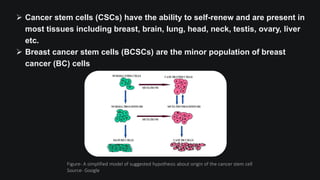
Figure- A simplified model of suggested hypothesis about origin of the cancer stem cell
Source- Google
1. Self-renew: CSCs have the ability to divide and give rise to identical copies
of themselves. This property allows them to persist over time which is result
in tumor growth
2. Differentiation: CSCs can differentiate into various cell types present within
the tumor, including both cancerous and non-cancerous cells. This property
allows to generate a heterogeneous population of cells within the tumor
mass.
3. Drug resistance: CSCs are resistant to conventional cancer therapies, such
as chemotherapy and radiation. This resistance is attributed to various
mechanisms, like expression of drug efflux pumps, enhanced DNA repair
mechanisms.
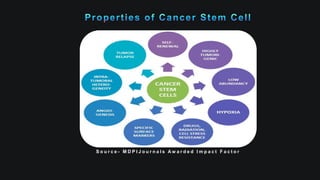
4. Heterogeneity: CSCs are characterized by significant heterogeneity within a
tumor. Different CSCs may possess distinct molecular profiles, gene
expression patterns, and functional properties. This heterogeneity contributes
to the diversity of cell type.
5. Microenvironment interaction: CSCs interact with their surrounding
microenvironment, which consists of stromal cells, extracellular matrix
components and signaling molecules. These interactions influence CSC in
self-renewal, and differentiation.
6. Tumor initiation: CSCs are implicated in tumor initiation, as they have the
capacity to give rise to new tumors.
7. Tumorigenicity: CSCs have the capacity to initiate tumor formation. They
possess the ability to regenerate a new tumor when transplanted into a host
organism.
S o u r c e - M D P I J o u r n a l s A w a r d e d I m p a c t F a c t o r
1. Acceleration of the cell cycle- Loss the control and cell often reproduces very fast because
change in DNA sequence.
2. Genomic alteration- This include deletion, post translation modification, mutiple mutation.
3. Invasive growth- Growth occure like it’s disrupt the basement membrane & penetrate
underlying stroma.
4. Increased cell mobility- Move fast because they are diiferent from noramal cells.
5. Chemotaxis- Migration of cell under a chemical gradient.
6. Changes in the cellular surface- Negative loading of cell surface.
7. Secretion of lytic factors- Produces proteases that digest extra cellular matrix.
 Markers in cancer stem cells can be broadly categorized into two types:
1) Surface Markers
2) Functional Markers
 Markers are used to identify and characterize cancer stem cells based on
their presence on the cell surface or their functional properties.
1) Surface Markers-
 Surface markers are proteins or glycoproteins that are located on the
outer surface of the cell membrane. They can be identified using specific
antibodies or other molecular probes.
Some common surface markers used for cancer stem cell identification
include:
• CD44- Positively correlated
• CD133- Positive
• CD24- Positive
• CD29- Positive
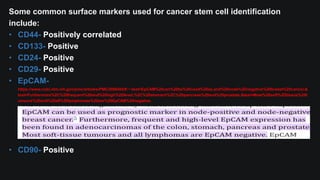
• EpCAM-
https://www.ncbi.nlm.nih.gov/pmc/articles/PMC3088404/#:~:text=EpCAM%20can%20be%20used%20as,and%20node%2Dnegative%20breast%20cancer.&
text=Furthermore%2C%20frequent%20and%20high%2Dlevel,%2C%20stomach%2C%20pancreas%20and%20prostate.&text=Most%20soft%2Dtissue%20t
umours%20and%20all%20lymphomas%20are%20EpCAM%20negative.
• CD90- Positive
2) Functional Markers-
 These markers are often linked to the stem-like properties of self-renewal,
differentiation, and tumor initiation.
Some common functional markers used for cancer stem cell characterization
include:
• ALDH1 (aldehyde dehydrogenase 1): Enzyme involved in detoxifying
intracellular aldehydes and associated with stem-like properties.
• Sphere-forming ability: Cancer stem cells often form spheres in culture
conditions, indicating their self-renewal capability.
• Drug efflux pumps (e.g., ABC transporters): Cancer stem cells may
express these pumps, allowing them to resist chemotherapy.
• Tumorsphere-initiating frequency: This measures the ability of cancer
stem cells to initiate tumor formation.
M E E T T H E F U T U R E

Cancer Stem Cell

  • 1.
    Cancer Stem Cell PresentedBy- Rika Rani Pradhan MSc Biotechnology KIIT School of Biotechnology
  • 2.
  • 3.
     Cancer stemcells (CSCs) are cancer cells.  Cancer stem cells (CSCs), also known as tumor -initiating cell.  CSCs are a small subpopulation of cells within a tumor that possess characteristics similar to stem cells.  Stem cells are unique cells with the ability to self -renew and dif ferentiate into various specialized cell types in the body.  Similarly, CSCs have the capacity to self -renew and give rise to dif ferent types of cancer cells within a tumor.  CSCs originate from dif ferentiated cells or adult tissue resident stem cells.
  • 4.
     Cancer stemcells are believed to play a significant role in tumor growth and resistance to conventional cancer treatments such as chemotherapy and radiation therapy. Source- Gene Tex
  • 5.
     Cancer stemcells (CSCs) have the ability to self-renew and are present in most tissues including breast, brain, lung, head, neck, testis, ovary, liver etc.  Breast cancer stem cells (BCSCs) are the minor population of breast cancer (BC) cells Figure- A simplified model of suggested hypothesis about origin of the cancer stem cell Source- Google
  • 6.
    1. Self-renew: CSCshave the ability to divide and give rise to identical copies of themselves. This property allows them to persist over time which is result in tumor growth 2. Differentiation: CSCs can differentiate into various cell types present within the tumor, including both cancerous and non-cancerous cells. This property allows to generate a heterogeneous population of cells within the tumor mass. 3. Drug resistance: CSCs are resistant to conventional cancer therapies, such as chemotherapy and radiation. This resistance is attributed to various mechanisms, like expression of drug efflux pumps, enhanced DNA repair mechanisms.
  • 7.
    4. Heterogeneity: CSCsare characterized by significant heterogeneity within a tumor. Different CSCs may possess distinct molecular profiles, gene expression patterns, and functional properties. This heterogeneity contributes to the diversity of cell type. 5. Microenvironment interaction: CSCs interact with their surrounding microenvironment, which consists of stromal cells, extracellular matrix components and signaling molecules. These interactions influence CSC in self-renewal, and differentiation. 6. Tumor initiation: CSCs are implicated in tumor initiation, as they have the capacity to give rise to new tumors. 7. Tumorigenicity: CSCs have the capacity to initiate tumor formation. They possess the ability to regenerate a new tumor when transplanted into a host organism.
  • 8.
    S o ur c e - M D P I J o u r n a l s A w a r d e d I m p a c t F a c t o r
  • 9.
    1. Acceleration ofthe cell cycle- Loss the control and cell often reproduces very fast because change in DNA sequence. 2. Genomic alteration- This include deletion, post translation modification, mutiple mutation. 3. Invasive growth- Growth occure like it’s disrupt the basement membrane & penetrate underlying stroma. 4. Increased cell mobility- Move fast because they are diiferent from noramal cells. 5. Chemotaxis- Migration of cell under a chemical gradient. 6. Changes in the cellular surface- Negative loading of cell surface. 7. Secretion of lytic factors- Produces proteases that digest extra cellular matrix.
  • 10.
     Markers incancer stem cells can be broadly categorized into two types: 1) Surface Markers 2) Functional Markers  Markers are used to identify and characterize cancer stem cells based on their presence on the cell surface or their functional properties. 1) Surface Markers-  Surface markers are proteins or glycoproteins that are located on the outer surface of the cell membrane. They can be identified using specific antibodies or other molecular probes.
  • 11.
    Some common surfacemarkers used for cancer stem cell identification include: • CD44- Positively correlated • CD133- Positive • CD24- Positive • CD29- Positive • EpCAM- https://www.ncbi.nlm.nih.gov/pmc/articles/PMC3088404/#:~:text=EpCAM%20can%20be%20used%20as,and%20node%2Dnegative%20breast%20cancer.& text=Furthermore%2C%20frequent%20and%20high%2Dlevel,%2C%20stomach%2C%20pancreas%20and%20prostate.&text=Most%20soft%2Dtissue%20t umours%20and%20all%20lymphomas%20are%20EpCAM%20negative. • CD90- Positive
  • 12.
    2) Functional Markers- These markers are often linked to the stem-like properties of self-renewal, differentiation, and tumor initiation. Some common functional markers used for cancer stem cell characterization include: • ALDH1 (aldehyde dehydrogenase 1): Enzyme involved in detoxifying intracellular aldehydes and associated with stem-like properties. • Sphere-forming ability: Cancer stem cells often form spheres in culture conditions, indicating their self-renewal capability. • Drug efflux pumps (e.g., ABC transporters): Cancer stem cells may express these pumps, allowing them to resist chemotherapy. • Tumorsphere-initiating frequency: This measures the ability of cancer stem cells to initiate tumor formation.
  • 13.
    M E ET T H E F U T U R E