(Department of Pharmaceutical Sciences) Shalom
Institute of Health and Allied Sciences Sam
Higginbottom University of Agriculture, Technology
and Sciences
Prayagraj (U.P.) India-211007
Presented To:
Dr. Kanika Patel Ma’am Presented By:
Netra Prasad Neupane
17BPH080
Presentation Topic: General principles of prevention and control of cancer
Defination
• Cancer is term used to describe a large group of diseases that are
characterized by a cellular malfunction.
• Healthy cells are programmed to divide in particular time interval.
• Cancerous cells do not have this programming and therefore replicate
out of control. They also serve no physiological function.
• Medically cancer is known as malignant neoplasm.
Introduction
• Cancer is a group of more than 100 different diseases.
• It can develop almost anywhere in the body.
• Cancer is a group of diseases involving abnormal cell growth with the
potential to invade or spread to other parts of the body.
• These contrast with benign tumors, which do not spread.
• Cancer begins when genetic changes interfere with this orderly
process.
• Cells start to grow uncontrollably.
Types of tumor
• Tumor is any uncontrollable mass of cells.
• There are two types of tumor
• 1. Benign Tumor 2. Malignant Tumor
• A benign tumor means the tumor can grow but will not spread. Some
types of cancer do not form a tumor.
E.g. leukemias, most types of lymphoma, and myeloma.
• Benign tumor enclosed in fibrous shell or capsule.
• They can be dangerous if they press on vital organs such as brain.
• It stay confined to its original location.
Malignant Tumor:
This type of tumor are capable of invading surrounding tissue or
invading the entire body.
Invade and emit claw like protrusions that disrupt the RNA and DNA of
normal cells (these cancerous cells act like a virus).
Most malignant cells become ‘metastatic’.
Types of cancer:
• Carcinomas: - A carcinoma begins in the skin or the tissue that covers
the surface of internal organs and glands.
• Sarcomas: - A sarcoma begins in the tissues that support and connect
the body.
• Leukemias: - Leukemia is a cancer of the blood. Leukemia begins
when healthy blood cells change and grow uncontrollably.
• Lymphomas: - Lymphoma is a cancer that begins in the lymphatic
system.
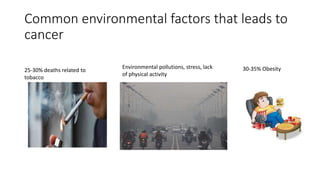
Common environmental factors that leads to
cancer
25-30% deaths related to
tobacco
30-35% Obesity
Environmental pollutions, stress, lack
of physical activity
Tests:
• Biopsy of tumor
• Blood tests
• Bone marrow biopsy
• Chest X-ray
• Complete blood count (CBC)
• CT scan
• Liver function tests
• MRI scans
Treatment
• Chemotherapy
• Radiation
• Surgery
• Small molecule inhibitor
• Antibodies
• Cell Based immunotherapy
• Gene Therapy
Prevention
• Eating a healthy diet
• Exercising regularly
• Limiting alcohol
• Maintaining a healthy weight
• Minimizing your exposure to radiation and toxic chemicals
• Not smoking or chewing tobacco
• Reducing sun exposure, especially if you burn easily.
National Cancer Control Programme
• This programme envisages control use of tobacco and alcohol and
early diagnosis and treatment of uterine and cervical cancer.
1. Primary prevention and screening programs
2. Cancer detection and prevention clinics
3. Treatment Facilities
4. Palliative care
5. Cancer registry network
6. Human resource generation
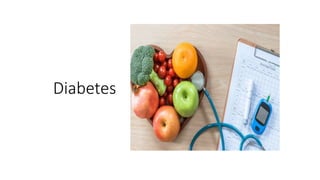
Diabetes
Introduction
• Diabetes is a chronic disease
• Diabetes is marked by high levels of blood sugar in the blood.
• Blood glucose is the main source of energy and comes from the food.
• Diabetes can cause serious health complications including hearth
disease, blindness, kidney failure and lower-extremity ampulations.
Types of diabetes
• Type 1 Diabetes
• Type 2 Diabetes
Type 1 diabetes
• Insulin-dependent diabetes mellitus (IDDM)
• Type 1 diabetes is a chronic disease that occurs when the pancreas
does not produce enough insulin to properly control blood sugar
levels.
• The body’s own immune system attacks and destroys beta cells in the
pancreas that are responsible for creating the hormone insulin.
Type 2 diabetes
• Non-insulin-dependent diabetes mellitus (NIDDM)
• Type 2 diabetes formerly called non-insulin-dependent diabetes is a
disorder that is characterized by high blood glucose in the context of
insulin resistance and relative insulin deficiency.
• Type 2 diabetes occurs when the pancreas does not make enough
insulin or the cells of the body become resistant to insulin.
Hypoglycemia Vs Hyperglycemia
• Hypoglycemia, also called low blood glucose or low blood sugar,
occurs when blood glucose drops below normal levels.
• If blood sugar is lower than 70 then this conditions is called
hypoglycemia.
• Hyperglycemia, or high blood sugar is a condition in which an
excessive amount of glucose circulates in the blood plasma.
• If blood sugar is more than 120 then this conditions is called
hyperglycemia.
Symptoms of diabetes
• Frequent urination
• Excessive thirst
• Unexplained weight loss
• Extreme hunger
• Sudden vision changes
• Tingling vision changes
• Feeling very tired much of the time
• Very dry skin
National diabetes control programme
• Lunched in 2010
• It focus on strengthening of infrastructure, human resource
development, health promotion, early screening.
• The programme is known as National Programme for Prevention and
Contol of Cancer, Diabetes, Cardiovascular disease and Strokes
(NPCDCS).
• Screening is taken above the age >30
• Operational guidelines revised in 2013-2017
Conclusion
• Cancer and diabetes are chronic, non-transmissible disease
• Both of these disease are prevalent among the obes people.
• By controlling eating habits, smoking, drinking and physical exercise
can prevent from having these disease.
References
• Cairns, John. "The origin of human cancers." Nature 289.5796 (1981):
353-357.
• Lengauer, Christoph, Kenneth W. Kinzler, and Bert Vogelstein.
"Genetic instabilities in human cancers." Nature 396.6712 (1998):
643-649.
• Marks, Robin. "An overview of skin cancers." Cancer 75.S2 (1995):
607-612.
• Diabetes, U. K., and Hotel Lobby. "What is diabetes." Diabetes
UK (2014).
Thank you

Cancer and Diabetes

  • 1.
    (Department of PharmaceuticalSciences) Shalom Institute of Health and Allied Sciences Sam Higginbottom University of Agriculture, Technology and Sciences Prayagraj (U.P.) India-211007 Presented To: Dr. Kanika Patel Ma’am Presented By: Netra Prasad Neupane 17BPH080 Presentation Topic: General principles of prevention and control of cancer
  • 2.
    Defination • Cancer isterm used to describe a large group of diseases that are characterized by a cellular malfunction. • Healthy cells are programmed to divide in particular time interval. • Cancerous cells do not have this programming and therefore replicate out of control. They also serve no physiological function. • Medically cancer is known as malignant neoplasm.
  • 3.
    Introduction • Cancer isa group of more than 100 different diseases. • It can develop almost anywhere in the body. • Cancer is a group of diseases involving abnormal cell growth with the potential to invade or spread to other parts of the body. • These contrast with benign tumors, which do not spread. • Cancer begins when genetic changes interfere with this orderly process. • Cells start to grow uncontrollably.
  • 4.
    Types of tumor •Tumor is any uncontrollable mass of cells. • There are two types of tumor • 1. Benign Tumor 2. Malignant Tumor • A benign tumor means the tumor can grow but will not spread. Some types of cancer do not form a tumor. E.g. leukemias, most types of lymphoma, and myeloma.
  • 5.
    • Benign tumorenclosed in fibrous shell or capsule. • They can be dangerous if they press on vital organs such as brain. • It stay confined to its original location. Malignant Tumor: This type of tumor are capable of invading surrounding tissue or invading the entire body. Invade and emit claw like protrusions that disrupt the RNA and DNA of normal cells (these cancerous cells act like a virus). Most malignant cells become ‘metastatic’.
  • 6.
    Types of cancer: •Carcinomas: - A carcinoma begins in the skin or the tissue that covers the surface of internal organs and glands. • Sarcomas: - A sarcoma begins in the tissues that support and connect the body. • Leukemias: - Leukemia is a cancer of the blood. Leukemia begins when healthy blood cells change and grow uncontrollably. • Lymphomas: - Lymphoma is a cancer that begins in the lymphatic system.
  • 7.
    Common environmental factorsthat leads to cancer 25-30% deaths related to tobacco 30-35% Obesity Environmental pollutions, stress, lack of physical activity
  • 8.
    Tests: • Biopsy oftumor • Blood tests • Bone marrow biopsy • Chest X-ray • Complete blood count (CBC) • CT scan • Liver function tests • MRI scans
  • 9.
    Treatment • Chemotherapy • Radiation •Surgery • Small molecule inhibitor • Antibodies • Cell Based immunotherapy • Gene Therapy
  • 10.
    Prevention • Eating ahealthy diet • Exercising regularly • Limiting alcohol • Maintaining a healthy weight • Minimizing your exposure to radiation and toxic chemicals • Not smoking or chewing tobacco • Reducing sun exposure, especially if you burn easily.
  • 11.
    National Cancer ControlProgramme • This programme envisages control use of tobacco and alcohol and early diagnosis and treatment of uterine and cervical cancer. 1. Primary prevention and screening programs 2. Cancer detection and prevention clinics 3. Treatment Facilities 4. Palliative care 5. Cancer registry network 6. Human resource generation
  • 12.
  • 13.
    Introduction • Diabetes isa chronic disease • Diabetes is marked by high levels of blood sugar in the blood. • Blood glucose is the main source of energy and comes from the food. • Diabetes can cause serious health complications including hearth disease, blindness, kidney failure and lower-extremity ampulations.
  • 14.
    Types of diabetes •Type 1 Diabetes • Type 2 Diabetes
  • 15.
    Type 1 diabetes •Insulin-dependent diabetes mellitus (IDDM) • Type 1 diabetes is a chronic disease that occurs when the pancreas does not produce enough insulin to properly control blood sugar levels. • The body’s own immune system attacks and destroys beta cells in the pancreas that are responsible for creating the hormone insulin.
  • 16.
    Type 2 diabetes •Non-insulin-dependent diabetes mellitus (NIDDM) • Type 2 diabetes formerly called non-insulin-dependent diabetes is a disorder that is characterized by high blood glucose in the context of insulin resistance and relative insulin deficiency. • Type 2 diabetes occurs when the pancreas does not make enough insulin or the cells of the body become resistant to insulin.
  • 17.
    Hypoglycemia Vs Hyperglycemia •Hypoglycemia, also called low blood glucose or low blood sugar, occurs when blood glucose drops below normal levels. • If blood sugar is lower than 70 then this conditions is called hypoglycemia. • Hyperglycemia, or high blood sugar is a condition in which an excessive amount of glucose circulates in the blood plasma. • If blood sugar is more than 120 then this conditions is called hyperglycemia.
  • 18.
    Symptoms of diabetes •Frequent urination • Excessive thirst • Unexplained weight loss • Extreme hunger • Sudden vision changes • Tingling vision changes • Feeling very tired much of the time • Very dry skin
  • 19.
    National diabetes controlprogramme • Lunched in 2010 • It focus on strengthening of infrastructure, human resource development, health promotion, early screening. • The programme is known as National Programme for Prevention and Contol of Cancer, Diabetes, Cardiovascular disease and Strokes (NPCDCS). • Screening is taken above the age >30 • Operational guidelines revised in 2013-2017
  • 20.
    Conclusion • Cancer anddiabetes are chronic, non-transmissible disease • Both of these disease are prevalent among the obes people. • By controlling eating habits, smoking, drinking and physical exercise can prevent from having these disease.
  • 21.
    References • Cairns, John."The origin of human cancers." Nature 289.5796 (1981): 353-357. • Lengauer, Christoph, Kenneth W. Kinzler, and Bert Vogelstein. "Genetic instabilities in human cancers." Nature 396.6712 (1998): 643-649. • Marks, Robin. "An overview of skin cancers." Cancer 75.S2 (1995): 607-612. • Diabetes, U. K., and Hotel Lobby. "What is diabetes." Diabetes UK (2014).
  • 22.