Good Morning 12/13/11
• Take a handout out of the purple tray
and begin working on it.
• On the back, answer or define:
– How is the country organized?
– Where is it located?
– What kind of geographic features does it
have?
– What language do they speak?
– What kind of natural resources do they have?
Physical Feature

Notes
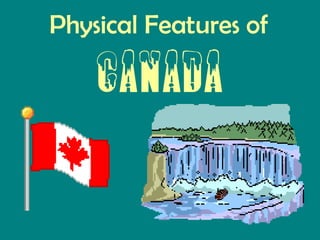
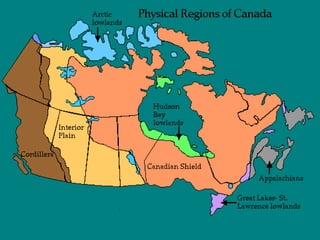
Physical Features of

Canada
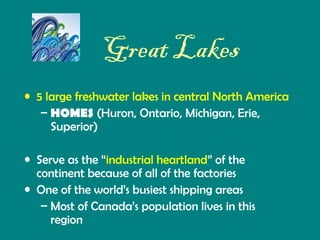
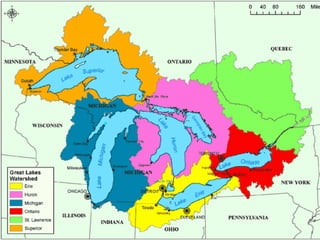
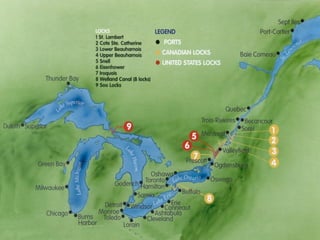
Great Lakes
• 5 large freshwater lakes in central North America
– HOMES (Huron, Ontario, Michigan, Erie,
Superior)
• Serve as the “industrial heartland” of the
continent because of all of the factories
• One of the world’s busiest shipping areas
– Most of Canada’s population lives in this
region
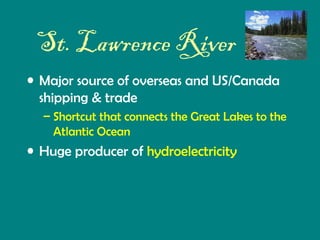
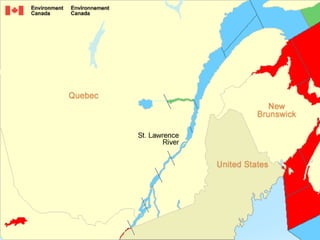
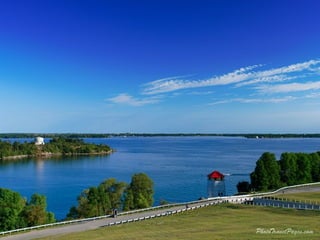
St. Lawrence River
• Major source of overseas and US/Canada
shipping & trade
– Shortcut that connects the Great Lakes to the
Atlantic Ocean

• Huge producer of hydroelectricity
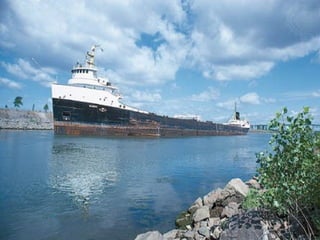
St. Lawrence Seaway
• A canal completed in 1959 at the eastern end of the
Great Lakes
– Connects the Great Lakes with the St. Lawrence
River (which flows to the Atlantic Ocean)
• Major source of overseas and US/Canada shipping &
trade
– Closed from November to April (frozen)
– Seaway has made cities in Eastern Canada home
to many successful manufacturing companies
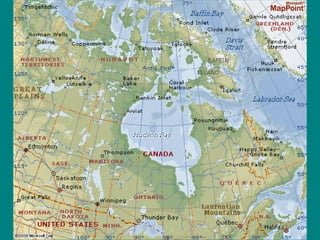
Hudson Bay
• HUGE inland sea in east central Canada
• “an arm” of the Atlantic Ocean
– Grain from Alberta & Saskatchewan is
shipped from Hudson Bay out to the
Atlantic and on to other countries
– Only navigable from July to October
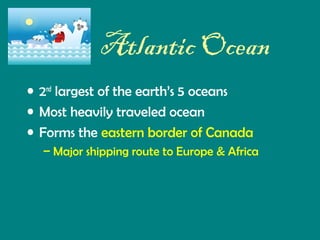
Atlantic Ocean
• 2nd largest of the earth’s 5 oceans
• Most heavily traveled ocean
• Forms the eastern border of Canada
– Major shipping route to Europe & Africa
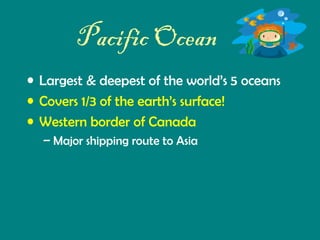
Pacific Ocean
• Largest & deepest of the world’s 5 oceans
• Covers 1/3 of the earth’s surface!
• Western border of Canada
– Major shipping route to Asia
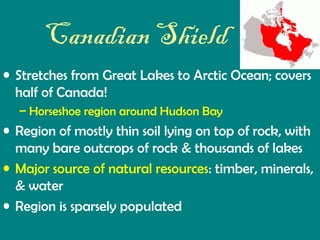
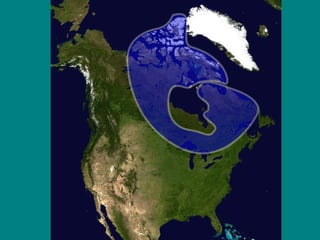
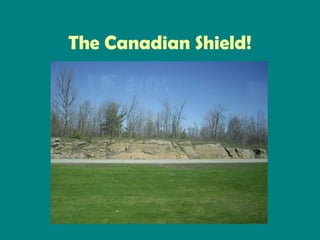
Canadian Shield
• Stretches from Great Lakes to Arctic Ocean; covers
half of Canada!
– Horseshoe region around Hudson Bay

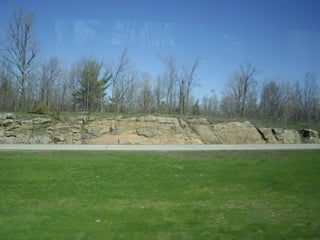
• Region of mostly thin soil lying on top of rock, with
many bare outcrops of rock & thousands of lakes
• Major source of natural resources: timber, minerals,
& water
• Region is sparsely populated
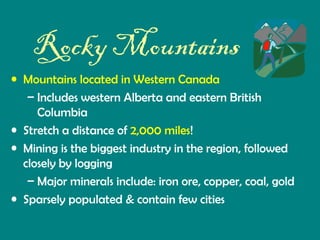
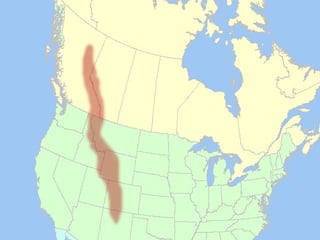
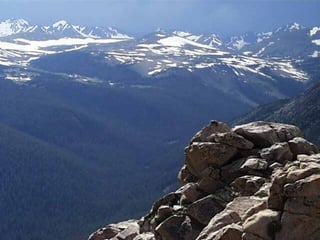
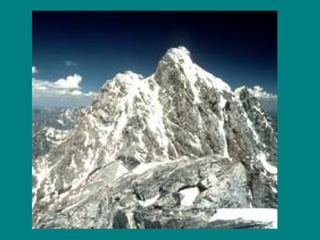
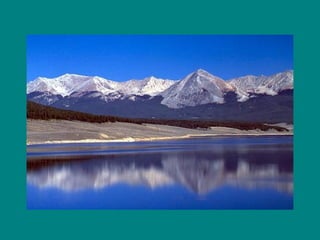
Rocky Mountains
• Mountains located in Western Canada
– Includes western Alberta and eastern British
Columbia
• Stretch a distance of 2,000 miles!
• Mining is the biggest industry in the region, followed
closely by logging
– Major minerals include: iron ore, copper, coal, gold
• Sparsely populated & contain few cities
Be the Thing…
• Your Task:
– Choose 1 of the physical features
– Fold your paper “hamburger style” to make a desk tent

• On the front : Imagine that you are one of the
features. Write 5 facts about yourself.
• On the back: draw an illustration of the feature
– We will walk around and try to guess the features!
My Example…

Who Am I?
• Brrrrr! I am always so cold!! It’s chilly up here in
northern Canada.
• I am so tired of everybody always picking on
me. Dig, dig, dig all day long.
• I wish I had some pretty trees to look at…All
that I can see is scraggly trees and flat, rocky
land.
• It’s so lonely. No one lives near me.
The Canadian Shield!

Canada physical features

  • 1.
    Good Morning 12/13/11 •Take a handout out of the purple tray and begin working on it. • On the back, answer or define: – How is the country organized? – Where is it located? – What kind of geographic features does it have? – What language do they speak? – What kind of natural resources do they have?
  • 2.
  • 3.
  • 5.
    Great Lakes • 5large freshwater lakes in central North America – HOMES (Huron, Ontario, Michigan, Erie, Superior) • Serve as the “industrial heartland” of the continent because of all of the factories • One of the world’s busiest shipping areas – Most of Canada’s population lives in this region
  • 8.
    St. Lawrence River •Major source of overseas and US/Canada shipping & trade – Shortcut that connects the Great Lakes to the Atlantic Ocean • Huge producer of hydroelectricity
  • 11.
    St. Lawrence Seaway •A canal completed in 1959 at the eastern end of the Great Lakes – Connects the Great Lakes with the St. Lawrence River (which flows to the Atlantic Ocean) • Major source of overseas and US/Canada shipping & trade – Closed from November to April (frozen) – Seaway has made cities in Eastern Canada home to many successful manufacturing companies
  • 14.
    Hudson Bay • HUGEinland sea in east central Canada • “an arm” of the Atlantic Ocean – Grain from Alberta & Saskatchewan is shipped from Hudson Bay out to the Atlantic and on to other countries – Only navigable from July to October
  • 18.
    Atlantic Ocean • 2ndlargest of the earth’s 5 oceans • Most heavily traveled ocean • Forms the eastern border of Canada – Major shipping route to Europe & Africa
  • 19.
    Pacific Ocean • Largest& deepest of the world’s 5 oceans • Covers 1/3 of the earth’s surface! • Western border of Canada – Major shipping route to Asia
  • 20.
    Canadian Shield • Stretchesfrom Great Lakes to Arctic Ocean; covers half of Canada! – Horseshoe region around Hudson Bay • Region of mostly thin soil lying on top of rock, with many bare outcrops of rock & thousands of lakes • Major source of natural resources: timber, minerals, & water • Region is sparsely populated
  • 23.
    Rocky Mountains • Mountainslocated in Western Canada – Includes western Alberta and eastern British Columbia • Stretch a distance of 2,000 miles! • Mining is the biggest industry in the region, followed closely by logging – Major minerals include: iron ore, copper, coal, gold • Sparsely populated & contain few cities
  • 29.
    Be the Thing… •Your Task: – Choose 1 of the physical features – Fold your paper “hamburger style” to make a desk tent • On the front : Imagine that you are one of the features. Write 5 facts about yourself. • On the back: draw an illustration of the feature – We will walk around and try to guess the features!
  • 30.
    My Example… Who AmI? • Brrrrr! I am always so cold!! It’s chilly up here in northern Canada. • I am so tired of everybody always picking on me. Dig, dig, dig all day long. • I wish I had some pretty trees to look at…All that I can see is scraggly trees and flat, rocky land. • It’s so lonely. No one lives near me.
  • 31.