





Can Indian Media Be Global ? Television, Print, Film & Radio
Entertainment & Media Industry Growth outperforms the economy One of the fastest growing sectors of the Indian economy Current Size : Rs 40,230 Crore Estimated growth rate : 20 % over the next 4 years Source : PwC analysis
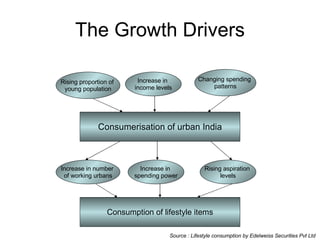
The Growth Drivers Consumerisation of urban India Rising proportion of  young population Increase in  income levels Changing spending  patterns Increase in number  of working urbans Increase in  spending power Rising aspiration  levels Consumption of lifestyle items Source : Lifestyle consumption by Edelweiss Securities Pvt Ltd
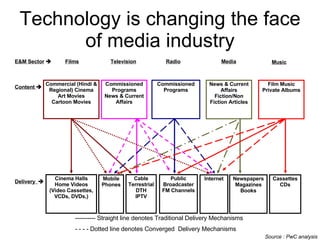
Technology is changing the face of media industry Films Television Radio Media Music E&M Sector    Content   Commercial (Hindi & Regional) Cinema Art Movies Cartoon Movies Commissioned Programs News & Current Affairs Commissioned Programs News & Current Affairs Fiction/Non Fiction Articles Film Music Private Albums Delivery   Cinema Halls Home Videos (Video Cassettes, VCDs, DVDs,) Cable Terrestrial DTH IPTV Public Broadcaster FM Channels Newspapers Magazines Books Cassettes CDs Mobile Phones Internet ---------- Straight line denotes Traditional Delivery Mechanisms - - - - Dotted line denotes Converged  Delivery Mechanisms Source : PwC analysis
Television
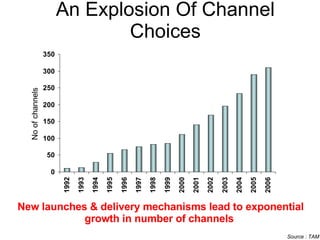
An Explosion Of Channel Choices New launches & delivery mechanisms lead to exponential growth in number of channels  Source : TAM
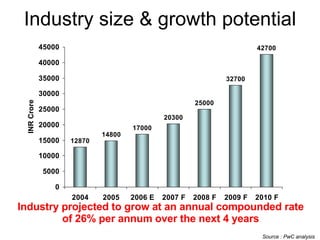
Industry size & growth potential Source : PwC analysis Industry projected to grow at an annual compounded rate of 26% per annum over the next 4 years
Industry structure Television dominates the entertainment & media industry 3 segments : Advertising, Subscription & Software
Growth Drivers - Subscription Projected CAGR of 29 % over the next 5 years Current average monthly collection : Rs 130. Projected : Rs 250 (by 2010) Larger base of TV households from lower SECs New regulatory changes & delivery mechanisms (like CAS & DTH) will result in improved declarations New technologies will bring in increased revenues through value added services
Growth Drivers - Advertising Ad spend in India : 0.48 % of GDP ; global average 0.96 % Growth in disposable incomes: urbanization & consumerism Increased reach of the medium due to expanding delivery platforms and technology advancements Higher investment from sunrise sectors. Continued support from traditional categories (FMCG, durables ) Separate viewership measurement for upmarket audience (Elite Panel)  Will result in higher niche channel spends
Growth Drivers - Software Sustained growth in this sector Frequent & never ending launch of 24 hour channels leading to demand for content Regional channel potential being tapped by national players. Increased demand for language programming Better performance of dubbed foreign content (movies, cricket commentary , cartoons) will increase demand for such services
Key developments CAS An addressable system to provide subscribers with a selective choice of content via the “pay” mode Implemented in Zone -1 areas of Bombay, Delhi and Kolkata from Jan 2007 As per TAM’s latest report , 17 % penetration in the notified areas IPTV MTNL offering services in Delhi & Mumbai Around 70 – 100 channels on offer Service allows for time-shifted TV : viewers can watch programs upto a week old
Key developments DTH Allowed by Government in 2000 Absence of middle men – consumer apathy with current Local Cable Operators  DTH is 'flexible‘, it is not connected to the ground infrastructure DTH is a ‘National’ service :same STB can be used in any city Current players DD Direct, Dish TV and Tata Sky ( Star + Tata venture) In the pipeline : Reliance, Sun group Subscriber nos : Dish TV – 20 L, Tata Sky – 4 L, DD – 50 L
Can Indian Television Industry Go Global ? Some pointers
Homegrown channels vs foreign networks Indian channels dominate most of the markets / genres (Zee, Sun , ETV, Aaj Tak , NDTV) Zee’s improved performance vs Star Plus decline at national level Regional channels dominate in TN, AP, Karnataka, Kerala, WB , Maharashtra News, Hindi movie , music genres dominated by Indian channels In sports, new entrant Neo Sports takes on ESPN, Star Sports, Ten Sports.
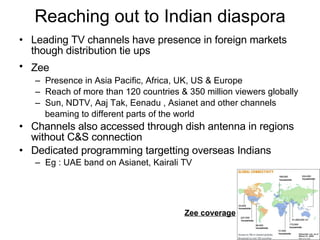
Reaching out to Indian diaspora Leading TV channels have presence in foreign markets though distribution tie ups Zee   Presence in Asia Pacific, Africa, UK, US & Europe Reach of more than 120 countries & 350 million viewers globally Sun, NDTV, Aaj Tak, Eenadu , Asianet and other channels  beaming to different parts of the world Channels also accessed through dish antenna in regions without C&S connection Dedicated programming targetting overseas Indians  Eg : UAE band on Asianet, Kairali TV Zee coverage
Attracting strategic and financial investors Television segment open to FDI 49 % for cable & DTH; 26 % for news channel Indian channels / media groups attracting foreign investment  Reuters, UK takes equity stake in Times Global Broadcasting Blackstone invests $275 Mn in Eenadu CNN IBN: partnership between Turner International and TV18 Tata Sky : alliance between Tata & Star for DTH operations in the country
Joint ventures recognizing strength of Indian entities NDTV & Genpact alliance offers media outsourcing services to enterprises   Editing, digitizing and subtitling Star Ananda Bengali news channel – alliance between ABP & Star   Balaji Telefilms  & Star form new company to launch Telugu channel
WTO agreement Will finally open up media segments across countries to global competition
Barriers to growth  Lack of uniform media policy for foreign investment Different caps in FDI in various segments DTH 49 % ; cable 49 % (ownership can only be with Indian citizens) News channel 26 % ; Entertainment 100 % Adhoc content regulation Content regulator vs self-regulation Debate continues on the working mechanism of content regulation - enforcement, penalties etc Recent issue : government ban on AXN channel for showing adult content Sports broadcast ordinance : compulsory for content providers to share content with DD
Barriers to growth  Price regulation TRAI recommendations stifle broadcaster’s attempt to fix prices based on market dynamics Cross media ownership rules Government yet to evolve clear rules in this regard Potential investors unable to plan their long-term strategy for the market Lack of empowered regulators Many TRAI recommendations still not fully acted upon Eg: Addressability in distribution, digitalisation of cable TV, privatisation of terrestrial broadcasting etc Yet to enact broadcasts bill; Content code (BRAI)
Print
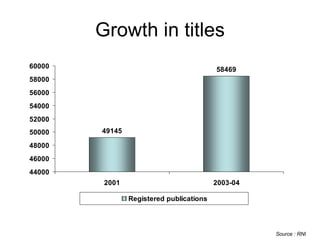
Growth in titles Source : RNI
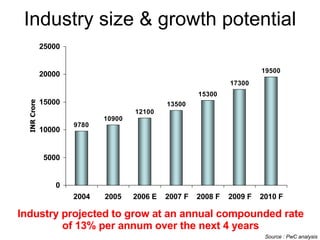
Industry size & growth potential Source : PwC analysis Industry projected to grow at an annual compounded rate of 13% per annum over the next 4 years
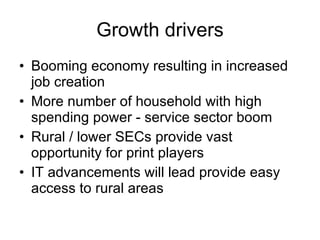
Growth drivers Booming economy resulting in increased job creation More number of household with high spending power - service sector boom Rural / lower SECs provide vast opportunity for print players  IT advancements will lead provide easy access to rural areas
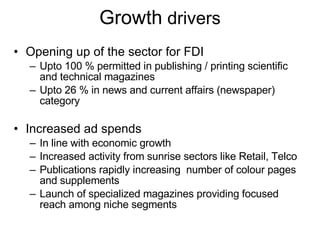
Growth  drivers Opening up of the sector for FDI Upto 100 % permitted in publishing / printing scientific and technical magazines Upto 26 % in news and current affairs (newspaper) category Increased ad spends In line with economic growth Increased activity from sunrise sectors like Retail, Telco Publications rapidly increasing  number of colour pages and supplements Launch of specialized magazines providing focused reach among niche segments
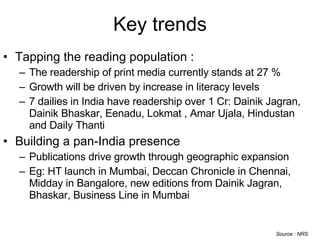
Key trends Tapping the reading population : The readership of print media currently stands at 27 % Growth will be driven by increase in literacy levels 7 dailies in India have readership over 1 Cr: Dainik Jagran, Dainik Bhaskar, Eenadu, Lokmat , Amar Ujala, Hindustan and Daily Thanti   Building a pan-India presence Publications drive growth through geographic expansion Eg: HT launch in Mumbai, Deccan Chronicle in Chennai, Midday in Bangalore, new editions from Dainik Jagran, Bhaskar, Business Line in Mumbai Source : NRS
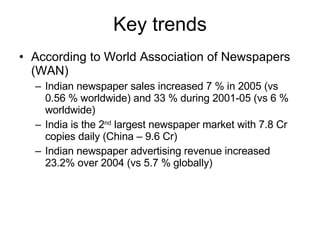
Key trends According to World Association of Newspapers (WAN) Indian newspaper sales increased 7 % in 2005 (vs 0.56 % worldwide) and 33 % during 2001-05 (vs 6 % worldwide) India is the 2 nd  largest newspaper market with 7.8 Cr copies daily (China – 9.6 Cr) Indian newspaper advertising revenue increased 23.2% over 2004 (vs 5.7 % globally)
Can Indian Print Media Go Global ? Some pointers
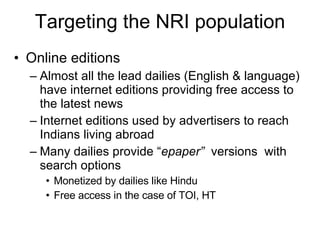
Targeting the NRI population Online editions Almost all the lead dailies (English & language) have internet editions providing free access to the latest news Internet editions used by advertisers to reach Indians living abroad Many dailies provide “ epaper”  versions  with search options Monetized by dailies like Hindu Free access in the case of TOI, HT
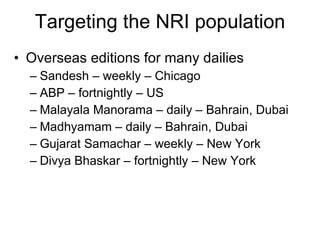
Targeting the NRI population Overseas editions for many dailies Sandesh – weekly – Chicago ABP – fortnightly – US Malayala Manorama – daily – Bahrain, Dubai Madhyamam – daily – Bahrain, Dubai Gujarat Samachar – weekly – New York Divya Bhaskar – fortnightly – New York
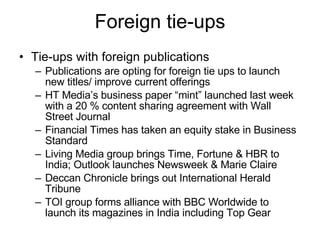
Foreign tie-ups Tie-ups with foreign publications Publications are opting for foreign tie ups to launch new titles/ improve current offerings HT Media’s business paper “mint” launched last week with a 20 % content sharing agreement with Wall Street Journal Financial Times has taken an equity stake in Business Standard Living Media group brings Time, Fortune & HBR to India; Outlook launches Newsweek & Marie Claire Deccan Chronicle brings out International Herald Tribune TOI group forms alliance with BBC Worldwide to launch its magazines in India including Top Gear
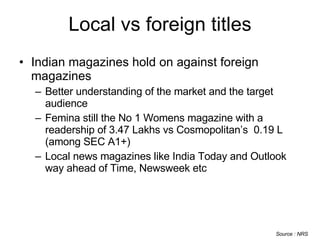
Local vs foreign titles Indian magazines hold on against foreign magazines Better understanding of the market and the target audience Femina still the No 1 Womens magazine with a  readership of 3.47 Lakhs vs Cosmopolitan’s  0.19 L (among SEC A1+) Local news magazines like India Today and Outlook way ahead of Time, Newsweek etc Source : NRS
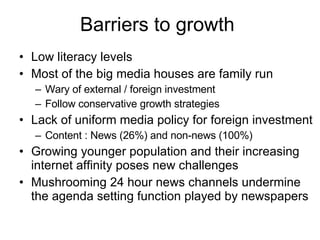
Barriers to growth  Low literacy levels Most of the big media houses are family run  Wary of external / foreign investment Follow conservative growth strategies Lack of uniform media policy for foreign investment Content : News (26%) and non-news (100%) Growing younger population and their increasing internet affinity poses new challenges Mushrooming 24 hour news channels undermine the agenda setting function played by newspapers
Films
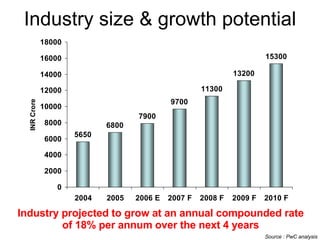
Industry size & growth potential Source : PwC analysis Industry projected to grow at an annual compounded rate of 18% per annum over the next 4 years
Growth drivers Advancements in technology helping the industry in film production, exhibition and marketing Corporatisation of the film industry Many exhibition companies (PVR, Shringar, Inox) have gone public Entry of the largest industrial house in the E & M industry – Reliance acquired majority stake in Adlabs Corporates also forayed into film distribution eg. UTV software Increased marketing spends  Corporatisation also resulted in innovative marketing activities : microsites, blogs, contests, mobile downloads etc Centralised marketing and promotion activities
Growth drivers Derisking through portfolio approach (multiple releases with multiple revenue streams) Companies getting associated through in film brand placements, endorsements etc Mobile companies :selling ringtones and wallpapers at premium rates Merchandising catching on in a big way Growing number of multiplexes  Incentive for low-budget, niche films and experimental cinema Higher admission rates : account for 60 % of Box Office revenues
Can Indian Film Industry Go Global ? Some pointers
Tapping overseas markets Growing collection from overseas markets Indian films are becoming increasingly popular even with the non Indian community More number of prints being released abroad  Overseas revenues estimated to account for 10 % of total earnings by 2010 In 2006, films like Kabhie Alvidha Na Kehna, Fanaa, Rang De Basanti emerged blockbusters in UK and North America.  Forbes magazine estimates : Dhoom-2 ($18.4 million) Fanaa ($17.7 million) and  KANK ($17.5 million) Regional language movies (Telugu, Tamil) also popular abroad
Digital Cinema – removing the distance barrier Digitalization of Cinema India is on the verge of becoming the largest digital theatre country in the world  Malayalam movie "Moonnamathoraal"  reportedly became the first film to be digitally released: Sept’06  Advantages : curbs piracy, reduces production cost, gives better clarity and allows simultaneous release across centres reducing revenue loss FICCI estimates 25-30 % growth through digitalization and savings worth 2000 Cr (incurred due to piracy & film stock import)
International co-productions Increased corporatisation has resulted in Indian companies doing more co-productions UTV tie up with Fox , Will Smith’s Overbrook , Porchlight (animation) Viacom plans co-production with local film makers Percept Picture Company joined hands with Further Films and Sahara One  to produce “Tree of Life”
Cinema – the future Could we imagine these 15-20 years back ? Mobile phones becoming an integral part of our life  Cameras without film  Access to around 300 TV channels  Reading newspapers on the net  In the next 2 – 3 years Physical movie prints will become obsolete Movie producers will be able to digitally release movies across all theatres in India (12000+) and abroad Reduced time lag in releasing home videos - higher revenues, reduced piracy  Drop in VCD costs: Moser Baer already releasing regional movies in the Rs 28 – 34 price range
Barriers to growth  Low capital / investment levels Producers unable to invest in a large number of prints and marketing initiatives  Digitalization will change the scenario Piracy Most of the credible efforts to combat piracy initiated by industry bodies  Current copyright act dated in terms of technology improvements
FM Radio Sector opened up after years of government dominance 338 licenses given away for 91 cities in the 2 nd  phase of radio privatisation 20 % FDI allowed by government Eg: Virgin Radio tie up with HT Media, Mid day & BBC for Radio One   Revenue share agreement in contrast to the earlier fixed license fee regime Only 20 stations were set up after auctioning of 108 frequencies  during round 1 of privatisation
FM opportunities Investments Need for financial investments as well as technical and operating experience to run the stations Content boost Average requirement expected to be 5000 content hours per annum per radio channel Potential to reach local markets Only 22 of the 338 channels are in the four metro cities Huge potential to target the smaller cities
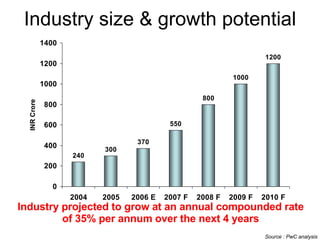
Industry size & growth potential Source : PwC analysis Industry projected to grow at an annual compounded rate of 35% per annum over the next 4 years
Radio going global Indian channels on international satellite radio services like World Space RM Radio, Jhankaar, Gandharv, NDTV etc Numerous Indian stations reaching out to people of Indian origin in foreign countries RBC Radio (US), Asianet Radio (Gulf countries) 24 hour Tamil station in Singapore ( Oli 96.8 FM) Numerous Indian stations in Trinidad, Fuji, Mauritius Strong advertising support from local / MNC clients
Can Indian media companies go global ? Acquiring / taking a stake in local companies NDTV and SE Asian news broadcasting company Astro Broadcast have tied up to do business in Malaysia and Indonesia UTV , Astro JV to launch channels in Hindi, Regional, Indonesia and Malaysia Bahasa Astro and Sun TV have formed a joint venture to generate and distribute TV programs/channels for global audience More acquisitions likely as companies go public and have access to funds
Can Indian Media Be Global ?
Yes the foundation has been laid Large Indian companies will take over foreign entities Zee’s acquisition of Ten Sports an indicator of things to come Synergies, access to funds, regulatory mechanism will set the pace  TV, Films & Radio have already gone global Potential for further growth through technology advancements & relaxed trade agreements Huge talent pool – creative & technical – will drive this growth
Print  Internet and epaper versions already available More international editions once the base population crosses threshold figure Increased interest in India will create huge demand for Indian content  More syndication arrangements in the offing Print will catch on………soon
Thank you
Appendix
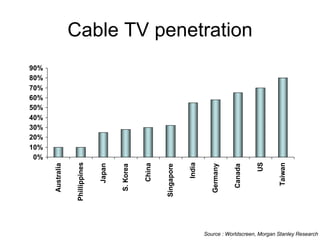
Cable TV penetration Source : Worldscreen, Morgan Stanley Research
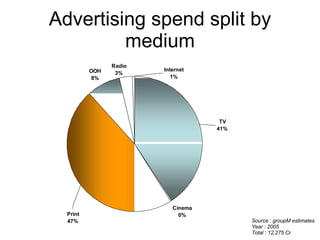
Advertising spend split by medium Source : groupM estimates Year : 2005  Total : 12,275 Cr
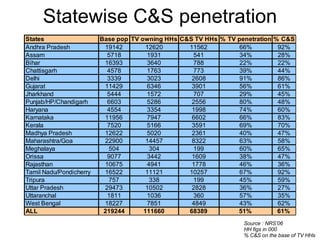
Statewise C&S penetration Source : NRS’06 HH figs in 000 % C&S on the base of TV HHs

Can India Media Be Global

  • 1.
    Can Indian MediaBe Global ? Television, Print, Film & Radio
  • 2.
    Entertainment & MediaIndustry Growth outperforms the economy One of the fastest growing sectors of the Indian economy Current Size : Rs 40,230 Crore Estimated growth rate : 20 % over the next 4 years Source : PwC analysis
  • 3.
    The Growth DriversConsumerisation of urban India Rising proportion of young population Increase in income levels Changing spending patterns Increase in number of working urbans Increase in spending power Rising aspiration levels Consumption of lifestyle items Source : Lifestyle consumption by Edelweiss Securities Pvt Ltd
  • 4.
    Technology is changingthe face of media industry Films Television Radio Media Music E&M Sector  Content  Commercial (Hindi & Regional) Cinema Art Movies Cartoon Movies Commissioned Programs News & Current Affairs Commissioned Programs News & Current Affairs Fiction/Non Fiction Articles Film Music Private Albums Delivery  Cinema Halls Home Videos (Video Cassettes, VCDs, DVDs,) Cable Terrestrial DTH IPTV Public Broadcaster FM Channels Newspapers Magazines Books Cassettes CDs Mobile Phones Internet ---------- Straight line denotes Traditional Delivery Mechanisms - - - - Dotted line denotes Converged Delivery Mechanisms Source : PwC analysis
  • 5.
  • 6.
    An Explosion OfChannel Choices New launches & delivery mechanisms lead to exponential growth in number of channels Source : TAM
  • 7.
    Industry size &growth potential Source : PwC analysis Industry projected to grow at an annual compounded rate of 26% per annum over the next 4 years
  • 8.
    Industry structure Televisiondominates the entertainment & media industry 3 segments : Advertising, Subscription & Software
  • 9.
    Growth Drivers -Subscription Projected CAGR of 29 % over the next 5 years Current average monthly collection : Rs 130. Projected : Rs 250 (by 2010) Larger base of TV households from lower SECs New regulatory changes & delivery mechanisms (like CAS & DTH) will result in improved declarations New technologies will bring in increased revenues through value added services
  • 10.
    Growth Drivers -Advertising Ad spend in India : 0.48 % of GDP ; global average 0.96 % Growth in disposable incomes: urbanization & consumerism Increased reach of the medium due to expanding delivery platforms and technology advancements Higher investment from sunrise sectors. Continued support from traditional categories (FMCG, durables ) Separate viewership measurement for upmarket audience (Elite Panel) Will result in higher niche channel spends
  • 11.
    Growth Drivers -Software Sustained growth in this sector Frequent & never ending launch of 24 hour channels leading to demand for content Regional channel potential being tapped by national players. Increased demand for language programming Better performance of dubbed foreign content (movies, cricket commentary , cartoons) will increase demand for such services
  • 12.
    Key developments CASAn addressable system to provide subscribers with a selective choice of content via the “pay” mode Implemented in Zone -1 areas of Bombay, Delhi and Kolkata from Jan 2007 As per TAM’s latest report , 17 % penetration in the notified areas IPTV MTNL offering services in Delhi & Mumbai Around 70 – 100 channels on offer Service allows for time-shifted TV : viewers can watch programs upto a week old
  • 13.
    Key developments DTHAllowed by Government in 2000 Absence of middle men – consumer apathy with current Local Cable Operators DTH is 'flexible‘, it is not connected to the ground infrastructure DTH is a ‘National’ service :same STB can be used in any city Current players DD Direct, Dish TV and Tata Sky ( Star + Tata venture) In the pipeline : Reliance, Sun group Subscriber nos : Dish TV – 20 L, Tata Sky – 4 L, DD – 50 L
  • 14.
    Can Indian TelevisionIndustry Go Global ? Some pointers
  • 15.
    Homegrown channels vsforeign networks Indian channels dominate most of the markets / genres (Zee, Sun , ETV, Aaj Tak , NDTV) Zee’s improved performance vs Star Plus decline at national level Regional channels dominate in TN, AP, Karnataka, Kerala, WB , Maharashtra News, Hindi movie , music genres dominated by Indian channels In sports, new entrant Neo Sports takes on ESPN, Star Sports, Ten Sports.
  • 16.
    Reaching out toIndian diaspora Leading TV channels have presence in foreign markets though distribution tie ups Zee Presence in Asia Pacific, Africa, UK, US & Europe Reach of more than 120 countries & 350 million viewers globally Sun, NDTV, Aaj Tak, Eenadu , Asianet and other channels beaming to different parts of the world Channels also accessed through dish antenna in regions without C&S connection Dedicated programming targetting overseas Indians Eg : UAE band on Asianet, Kairali TV Zee coverage
  • 17.
    Attracting strategic andfinancial investors Television segment open to FDI 49 % for cable & DTH; 26 % for news channel Indian channels / media groups attracting foreign investment Reuters, UK takes equity stake in Times Global Broadcasting Blackstone invests $275 Mn in Eenadu CNN IBN: partnership between Turner International and TV18 Tata Sky : alliance between Tata & Star for DTH operations in the country
  • 18.
    Joint ventures recognizingstrength of Indian entities NDTV & Genpact alliance offers media outsourcing services to enterprises Editing, digitizing and subtitling Star Ananda Bengali news channel – alliance between ABP & Star Balaji Telefilms & Star form new company to launch Telugu channel
  • 19.
    WTO agreement Willfinally open up media segments across countries to global competition
  • 20.
    Barriers to growth Lack of uniform media policy for foreign investment Different caps in FDI in various segments DTH 49 % ; cable 49 % (ownership can only be with Indian citizens) News channel 26 % ; Entertainment 100 % Adhoc content regulation Content regulator vs self-regulation Debate continues on the working mechanism of content regulation - enforcement, penalties etc Recent issue : government ban on AXN channel for showing adult content Sports broadcast ordinance : compulsory for content providers to share content with DD
  • 21.
    Barriers to growth Price regulation TRAI recommendations stifle broadcaster’s attempt to fix prices based on market dynamics Cross media ownership rules Government yet to evolve clear rules in this regard Potential investors unable to plan their long-term strategy for the market Lack of empowered regulators Many TRAI recommendations still not fully acted upon Eg: Addressability in distribution, digitalisation of cable TV, privatisation of terrestrial broadcasting etc Yet to enact broadcasts bill; Content code (BRAI)
  • 22.
  • 23.
    Growth in titlesSource : RNI
  • 24.
    Industry size &growth potential Source : PwC analysis Industry projected to grow at an annual compounded rate of 13% per annum over the next 4 years
  • 25.
    Growth drivers Boomingeconomy resulting in increased job creation More number of household with high spending power - service sector boom Rural / lower SECs provide vast opportunity for print players IT advancements will lead provide easy access to rural areas
  • 26.
    Growth driversOpening up of the sector for FDI Upto 100 % permitted in publishing / printing scientific and technical magazines Upto 26 % in news and current affairs (newspaper) category Increased ad spends In line with economic growth Increased activity from sunrise sectors like Retail, Telco Publications rapidly increasing number of colour pages and supplements Launch of specialized magazines providing focused reach among niche segments
  • 27.
    Key trends Tappingthe reading population : The readership of print media currently stands at 27 % Growth will be driven by increase in literacy levels 7 dailies in India have readership over 1 Cr: Dainik Jagran, Dainik Bhaskar, Eenadu, Lokmat , Amar Ujala, Hindustan and Daily Thanti Building a pan-India presence Publications drive growth through geographic expansion Eg: HT launch in Mumbai, Deccan Chronicle in Chennai, Midday in Bangalore, new editions from Dainik Jagran, Bhaskar, Business Line in Mumbai Source : NRS
  • 28.
    Key trends Accordingto World Association of Newspapers (WAN) Indian newspaper sales increased 7 % in 2005 (vs 0.56 % worldwide) and 33 % during 2001-05 (vs 6 % worldwide) India is the 2 nd largest newspaper market with 7.8 Cr copies daily (China – 9.6 Cr) Indian newspaper advertising revenue increased 23.2% over 2004 (vs 5.7 % globally)
  • 29.
    Can Indian PrintMedia Go Global ? Some pointers
  • 30.
    Targeting the NRIpopulation Online editions Almost all the lead dailies (English & language) have internet editions providing free access to the latest news Internet editions used by advertisers to reach Indians living abroad Many dailies provide “ epaper” versions with search options Monetized by dailies like Hindu Free access in the case of TOI, HT
  • 31.
    Targeting the NRIpopulation Overseas editions for many dailies Sandesh – weekly – Chicago ABP – fortnightly – US Malayala Manorama – daily – Bahrain, Dubai Madhyamam – daily – Bahrain, Dubai Gujarat Samachar – weekly – New York Divya Bhaskar – fortnightly – New York
  • 32.
    Foreign tie-ups Tie-upswith foreign publications Publications are opting for foreign tie ups to launch new titles/ improve current offerings HT Media’s business paper “mint” launched last week with a 20 % content sharing agreement with Wall Street Journal Financial Times has taken an equity stake in Business Standard Living Media group brings Time, Fortune & HBR to India; Outlook launches Newsweek & Marie Claire Deccan Chronicle brings out International Herald Tribune TOI group forms alliance with BBC Worldwide to launch its magazines in India including Top Gear
  • 33.
    Local vs foreigntitles Indian magazines hold on against foreign magazines Better understanding of the market and the target audience Femina still the No 1 Womens magazine with a readership of 3.47 Lakhs vs Cosmopolitan’s 0.19 L (among SEC A1+) Local news magazines like India Today and Outlook way ahead of Time, Newsweek etc Source : NRS
  • 34.
    Barriers to growth Low literacy levels Most of the big media houses are family run Wary of external / foreign investment Follow conservative growth strategies Lack of uniform media policy for foreign investment Content : News (26%) and non-news (100%) Growing younger population and their increasing internet affinity poses new challenges Mushrooming 24 hour news channels undermine the agenda setting function played by newspapers
  • 35.
  • 36.
    Industry size &growth potential Source : PwC analysis Industry projected to grow at an annual compounded rate of 18% per annum over the next 4 years
  • 37.
    Growth drivers Advancementsin technology helping the industry in film production, exhibition and marketing Corporatisation of the film industry Many exhibition companies (PVR, Shringar, Inox) have gone public Entry of the largest industrial house in the E & M industry – Reliance acquired majority stake in Adlabs Corporates also forayed into film distribution eg. UTV software Increased marketing spends Corporatisation also resulted in innovative marketing activities : microsites, blogs, contests, mobile downloads etc Centralised marketing and promotion activities
  • 38.
    Growth drivers Deriskingthrough portfolio approach (multiple releases with multiple revenue streams) Companies getting associated through in film brand placements, endorsements etc Mobile companies :selling ringtones and wallpapers at premium rates Merchandising catching on in a big way Growing number of multiplexes Incentive for low-budget, niche films and experimental cinema Higher admission rates : account for 60 % of Box Office revenues
  • 39.
    Can Indian FilmIndustry Go Global ? Some pointers
  • 40.
    Tapping overseas marketsGrowing collection from overseas markets Indian films are becoming increasingly popular even with the non Indian community More number of prints being released abroad Overseas revenues estimated to account for 10 % of total earnings by 2010 In 2006, films like Kabhie Alvidha Na Kehna, Fanaa, Rang De Basanti emerged blockbusters in UK and North America. Forbes magazine estimates : Dhoom-2 ($18.4 million) Fanaa ($17.7 million) and KANK ($17.5 million) Regional language movies (Telugu, Tamil) also popular abroad
  • 41.
    Digital Cinema –removing the distance barrier Digitalization of Cinema India is on the verge of becoming the largest digital theatre country in the world Malayalam movie "Moonnamathoraal" reportedly became the first film to be digitally released: Sept’06 Advantages : curbs piracy, reduces production cost, gives better clarity and allows simultaneous release across centres reducing revenue loss FICCI estimates 25-30 % growth through digitalization and savings worth 2000 Cr (incurred due to piracy & film stock import)
  • 42.
    International co-productions Increasedcorporatisation has resulted in Indian companies doing more co-productions UTV tie up with Fox , Will Smith’s Overbrook , Porchlight (animation) Viacom plans co-production with local film makers Percept Picture Company joined hands with Further Films and Sahara One to produce “Tree of Life”
  • 43.
    Cinema – thefuture Could we imagine these 15-20 years back ? Mobile phones becoming an integral part of our life Cameras without film Access to around 300 TV channels Reading newspapers on the net In the next 2 – 3 years Physical movie prints will become obsolete Movie producers will be able to digitally release movies across all theatres in India (12000+) and abroad Reduced time lag in releasing home videos - higher revenues, reduced piracy Drop in VCD costs: Moser Baer already releasing regional movies in the Rs 28 – 34 price range
  • 44.
    Barriers to growth Low capital / investment levels Producers unable to invest in a large number of prints and marketing initiatives Digitalization will change the scenario Piracy Most of the credible efforts to combat piracy initiated by industry bodies Current copyright act dated in terms of technology improvements
  • 45.
    FM Radio Sectoropened up after years of government dominance 338 licenses given away for 91 cities in the 2 nd phase of radio privatisation 20 % FDI allowed by government Eg: Virgin Radio tie up with HT Media, Mid day & BBC for Radio One Revenue share agreement in contrast to the earlier fixed license fee regime Only 20 stations were set up after auctioning of 108 frequencies during round 1 of privatisation
  • 46.
    FM opportunities InvestmentsNeed for financial investments as well as technical and operating experience to run the stations Content boost Average requirement expected to be 5000 content hours per annum per radio channel Potential to reach local markets Only 22 of the 338 channels are in the four metro cities Huge potential to target the smaller cities
  • 47.
    Industry size &growth potential Source : PwC analysis Industry projected to grow at an annual compounded rate of 35% per annum over the next 4 years
  • 48.
    Radio going globalIndian channels on international satellite radio services like World Space RM Radio, Jhankaar, Gandharv, NDTV etc Numerous Indian stations reaching out to people of Indian origin in foreign countries RBC Radio (US), Asianet Radio (Gulf countries) 24 hour Tamil station in Singapore ( Oli 96.8 FM) Numerous Indian stations in Trinidad, Fuji, Mauritius Strong advertising support from local / MNC clients
  • 49.
    Can Indian mediacompanies go global ? Acquiring / taking a stake in local companies NDTV and SE Asian news broadcasting company Astro Broadcast have tied up to do business in Malaysia and Indonesia UTV , Astro JV to launch channels in Hindi, Regional, Indonesia and Malaysia Bahasa Astro and Sun TV have formed a joint venture to generate and distribute TV programs/channels for global audience More acquisitions likely as companies go public and have access to funds
  • 50.
    Can Indian MediaBe Global ?
  • 51.
    Yes the foundationhas been laid Large Indian companies will take over foreign entities Zee’s acquisition of Ten Sports an indicator of things to come Synergies, access to funds, regulatory mechanism will set the pace TV, Films & Radio have already gone global Potential for further growth through technology advancements & relaxed trade agreements Huge talent pool – creative & technical – will drive this growth
  • 52.
    Print Internetand epaper versions already available More international editions once the base population crosses threshold figure Increased interest in India will create huge demand for Indian content More syndication arrangements in the offing Print will catch on………soon
  • 53.
  • 54.
  • 55.
    Cable TV penetrationSource : Worldscreen, Morgan Stanley Research
  • 56.
    Advertising spend splitby medium Source : groupM estimates Year : 2005 Total : 12,275 Cr
  • 57.
    Statewise C&S penetrationSource : NRS’06 HH figs in 000 % C&S on the base of TV HHs