Reengineering involves improving existing software or business processes by making them more efficient, effective and adaptable to current business needs. It is an iterative process that involves reverse engineering the existing system, redesigning problematic areas, and forward engineering changes by implementing a redesigned prototype and refining it based on feedback. The goal is to create a system with improved functionality, performance, maintainability and alignment with current business goals and technologies.
What is it?Consider any technology, you use it regularly. It is getting old, breaks too often, takes longer to repair and no longer represents the newest technology. If the product is hardware ,throw it away and buy newer model. But, if it is custom-built software,need to rebuil it. “ Create a product with added functionality, better performance and reliability and improved maintainability” Reengineering
3.
Who does it?At business level, reengineering performed by business specialist. At software level,reengineering performed by software engineers. Reengineering
4.
Business Process Reengineering(BPR)(I) A business process; is a set of logically related tasks performed to achieve a defined business outcome. Within the business process, people, equipment, material resources and business procedures are combined. Examples; Designing a new product, Hiring a new employee...Each demands a set of tasks and needs diverse resources. Reengineering
5.
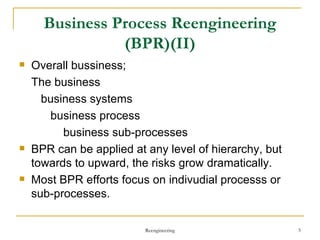
Business Process Reengineering(BPR)(II) Overall bussiness; The business business systems business process business sub-processes BPR can be applied at any level of hierarchy, but towards to upward, the risks grow dramatically. Most BPR efforts focus on indivudial processs or sub-processes. Reengineering
6.
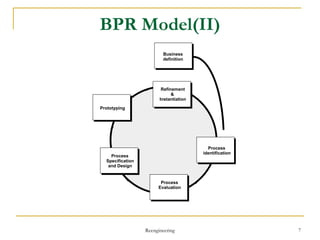
BPR Model(I) Likemost engineering activities, business process reengineering is iterative. There is no start and end to BPR. It is an evolutionary process. The model defines the six activities. Reengineering
7.
BPR Model(II) ReengineeringBusiness definition Process identification Process Evaluation Process Specification and Design Prototyping Refinement & Instantiation
8.
BPR Model(III) Businessredefinition business goals identified in the context of key drivers cost reduction time reduction quality improvement empowerment Process identification processes that are critical to achieving business goals are identified and prioritized Process evaluation existing processes are analyzed and measured process costs and time are noted quality/performance problems are isolated Reengineering
9.
BPR Model(IV) Processspecification and design based on information obtained during three BPR activities, use-cases are prepared for each process to be redesigned new tasks are designed for each process Prototyping used to test redisgned processes before integrating them into the business Refinement and instantiation based on feedback from the prototype, business processes are refined refined processes then instantiated within a business system Reengineering
10.
Software Reengineering Muchof the software we depend on today is average 10 to 15 years old. Even when these programs were created using the best design and coding techniques known at the time(and most were not), they were created when program size and storage space were principle concerns. They were then migrated to new platforms. Ajusted for changes in machine and operating system technology. Enhanced to meet new users. “ The result is poorly designed structures, poor coding, poor logic and poor documentation” Reengineering
11.
Software Reengineering Process Model(I) Reengineering takes time. It costs significant amounts of money, it absorbs resources. So,it is accomplished in a few months or even a few years. Reengineering
12.
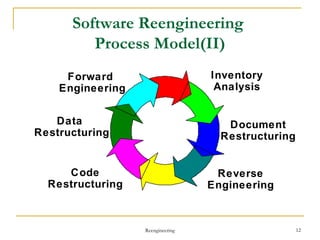
Software Reengineering Process Model(II) Reengineering Data Restructuring Forward Engineering Code Restructuring Document Restructuring Inventory Analysis Reverse Engineering
13.
Inventory Analysis Build a table that contains all applications Establish a list of criteria, e.g., name of the application year it was originally created number of substantive changes made to it total effort applied to make these changes date of last substantive change effort applied to make the last change system(s) in which it resides applications to which it interfaces, ... Analyze and prioritize to select candidates for reengineering Reengineering
14.
Document Restructuring Options range from doing nothing to regeneration of all documentation for critical system . “ Creating is far too time consuming”.In some cases correct approach. It is not possible to recreate documentation for hundreds of computer programs. “ Documentation must be updated, but have limited resources”. It may not be necessary to fully redocument an application. Rather then portions of the system that are currently undergoing change are fully documented. “ The system is business ciritical and must be fully redocumented. ” Reengineering
15.
Reverse Engineering (I)The term “Reverse Engineering” has its origins in the hardware world. A company disassembles a competitive hardware product, to understand its competitor’s design and manufacturing secrets. For software quite similar.But not a competitor’s software. It is company’s own program. “ Anayzing a program in an effort to create a representation of the program at a higher level of abstraction than source code” Reengineering
16.
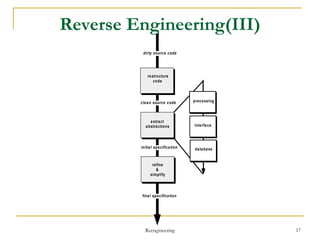
Reverse Engineering (II)Reverse engineering conjures a “magic slot”. We feed undocumented source listing into the slot and out the other end comes full documentation for the computer program. Reverse engineering can extract design information from source code, but some properties exist; Abstraction Level : Sophistication of design information that can be extracted from source code. Should be as high as possible. Completeness : A mount of detail gathered at the abstraction level . Decreases as abstraction level increases . Directionality Reengineering
Reverse Engineering (IV)R.E. To Understand Process ing The overall functionality of the entire application must be understood. A block diagram, representing the interaction between functional abstractions is created. Things become more complex when the code inside a component is considered. In almost every component has a section of code prepares data for processing, a different section of code does processing and another section which prepares the result. For large system CASE tools are used to parse the semantics of existing code. Reengineering
19.
Reverse Engineering (V)R.E. To Understand Data Internal data structures Definition of classes Identify local data structures that record information about global data structures Identify relationships between these local data structures & the global data structures Group variables that have logical connections Database structure Build initial object model Determine candidate keys Refine tentative classes – possibly combine to single class Define generalizations Discover associations Reengineering
20.
Reverse Engineering (VI)R.E. User Interfaces To fully understand an existing user interface, the structure and behavior of the interface must be specified. What are the basic actions?(keystrokes, mouse clicks...) What is the response of the system to these actions. It is important to note that a replacement GUI may not mirror old interface. In fact, it may be radically different. Reengineering
21.
Restructuring (I) Doesnot modify the overall architecture Code Restructuring Data Restructuring Advantages Adhere to modern software engineering standards . Frustration among software engineers reduced . Maintenance efforts reduced . Easier to test & debug . Reengineering
22.
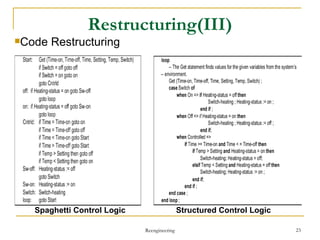
Restructuring (II) CodeRestructuring The most common type of restructuring. If modules were coded in a way that makes them difficult to understand, test and maintain. To accomplish this activity The source code is analyzed using a restructuring tool Violations of structured programming constructs are noted. Code then restructured manual or automatically. Th resultant restructured code is reviewed and tested. Reengineering
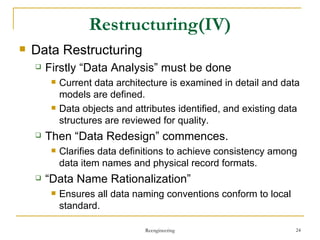
Restructuring (IV) DataRestructuring Firstly “Data Analysis” must be done Current data architecture is examined in detail and data models are defined. Data objects and attributes identified, and existing data structures are reviewed for quality. Then “Data Redesign” commences. Clarifies data definitions to achieve consistency among data item names and physical record formats. “ Data Name Rationalization” Ensures all data naming conventions conform to local standard. Reengineering
25.
Forward Engineering (I) Also called “renovation” or “reclamation” Uses design information from existing software to alter the existing system in an effort to improve its overall quality. Reengineering
26.
Options for poorlydesigned source code Change necessary lines of source code Understand bigger picture & use this to guide modifications Redesign, recode, & test portions that need modification Completely redesign, recode, and test system Forward Engineering (II) Reengineering
27.
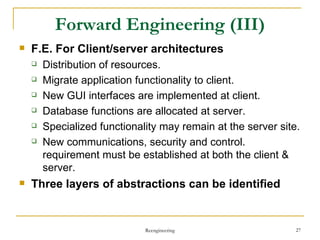
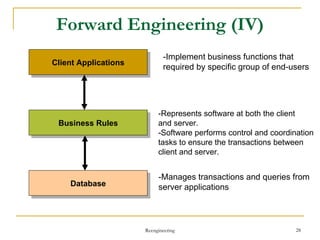
Forward Engineering (III) F.E. For Client/server architectures Distribution of resources . Migrate application functionality to client . New GUI interfaces are implemented at client . Database functions are allocated at server . Specialized functionality may remain at the server site. New communications, security and control. requirement must be established at both the client & server . Three layers of abstractions can be identified Reengineering
28.
Forward Engineering (IV) Reengineering -Manages transactions and queries from server applications -Represents software at both the client and server. -Software performs control and coordination tasks to ensure the transactions between client and server. -Implement business functions that required by specific group of end-users Client Applications Business Rules Database
29.
Forward Engineering (V) F.E. For Object-Oriented Architectures Existing software is reverse engineered so that appropriate data, functional and behavioral models can be created. Data models are used to establish the basis for the definition og classes. Then class hierarchies, object relationship models are defined. Reengineering
30.
Forward Engineering User interfaces Understand original interface & data Remodel behavior of old interface into abstractions in context of GUI Add improvements that make the mode of interaction more efficient. Build and integrate new GUI . Forward Engineering (VI) Reengineering