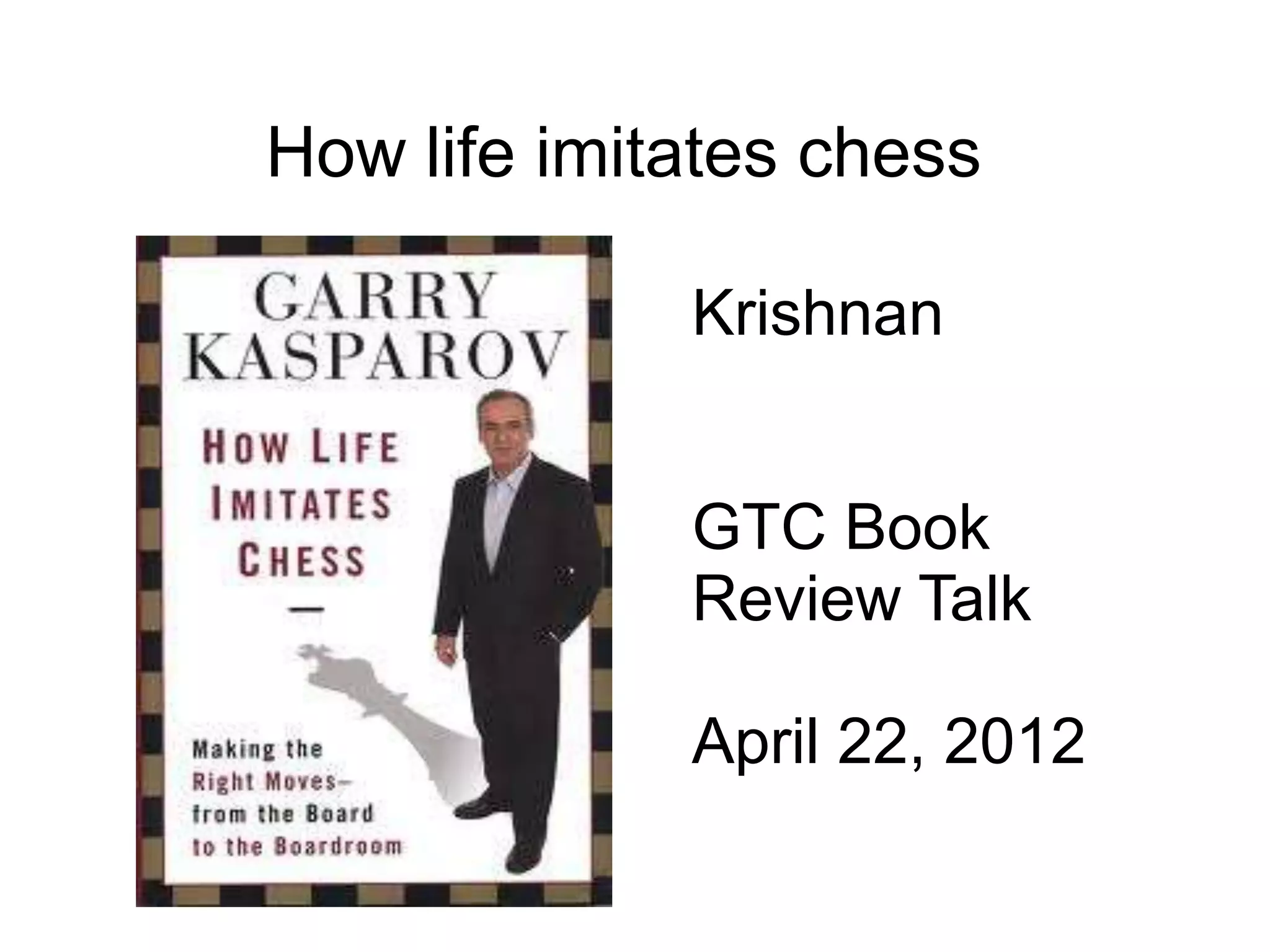
How life imitates chess

             Krishnan


             GTC Book
             Review Talk

             April 22, 2012
Chess mimics real life decision
               making
   Chess is a laboratory for the decision making
    process
   Have to make constant stream of exact,
    informed decisions
   Decisions made in real-time and under pressure
   Requires calculation, creativity and desire for
    results
Three parts of the book
   Part 1 – Strategy, calculation, preparation
   Part 2 – Evaluation and analysis
       What changes are needed and why
   Part 3 – Ongoing, continous performance
    improvement
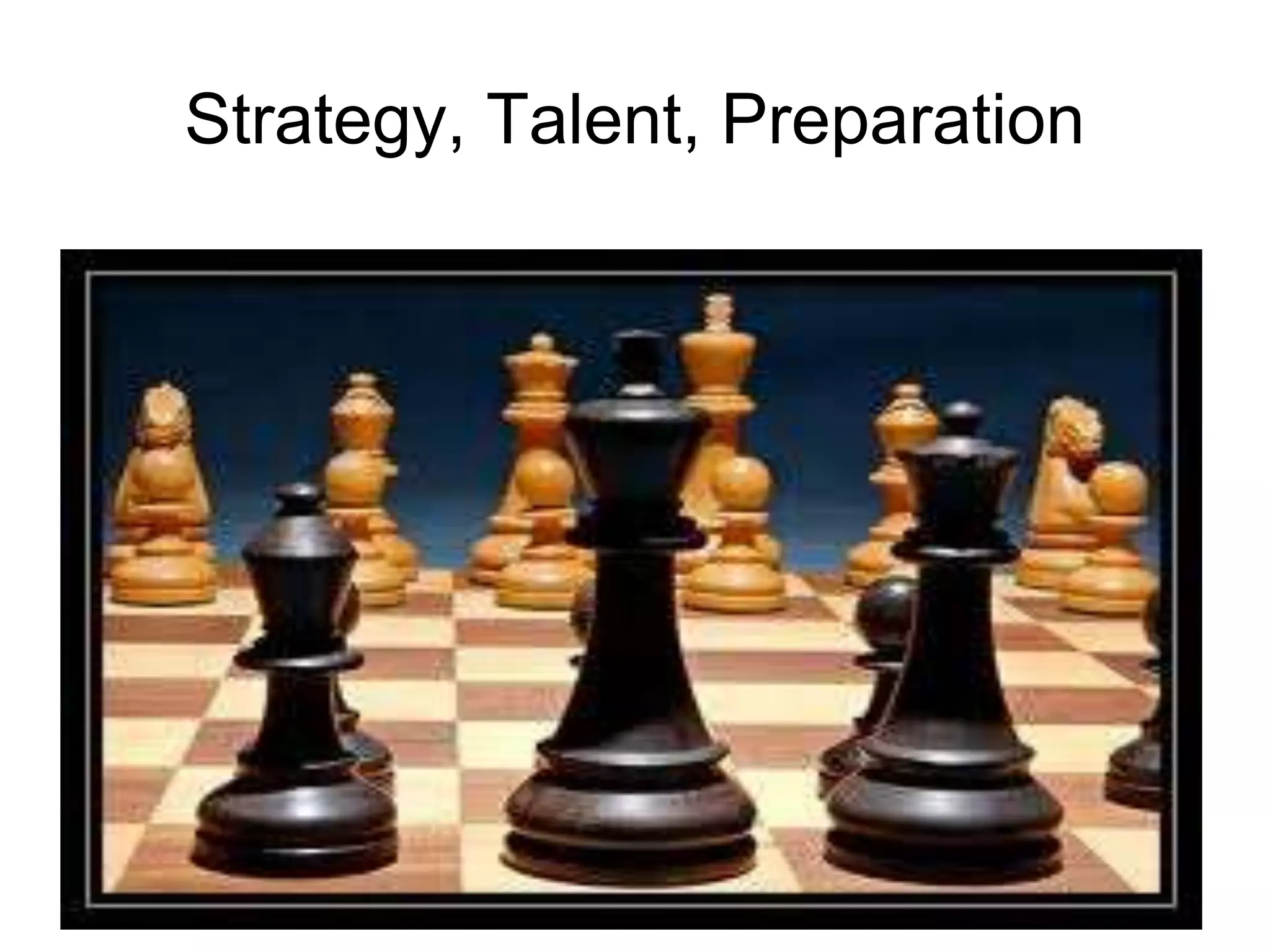
Strategy, Talent, Preparation
Strategy
Strategy without tactics is the slowest route to
  victory. Tactics without strategy is the noise
  before defeat – Sun Tzu


The question “Why ?” separates visionaries from
 functionaries
  William Boeing – invested in superior technology


Play your own game – Aware of your own
  strengths and weaknesses
Why ?
• “Why?” is the question that separates
  visionaries from functionaries, great strategists
  from mere tacticians. You must ask this
  question constantly if you are to understand and
  develop and follow your strategy
• … our goal is to improve our position. You must
  avoid creating weaknesses, find small ways to
  improve your pieces, and think small – but never
  stop thinking.
Strategy
If you are employing a powerful and successful
strategy, whether gaining space on the
chessboard or market share in global commerce,
the competition will try to trip you up by getting
you to abandon it. If your plans are sound and
your tactical awareness is good, your competitor
can only succeed with your help.
On Change
Change can be essential, but it should only be
made with careful consideration and just cause.
Losing can persuade you to change what does not
need to be changed, and winning can convince
you everything is fine even if you are on the brink
of disaster. If you are quick to blame faulty
strategy and change it all the time, you don’t really
have any strategy at all.
Talent
When I was eleven, I just got good – Bobby
 Fischer


Tal doesnt move the pieces by hand, he uses a
 magic wand
  Tal's pieces seemed to move faster than his
   opponents
  Dragging a hippo out of a marsh story


Developing the habit of imagination
Preparation
If a man has talent and cannot use it, he has failed
   – Thomas Wolfe


Jose Raul Capablanca vs. Alexander Alekhine
- World championship, Buenos Aires, 1927
- Capablanca didnt prepare much, Alekhine was
  fanatical about his preparation (8 hrs / day)


Alekhine won the match
Preparation
If you said you didn’t have enough time, that
meant you were not well organized.

Botvinnik summed up his philosophy by stating,
“The difference between man and animal is that
man is capable of establishing priorities!”
On working hard
It’s not enough to be talented. It’s not enough to
work hard and to study late into the night. You
must also become intimately aware of the
methods you use to reach your decisions.
Calculation
A computer may look at millions of moves per
second, but lacks a deep sense of why one move
is better than another; this capacity for evaluation
is where computers falter and humans excel. It
doesn’t matter how far ahead you see if you don’t
understand what you are looking at.
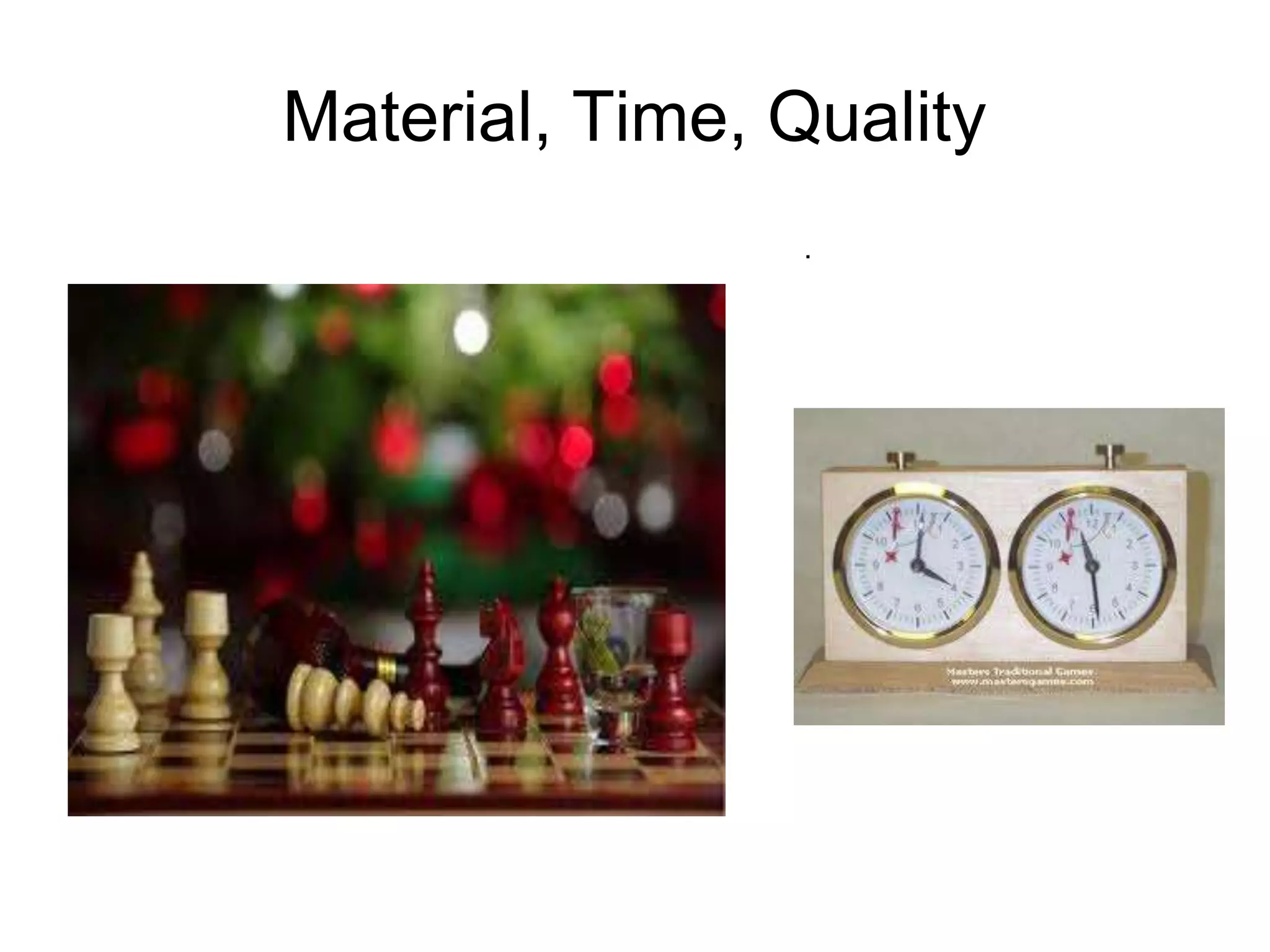
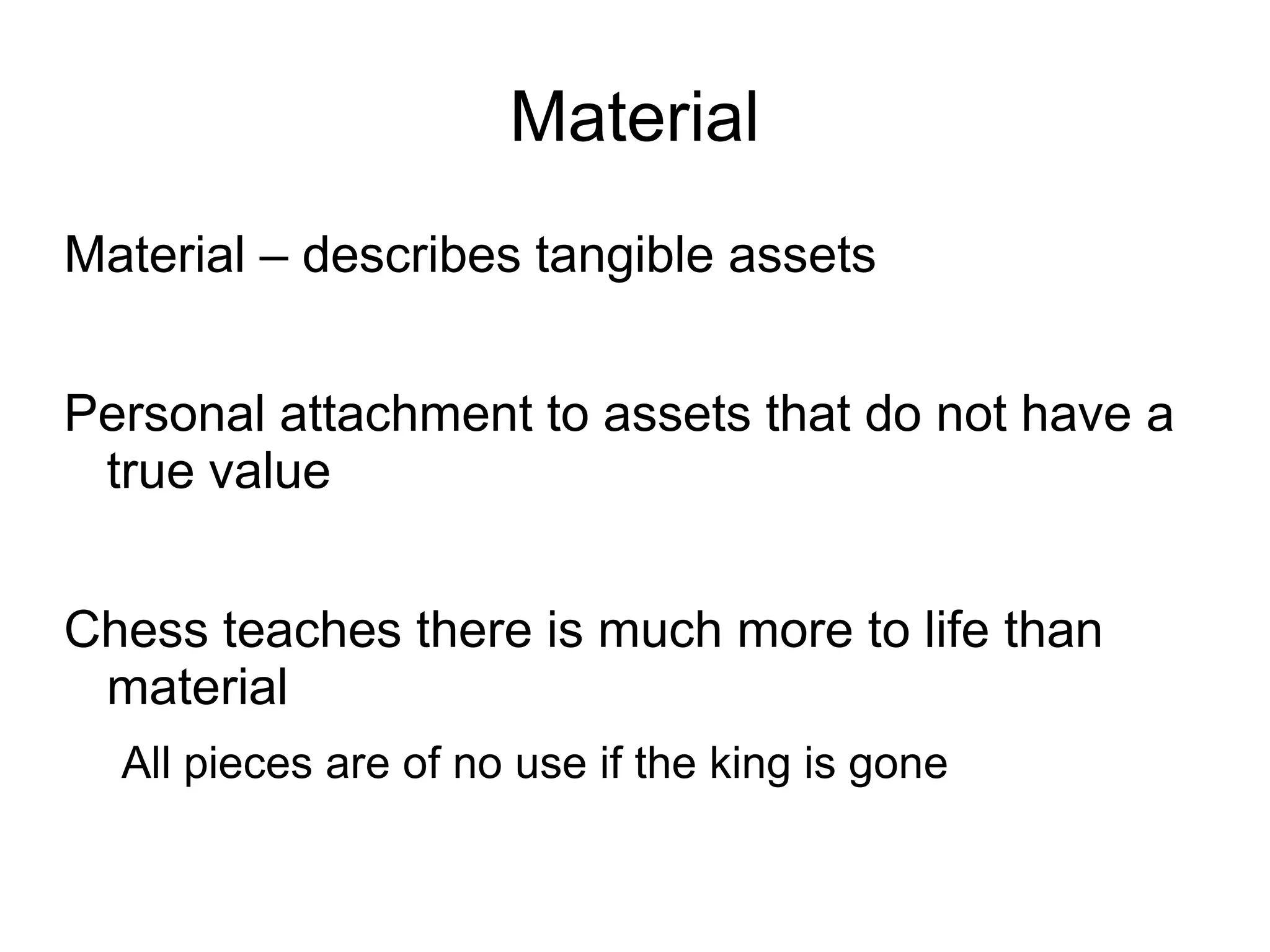
Material, Time, Quality
                 .
Material
Material – describes tangible assets


Personal attachment to assets that do not have a
 true value


Chess teaches there is much more to life than
 material
  All pieces are of no use if the king is gone
Time
Clock time – Time to make moves
Board time – Number of moves to achieve an
 objective


Time can be swapped for material – E.g. More
  money for express delivery


Mikhail Tal – the ultimate time player, did not care
 much for material
Quality
A knight in the center is more valuable than one
  on the edge
  A knight on the rim is dim


In warfare, the highest ground is sought
e.g. Kargil


Jack Welch – Kept the best GE businesses
  No 1 or 2 in the market
Expanding powers of evaluation
Choosing a house – Trading material for quality


Dont fall too much in love with your bishops (in
 chess) or the corner office


By using time wisely and putting material to good
 use, we can achieve quality (=happiness)
Material, Time, Quality
But I believe that by using your time wisely you
can put all your material to your best advantage
and achieve the ultimate goal of quality. That’s the
promise of the material-time-quality concept–in
chess and in life.
Exchanges and imbalances
Microsoft exchanged material for quality in the
 browser wars
  Used its cash and placement advantages


If we can detect or cultivate a weak spot in our
opponent’s position, we can then attempt to
transform our position to take advantage of that
weakness
Phases of the game
So dedicate yourself to making the time, finding a
space in which you can think and learn, and
finding new ideas with which to shock your
adversaries.
Question Success
• Question the status quo at all times, especially when
  things are going well. When something goes wrong,
  you naturally want to do it better next time ,but you
  must train yourself to want to do it better even when
  things go right
• That’s why I always think of Simon Bolivar and
remember that experienced soldier who studies
the battlefields in the aftermath of the war returns with
both wisdom and renewed courage.
Intuition
As they develop, our instincts–our intuitive
senses–become labor-saving and time-saving
devices; they literally cut down the time it takes to
make a proper evaluation and act. You can collect
and analyze new information forever without ever
making a decision. Something has to tell you
when the law of diminishing returns is kicking in.
And that something is intuition.
Crisis point
• Everything is condensed into one single
  moment, it decides our life – Franz Kafka
• The best indicator of a chess player’s form is to
  detect the climax of the game - Spassky
• Crisis really means a turning point, a critical
  moment when the stakes are high and the
  outcome uncertain. It also implies a point of no
  return. This signifies both danger and
  opportunity…
In Summary
This book stresses the importance of wanting to
 improve the way you do things


It is also important to understand why you are
   doing what you are doing

How life imitates chess

  • 1.
    How life imitateschess Krishnan GTC Book Review Talk April 22, 2012
  • 3.
    Chess mimics reallife decision making  Chess is a laboratory for the decision making process  Have to make constant stream of exact, informed decisions  Decisions made in real-time and under pressure  Requires calculation, creativity and desire for results
  • 4.
    Three parts ofthe book  Part 1 – Strategy, calculation, preparation  Part 2 – Evaluation and analysis  What changes are needed and why  Part 3 – Ongoing, continous performance improvement
  • 5.
  • 6.
    Strategy Strategy without tacticsis the slowest route to victory. Tactics without strategy is the noise before defeat – Sun Tzu The question “Why ?” separates visionaries from functionaries William Boeing – invested in superior technology Play your own game – Aware of your own strengths and weaknesses
  • 7.
    Why ? • “Why?”is the question that separates visionaries from functionaries, great strategists from mere tacticians. You must ask this question constantly if you are to understand and develop and follow your strategy • … our goal is to improve our position. You must avoid creating weaknesses, find small ways to improve your pieces, and think small – but never stop thinking.
  • 8.
    Strategy If you areemploying a powerful and successful strategy, whether gaining space on the chessboard or market share in global commerce, the competition will try to trip you up by getting you to abandon it. If your plans are sound and your tactical awareness is good, your competitor can only succeed with your help.
  • 9.
    On Change Change canbe essential, but it should only be made with careful consideration and just cause. Losing can persuade you to change what does not need to be changed, and winning can convince you everything is fine even if you are on the brink of disaster. If you are quick to blame faulty strategy and change it all the time, you don’t really have any strategy at all.
  • 10.
    Talent When I waseleven, I just got good – Bobby Fischer Tal doesnt move the pieces by hand, he uses a magic wand Tal's pieces seemed to move faster than his opponents Dragging a hippo out of a marsh story Developing the habit of imagination
  • 11.
    Preparation If a manhas talent and cannot use it, he has failed – Thomas Wolfe Jose Raul Capablanca vs. Alexander Alekhine - World championship, Buenos Aires, 1927 - Capablanca didnt prepare much, Alekhine was fanatical about his preparation (8 hrs / day) Alekhine won the match
  • 12.
    Preparation If you saidyou didn’t have enough time, that meant you were not well organized. Botvinnik summed up his philosophy by stating, “The difference between man and animal is that man is capable of establishing priorities!”
  • 13.
    On working hard It’snot enough to be talented. It’s not enough to work hard and to study late into the night. You must also become intimately aware of the methods you use to reach your decisions.
  • 14.
    Calculation A computer maylook at millions of moves per second, but lacks a deep sense of why one move is better than another; this capacity for evaluation is where computers falter and humans excel. It doesn’t matter how far ahead you see if you don’t understand what you are looking at.
  • 15.
  • 16.
    Material Material – describestangible assets Personal attachment to assets that do not have a true value Chess teaches there is much more to life than material All pieces are of no use if the king is gone
  • 17.
    Time Clock time –Time to make moves Board time – Number of moves to achieve an objective Time can be swapped for material – E.g. More money for express delivery Mikhail Tal – the ultimate time player, did not care much for material
  • 18.
    Quality A knight inthe center is more valuable than one on the edge A knight on the rim is dim In warfare, the highest ground is sought e.g. Kargil Jack Welch – Kept the best GE businesses No 1 or 2 in the market
  • 19.
    Expanding powers ofevaluation Choosing a house – Trading material for quality Dont fall too much in love with your bishops (in chess) or the corner office By using time wisely and putting material to good use, we can achieve quality (=happiness)
  • 20.
    Material, Time, Quality ButI believe that by using your time wisely you can put all your material to your best advantage and achieve the ultimate goal of quality. That’s the promise of the material-time-quality concept–in chess and in life.
  • 21.
    Exchanges and imbalances Microsoftexchanged material for quality in the browser wars Used its cash and placement advantages If we can detect or cultivate a weak spot in our opponent’s position, we can then attempt to transform our position to take advantage of that weakness
  • 22.
    Phases of thegame So dedicate yourself to making the time, finding a space in which you can think and learn, and finding new ideas with which to shock your adversaries.
  • 23.
    Question Success • Questionthe status quo at all times, especially when things are going well. When something goes wrong, you naturally want to do it better next time ,but you must train yourself to want to do it better even when things go right • That’s why I always think of Simon Bolivar and remember that experienced soldier who studies the battlefields in the aftermath of the war returns with both wisdom and renewed courage.
  • 24.
    Intuition As they develop,our instincts–our intuitive senses–become labor-saving and time-saving devices; they literally cut down the time it takes to make a proper evaluation and act. You can collect and analyze new information forever without ever making a decision. Something has to tell you when the law of diminishing returns is kicking in. And that something is intuition.
  • 25.
    Crisis point • Everythingis condensed into one single moment, it decides our life – Franz Kafka • The best indicator of a chess player’s form is to detect the climax of the game - Spassky • Crisis really means a turning point, a critical moment when the stakes are high and the outcome uncertain. It also implies a point of no return. This signifies both danger and opportunity…
  • 26.
    In Summary This bookstresses the importance of wanting to improve the way you do things It is also important to understand why you are doing what you are doing