Matt Wood
Camera Shots and Movement
Shots
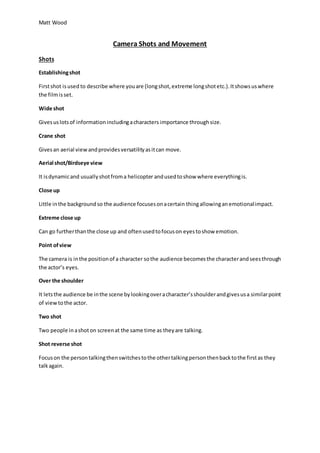
Establishingshot
Firstshot isused to describe where youare (longshot,extreme longshotetc.).Itshowsuswhere
the filmisset.
Wide shot
Givesuslotsof information includingacharacters importance throughsize.
Crane shot
Givesan aerial viewandprovidesversatilityasitcan move.
Aerial shot/Birdseye view
It isdynamicand usuallyshotfroma helicopter andusedtoshow where everythingis.
Close up
Little inthe backgroundso the audience focusesonacertain thingallowinganemotionalimpact.
Extreme close up
Can go furtherthanthe close up and oftenusedtofocuson eyestoshow emotion.
Point ofview
The camera is inthe positionof a character sothe audience becomesthe characterandseesthrough
the actor’s eyes.
Over the shoulder
It letsthe audience be inthe scene bylookingoveracharacter’sshoulderandgivesusa similarpoint
of viewtothe actor.
Two shot
Two people inashoton screenat the same time as theyare talking.
Shot reverse shot
Focuson the persontalkingthenswitchestothe othertalkingpersonthenbacktothe firstas they
talkagain.
Matt Wood
Movement
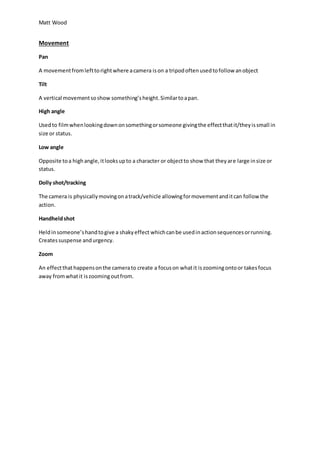
Pan
A movementfromlefttorightwhere acamera ison a tripodoftenusedtofollow anobject
Tilt
A vertical movementsoshow something’sheight.Similartoapan.
High angle
Usedto filmwhenlookingdownonsomethingorsomeone givingthe effectthatit/theyissmall in
size or status.
Low angle
Opposite toa highangle,itlooksupto a character or objectto show that theyare large insize or
status.
Dolly shot/tracking
The camera is physicallymovingonatrack/vehicle allowingformovementanditcan follow the
action.
Handheldshot
Heldinsomeone’shandtogive a shakyeffect whichcanbe usedinactionsequencesorrunning.
Createssuspense andurgency.
Zoom
An effectthathappensonthe camerato create a focuson whatit iszoomingontoor takesfocus
away fromwhatit iszoomingoutfrom.

Camera shots and movement

  • 1.
    Matt Wood Camera Shotsand Movement Shots Establishingshot Firstshot isused to describe where youare (longshot,extreme longshotetc.).Itshowsuswhere the filmisset. Wide shot Givesuslotsof information includingacharacters importance throughsize. Crane shot Givesan aerial viewandprovidesversatilityasitcan move. Aerial shot/Birdseye view It isdynamicand usuallyshotfroma helicopter andusedtoshow where everythingis. Close up Little inthe backgroundso the audience focusesonacertain thingallowinganemotionalimpact. Extreme close up Can go furtherthanthe close up and oftenusedtofocuson eyestoshow emotion. Point ofview The camera is inthe positionof a character sothe audience becomesthe characterandseesthrough the actor’s eyes. Over the shoulder It letsthe audience be inthe scene bylookingoveracharacter’sshoulderandgivesusa similarpoint of viewtothe actor. Two shot Two people inashoton screenat the same time as theyare talking. Shot reverse shot Focuson the persontalkingthenswitchestothe othertalkingpersonthenbacktothe firstas they talkagain.
  • 2.
    Matt Wood Movement Pan A movementfromlefttorightwhereacamera ison a tripodoftenusedtofollow anobject Tilt A vertical movementsoshow something’sheight.Similartoapan. High angle Usedto filmwhenlookingdownonsomethingorsomeone givingthe effectthatit/theyissmall in size or status. Low angle Opposite toa highangle,itlooksupto a character or objectto show that theyare large insize or status. Dolly shot/tracking The camera is physicallymovingonatrack/vehicle allowingformovementanditcan follow the action. Handheldshot Heldinsomeone’shandtogive a shakyeffect whichcanbe usedinactionsequencesorrunning. Createssuspense andurgency. Zoom An effectthathappensonthe camerato create a focuson whatit iszoomingontoor takesfocus away fromwhatit iszoomingoutfrom.