Caltrain
Future Technology Assessment

     Prepared for: Palo Alto Rail Committee
               Prepared by: JPB


                 May 26, 2011
Committee Requested Topics
•   Electrification Project (4/13/11)
•   Electrification 35% Design (4/28/11)
•   EMU vs. DMU (5/26/11)
•   HSR and Caltrain MOU (TBD)
EMU vs. DMU


EMU                 DMU
Locomotive Hauled Consist (LHC)


•   Typically one powered vehicle per
    train
•   Heavy – acceleration proportional to
    train length
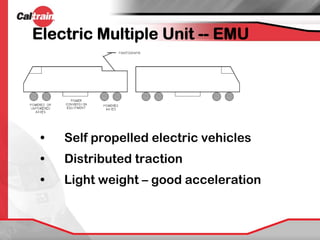
Electric Multiple Unit -- EMU


 •   Self propelled electric vehicles
 •   Distributed traction
 •   Light weight – good acceleration
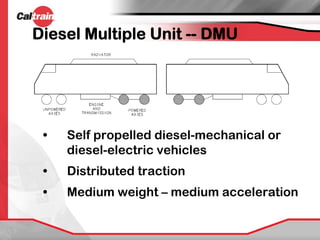
Diesel Multiple Unit -- DMU


 •   Self propelled diesel-mechanical or
     diesel-electric vehicles
 •   Distributed traction
 •   Medium weight – medium acceleration
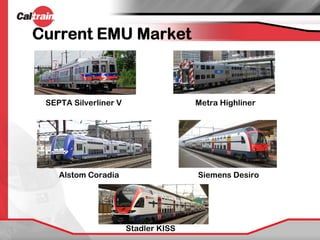
Current EMU Market


 SEPTA Silverliner V                  Metra Highliner


    Alstom Coradia                    Siemens Desiro


                       Stadler KISS
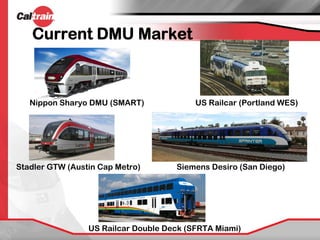
Current DMU Market


   Nippon Sharyo DMU (SMART)              US Railcar (Portland WES)


Stadler GTW (Austin Cap Metro)       Siemens Desiro (San Diego)


                 US Railcar Double Deck (SFRTA Miami)
How Local Needs Drive Vehicle
        Selection (Recent Projects)

                        Number   System  Station              Train         Train                     Car 
                                                  Boardings                        Headway  Trains           Vehicle 
       Railroad            of    Length  Spacing             Length        Length                    Miles 
                                                   per Day                          (min) per day           Selected
                        Stations (miles) (miles)              (cars)       (seats)                  per Day


Caltrain*                  23      47.3       2.1     71,000       6        600        10       114    32,353    EMU

Denver RTD ‐ East           7      23.2       3.3      2,590       4        360        15       149    13,827    EMU

Denver RTD ‐ Gold           8      11.4       1.4      1,350       2        180        15       145    3,306     EMU

SMART (full buildout)      14      70.2       5.0      6,550       2        158        30       30     4,212     DMU

eBART                       3        10        3.3     3,900        2        100        15       200   4,000     DMU
*Future (2035) 6 TPH ‐ San Jose to San Francisco (assume Gilroy service continues as locomotive 
hauled)
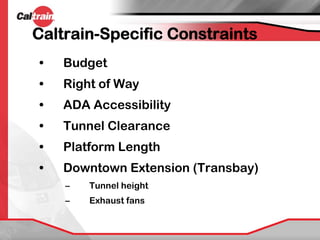
Caltrain-Specific Constraints
•   Budget
•   Right of Way
•   ADA Accessibility
•   Tunnel Clearance
•   Platform Length
•   Downtown Extension (Transbay)
    –   Tunnel height
    –   Exhaust fans
Uncertainties – 30-year Decisions
Energy Pricing
    •   Diesel
    •   Electricity

Changing Federal Regulations
    •   ADA
    •   EPA

Economy
    •   Funding
    •   Ridership

Technology Advancements
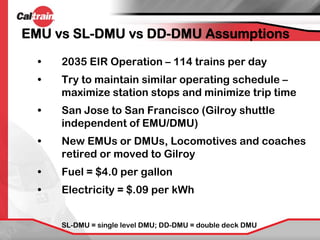
EMU vs SL-DMU vs DD-DMU Assumptions

  •   2035 EIR Operation – 114 trains per day
  •   Try to maintain similar operating schedule –
      maximize station stops and minimize trip time
  •   San Jose to San Francisco (Gilroy shuttle
      independent of EMU/DMU)
  •   New EMUs or DMUs, Locomotives and coaches
      retired or moved to Gilroy
  •   Fuel = $4.0 per gallon
  •   Electricity = $.09 per kWh


      SL-DMU = single level DMU; DD-DMU = double deck DMU
Performance Comparison
                                                            Single Level  Double Deck 
Performance Item                             Bi‐Level EMU
                                                               DMU           DMU

Train Length (number of cars)                      6             8             4
Seating Capacity (passengers per car)             100            78           180
Powered Cars per Train                           Half           All           All*
Estimated One Way Energy Use                  1,723 kWh       122 gal        73 gal
Acceleration                                    Highest       Middle         Lowest

*Even with all cars powered, the number of station stops must be reduced to maintain 
common trip time
Infrastructure Comparison
                                                                  Bi‐Level    Single Level  Double Deck 
Infrastructure Issue                                   Existing
                                                                   EMU           DMU           DMU

Train Length (number of cars)                               5        6             8            4
Platform Length (feet)                                  519*        500          680           350
Platform Height for Level Boarding (inches)                 8**     25         25 or 48        48
Car Height (nominal clearance)                          16'‐2"    15'‐1"        14'‐7"        19'‐8"
Will it fit in existing tunnels?                            Yes     Yes           Yes          No
Will it fit in current design for DTX tunnel?               Yes     Yes           Yes          No

Additional ventilation required?                            Yes     No            Yes          Yes
Overhead Traction Electrification Required?                 No      Yes           No           No

Red text indicates infrastructure modifications needed
*Shortest platform, others are longer
**Existing 8" platforms do not accommodate level boarding
Lifecycle Cost Comparison
                                                            Single Level    Double Deck 
Cost Item                                  Bi‐Level EMU
                                                               DMU            DMU*
Fleet Size                                     160             214             106
Fleet Cost                                      $$$            $$$             $$$
Electrification Capital Cost ($785 mil)       $$$$              ‐                ‐
Extend Platform Length (feet)                    ‐              $$               ‐
Raise Platforms                                  $               $              $$
Bore Existing Tunnels                            ‐               ‐              $$
Increased Bore in DTX                            ‐               ‐              $$
Ventilation of DTX for Diesel                    ‐              $$              $$
Maintenance and Storage Facilities              $$              $$               $
Energy and Vehicle Maintenance (30 yrs)        $$$$           $$$$$            $$$$
Lifecycle Cost over 30 Years                  $$$$$           $$$$$           $$$$$
$ > $20 mil
$$ $20 mil - 100 mil                      $$$$ > $500 mil -$1 bil
$$$ $100 mil - $500 mil                   $$$$$ < $1 bil
Recommended Technology: EMU

•   Proven technology and large supplier pool =
    low risk
•   Frequent service (6 TPH or more during peak)
•   Highest acceleration allows service to
    maximum number of stations
•   Manageable fleet size
•   Fits current platform lengths
•   Lowest local emissions (noise and air quality)
Emerging Technology
Emerging Technologies - Hybrids


                             Fuel Cell Switch Engine
Hybrid Freight Locomotive


 Hybrid Metro Vehicle       Hybrid Streetcar
Questions
/ Answers

Caltrain EMU DMU Comparison

  • 1.
    Caltrain Future Technology Assessment Prepared for: Palo Alto Rail Committee Prepared by: JPB May 26, 2011
  • 2.
    Committee Requested Topics • Electrification Project (4/13/11) • Electrification 35% Design (4/28/11) • EMU vs. DMU (5/26/11) • HSR and Caltrain MOU (TBD)
  • 3.
  • 4.
    Locomotive Hauled Consist(LHC) • Typically one powered vehicle per train • Heavy – acceleration proportional to train length
  • 5.
    Electric Multiple Unit-- EMU • Self propelled electric vehicles • Distributed traction • Light weight – good acceleration
  • 6.
    Diesel Multiple Unit-- DMU • Self propelled diesel-mechanical or diesel-electric vehicles • Distributed traction • Medium weight – medium acceleration
  • 7.
    Current EMU Market SEPTA Silverliner V Metra Highliner Alstom Coradia Siemens Desiro Stadler KISS
  • 8.
    Current DMU Market Nippon Sharyo DMU (SMART) US Railcar (Portland WES) Stadler GTW (Austin Cap Metro) Siemens Desiro (San Diego) US Railcar Double Deck (SFRTA Miami)
  • 9.
    How Local NeedsDrive Vehicle Selection (Recent Projects) Number   System  Station  Train  Train  Car  Boardings  Headway  Trains  Vehicle  Railroad of    Length  Spacing  Length  Length  Miles  per Day (min) per day Selected Stations (miles) (miles) (cars) (seats) per Day Caltrain* 23 47.3 2.1 71,000  6 600 10 114 32,353  EMU Denver RTD ‐ East 7 23.2 3.3 2,590  4 360 15 149 13,827  EMU Denver RTD ‐ Gold 8 11.4 1.4 1,350  2 180 15 145 3,306  EMU SMART (full buildout) 14 70.2 5.0 6,550  2 158 30 30 4,212  DMU eBART 3 10 3.3 3,900  2 100 15 200 4,000  DMU *Future (2035) 6 TPH ‐ San Jose to San Francisco (assume Gilroy service continues as locomotive  hauled)
  • 10.
    Caltrain-Specific Constraints • Budget • Right of Way • ADA Accessibility • Tunnel Clearance • Platform Length • Downtown Extension (Transbay) – Tunnel height – Exhaust fans
  • 11.
    Uncertainties – 30-yearDecisions Energy Pricing • Diesel • Electricity Changing Federal Regulations • ADA • EPA Economy • Funding • Ridership Technology Advancements
  • 12.
    EMU vs SL-DMUvs DD-DMU Assumptions • 2035 EIR Operation – 114 trains per day • Try to maintain similar operating schedule – maximize station stops and minimize trip time • San Jose to San Francisco (Gilroy shuttle independent of EMU/DMU) • New EMUs or DMUs, Locomotives and coaches retired or moved to Gilroy • Fuel = $4.0 per gallon • Electricity = $.09 per kWh SL-DMU = single level DMU; DD-DMU = double deck DMU
  • 13.
    Performance Comparison Single Level  Double Deck  Performance Item Bi‐Level EMU DMU DMU Train Length (number of cars) 6 8 4 Seating Capacity (passengers per car) 100 78 180 Powered Cars per Train Half All All* Estimated One Way Energy Use 1,723 kWh 122 gal 73 gal Acceleration Highest Middle Lowest *Even with all cars powered, the number of station stops must be reduced to maintain  common trip time
  • 14.
    Infrastructure Comparison Bi‐Level  Single Level  Double Deck  Infrastructure Issue Existing EMU DMU DMU Train Length (number of cars) 5 6 8 4 Platform Length (feet) 519* 500 680 350 Platform Height for Level Boarding (inches) 8** 25 25 or 48 48 Car Height (nominal clearance) 16'‐2" 15'‐1" 14'‐7" 19'‐8" Will it fit in existing tunnels? Yes Yes Yes No Will it fit in current design for DTX tunnel? Yes Yes Yes No Additional ventilation required? Yes No Yes Yes Overhead Traction Electrification Required? No Yes No No Red text indicates infrastructure modifications needed *Shortest platform, others are longer **Existing 8" platforms do not accommodate level boarding
  • 15.
    Lifecycle Cost Comparison Single Level  Double Deck  Cost Item Bi‐Level EMU DMU DMU* Fleet Size 160 214 106 Fleet Cost $$$ $$$ $$$ Electrification Capital Cost ($785 mil) $$$$ ‐ ‐ Extend Platform Length (feet) ‐ $$ ‐ Raise Platforms $ $ $$ Bore Existing Tunnels ‐ ‐ $$ Increased Bore in DTX ‐ ‐ $$ Ventilation of DTX for Diesel ‐ $$ $$ Maintenance and Storage Facilities $$ $$ $ Energy and Vehicle Maintenance (30 yrs) $$$$ $$$$$ $$$$ Lifecycle Cost over 30 Years $$$$$ $$$$$ $$$$$ $ > $20 mil $$ $20 mil - 100 mil $$$$ > $500 mil -$1 bil $$$ $100 mil - $500 mil $$$$$ < $1 bil
  • 16.
    Recommended Technology: EMU • Proven technology and large supplier pool = low risk • Frequent service (6 TPH or more during peak) • Highest acceleration allows service to maximum number of stations • Manageable fleet size • Fits current platform lengths • Lowest local emissions (noise and air quality)
  • 17.
  • 18.
    Emerging Technologies -Hybrids Fuel Cell Switch Engine Hybrid Freight Locomotive Hybrid Metro Vehicle Hybrid Streetcar
  • 19.