ASSESSMENT CHECKLIST FOR CHILDREN WITH
DISABILITY
Date of Assessment:_______________________
Name: _______________________________________________________
Date of Birth: ________________________ Age: _______ Sex: _______
I. Cognitive Behavior OK NEEDS REVIEW
1. Performance Observation
 Pencil is held properly ( ) ( )
 Paper is positioned at a ‘normal’ slant ( ) ( )
 Writing posture is acceptable ( ) ( )
 Writing speed is acceptable ( ) ( )
2. Correct Letter Formation
 Closed letters are closed ( ) ( )
 Looped letters are looped ( ) ( )
 Stick letters are not looped ( ) ( )
 i’s and j’s are dotted directly above ( ) ( )
 x’s and t’s are crossed accurately ( ) ( )
 m’s and n’s have the correct number of bumps ( ) ( )
 All lowercase letters begin on the line (unless ( ) ( )
 they follow b. o, v or w)
 All lowercase letters end on the line ( ) ( )
 v’s and u’s are clearly not ry and ry ( ) ( )
 Uppercase letters are correctly or acceptably ( ) ( )
formed
 Numbers are correctly formed ( ) ( )
3. Fluency
 Writing is smooth not choppy ( ) ( )
 Pencil pressure appears even ( ) ( )
 Words appear to be written as complete units ( ) ( )
4. Reading YES NO
 Loses place in a line while reading ( ) ( )
 Repeats, omits or add words ( ) ( )
 Does not read fluently ( ) ( )
 Confuses similar words or letter as to ( ) ( )
visual configuration
 Uses fingers to follow the line while reading ( ) ( )
 Dislikes reading ( ) ( )
 Shows indication of proof reading skills, but ( ) ( )
not necessarily in all areas
 Has difficulty understanding or remembering ( ) ( )
what is read to him
 Has difficulty remembering the sequence of ( ) ( )
events of a story read
5. Mathematics
 Has difficulty associating numbers with symbol ( ) ( )
 Cannot recall Math facts instantly ( ) ( )
 Shows confusion with columns and spacing ( ) ( )
 Has difficulty with story problems ( ) ( )
 Fails to comprehend Math concepts ( ) ( )
 Has difficulty in the formation of geometric ( ) ( )
shapes and numbers
 Makes reversals of numbers in writing and/or ( ) ( )
reading after sufficient instruction and practice
 Demonstrates confusion with written and/or ( ) ( )
oral arithmetic
6. Hearing/Speech
 Shows indications of delayed speech ( ) ( )
 Has trouble/difficulty following oral directions ( ) ( )
 Does not often seem to listen when spoken to ( ) ( )
 Has a poor listening skill ( ) ( )
 Has an articulation problem ( ) ( )
II. Motor Behavior
 Shows clumsy movements on the playground ( ) ( )
and/or in classroom; for example, constantly
tripping over chairs, running into play
equipment, etc
 Have difficulty hopping, skipping, jumping, ( ) ( )
walking and climbing stairs, which may indicate
immature physical development
 Has difficulty walking in straight lines ( ) ( )
and/or balance beams
 Has difficulty buttoning, zippering and ( ) ( )
snapping articles of clothing
 Cannot easily cut with scissors ( ) ( )
 Holds crayons and pencil awkwardly ( ) ( )
 Demonstrates confusion with direction ( ) ( )
of left, right, up down, in front, behind, etc.
III. Social Behaviors
 Demonstrate confusion when changes are ( ) ( )
made in any daily routine
 Usually sloppy ( ) ( )
 Demonstrates destructive behavior ( ) ( )
over belongings
 Tends to be easily distracted by visual or ( ) ( )
auditory stimuli
 Maybe demanding or attracts individual ( ) ( )
attention through overt behavior tactics,
for example, loudly interrupting teacher or
others in the middle of class activities
 Has difficulty in getting along with peers ( ) ( )
and/or adults
 May show indications of certain physical ( ) ( )
characteristics such as nervousness, startled
movements, uneasiness when sitting for
even a short period of time, etc
 May pout or cry easily with easily with very ( ) ( )
little season
 May exhibit flighty or erratic behavior such as ( ) ( )
getting up in the middle of a work period to
dance around
 May tell tales or bizarre stories to peers and/or ( ) ( )
teacher
 Has an unusually short attention span for ( ) ( )
his/her age
Prepared by:
___________________________________________________________

Assessment checklist-for-children-with-disability

  • 1.
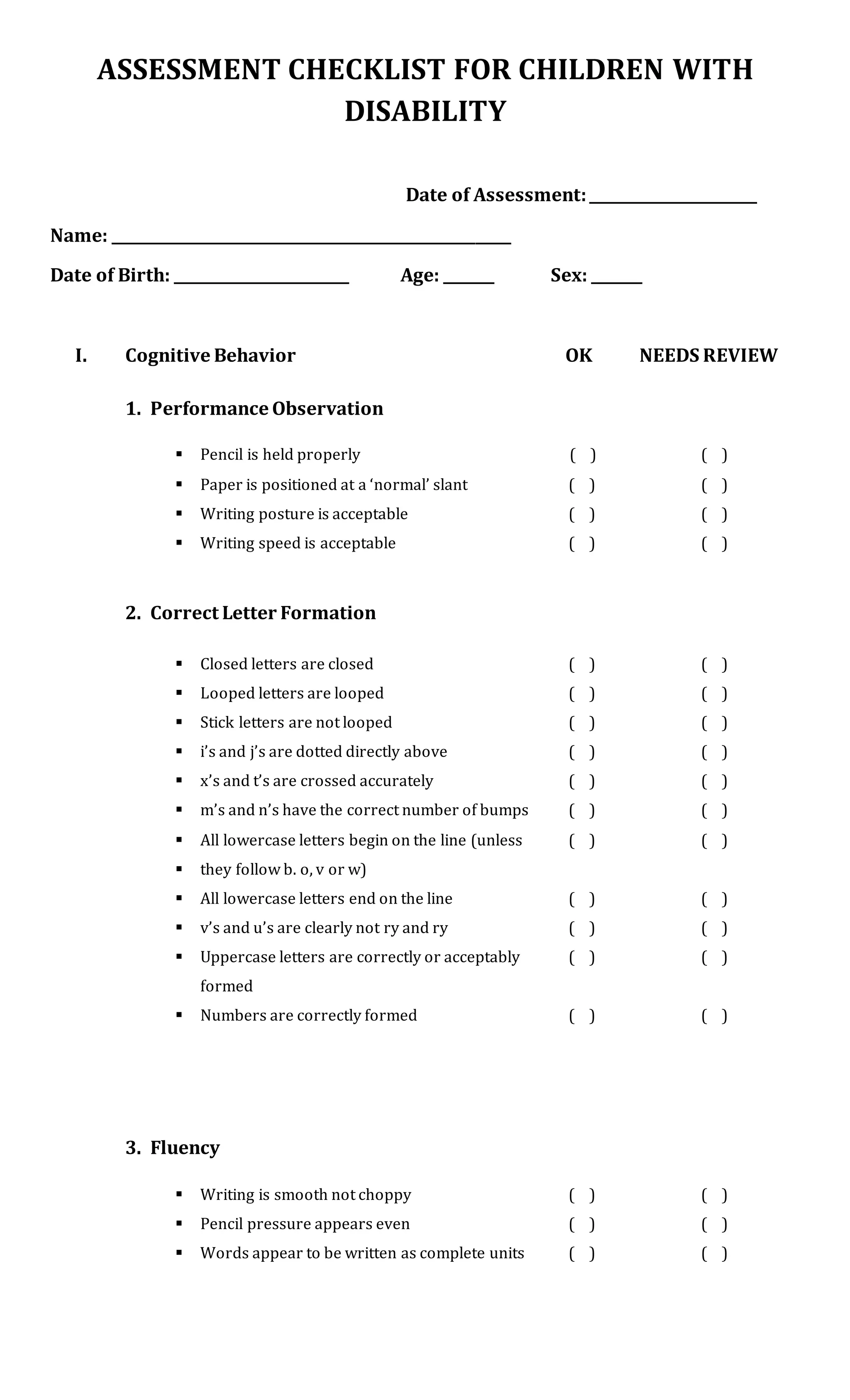
    ASSESSMENT CHECKLIST FORCHILDREN WITH DISABILITY Date of Assessment:_______________________ Name: _______________________________________________________ Date of Birth: ________________________ Age: _______ Sex: _______ I. Cognitive Behavior OK NEEDS REVIEW 1. Performance Observation  Pencil is held properly ( ) ( )  Paper is positioned at a ‘normal’ slant ( ) ( )  Writing posture is acceptable ( ) ( )  Writing speed is acceptable ( ) ( ) 2. Correct Letter Formation  Closed letters are closed ( ) ( )  Looped letters are looped ( ) ( )  Stick letters are not looped ( ) ( )  i’s and j’s are dotted directly above ( ) ( )  x’s and t’s are crossed accurately ( ) ( )  m’s and n’s have the correct number of bumps ( ) ( )  All lowercase letters begin on the line (unless ( ) ( )  they follow b. o, v or w)  All lowercase letters end on the line ( ) ( )  v’s and u’s are clearly not ry and ry ( ) ( )  Uppercase letters are correctly or acceptably ( ) ( ) formed  Numbers are correctly formed ( ) ( ) 3. Fluency  Writing is smooth not choppy ( ) ( )  Pencil pressure appears even ( ) ( )  Words appear to be written as complete units ( ) ( )
  • 2.
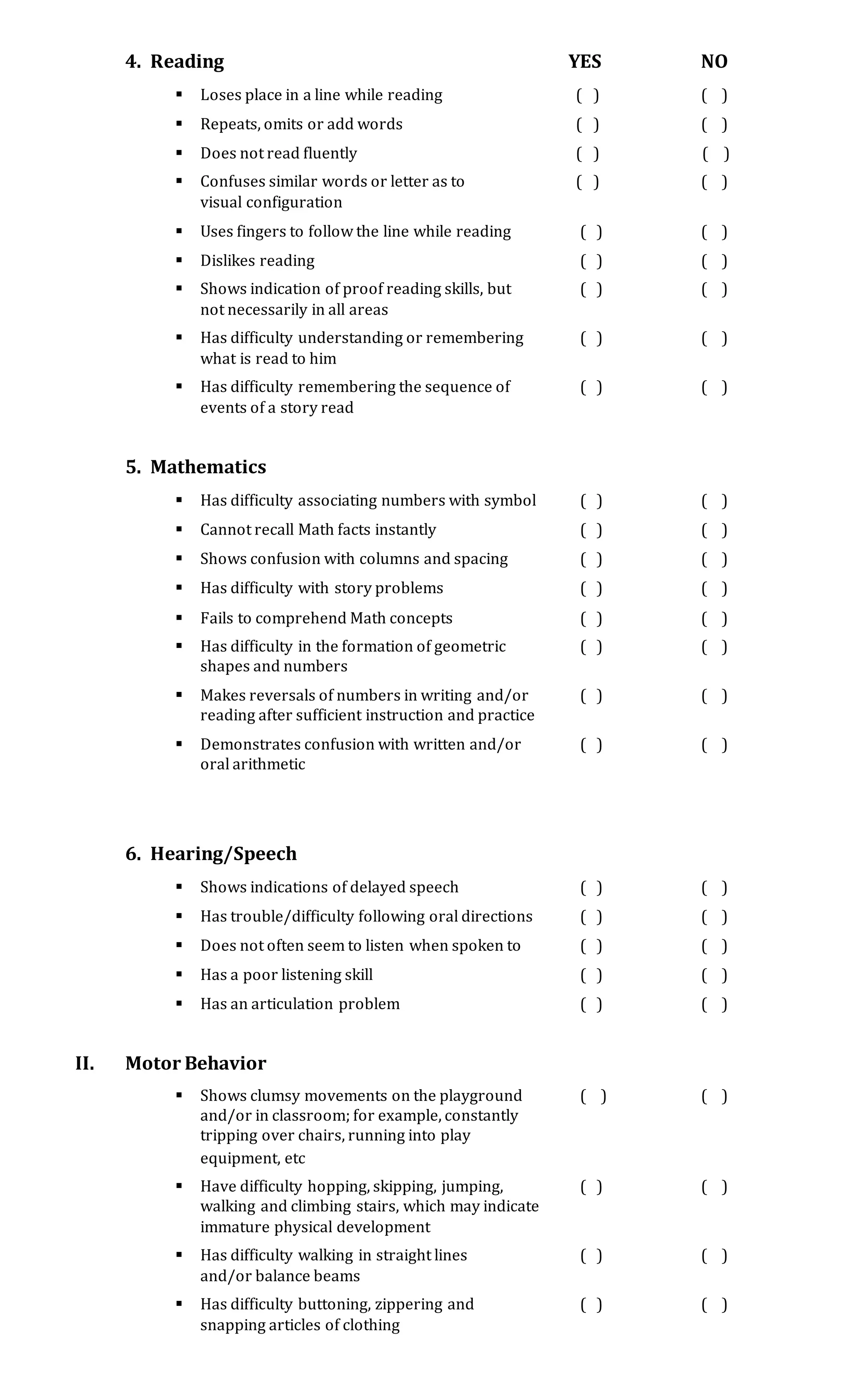
    4. Reading YESNO  Loses place in a line while reading ( ) ( )  Repeats, omits or add words ( ) ( )  Does not read fluently ( ) ( )  Confuses similar words or letter as to ( ) ( ) visual configuration  Uses fingers to follow the line while reading ( ) ( )  Dislikes reading ( ) ( )  Shows indication of proof reading skills, but ( ) ( ) not necessarily in all areas  Has difficulty understanding or remembering ( ) ( ) what is read to him  Has difficulty remembering the sequence of ( ) ( ) events of a story read 5. Mathematics  Has difficulty associating numbers with symbol ( ) ( )  Cannot recall Math facts instantly ( ) ( )  Shows confusion with columns and spacing ( ) ( )  Has difficulty with story problems ( ) ( )  Fails to comprehend Math concepts ( ) ( )  Has difficulty in the formation of geometric ( ) ( ) shapes and numbers  Makes reversals of numbers in writing and/or ( ) ( ) reading after sufficient instruction and practice  Demonstrates confusion with written and/or ( ) ( ) oral arithmetic 6. Hearing/Speech  Shows indications of delayed speech ( ) ( )  Has trouble/difficulty following oral directions ( ) ( )  Does not often seem to listen when spoken to ( ) ( )  Has a poor listening skill ( ) ( )  Has an articulation problem ( ) ( ) II. Motor Behavior  Shows clumsy movements on the playground ( ) ( ) and/or in classroom; for example, constantly tripping over chairs, running into play equipment, etc  Have difficulty hopping, skipping, jumping, ( ) ( ) walking and climbing stairs, which may indicate immature physical development  Has difficulty walking in straight lines ( ) ( ) and/or balance beams  Has difficulty buttoning, zippering and ( ) ( ) snapping articles of clothing
  • 3.
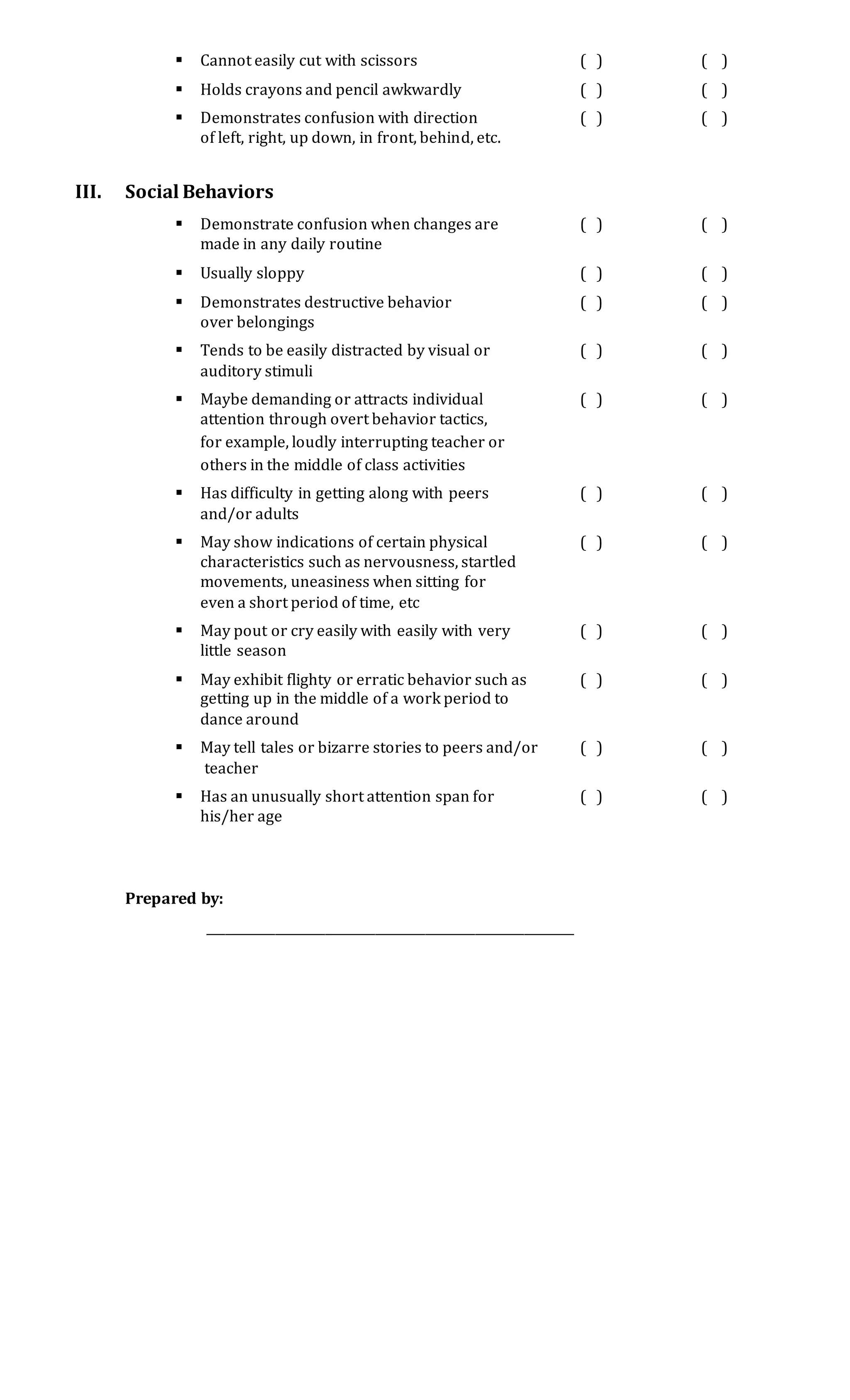
     Cannot easilycut with scissors ( ) ( )  Holds crayons and pencil awkwardly ( ) ( )  Demonstrates confusion with direction ( ) ( ) of left, right, up down, in front, behind, etc. III. Social Behaviors  Demonstrate confusion when changes are ( ) ( ) made in any daily routine  Usually sloppy ( ) ( )  Demonstrates destructive behavior ( ) ( ) over belongings  Tends to be easily distracted by visual or ( ) ( ) auditory stimuli  Maybe demanding or attracts individual ( ) ( ) attention through overt behavior tactics, for example, loudly interrupting teacher or others in the middle of class activities  Has difficulty in getting along with peers ( ) ( ) and/or adults  May show indications of certain physical ( ) ( ) characteristics such as nervousness, startled movements, uneasiness when sitting for even a short period of time, etc  May pout or cry easily with easily with very ( ) ( ) little season  May exhibit flighty or erratic behavior such as ( ) ( ) getting up in the middle of a work period to dance around  May tell tales or bizarre stories to peers and/or ( ) ( ) teacher  Has an unusually short attention span for ( ) ( ) his/her age Prepared by: ___________________________________________________________