Geneva 2020
Governance /Accountability Structure
Work Group Meeting
March30,2015
10a.m-11:30a.m.
Board Room,Geneva CommunityCenter
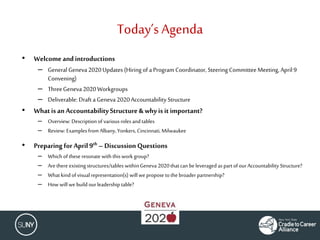
Today’s Agenda
• Welcome andintroductions
– GeneralGeneva 2020Updates (Hiring of a Program Coordinator, Steering CommitteeMeeting, April9
Convening)
– ThreeGeneva 2020Workgroups
– Deliverable: Draft a Geneva 2020Accountability Structure
• WhatisanAccountabilityStructure & whyis it important?
– Overview: Description of various rolesandtables
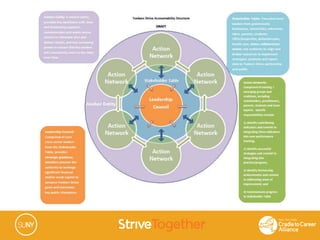
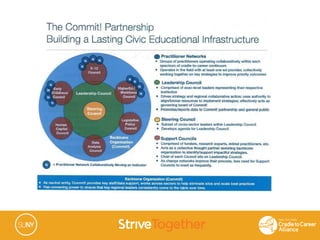
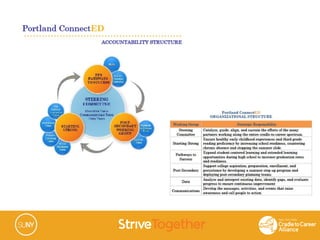
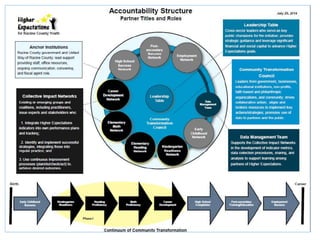
– Review: Examples from Albany, Yonkers, Cincinnati, Milwaukee
• Preparing for April9th – Discussion Questions
– Which ofthese resonate with this work group?
– Arethere existing structures/tables within Geneva 2020 that can be leveraged as partofour Accountability Structure?
– What kind ofvisual representation(s) will we propose tothe broader partnership?
– How will we build ourleadership table?
Our Deliverable …
Draft anaccountabilitystructure forGeneva 2020
thatwill be presented tothebroader partnership
on April9, 2015for their review andapproval.
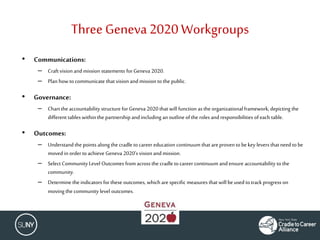
Three Geneva 2020 Workgroups
• Communications:
– Craftvision andmission statements forGeneva 2020.
– Plan how tocommunicate that vision andmission tothe public.
• Governance:
– Chartthe accountability structure for Geneva 2020 that will function as the organizationalframework, depicting the
different tables within the partnership andincluding an outline ofthe rolesandresponsibilities ofeach table.
• Outcomes:
– Understand the points along the cradle tocareer education continuum that areproven to be key levers that need tobe
moved in order toachieve Geneva 2020’s vision andmission.
– Select Community Level Outcomes from across the cradle tocareer continuum andensure accountability tothe
community.
– Determine the indicators forthese outcomes, which arespecific measures that will be used totrack progress on
moving the community level outcomes.
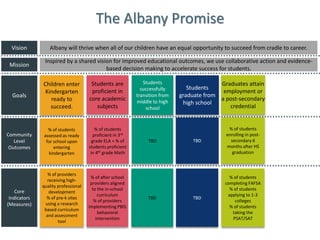
Goals
Community
Level
Outcomes
Children enter
Kindergarten
ready to
succeed.
Core
Indicators
(Measures)
Students are
proficient in
core academic
subjects
Students
successfully
transition from
middle to high
school
Graduates attain
employment or
a post-secondary
credential
% of students
enrolling in post-
secondary 6
months after HS
graduation
% of students
assessed as ready
for school upon
entering
kindergarten
% of students
proficient in 3rd
grade ELA + % of
students proficient
in 4th grade Math
TBD
% of providers
receiving high-
quality professional
development
% of pre-k sites
using a research
based curriculum
and assessment
tool
% of after school
providers aligned
to the in-school
curriculum
% of providers
implementing PBIS
behavioral
intervention
TBD
% of students
completing FAFSA
% of students
applying to 1-3
colleges
% of students
taking the
PSAT/SAT
Students
graduate from
high school
TBD
TBD
Mission
Vision Albany will thrive when all of our children have an equal opportunity to succeed from cradle to career.
Inspired by a shared vision for improved educational outcomes, we use collaborative action and evidence-
based decision making to accelerate success for students.
The Albany Promise
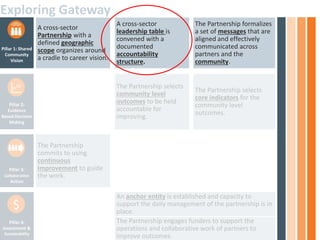
Pillar 2:
Evidence
Based Decision
Making
Pillar 3:
Collaborative
Action
Pillar 4:
Investment &
Sustainability
Pillar 1: Shared
Community
Vision
A cross-sector
Partnership with a
defined geographic
scope organizes around
a cradle to career vision.
A cross-sector
leadership table is
convened with a
documented
accountability
structure.
The Partnership selects
community level
outcomes to be held
accountable for
improving.
The Partnership selects
core indicators for the
community level
outcomes.
The Partnership
commits to using
continuous
improvement to guide
the work.
An anchor entity is established and capacity to
support the daily management of the partnership is in
place.
The Partnership engages funders to support the
operations and collaborative work of partners to
improve outcomes.
Exploring Gateway
The Partnership formalizes
a set of messages that are
aligned and effectively
communicated across
partners and the
community.
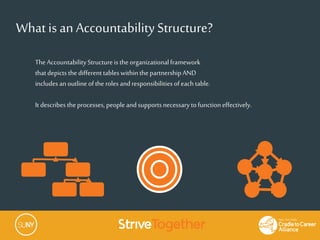
The AccountabilityStructureis theorganizationalframework
thatdepicts thedifferenttableswithinthe partnershipAND
includesanoutline ofthe roles andresponsibilitiesofeach table.
It describes theprocesses, people andsupportsnecessarytofunctioneffectively.
What is an AccountabilityStructure?
Accountability structuresprovide:
- Clarity
•Around roles & responsibilities
•Around decision making and authority
- Organization
•Organizesthe work to improve effectiveness and efficiency
• Outlines an organized work-flow
- Communication
•Visual of what a cradle to careerpartnership looks like
Whyis an Accountability Structure important?
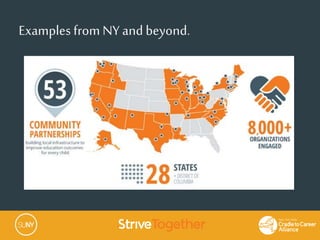
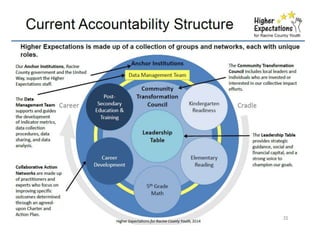
Examples from NY and beyond.
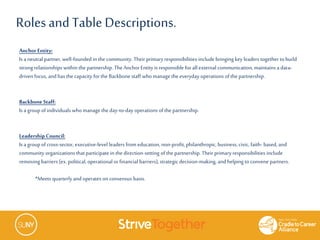
Anchor Entity:
Is a neutral partner,well-founded in the community. Their primaryresponsibilities include bringing key leaders together tobuild
strong relationships within the partnership. The Anchor Entity is responsible for all external communication, maintains a data-
driven focus, andhas the capacity forthe Backbone staff whomanage the everyday operations of the partnership.
Backbone Staff:
Is a groupofindividuals whomanage the day-to-day operations ofthe partnership.
Leadership Council:
Is a groupofcross-sector, executive-level leaders from education, non-profit, philanthropic, business, civic, faith- based, and
community organizations that participate in the direction-setting ofthe partnership. Their primaryresponsibilities include
removing barriers (ex. political, operational orfinancial barriers),strategic decision-making, andhelping toconvene partners.
*Meets quarterlyand operates on consensus basis.
Rolesand Table Descriptions.
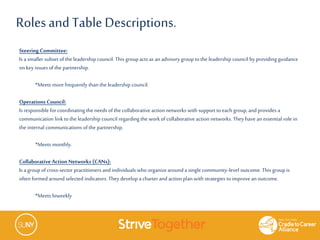
Steering Committee:
Is a smaller subset ofthe leadership council. This groupacts as an advisorygrouptothe leadership council by providingguidance
on key issues of the partnership.
*Meets morefrequently than the leadership council.
Operations Council:
Is responsible for coordinating the needs ofthe collaborative action networks with support toeach group,andprovides a
communication link tothe leadership council regardingthe workof collaborative action networks. They have an essential role in
the internal communications ofthe partnership.
*Meets monthly.
CollaborativeAction Networks (CANs):
Isa group of cross-sector practitioners and individuals who organizearounda single community-level outcome. This groupis
often formed around selected indicators. They develop a charter andaction plan with strategies toimprovean outcome.
*Meets biweekly
Rolesand Table Descriptions.
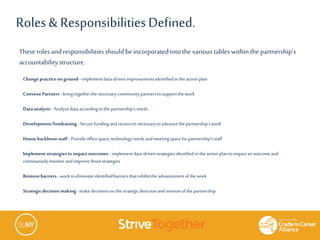
Theseroles andresponsibilitiesshouldbeincorporatedintothe varioustableswithinthe partnership’s
accountabilitystructure.
Changepractice onground - implementdata-drivenimprovementsidentifiedintheactionplan
ConvenePartners- bringtogetherthenecessarycommunitypartnerstosupportthework
Dataanalysis - Analyzedataaccordingtothepartnership’sneeds
Development/fundraising- Securefundingandresourcesnecessarytoadvancethepartnership’swork
Housebackbonestaff - Provideofficespace,technologyneedsandmeetingspaceforpartnership’sstaff
Implementstrategiestoimpact outcomes - implementdata-drivenstrategiesidentifiedintheactionplantoimpactan outcomeand
continuouslymonitorandimprovethosestrategies
Removebarriers- worktoeliminateidentifiedbarriersthatinhibittheadvancementofthework
Strategicdecision making- make decisionsonthestrategicdirectionandmissionofthepartnership
Roles& ResponsibilitiesDefined.
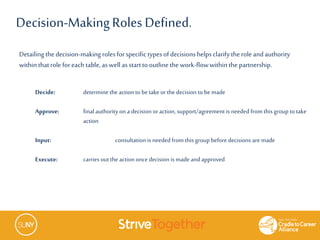
Detailing thedecision-makingrolesforspecific typesofdecisions helpsclarifytheroleandauthority
withinthatroleforeach table,aswell asstarttooutlinethework-flowwithinthe partnership.
Decide: determine the action to betake or the decision to bemade
Approve: final authority on a decision or action, support/agreement is needed fromthis group to take
action
Input: consultation is needed from this group before decisions are made
Execute: carries out the action once decision is made and approved
Decision-MakingRoles Defined.
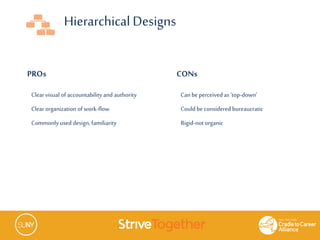
PROs
• Clearvisual of accountability and authority
• Clearorganization of work-flow
• Commonlyused design, familiarity
Hierarchical Designs
CONs
• Canbe perceivedas ‘top-down’
• Could beconsidered bureaucratic
• Rigid-not organic
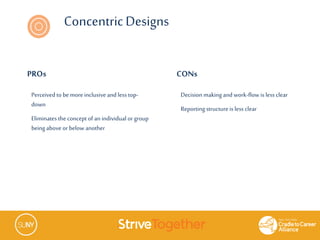
PROs
• Perceived to bemore inclusiveand less top-
down
• Eliminates the concept of an individual or group
being above or below another
ConcentricDesigns
CONs
• Decision makingand work-flow is less clear
• Reporting structure is less clear
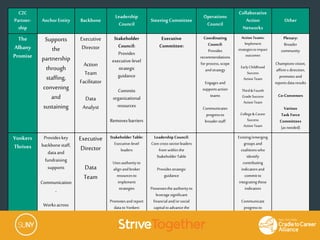
C2C
Partner-
ship
AnchorEntity Backbone
Leadership
Council
SteeringCommittee
Operations
Council
Collaborative
Action
Networks
Other
The
Albany
Promise
Supports
the
partnership
through
staffing,
convening
and
sustaining
Executive
Director
Action
Team
Facilitator
Data
Analyst
Stakeholder
Council:
Provides
executive-level
strategic
guidance
Commits
organizational
resources
Removesbarriers
Executive
Committee:
Coordinating
Council:
Provides
recommendations
forprocess,scope
andstrategy
Engages and
supportsaction
teams
Communicates
progressto
broaderstaff
Action Teams:
Implement
strategiestoimpact
outcomes
EarlyChildhood
Success
ActionTeam
Third& Fourth
GradeSuccess
ActionTeam
College&Career
Success
ActionTeam
Plenary:
Broader
community
Championsvision,
affirms direction,
promotesand
reportsdataresults
Co-Convenors
Various
Task Force
Committees
(asneeded)
Yonkers
Thrives
Provideskey
backbone staff,
dataand
fundraising
supports
Communication
,
Worksacross
sectors
Executive
Director
Data
Team
Stakeholder Table:
Executive-level
leaders
Usesauthorityto
alignandbroker
resourcesto
implement
strategies
Promotesand report
datato Yonkers
Strive partnership
andpublic
Leadership Council:
Corecross-sectorleaders
from withinthe
StakeholderTable
Providesstrategic
guidance
Possessesthe authorityto
leveragesignificant
financialand/orsocial
capitalto advancethe
goalsandoutcomes
Keypublic champions
Existing/emerging
groupsand
coalitionswho
identify
contributing
indicatorsand
commit to
integratingthese
indicators
Communicate
progressto
StakeholderTable
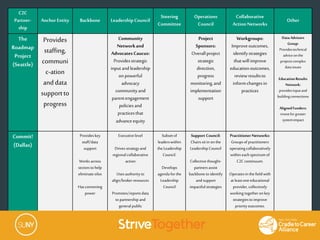
C2C
Partner-
ship
AnchorEntity Backbone LeadershipCouncil
Steering
Committee
Operations
Council
Collaborative
ActionNetworks
Other
The
Roadmap
Project
(Seattle)
Provides
staffing,
communi
c-ation
anddata
supportto
progress
Community
Networkand
AdvocatesCaucus:
Providesstrategic
inputandleadership
onpowerful
advocacy
communityand
parentengagement
policiesand
practicesthat
advanceequity
Project
Sponsors:
Overallproject
strategic
direction,
progress
monitoring,and
implementation
support
Workgroups:
Improveoutcomes,
identifystrategies
thatwillimprove
educationoutcomes,
reviewresultsto
informchangesin
practices
Data Advisors
Group:
Providestechnical
adviceonthe
projectscomplex
dataissues
EducationResults
Network:
providesinputand
buildingconnections
AlignedFunders:
investforgreater
systemimpact
Commit!
(Dallas)
Provideskey
staff/data
support
Works across
sectorsto help
eliminatesilos
Hasconvening
power
Executive level
Drives strategyand
regionalcollaborative
action
Usesauthorityto
align/brokerresources
Promotes/reportsdata
to partnershipand
generalpublic
Subsetof
leaderswithin
the Leadership
Council.
Develops
agendafor the
Leadership
Council
Support Council:
Chairssit in on the
LeadershipCouncil
Collectivethought-
partnersassist
backboneto identify
andsupport
impactfulstrategies
Practitioner Networks:
Groupsof practitioners
operatingcollaboratively
within eachspectrumof
C2C continuum.
Operatesinthefieldwith
at leastoneeducational
provider,collectively
working togetheronkey
strategiesto improve
priorityoutcomes.
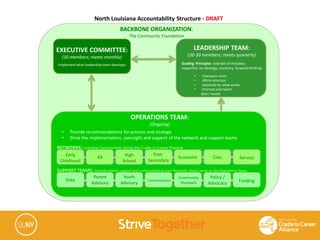
EXECUTIVE COMMITTEE:
(10 members; meets monthly)
Implementwhat leadership team develops
LEADERSHIP TEAM:
(20-30 members; meets quarterly)
Guiding Principles: tolerant of mistakes;
respectful, no ideology, visionary, forward-thinking
• Champion vision
• Affirm direction
• Advocate for what works
• Promote and report
data / results
BACKBONE ORGANIZATION:
The Community Foundation
North Louisiana Accountability Structure - DRAFT
OPERATIONS TEAM:
(Ongoing)
• Provide recommendations for process and strategy
• Drive the implementation, oversight and support of the network and support teams
NETWORKS: Learning Communities Along the Cradle to Career Pipeline
Early
Childhood
K8 High
School
Post-
Secondary
Economic Civic Service
SUPPORT TEAMS: Provide advice, support and sustainabilityto each Network. Chairs serve on the Operations Team.
Data
Parent
Advisory
Youth
Advisory
Communications
Community
Outreach Funding
Policy /
Advocacy
• Is thereanationalor NYSexample thatresonates?
• Whatkindofvisual representation(s)do wewanttoproposetoourbroaderpartnership?
• Are thereexisting structures/tablesthatcanbeleveraged as partofthe Geneva 2020’s
AccountabilityStructure?
• WhatshouldourAccountabilityStructurelooklike?
Work GroupDiscussion:
Thank You
We hopeto see everyone onApril 9,noon-4p.m.at the
Geneva 2020CommunityConvening
Hobart andWilliam SmithColleges

Materials for governance workgroup march 30 2015

  • 1.
    Geneva 2020 Governance /AccountabilityStructure Work Group Meeting March30,2015 10a.m-11:30a.m. Board Room,Geneva CommunityCenter
  • 2.
    Today’s Agenda • Welcomeandintroductions – GeneralGeneva 2020Updates (Hiring of a Program Coordinator, Steering CommitteeMeeting, April9 Convening) – ThreeGeneva 2020Workgroups – Deliverable: Draft a Geneva 2020Accountability Structure • WhatisanAccountabilityStructure & whyis it important? – Overview: Description of various rolesandtables – Review: Examples from Albany, Yonkers, Cincinnati, Milwaukee • Preparing for April9th – Discussion Questions – Which ofthese resonate with this work group? – Arethere existing structures/tables within Geneva 2020 that can be leveraged as partofour Accountability Structure? – What kind ofvisual representation(s) will we propose tothe broader partnership? – How will we build ourleadership table?
  • 3.
    Our Deliverable … Draftanaccountabilitystructure forGeneva 2020 thatwill be presented tothebroader partnership on April9, 2015for their review andapproval.
  • 4.
    Three Geneva 2020Workgroups • Communications: – Craftvision andmission statements forGeneva 2020. – Plan how tocommunicate that vision andmission tothe public. • Governance: – Chartthe accountability structure for Geneva 2020 that will function as the organizationalframework, depicting the different tables within the partnership andincluding an outline ofthe rolesandresponsibilities ofeach table. • Outcomes: – Understand the points along the cradle tocareer education continuum that areproven to be key levers that need tobe moved in order toachieve Geneva 2020’s vision andmission. – Select Community Level Outcomes from across the cradle tocareer continuum andensure accountability tothe community. – Determine the indicators forthese outcomes, which arespecific measures that will be used totrack progress on moving the community level outcomes.
  • 5.
    Goals Community Level Outcomes Children enter Kindergarten ready to succeed. Core Indicators (Measures) Studentsare proficient in core academic subjects Students successfully transition from middle to high school Graduates attain employment or a post-secondary credential % of students enrolling in post- secondary 6 months after HS graduation % of students assessed as ready for school upon entering kindergarten % of students proficient in 3rd grade ELA + % of students proficient in 4th grade Math TBD % of providers receiving high- quality professional development % of pre-k sites using a research based curriculum and assessment tool % of after school providers aligned to the in-school curriculum % of providers implementing PBIS behavioral intervention TBD % of students completing FAFSA % of students applying to 1-3 colleges % of students taking the PSAT/SAT Students graduate from high school TBD TBD Mission Vision Albany will thrive when all of our children have an equal opportunity to succeed from cradle to career. Inspired by a shared vision for improved educational outcomes, we use collaborative action and evidence- based decision making to accelerate success for students. The Albany Promise
  • 6.
    Pillar 2: Evidence Based Decision Making Pillar3: Collaborative Action Pillar 4: Investment & Sustainability Pillar 1: Shared Community Vision A cross-sector Partnership with a defined geographic scope organizes around a cradle to career vision. A cross-sector leadership table is convened with a documented accountability structure. The Partnership selects community level outcomes to be held accountable for improving. The Partnership selects core indicators for the community level outcomes. The Partnership commits to using continuous improvement to guide the work. An anchor entity is established and capacity to support the daily management of the partnership is in place. The Partnership engages funders to support the operations and collaborative work of partners to improve outcomes. Exploring Gateway The Partnership formalizes a set of messages that are aligned and effectively communicated across partners and the community.
  • 7.
    The AccountabilityStructureis theorganizationalframework thatdepictsthedifferenttableswithinthe partnershipAND includesanoutline ofthe roles andresponsibilitiesofeach table. It describes theprocesses, people andsupportsnecessarytofunctioneffectively. What is an AccountabilityStructure?
  • 8.
    Accountability structuresprovide: - Clarity •Aroundroles & responsibilities •Around decision making and authority - Organization •Organizesthe work to improve effectiveness and efficiency • Outlines an organized work-flow - Communication •Visual of what a cradle to careerpartnership looks like Whyis an Accountability Structure important?
  • 9.
    Examples from NYand beyond.
  • 10.
    Anchor Entity: Is aneutral partner,well-founded in the community. Their primaryresponsibilities include bringing key leaders together tobuild strong relationships within the partnership. The Anchor Entity is responsible for all external communication, maintains a data- driven focus, andhas the capacity forthe Backbone staff whomanage the everyday operations of the partnership. Backbone Staff: Is a groupofindividuals whomanage the day-to-day operations ofthe partnership. Leadership Council: Is a groupofcross-sector, executive-level leaders from education, non-profit, philanthropic, business, civic, faith- based, and community organizations that participate in the direction-setting ofthe partnership. Their primaryresponsibilities include removing barriers (ex. political, operational orfinancial barriers),strategic decision-making, andhelping toconvene partners. *Meets quarterlyand operates on consensus basis. Rolesand Table Descriptions.
  • 11.
    Steering Committee: Is asmaller subset ofthe leadership council. This groupacts as an advisorygrouptothe leadership council by providingguidance on key issues of the partnership. *Meets morefrequently than the leadership council. Operations Council: Is responsible for coordinating the needs ofthe collaborative action networks with support toeach group,andprovides a communication link tothe leadership council regardingthe workof collaborative action networks. They have an essential role in the internal communications ofthe partnership. *Meets monthly. CollaborativeAction Networks (CANs): Isa group of cross-sector practitioners and individuals who organizearounda single community-level outcome. This groupis often formed around selected indicators. They develop a charter andaction plan with strategies toimprovean outcome. *Meets biweekly Rolesand Table Descriptions.
  • 13.
    Theseroles andresponsibilitiesshouldbeincorporatedintothe varioustableswithinthepartnership’s accountabilitystructure. Changepractice onground - implementdata-drivenimprovementsidentifiedintheactionplan ConvenePartners- bringtogetherthenecessarycommunitypartnerstosupportthework Dataanalysis - Analyzedataaccordingtothepartnership’sneeds Development/fundraising- Securefundingandresourcesnecessarytoadvancethepartnership’swork Housebackbonestaff - Provideofficespace,technologyneedsandmeetingspaceforpartnership’sstaff Implementstrategiestoimpact outcomes - implementdata-drivenstrategiesidentifiedintheactionplantoimpactan outcomeand continuouslymonitorandimprovethosestrategies Removebarriers- worktoeliminateidentifiedbarriersthatinhibittheadvancementofthework Strategicdecision making- make decisionsonthestrategicdirectionandmissionofthepartnership Roles& ResponsibilitiesDefined.
  • 14.
    Detailing thedecision-makingrolesforspecific typesofdecisionshelpsclarifytheroleandauthority withinthatroleforeach table,aswell asstarttooutlinethework-flowwithinthe partnership. Decide: determine the action to betake or the decision to bemade Approve: final authority on a decision or action, support/agreement is needed fromthis group to take action Input: consultation is needed from this group before decisions are made Execute: carries out the action once decision is made and approved Decision-MakingRoles Defined.
  • 15.
    PROs • Clearvisual ofaccountability and authority • Clearorganization of work-flow • Commonlyused design, familiarity Hierarchical Designs CONs • Canbe perceivedas ‘top-down’ • Could beconsidered bureaucratic • Rigid-not organic
  • 16.
    PROs • Perceived tobemore inclusiveand less top- down • Eliminates the concept of an individual or group being above or below another ConcentricDesigns CONs • Decision makingand work-flow is less clear • Reporting structure is less clear
  • 17.
    C2C Partner- ship AnchorEntity Backbone Leadership Council SteeringCommittee Operations Council Collaborative Action Networks Other The Albany Promise Supports the partnership through staffing, convening and sustaining Executive Director Action Team Facilitator Data Analyst Stakeholder Council: Provides executive-level strategic guidance Commits organizational resources Removesbarriers Executive Committee: Coordinating Council: Provides recommendations forprocess,scope andstrategy Engages and supportsaction teams Communicates progressto broaderstaff ActionTeams: Implement strategiestoimpact outcomes EarlyChildhood Success ActionTeam Third& Fourth GradeSuccess ActionTeam College&Career Success ActionTeam Plenary: Broader community Championsvision, affirms direction, promotesand reportsdataresults Co-Convenors Various Task Force Committees (asneeded) Yonkers Thrives Provideskey backbone staff, dataand fundraising supports Communication , Worksacross sectors Executive Director Data Team Stakeholder Table: Executive-level leaders Usesauthorityto alignandbroker resourcesto implement strategies Promotesand report datato Yonkers Strive partnership andpublic Leadership Council: Corecross-sectorleaders from withinthe StakeholderTable Providesstrategic guidance Possessesthe authorityto leveragesignificant financialand/orsocial capitalto advancethe goalsandoutcomes Keypublic champions Existing/emerging groupsand coalitionswho identify contributing indicatorsand commit to integratingthese indicators Communicate progressto StakeholderTable
  • 18.
    C2C Partner- ship AnchorEntity Backbone LeadershipCouncil Steering Committee Operations Council Collaborative ActionNetworks Other The Roadmap Project (Seattle) Provides staffing, communi c-ation anddata supportto progress Community Networkand AdvocatesCaucus: Providesstrategic inputandleadership onpowerful advocacy communityand parentengagement policiesand practicesthat advanceequity Project Sponsors: Overallproject strategic direction, progress monitoring,and implementation support Workgroups: Improveoutcomes, identifystrategies thatwillimprove educationoutcomes, reviewresultsto informchangesin practices DataAdvisors Group: Providestechnical adviceonthe projectscomplex dataissues EducationResults Network: providesinputand buildingconnections AlignedFunders: investforgreater systemimpact Commit! (Dallas) Provideskey staff/data support Works across sectorsto help eliminatesilos Hasconvening power Executive level Drives strategyand regionalcollaborative action Usesauthorityto align/brokerresources Promotes/reportsdata to partnershipand generalpublic Subsetof leaderswithin the Leadership Council. Develops agendafor the Leadership Council Support Council: Chairssit in on the LeadershipCouncil Collectivethought- partnersassist backboneto identify andsupport impactfulstrategies Practitioner Networks: Groupsof practitioners operatingcollaboratively within eachspectrumof C2C continuum. Operatesinthefieldwith at leastoneeducational provider,collectively working togetheronkey strategiesto improve priorityoutcomes.
  • 19.
    EXECUTIVE COMMITTEE: (10 members;meets monthly) Implementwhat leadership team develops LEADERSHIP TEAM: (20-30 members; meets quarterly) Guiding Principles: tolerant of mistakes; respectful, no ideology, visionary, forward-thinking • Champion vision • Affirm direction • Advocate for what works • Promote and report data / results BACKBONE ORGANIZATION: The Community Foundation North Louisiana Accountability Structure - DRAFT OPERATIONS TEAM: (Ongoing) • Provide recommendations for process and strategy • Drive the implementation, oversight and support of the network and support teams NETWORKS: Learning Communities Along the Cradle to Career Pipeline Early Childhood K8 High School Post- Secondary Economic Civic Service SUPPORT TEAMS: Provide advice, support and sustainabilityto each Network. Chairs serve on the Operations Team. Data Parent Advisory Youth Advisory Communications Community Outreach Funding Policy / Advocacy
  • 26.
    • Is thereanationalorNYSexample thatresonates? • Whatkindofvisual representation(s)do wewanttoproposetoourbroaderpartnership? • Are thereexisting structures/tablesthatcanbeleveraged as partofthe Geneva 2020’s AccountabilityStructure? • WhatshouldourAccountabilityStructurelooklike? Work GroupDiscussion:
  • 27.
    Thank You We hopetosee everyone onApril 9,noon-4p.m.at the Geneva 2020CommunityConvening Hobart andWilliam SmithColleges

Editor's Notes

  • #18 The NYS C2C Alliance at SUNY works to support those communities by sharing learnings, applying standards, offering technical assistance, and advocating for local, state and federal policy that will enable the partnerships to actually improve outcomes for their students.
  • #19 The NYS C2C Alliance at SUNY works to support those communities by sharing learnings, applying standards, offering technical assistance, and advocating for local, state and federal policy that will enable the partnerships to actually improve outcomes for their students.