Strategic Speaker Program Management   How to build and retain mutually beneficial relationships with thought leaders Presented at the CBI Premier Forum  on  Bio/Pharmaceutical Speaker Program Management February 19-20, 2009 Philadelphia, PA © 2009  O’Laughlin & Associates
Key elements for building successful relationships with  thought leaders/speakers Outline Alignment between commercial and medical strategic objectives with thought leader/academic institution needs  Identify and quantify thought leader base; develop and preserve relationships Provide excellent service to internal and external customers: Education/content, audience needs Logistics, program management, compensation  Seamless execution from program initiation to completion and follow up Enabled by state-of the art technology and nimble to execute on strategy, program management and fiscal commitments Regulatory and compliant savvy - meets the demands of a fast-changing/evolving environment Consensus on measurement of success (top do's and don'ts)
“ ASCO Takes On Conflict of Interest” The policy also outright prohibits physicians from assuming leadership positions in clinical trials if they have certain financial conflicts with the pharmaceutical company funding the trial, including  the receipt of non-mutual fund stock, royalty and license interests, and  speaking honoraria.  Additionally, the policy forbids certain practices, such as payments contingent on referral or outcome, or agreements that restrict the right of researchers to publish. The penalty for violating the policy: prohibition from publishing or presenting data, or dismissal from ASCO. Sep 1, 2003 12:00 PM, By John Otrompke http://meetingsnet.com/medicalmeetings/meetings_asco_takes_conflict/
Thought Leader Relationships: Effectively Managing Speakers Identify and quantify thought leader base; develop and preserve relationships Develop effective speaker pool Speaker Base – sub-set of strategic thought leader initiative across the organization Identify and objectively quantify speaker expertise and drive consensus across the organization Educate stakeholders about the nomination and selection process and its implications and commitments  National, Regional, Local  Utilization frequency Compensation levels Thought Leader Cross –functional team  Speaker Bureau cross-functional coordination
Thought Leader Relationships: Effectively Managing Speakers Excellent service to internal and external customers: Education and content; alignment of speakers  Engage speakers with content development  Create shared ownership and accountability for success Committees and sub-committees Opportunity to leverage speaker other area of knowledge (i.e. technology)
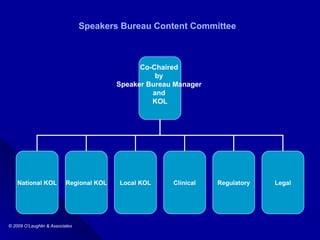
Speakers Bureau Content Committee Co-Chaired  by  Speaker Bureau Manager  and  KOL National KOL Regional KOL Local KOL Regulatory Legal Clinical
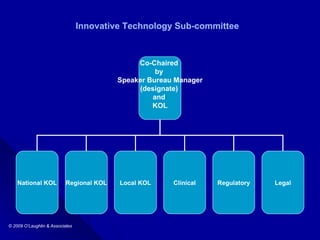
Innovative Technology Sub-committee Co-Chaired  by  Speaker Bureau Manager (designate)  and  KOL National KOL Regional KOL Local KOL Regulatory Legal Clinical
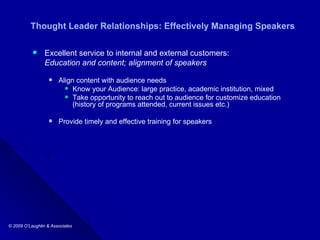
Thought Leader Relationships: Effectively Managing Speakers Excellent service to internal and external customers: Education and content; alignment of speakers  Align content with audience needs Know your Audience: large practice, academic institution, mixed Take opportunity to reach out to audience for customize education (history of programs attended, current issues etc.) Provide timely and effective training for speakers
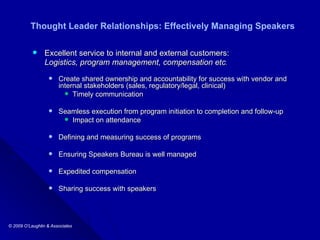
Thought Leader Relationships: Effectively Managing Speakers Excellent service to internal and external customers: Logistics, program management, compensation etc .   Create shared ownership and accountability for success with vendor and internal stakeholders (sales, regulatory/legal, clinical) Timely communication Seamless execution from program initiation to completion and follow-up Impact on attendance Defining and measuring success of programs  Ensuring Speakers Bureau is well managed  Expedited compensation  Sharing success with speakers
Thought Leader Relationships: Effectively Managing Speakers Regulatory and compliant savvy - meets the demands of a fast-changing/evolving environment Joint responsibility and accountability for internal and external stakeholders Insuring regulatory and compliance teams are integrated into the Speakers  Bureau management Communicate expectations early on  Benefits
Thought Leader Relationships: Effectively Managing Speakers Consensus on measurement of success (top do's and don'ts) Do’s Build cross functional teams to optimize strategic and tactical execution Strategically utilize thought leaders to support long & short-term business needs; create shared-ownership for success Communicate relentlessly Educate stakeholders about the investment, visibility and impact of the Speakers Bureau and it’s role in achieving Brand /Therapeutic area and corporate goals Remember that successful programs are a balance of content and execution Don’ts Wait until end of year to measure success Assume your customers will not need help in positioning your offerings Be afraid to make changes, or corrections to improve programs Shift all responsibilities to your speaker bureau vendor.  Maximize integration and partnership for success.  Forget to integrate all functions early and continually
Questions?? Thank you, Renee and Michael O'Laughlin & Associates Strategic health care marketing consulting olaughlinandassociates.com [email_address] 302-753-4816 (cell)

Strategic Spkr Mgmt 2 20 09

  • 1.
    Strategic Speaker ProgramManagement How to build and retain mutually beneficial relationships with thought leaders Presented at the CBI Premier Forum on Bio/Pharmaceutical Speaker Program Management February 19-20, 2009 Philadelphia, PA © 2009 O’Laughlin & Associates
  • 2.
    Key elements forbuilding successful relationships with thought leaders/speakers Outline Alignment between commercial and medical strategic objectives with thought leader/academic institution needs Identify and quantify thought leader base; develop and preserve relationships Provide excellent service to internal and external customers: Education/content, audience needs Logistics, program management, compensation Seamless execution from program initiation to completion and follow up Enabled by state-of the art technology and nimble to execute on strategy, program management and fiscal commitments Regulatory and compliant savvy - meets the demands of a fast-changing/evolving environment Consensus on measurement of success (top do's and don'ts)
  • 3.
    “ ASCO TakesOn Conflict of Interest” The policy also outright prohibits physicians from assuming leadership positions in clinical trials if they have certain financial conflicts with the pharmaceutical company funding the trial, including the receipt of non-mutual fund stock, royalty and license interests, and speaking honoraria. Additionally, the policy forbids certain practices, such as payments contingent on referral or outcome, or agreements that restrict the right of researchers to publish. The penalty for violating the policy: prohibition from publishing or presenting data, or dismissal from ASCO. Sep 1, 2003 12:00 PM, By John Otrompke http://meetingsnet.com/medicalmeetings/meetings_asco_takes_conflict/
  • 4.
    Thought Leader Relationships:Effectively Managing Speakers Identify and quantify thought leader base; develop and preserve relationships Develop effective speaker pool Speaker Base – sub-set of strategic thought leader initiative across the organization Identify and objectively quantify speaker expertise and drive consensus across the organization Educate stakeholders about the nomination and selection process and its implications and commitments National, Regional, Local Utilization frequency Compensation levels Thought Leader Cross –functional team Speaker Bureau cross-functional coordination
  • 5.
    Thought Leader Relationships:Effectively Managing Speakers Excellent service to internal and external customers: Education and content; alignment of speakers Engage speakers with content development Create shared ownership and accountability for success Committees and sub-committees Opportunity to leverage speaker other area of knowledge (i.e. technology)
  • 6.
    Speakers Bureau ContentCommittee Co-Chaired by Speaker Bureau Manager and KOL National KOL Regional KOL Local KOL Regulatory Legal Clinical
  • 7.
    Innovative Technology Sub-committeeCo-Chaired by Speaker Bureau Manager (designate) and KOL National KOL Regional KOL Local KOL Regulatory Legal Clinical
  • 8.
    Thought Leader Relationships:Effectively Managing Speakers Excellent service to internal and external customers: Education and content; alignment of speakers Align content with audience needs Know your Audience: large practice, academic institution, mixed Take opportunity to reach out to audience for customize education (history of programs attended, current issues etc.) Provide timely and effective training for speakers
  • 9.
    Thought Leader Relationships:Effectively Managing Speakers Excellent service to internal and external customers: Logistics, program management, compensation etc . Create shared ownership and accountability for success with vendor and internal stakeholders (sales, regulatory/legal, clinical) Timely communication Seamless execution from program initiation to completion and follow-up Impact on attendance Defining and measuring success of programs Ensuring Speakers Bureau is well managed Expedited compensation Sharing success with speakers
  • 10.
    Thought Leader Relationships:Effectively Managing Speakers Regulatory and compliant savvy - meets the demands of a fast-changing/evolving environment Joint responsibility and accountability for internal and external stakeholders Insuring regulatory and compliance teams are integrated into the Speakers Bureau management Communicate expectations early on Benefits
  • 11.
    Thought Leader Relationships:Effectively Managing Speakers Consensus on measurement of success (top do's and don'ts) Do’s Build cross functional teams to optimize strategic and tactical execution Strategically utilize thought leaders to support long & short-term business needs; create shared-ownership for success Communicate relentlessly Educate stakeholders about the investment, visibility and impact of the Speakers Bureau and it’s role in achieving Brand /Therapeutic area and corporate goals Remember that successful programs are a balance of content and execution Don’ts Wait until end of year to measure success Assume your customers will not need help in positioning your offerings Be afraid to make changes, or corrections to improve programs Shift all responsibilities to your speaker bureau vendor. Maximize integration and partnership for success. Forget to integrate all functions early and continually
  • 12.
    Questions?? Thank you,Renee and Michael O'Laughlin & Associates Strategic health care marketing consulting olaughlinandassociates.com [email_address] 302-753-4816 (cell)