Improving JSR Practices at
Country Level: Achievements
and Gaps in Eastern and
Central Africa
Joseph Karugia
Coordinator, ReSAKSS-ECA
Outline
• Need for Mutual Accountability
• Joint Sector Review
• Achievements in East and Central Africa
• Gaps
What is Mutual Accountability?
• A process by which two or more parties hold one
another accountable for the commitments they
have voluntarily made to one another
• Mutual Accountability (MA) is a core principle of
CAADP
• A mutual accountability framework (MAF) for
CAADP was developed by NCPA in 2011 to guide
MA processes at continental, regional and country
levels
Principles of MA
• A shared vision or agenda among the cooperating
parties
• Common objectives and strategies aimed at
achieving the vision
• Jointly agreed performance indicators based on
mutually agreed performance criteria
• Genuine dialogue and debate process based on
consent, common values and trust
What is a Joint Sector Review?
• Joint Sector Review (JSR) is one way of
operationalizing the MAF at country level
• The JSR process creates a platform to:
• assess the performance and results of the
agriculture sector
• assist governments to assess effectiveness of sector
policies and strategies
• assess how well state and non state actors have
implemented pledges and commitments (laid out in
CAADP compacts, NAIPs, and other agreements)
• guide decisions to continue with or make
adjustments in implementation of NAIP or
agreement
Principles of JSR
• National ownership and leadership
• Relevance to NAIP or cooperation agreement
• Inclusive participation
• Commitment to results by all participants
• Impartiality and evidence-based
• Enhance national planning
• Sensitivity to gender
• Learning experience
Purpose and benefits of JSR
• Main purpose is to determine and evaluate
observed results of sector performance and
compare with:
• intended results; or
• targets in NAIP or agreement
• Therefore, the JSR:
• allows diverse stakeholders to get insights into and influence
overall policies and priorities of the sector
• serves as a management and policy support tool for inclusive
stakeholder planning, programming, budget preparation and
execution, monitoring and evaluation, and overall
development of the sector
What to monitor?
• Five main areas:
• Development results e.g. income growth, poverty and
hunger reduction, food and nutrition security
• Overall agricultural sector growth targets, with specific
subsector and commodity targets
• Required financial and non-financial resources to
effectively implement the cooperation agreement
• Policies, programs, institutions, and implementation
processes
• Linkages (pathways to achieve the development
results), enabling environment, and assumptions
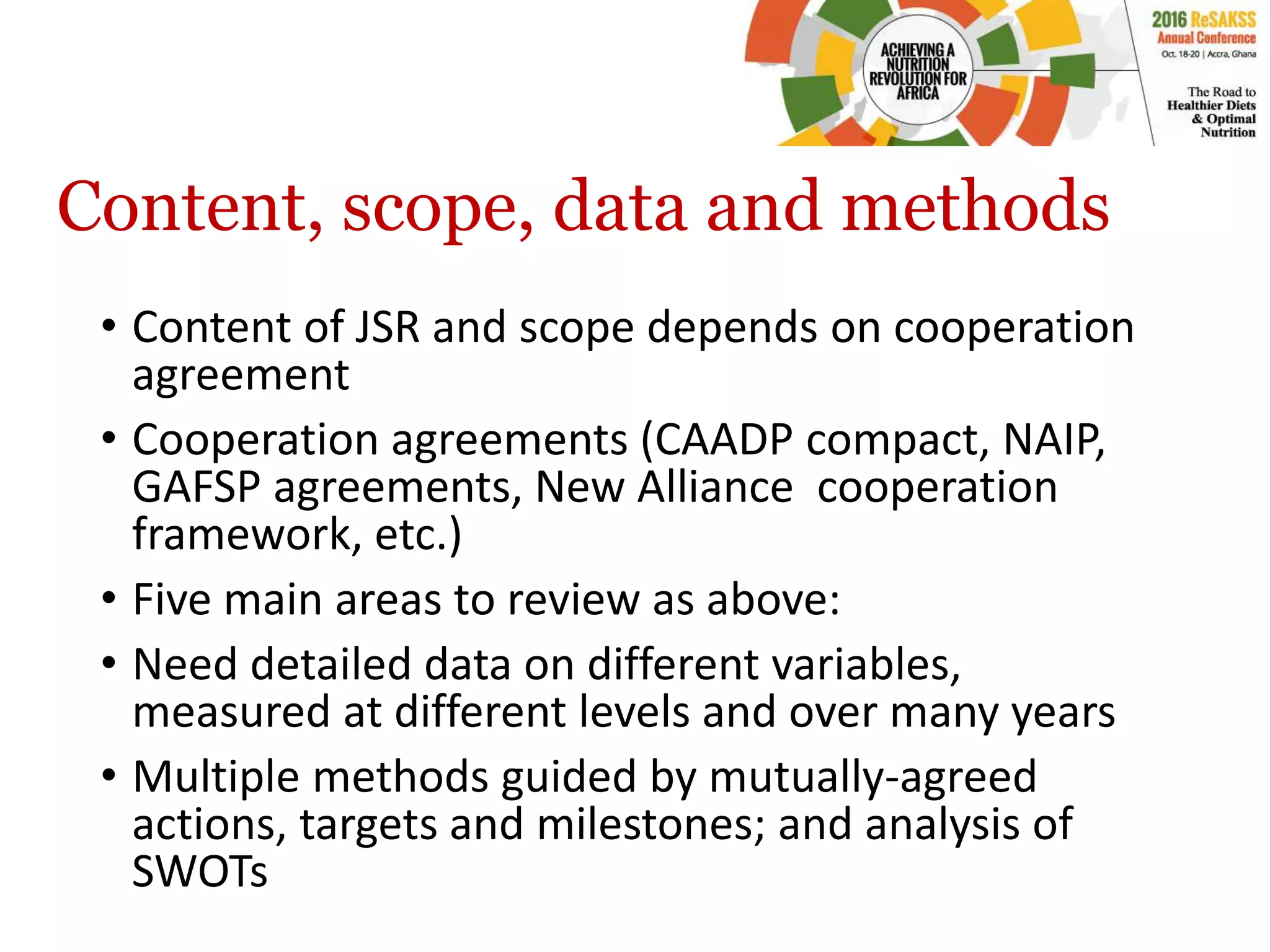
Content, scope, data and methods
• Content of JSR and scope depends on cooperation
agreement
• Cooperation agreements (CAADP compact, NAIP,
GAFSP agreements, New Alliance cooperation
framework, etc.)
• Five main areas to review as above:
• Need detailed data on different variables,
measured at different levels and over many years
• Multiple methods guided by mutually-agreed
actions, targets and milestones; and analysis of
SWOTs
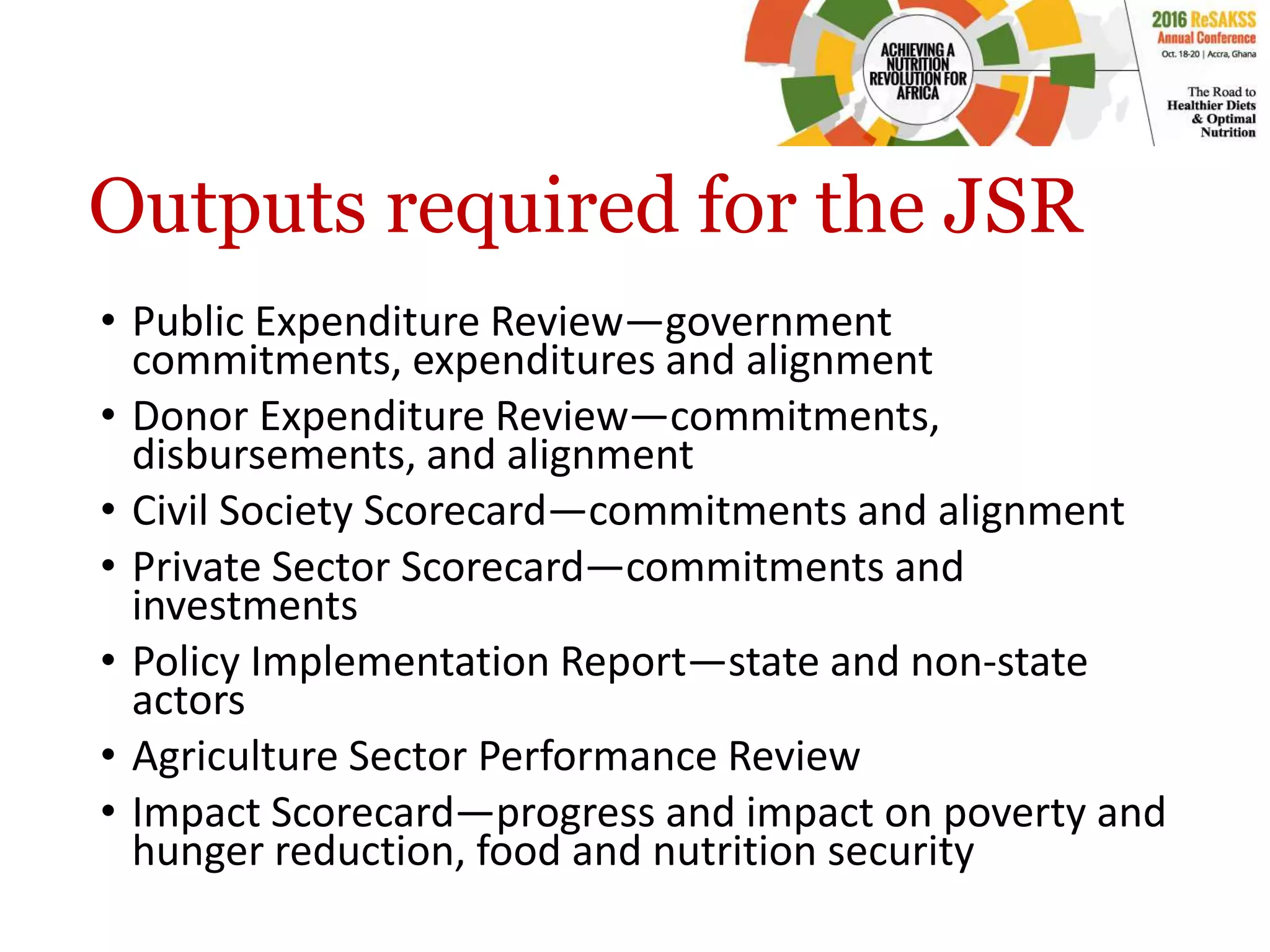
Outputs required for the JSR
• Public Expenditure Review—government
commitments, expenditures and alignment
• Donor Expenditure Review—commitments,
disbursements, and alignment
• Civil Society Scorecard—commitments and alignment
• Private Sector Scorecard—commitments and
investments
• Policy Implementation Report—state and non-state
actors
• Agriculture Sector Performance Review
• Impact Scorecard—progress and impact on poverty and
hunger reduction, food and nutrition security
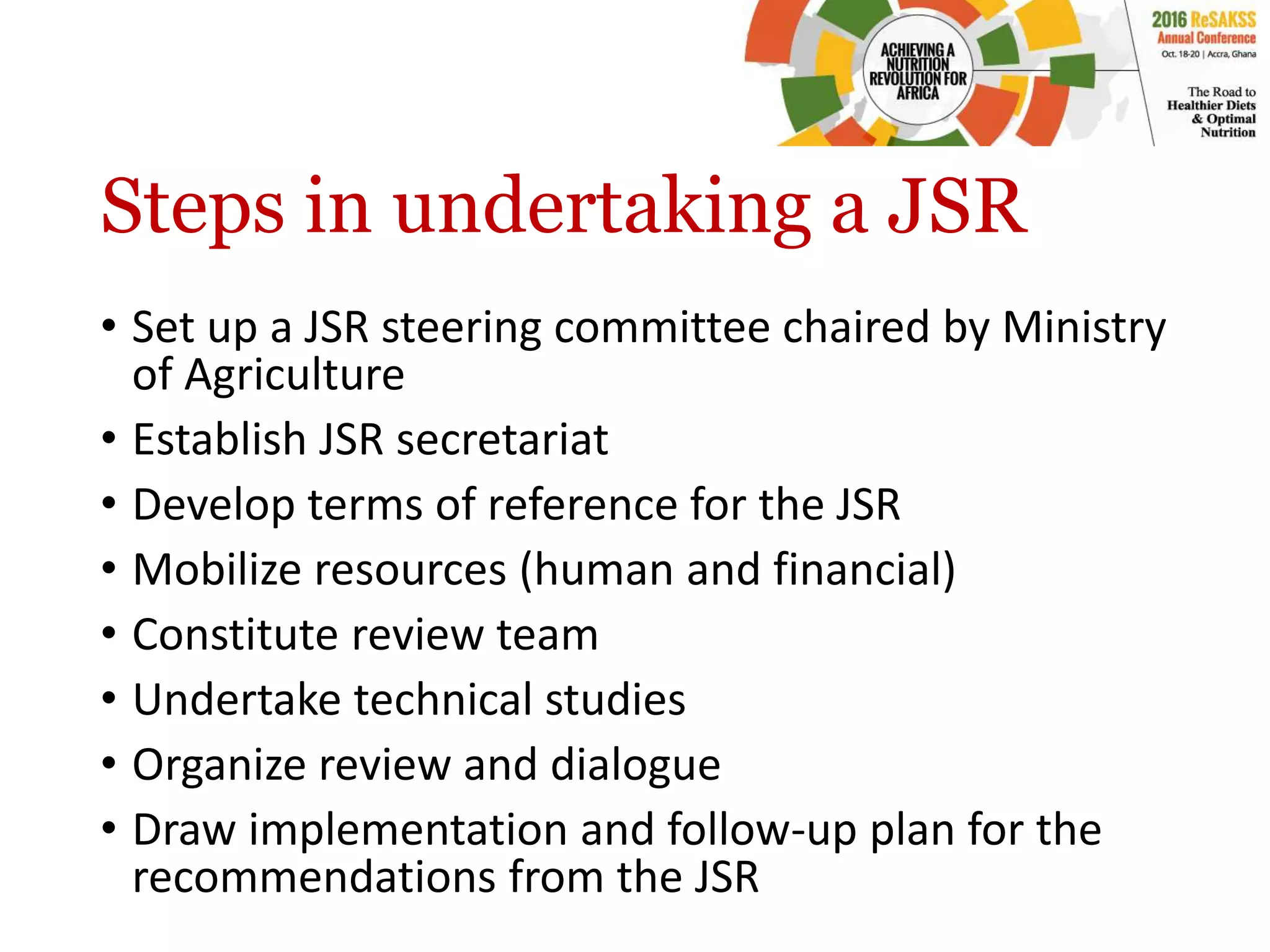
Steps in undertaking a JSR
• Set up a JSR steering committee chaired by Ministry
of Agriculture
• Establish JSR secretariat
• Develop terms of reference for the JSR
• Mobilize resources (human and financial)
• Constitute review team
• Undertake technical studies
• Organize review and dialogue
• Draw implementation and follow-up plan for the
recommendations from the JSR
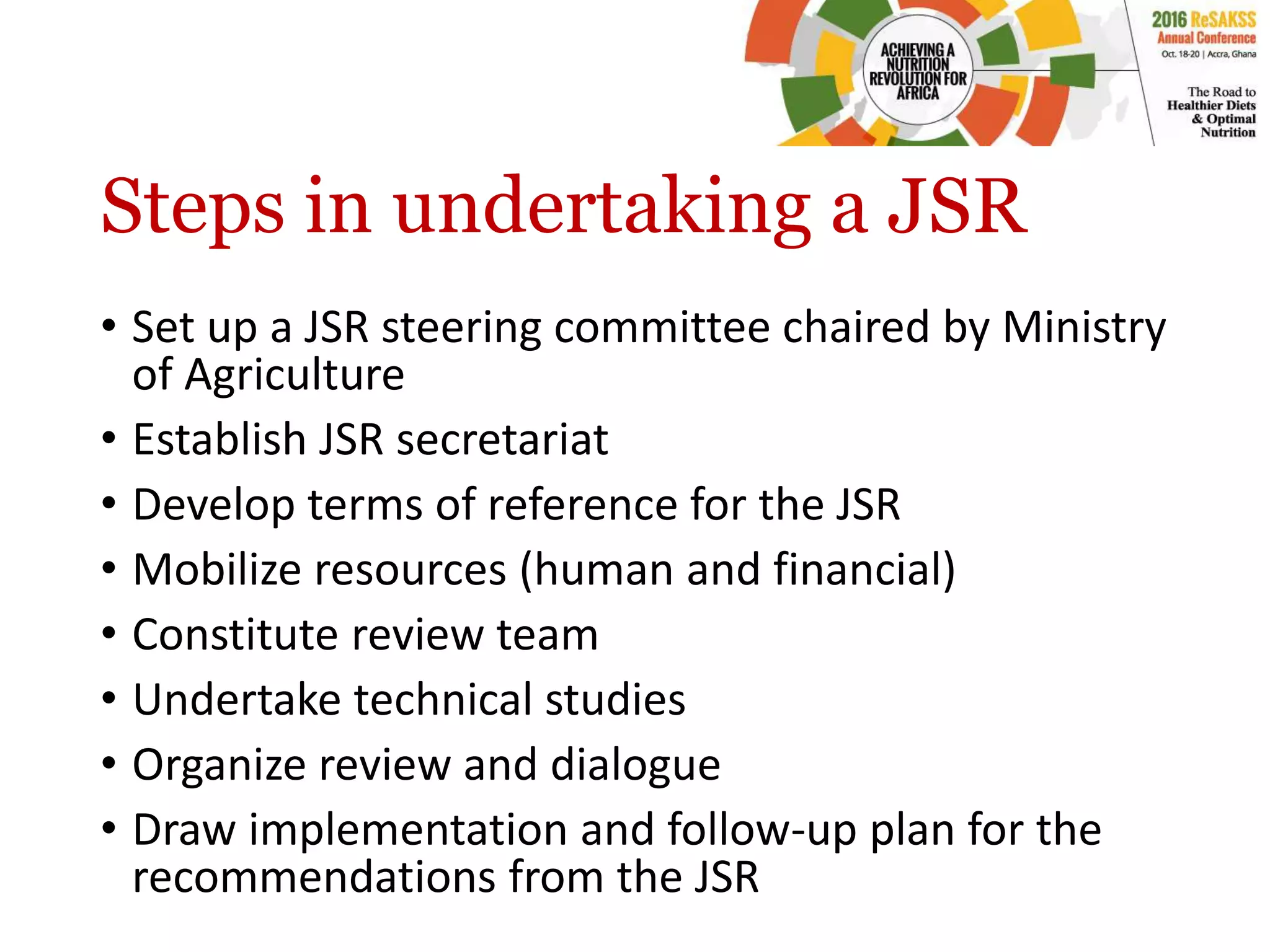
Steps in undertaking a JSR
• Set up a JSR steering committee chaired by Ministry
of Agriculture
• Establish JSR secretariat
• Develop terms of reference for the JSR
• Mobilize resources (human and financial)
• Constitute review team
• Undertake technical studies
• Organize review and dialogue
• Draw implementation and follow-up plan for the
recommendations from the JSR
Achievements and Gaps in
East and Central Africa
JSR Assessments in ECA
• AUC-led Process
• Agreement between Burundi, DRC, Ethiopia, Kenya,
Tanzania and Uganda to strengthen JSR processes
• Process led by Policy and Planning Directorates
• IFPRI/ReSAKSS and AfricaLead provided technical
support through JSR focal persons in the countries
• Country level experts engaged
Approach
• Examined previous review and consultative
processes in these countries - the stakeholders
involved and their roles
• Reviews of earlier reports
• Supplemented with information collected from
stakeholders: key informant interviews; data
collection templates; and consultative and
validation workshops
• Identified gaps in the review processes, possible
improvements that could be made and developed
stakeholder-specific action plans
Key findings
• Most countries undertake some kind of review
• PIF review in Ethiopia; ASR/PER review in Tanzania;
JASAR in Uganda; economic review of agriculture in
Kenya; PER in DRC,
• Strong ownership by governments and development
partners; not so by Non-State Actors (NSAs - private
sector and civil society organizations)
• In most cases, review processes are relevant to
cooperation agreement; however, in some cases
other initiatives/programs are not included
• Inclusiveness is an issue: Government and DPs
engage but NSAs are not fully engaged
Key findings
• Commitments normally by governments and
development partners; no similar commitments by
Non-State Actors
• Most reviews are not evidence-based; limited use
of objective analysis and poor data systems
• In many cases, results are meant to inform
planning; but there is limited capacity to utilize
results fully
• Benefits to women, youth and other marginalized
groups not adequately demonstrated in reviews
Key findings
• Sharing of results in-country conducted through
retreats and broad forums; less sharing at
regional/continental level
• No strong follow-up on recommendations –
mechanism for doing so not clearly defined
After JSR assessment, what
then?
• Awareness raised during the JSR assessment
across a wide range of stakeholders
• Action plans developed with key
actions/recommendations for different stakeholder
categories but follow up has been poor
• Most stakeholders keen on strengthening JSR
process in their country
After JSR assessment, what
then?
• A number of countries are in the process of
implementing a strengthened JSR as recommended
by the assessment
• Uganda in 2016 – early preparations; effective and early
involvement of non-state actors with a JASAR statement
paper (“private sector review”); and smaller sub-national
meetings
• Tanzania – early preparations; technical studies planned;
and involvement of sector ministries and non-state actors
• Kenya – has embraced strengthened JSR and is planning
to implement it through the Country SAKSS
• DRC – expressed willingness to conduct a strengthened
JSR after the assessment but no concrete action yet
Thank you
www.resakss.org

Improving JSR Practices at Country Level: Achievements and Gaps in Eastern and Central Africa

  • 1.
    Improving JSR Practicesat Country Level: Achievements and Gaps in Eastern and Central Africa Joseph Karugia Coordinator, ReSAKSS-ECA
  • 2.
    Outline • Need forMutual Accountability • Joint Sector Review • Achievements in East and Central Africa • Gaps
  • 3.
    What is MutualAccountability? • A process by which two or more parties hold one another accountable for the commitments they have voluntarily made to one another • Mutual Accountability (MA) is a core principle of CAADP • A mutual accountability framework (MAF) for CAADP was developed by NCPA in 2011 to guide MA processes at continental, regional and country levels
  • 4.
    Principles of MA •A shared vision or agenda among the cooperating parties • Common objectives and strategies aimed at achieving the vision • Jointly agreed performance indicators based on mutually agreed performance criteria • Genuine dialogue and debate process based on consent, common values and trust
  • 5.
    What is aJoint Sector Review? • Joint Sector Review (JSR) is one way of operationalizing the MAF at country level • The JSR process creates a platform to: • assess the performance and results of the agriculture sector • assist governments to assess effectiveness of sector policies and strategies • assess how well state and non state actors have implemented pledges and commitments (laid out in CAADP compacts, NAIPs, and other agreements) • guide decisions to continue with or make adjustments in implementation of NAIP or agreement
  • 6.
    Principles of JSR •National ownership and leadership • Relevance to NAIP or cooperation agreement • Inclusive participation • Commitment to results by all participants • Impartiality and evidence-based • Enhance national planning • Sensitivity to gender • Learning experience
  • 7.
    Purpose and benefitsof JSR • Main purpose is to determine and evaluate observed results of sector performance and compare with: • intended results; or • targets in NAIP or agreement • Therefore, the JSR: • allows diverse stakeholders to get insights into and influence overall policies and priorities of the sector • serves as a management and policy support tool for inclusive stakeholder planning, programming, budget preparation and execution, monitoring and evaluation, and overall development of the sector
  • 8.
    What to monitor? •Five main areas: • Development results e.g. income growth, poverty and hunger reduction, food and nutrition security • Overall agricultural sector growth targets, with specific subsector and commodity targets • Required financial and non-financial resources to effectively implement the cooperation agreement • Policies, programs, institutions, and implementation processes • Linkages (pathways to achieve the development results), enabling environment, and assumptions
  • 9.
    Content, scope, dataand methods • Content of JSR and scope depends on cooperation agreement • Cooperation agreements (CAADP compact, NAIP, GAFSP agreements, New Alliance cooperation framework, etc.) • Five main areas to review as above: • Need detailed data on different variables, measured at different levels and over many years • Multiple methods guided by mutually-agreed actions, targets and milestones; and analysis of SWOTs
  • 10.
    Outputs required forthe JSR • Public Expenditure Review—government commitments, expenditures and alignment • Donor Expenditure Review—commitments, disbursements, and alignment • Civil Society Scorecard—commitments and alignment • Private Sector Scorecard—commitments and investments • Policy Implementation Report—state and non-state actors • Agriculture Sector Performance Review • Impact Scorecard—progress and impact on poverty and hunger reduction, food and nutrition security
  • 11.
    Steps in undertakinga JSR • Set up a JSR steering committee chaired by Ministry of Agriculture • Establish JSR secretariat • Develop terms of reference for the JSR • Mobilize resources (human and financial) • Constitute review team • Undertake technical studies • Organize review and dialogue • Draw implementation and follow-up plan for the recommendations from the JSR
  • 12.
    Steps in undertakinga JSR • Set up a JSR steering committee chaired by Ministry of Agriculture • Establish JSR secretariat • Develop terms of reference for the JSR • Mobilize resources (human and financial) • Constitute review team • Undertake technical studies • Organize review and dialogue • Draw implementation and follow-up plan for the recommendations from the JSR
  • 13.
    Achievements and Gapsin East and Central Africa
  • 14.
    JSR Assessments inECA • AUC-led Process • Agreement between Burundi, DRC, Ethiopia, Kenya, Tanzania and Uganda to strengthen JSR processes • Process led by Policy and Planning Directorates • IFPRI/ReSAKSS and AfricaLead provided technical support through JSR focal persons in the countries • Country level experts engaged
  • 15.
    Approach • Examined previousreview and consultative processes in these countries - the stakeholders involved and their roles • Reviews of earlier reports • Supplemented with information collected from stakeholders: key informant interviews; data collection templates; and consultative and validation workshops • Identified gaps in the review processes, possible improvements that could be made and developed stakeholder-specific action plans
  • 16.
    Key findings • Mostcountries undertake some kind of review • PIF review in Ethiopia; ASR/PER review in Tanzania; JASAR in Uganda; economic review of agriculture in Kenya; PER in DRC, • Strong ownership by governments and development partners; not so by Non-State Actors (NSAs - private sector and civil society organizations) • In most cases, review processes are relevant to cooperation agreement; however, in some cases other initiatives/programs are not included • Inclusiveness is an issue: Government and DPs engage but NSAs are not fully engaged
  • 17.
    Key findings • Commitmentsnormally by governments and development partners; no similar commitments by Non-State Actors • Most reviews are not evidence-based; limited use of objective analysis and poor data systems • In many cases, results are meant to inform planning; but there is limited capacity to utilize results fully • Benefits to women, youth and other marginalized groups not adequately demonstrated in reviews
  • 18.
    Key findings • Sharingof results in-country conducted through retreats and broad forums; less sharing at regional/continental level • No strong follow-up on recommendations – mechanism for doing so not clearly defined
  • 19.
    After JSR assessment,what then? • Awareness raised during the JSR assessment across a wide range of stakeholders • Action plans developed with key actions/recommendations for different stakeholder categories but follow up has been poor • Most stakeholders keen on strengthening JSR process in their country
  • 20.
    After JSR assessment,what then? • A number of countries are in the process of implementing a strengthened JSR as recommended by the assessment • Uganda in 2016 – early preparations; effective and early involvement of non-state actors with a JASAR statement paper (“private sector review”); and smaller sub-national meetings • Tanzania – early preparations; technical studies planned; and involvement of sector ministries and non-state actors • Kenya – has embraced strengthened JSR and is planning to implement it through the Country SAKSS • DRC – expressed willingness to conduct a strengthened JSR after the assessment but no concrete action yet
  • 21.