Primarily Teaching:
Using Primary Sources to
Engage Students in the
     Study of History
           Stefanie Rosenberg Wager
 Email: stefanie.rosenbergwager@gmail.com
              Twitter: @srwteacher
  Blog: www.stefaniewager.blogspot.com
Websites: www.technologynow.wikispaces.com
   www.usingprimarysources.weebly.com
Poll Everywhere
 Question: Do you use primary sources in your
  classroom at least once a week?
   http://www.polleverywhere.com/multiple_choice_
    polls/MTQ1ODUzOTA3Ng
Using Primary Sources?
 In a recent study, teachers cited three main
  reasons they don’t use primary sources:
    No time to find primary sources.
    Too many resources available. It’s hard to funnel
     down to “best” resources.
    Don’t know how to effectively use primary sources
     with students.
So, What is a Primary
         Source?
 What is your definition of a primary source?

 Primary Source Sort

 Working with your elbow partner, rework your
  definition of a primary source.
    Be ready to share out!
One Definition
 Primary sources provide first hand testimony or
  direct evidence concerning a topic under
  investigation. They are created by witnesses or
  recorders who experienced the events or
  conditions being documented. Often these
  sources are created at the time when the events
  or conditions are occurring, but primary sources
  can also include autobiographies, memoirs, and
  oral histories recorded later.
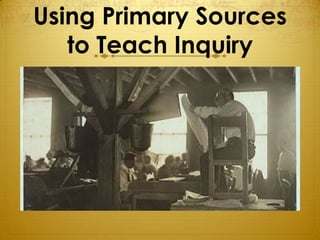
Using Primary Sources
   to Teach Inquiry
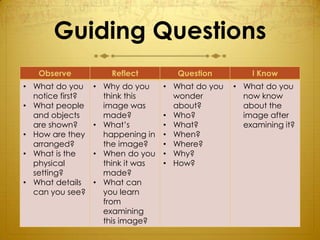
Guiding Questions
   Observe            Reflect         Question         I Know
• What do you     • Why do you     • What do you   • What do you
  notice first?     think this       wonder          now know
• What people       image was        about?          about the
  and objects       made?          • Who?            image after
  are shown?      • What’s         • What?           examining it?
• How are they      happening in   • When?
  arranged?         the image?     • Where?
• What is the     • When do you    • Why?
  physical          think it was   • How?
  setting?          made?
• What details    • What can
  can you see?      you learn
                    from
                    examining
                    this image?
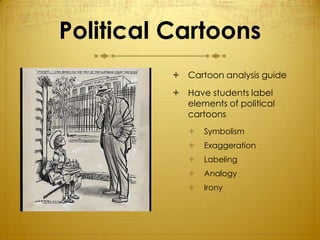
Political Cartoons
           Cartoon analysis guide
           Have students label
            elements of political
            cartoons
                Symbolism
                Exaggeration
                Labeling
                Analogy
                Irony
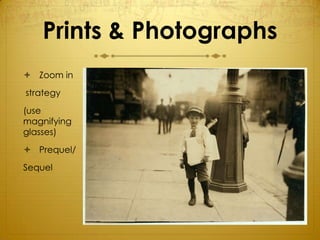
Prints & Photographs
 Zoom in
strategy

(use
magnifying
glasses)
 Prequel/
Sequel
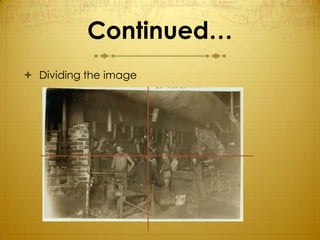
Continued…
 Dividing the image
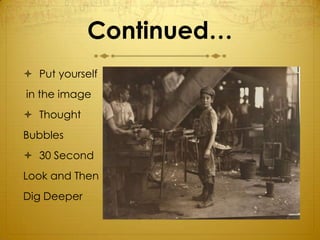
Continued…
 Put yourself
in the image
 Thought
Bubbles
 30 Second
Look and Then
Dig Deeper
Analyzing Maps
 The Devil is in the Details
    Give students pieces of a map and have each
     student examine one piece of the map.
    Have them record what they know on sticky notes
     and place on the map.
    Then have them share with a partner or larger
     group.
    Finally, have students put the map together to see
     the “big picture.”
Analyzing Documents
 Quote MVP
   Give students quotes and ask them to select their
    MVP (most valuable point) related to the lesson
    essential question.
 Tampering with History
   Change the document so it’s easier to read for
    struggling readers.
 Jigsaw with cooperative learning groups
Music/
      Sound Recordings
 Use a song or sound recording as a class opener.
 Using music to teach a certain time period in
  history
    Example: Civil War music, Great Depression, etc.
 LOC Jukebox (www.loc.gov/jukebox)
 LOC Sound Recordings
    Example: WPA Slave Narratives
     http://memory.loc.gov/ammem/collections/voice
     s/
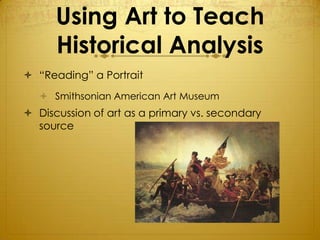
Using Art to Teach
      Historical Analysis
 “Reading” a Portrait
    Smithsonian American Art Museum
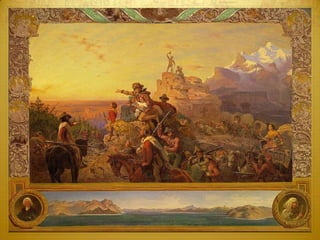
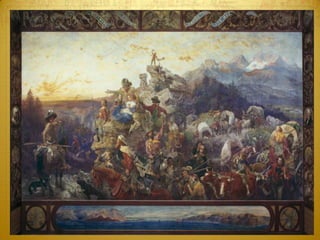
 Discussion of art as a primary vs. secondary
  source
General Strategies
 Weighing the evidence
    Example: Give students 5-7 documents related to
     causes of the Civil War. Students have to “weigh”
     which documents carry more weight and answer the
     essential question.
    Civil War Causes and Effects
     http://docsteach.org/activities/3895
 Sorting/categorizing primary sources
 Five senses chart
    Students analyze various documents and record what
     they hear, see, taste, feel, and smell.
Continued…
 Historical Debates
   Have students play the role of historical figures.
 Four Corners
   Pose a historical question and ask students to
    move to the corner of the room they agree with.
    Label corners agree, strongly agree, disagree,
    strongly disagree.
   For example: Slavery was the cause of the Civil
    War.
Continued…
 Structured Academic Controversy (SAC)
 Socratic Seminars
 DBQs (Document Based Questions)
      Check out the DBQ Project (www.dbqproject.com)
 Reading Like a Historian
      Sourcing, Contextualizing, Corroboration, Close Reading
 Wordle (www.wordle.net)
      Copy and paste text to create a visual image
      Great discussion starter and to compare documents
Historical Book
               Backdrops
   Book backdrops are a way to infuse primary sources into
    children’s literature.

   Steps:
       Find a piece of children’s literature that deals with some historical
        aspect (slavery, WWII, etc.)
       As a way to teach the book, select 2-3 primary sources that
        connect to the book in some way. This varies depending on age
        level and other factors. For younger students you might just select
        one image. For older students, you can usually select one short
        piece of text and photographs.
       Use primary source strategies to not only teach the book, but also
        the historical aspects of the book through the use of the primary
        sources. (You can also bring in technology such as QR codes to
        help with this step.)
Book Backdrops
             Example                                          QR
                                                             Codes


For a more detailed explanation go to www.stefaniewager.blogspot.com
Continued…


 On loan from the Benjamin Shapell Family Manuscript Foundation
 (070, Lincoln to Grace Bedell)


 http://myloc.gov/Exhibitions/lincoln/vignettes/CandidateLincoln/ExhibitObjects/LincolnsBeard.aspx
 The Library of Congress                                                 www.lov.gov/teachers
Where Can I Find
     Primary Sources?
 Top Ten Places to Find Primary
  Sources
 Other sources?
 One of the best places to find
  primary sources is….
   The Library of Congress (www.loc.gov)
Key Parts of Library of
     Congress Website
   American Memory (contains over 20 million digitized items)

   Exhibitions (place to view all exhibitions that have been at LOC)

   THOMAS (access to past and present Congressional records)

   World Digital Library (key primary sources from each region of the
    world)

   Veterans History Project (oral histories of veterans and other resources)

   Kids and Families Section

   Teachers Section (lots of resources on using primary sources, lesson
    plans, etc.)

   Researchers
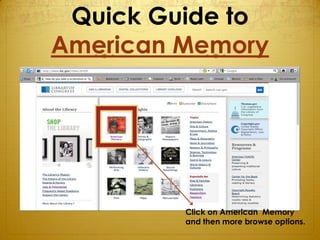
Quick Guide to
American Memory


         Click on American Memory
         and then more browse options.
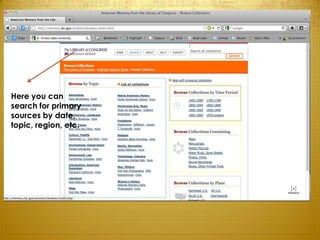
Here you can
search for primary
sources by date,
topic, region, etc.
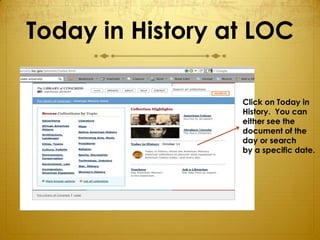
Today in History at LOC

                  Click on Today in
                  History. You can
                  either see the
                  document of the
                  day or search
                  by a specific date.
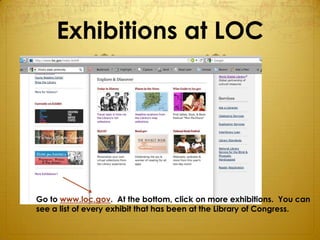
Exhibitions at LOC


Go to www.loc.gov. At the bottom, click on more exhibitions. You can
see a list of every exhibit that has been at the Library of Congress.
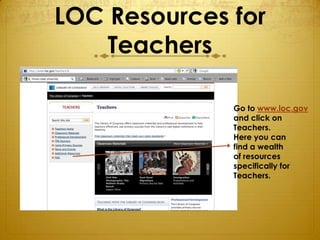
LOC Resources for
    Teachers

              Go to www.loc.gov
              and click on
              Teachers.
              Here you can
              find a wealth
              of resources
              specifically for
              Teachers.
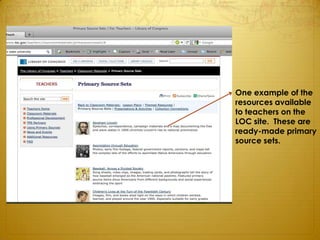
One example of the
resources available
to teachers on the
LOC site. These are
ready-made primary
source sets.
Using Primary Sources to
    Teach Historical Thinking
 Historical Thinking Skills
       Chronological Thinking
       Historical Comprehension
       Historical Analysis and Interpretation
       Historical Research Capabilities
       Historical Issues- Analysis and Decision Making

   An Introduction to Historical Thinking Skills
www.teachinghistory.org/historical-thinking-intro
Technology to Enhance Your
             History Classroom
    (Find many more links at www.technologynow.wikispaces.com)

   C-SPAN Classroom- Especially check out American History TV

       www.c-spanclassroom.org
   Glogster– Poster yourself

       www.edu.glogster.com
   Stixy– Create virtual bulletin boards

       http://stixy.com
   Live Binders- Create virtual binders

       http://livebinders.com
    Scribble Maps- Maps you can scribble on, add pictures, text, etc.

       www.scribblemaps.com
Continued…
   Docs Teach- Hundreds of ready-made activities around primary source
    documents from NARA.

        www.docsteach.org
   Voicethread- Collaborate around almost any type of media

        http://ed.voicethread.com
   Weebly- Create easy to use websites

        http://education.weebly.com
   Fotobabble- Create and share talking photos

        http://fotobabble.com
   Bitstrips- Create your own comic strips

        http://bitstrips.com
Continued…
   Capzles- Create virtual timelines

       http://capzles.com
   Dropbox- Free doc space and can share docs

       www.dropbox.com
   Show Document- Free web meetings

       www.showdocument.com
   Easy Bib- Create free bibliographies in MLA and APA

       http://easybib.com
   Edmodo- It’s like Facebook for K-12 education

       http://edmodo.com
Continued…
 Tube Chop- Easily edit any YouTube video
    www.tubechop.com
 Skype- Talk with anyone in the world… for FREE
    www.skype.com and http://education.skype.com
 Living Room Candidate- Presidential campaign ads
  since 1952.
    www.livingroomcandidate.org
 Cool Tools for Schools- Collection of Web 2.0 tools
    www.cooltoolsforschools.wikispaces.com
Questions?
Comments?

Primarily Teaching: Teaching with Primary Sources

  • 1.
    Primarily Teaching: Using PrimarySources to Engage Students in the Study of History Stefanie Rosenberg Wager Email: stefanie.rosenbergwager@gmail.com Twitter: @srwteacher Blog: www.stefaniewager.blogspot.com Websites: www.technologynow.wikispaces.com www.usingprimarysources.weebly.com
  • 2.
    Poll Everywhere  Question:Do you use primary sources in your classroom at least once a week?  http://www.polleverywhere.com/multiple_choice_ polls/MTQ1ODUzOTA3Ng
  • 3.
    Using Primary Sources? In a recent study, teachers cited three main reasons they don’t use primary sources:  No time to find primary sources.  Too many resources available. It’s hard to funnel down to “best” resources.  Don’t know how to effectively use primary sources with students.
  • 4.
    So, What isa Primary Source?  What is your definition of a primary source?  Primary Source Sort  Working with your elbow partner, rework your definition of a primary source.  Be ready to share out!
  • 5.
    One Definition  Primarysources provide first hand testimony or direct evidence concerning a topic under investigation. They are created by witnesses or recorders who experienced the events or conditions being documented. Often these sources are created at the time when the events or conditions are occurring, but primary sources can also include autobiographies, memoirs, and oral histories recorded later.
  • 6.
    Using Primary Sources to Teach Inquiry
  • 7.
    Guiding Questions Observe Reflect Question I Know • What do you • Why do you • What do you • What do you notice first? think this wonder now know • What people image was about? about the and objects made? • Who? image after are shown? • What’s • What? examining it? • How are they happening in • When? arranged? the image? • Where? • What is the • When do you • Why? physical think it was • How? setting? made? • What details • What can can you see? you learn from examining this image?
  • 8.
    Political Cartoons  Cartoon analysis guide  Have students label elements of political cartoons  Symbolism  Exaggeration  Labeling  Analogy  Irony
  • 9.
    Prints & Photographs Zoom in strategy (use magnifying glasses)  Prequel/ Sequel
  • 10.
  • 11.
    Continued…  Put yourself inthe image  Thought Bubbles  30 Second Look and Then Dig Deeper
  • 12.
    Analyzing Maps  TheDevil is in the Details  Give students pieces of a map and have each student examine one piece of the map.  Have them record what they know on sticky notes and place on the map.  Then have them share with a partner or larger group.  Finally, have students put the map together to see the “big picture.”
  • 13.
    Analyzing Documents  QuoteMVP  Give students quotes and ask them to select their MVP (most valuable point) related to the lesson essential question.  Tampering with History  Change the document so it’s easier to read for struggling readers.  Jigsaw with cooperative learning groups
  • 14.
    Music/ Sound Recordings  Use a song or sound recording as a class opener.  Using music to teach a certain time period in history  Example: Civil War music, Great Depression, etc.  LOC Jukebox (www.loc.gov/jukebox)  LOC Sound Recordings  Example: WPA Slave Narratives http://memory.loc.gov/ammem/collections/voice s/
  • 15.
    Using Art toTeach Historical Analysis  “Reading” a Portrait  Smithsonian American Art Museum  Discussion of art as a primary vs. secondary source
  • 18.
    General Strategies  Weighingthe evidence  Example: Give students 5-7 documents related to causes of the Civil War. Students have to “weigh” which documents carry more weight and answer the essential question.  Civil War Causes and Effects http://docsteach.org/activities/3895  Sorting/categorizing primary sources  Five senses chart  Students analyze various documents and record what they hear, see, taste, feel, and smell.
  • 19.
    Continued…  Historical Debates  Have students play the role of historical figures.  Four Corners  Pose a historical question and ask students to move to the corner of the room they agree with. Label corners agree, strongly agree, disagree, strongly disagree.  For example: Slavery was the cause of the Civil War.
  • 20.
    Continued…  Structured AcademicControversy (SAC)  Socratic Seminars  DBQs (Document Based Questions)  Check out the DBQ Project (www.dbqproject.com)  Reading Like a Historian  Sourcing, Contextualizing, Corroboration, Close Reading  Wordle (www.wordle.net)  Copy and paste text to create a visual image  Great discussion starter and to compare documents
  • 21.
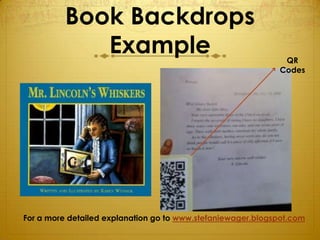
    Historical Book Backdrops  Book backdrops are a way to infuse primary sources into children’s literature.  Steps:  Find a piece of children’s literature that deals with some historical aspect (slavery, WWII, etc.)  As a way to teach the book, select 2-3 primary sources that connect to the book in some way. This varies depending on age level and other factors. For younger students you might just select one image. For older students, you can usually select one short piece of text and photographs.  Use primary source strategies to not only teach the book, but also the historical aspects of the book through the use of the primary sources. (You can also bring in technology such as QR codes to help with this step.)
  • 22.
    Book Backdrops Example QR Codes For a more detailed explanation go to www.stefaniewager.blogspot.com
  • 23.
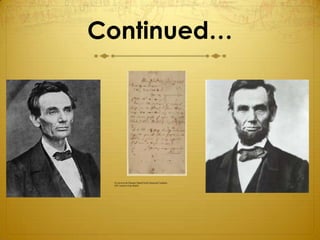
    Continued… On loanfrom the Benjamin Shapell Family Manuscript Foundation (070, Lincoln to Grace Bedell) http://myloc.gov/Exhibitions/lincoln/vignettes/CandidateLincoln/ExhibitObjects/LincolnsBeard.aspx The Library of Congress www.lov.gov/teachers
  • 24.
    Where Can IFind Primary Sources?  Top Ten Places to Find Primary Sources  Other sources?  One of the best places to find primary sources is….  The Library of Congress (www.loc.gov)
  • 25.
    Key Parts ofLibrary of Congress Website  American Memory (contains over 20 million digitized items)  Exhibitions (place to view all exhibitions that have been at LOC)  THOMAS (access to past and present Congressional records)  World Digital Library (key primary sources from each region of the world)  Veterans History Project (oral histories of veterans and other resources)  Kids and Families Section  Teachers Section (lots of resources on using primary sources, lesson plans, etc.)  Researchers
  • 26.
    Quick Guide to AmericanMemory Click on American Memory and then more browse options.
  • 27.
    Here you can searchfor primary sources by date, topic, region, etc.
  • 28.
    Today in Historyat LOC Click on Today in History. You can either see the document of the day or search by a specific date.
  • 29.
    Exhibitions at LOC Goto www.loc.gov. At the bottom, click on more exhibitions. You can see a list of every exhibit that has been at the Library of Congress.
  • 30.
    LOC Resources for Teachers Go to www.loc.gov and click on Teachers. Here you can find a wealth of resources specifically for Teachers.
  • 31.
    One example ofthe resources available to teachers on the LOC site. These are ready-made primary source sets.
  • 32.
    Using Primary Sourcesto Teach Historical Thinking  Historical Thinking Skills  Chronological Thinking  Historical Comprehension  Historical Analysis and Interpretation  Historical Research Capabilities  Historical Issues- Analysis and Decision Making  An Introduction to Historical Thinking Skills www.teachinghistory.org/historical-thinking-intro
  • 33.
    Technology to EnhanceYour History Classroom (Find many more links at www.technologynow.wikispaces.com)  C-SPAN Classroom- Especially check out American History TV  www.c-spanclassroom.org  Glogster– Poster yourself  www.edu.glogster.com  Stixy– Create virtual bulletin boards  http://stixy.com  Live Binders- Create virtual binders  http://livebinders.com  Scribble Maps- Maps you can scribble on, add pictures, text, etc.  www.scribblemaps.com
  • 34.
    Continued…  Docs Teach- Hundreds of ready-made activities around primary source documents from NARA.  www.docsteach.org  Voicethread- Collaborate around almost any type of media  http://ed.voicethread.com  Weebly- Create easy to use websites  http://education.weebly.com  Fotobabble- Create and share talking photos  http://fotobabble.com  Bitstrips- Create your own comic strips  http://bitstrips.com
  • 35.
    Continued…  Capzles- Create virtual timelines  http://capzles.com  Dropbox- Free doc space and can share docs  www.dropbox.com  Show Document- Free web meetings  www.showdocument.com  Easy Bib- Create free bibliographies in MLA and APA  http://easybib.com  Edmodo- It’s like Facebook for K-12 education  http://edmodo.com
  • 36.
    Continued…  Tube Chop-Easily edit any YouTube video  www.tubechop.com  Skype- Talk with anyone in the world… for FREE  www.skype.com and http://education.skype.com  Living Room Candidate- Presidential campaign ads since 1952.  www.livingroomcandidate.org  Cool Tools for Schools- Collection of Web 2.0 tools  www.cooltoolsforschools.wikispaces.com
  • 37.

Editor's Notes

  • #3 Time: 2 minutes
  • #4 Introductions: 5 minutesRate Yourself Activity and Discussion: 5 minutes
  • #5 Ask participants to think about their definition of a primary source. (2 minutes)Primary source sort (8 minutes)Rework definition of primary source (2 minutes)
  • #7 Using Primary Sources to Teach Inquiry with Primary Source Analysis Tool (10 minutes)Picture: Reader in a Cigar Factory He reads books and newspapers at the top of his voice all day long. This is all the education many of these workers receive. He is paid by them and they select what he reads. Tampa, Florida January 1909 from the Lewis Hine collection
  • #13 Do Waldseemuller Map Activity -Give a piece of the map to each person or pair-Ask participants to record observation about their section of the map on the primary source analysis sheet-Next, ask participants to get with another group and compare notes.-Once they are done sharing notes, ask participants to circulate around the room and put the map together. Notes about the Map: Crated by Martin Waldseemuller around 1507. It is the first known map to use the word “America.”
  • #17 Notes: Westward the Course of Empire Takes Its Way, US Capitol, 1861
  • #18 Notes: Final Version, 1862
  • #25 Pass out Top Ten Places to Find Primary Sources
  • #33 Reference Historical Thinking Standards,