Research Inventy: International Journal Of Engineering And Science
Vol.4, Issue 11 (November2014), PP 15-20
Issn (e): 2278-4721, Issn (p):2319-6483, www.researchinventy.com
15
Characteristic comparison of TiO2 thin films with an inorganic
and organic precursor at different molarities by Spray pyrolysis
I.Joseph Panneerdoss, S.Johnson Jeyakumar, M.Jothibas
Department of Physics,T.B.M.L.College,Porayar-609307,India
ABSTRACT :TiO2 thin films were deposited by spray pyrolysis technique using TiCl3 and TiAcAc as precursors
on glass substrate. The structural and optical characteristics have been studied with variation of precursor
concentration and precursor. XRD showed the structural orientation of the films especially in (101) plane
corresponding anatase phase of TiO2. Band gap energy, refractive index, extinction coefficient and dielectric
constants were estimated from U-V absorption data. The variations of these optical parameters with molar
concentrations and precursors had been studied. The intense green light emissions for the films at 0.05M and
0.1M for InCl3 precursor and U-V and violet emission for the films at 0.05M and 0.1M for TiAcAc precursor
were observed in the PL spectra.
KEYWORDS: TiAcAc, Pneumatic, Dielectric constant, organometallic.
I. INTRODUCTION
Titanium dioxide (TiO2) or titania thin films are widely studied because of their fascinating chemical,
electrical and optical properties [1,2]. TiO2 film in anatase phase could achieve the photocatalytic degradation of
organic compounds under the radiation of UV. So, it has a diversity of application views in the field of
environmental protection [3,5]. TiO2 thin film in rutile phase is known as a good blood compatibility material
and can be used as artificial heart valves [5]. In addition, TiO2 films are important optical films due to their high
reflective index and transparency over a wide spectral range [2]. During the two last decades, several methods
have been used for the TiO2 thin films preparation, [6], sol–gel method [7], chemical vapour deposition [8],
successive ionic layer adsorption and reaction (SILAR) [9], solvothermal [10], chemical bath deposition
[11] and spray pyrolysis [12]. Among these methods, spray pyrolysis technique has got many advantages such
as the low cost of the apparatus and source materials, accurate control over the deposition parameters and
producing large area films deposition compared to other deposition methods.
TiO2 films were deposited so far with Titanium (III) chloride (TiCl3), Titanium (IV) Chloride (TiCl4),
Titanium (IV) isopropoxide Ti(OCH(CH3)2)4, Titanium di-isopropoxyldi-ethyl hexanoate(Ti(OC3H7)2
(C7H15COO)2, Titanyl acetylacetonate (TiC10H14O5) etc used as precursors. Among these precursors, Titanyl
acetylacetonate (TiAcAc) is a predominant and TiCl3 is an infrequent source material for TiO2 films deposition.
In the present work we have compared the structural and optical characteristics of sprayed TiO2 films
with an inorganic precursor TiCl3 and an organic or organometallicprecursor TiAcAc at different molar
concentrations. Initially the XRD characterization of deposited films at different temperatures at a constant
precursor concentration is studied and the optimum temperature was fixed for both the precursors. Then the
optimum molarity was found by various studies of deposited TiO2 films for various precursor concentrations
with this optimum temperature. The scope of this work is to optimize the molar concentration and precursor of
highly transparent conductive TiO2 films by comparing the characteristics.
II. EXPERIMENTAL DETAILS
TiO2 films were deposited at different molarities for both the precursors by a pneumatic controlled
spray pyrolysis. TiCl3 and deionized water mixtures, TiAcAc and methanol mixtures were sprayed on to glass
substrates with dimension of 75 x 25 mm2
. During our experiments we had varied the precursor concentration to
0.05M and 0.1M by keeping substrate temperature and other deposition parameters as constant. In the spray
pyrolysis unit the substrate temperature was maintained with help of a heater and an electronic circuitry, which
contains a thermal sensor with relay switch. The precursor solution and career gas assembly connected to spray
gun was moved in the horizontal plane by means of pneumatic controlled system. The substrate to nozzle
distance was maintained at 25cm with 45o
angle. The films deposited on pre-cleaned glass plates were gradually
cooled to room temperature and then rinsed with deionized water and dried.The obtained TiO2 films were
annealed at 500o
C for 5 hours in stagnant air.
Characteristic comparison of TiO2 thin films…
16
The well-adherent TiO2 films underwent structural, optical studies. The structural studies were carried
out by using on Pan Analytic X’Part PRO Powder X-ray diffractometer (XRD) equipped with Cu-Kα
radiation (λ=1.5418Å). The optical absorption and photoluminescence spectra were recorded using UV-VIS-
Perkin Elmer’s LAMBDA35 spectrophotometer and Varian Carry ellipse photoluminescence spectrometer
respectively.
III. RESULTS AND DISCUSSION
3.1. Structural studies:
The XRD spectra of TiO2 films for the molarities 0.05M and 0.1M for the precursor (i) TiCl3 and
(ii) TiAcAc are as shown in Fig.1.The XRD spectra of TiO2 films deposited at various molar concentrations of
0.05M and 0.1M and heat-treated at 500o
C for 5 hours are shown in Fig.1. The plots show polycrystalline nature
with a noticeable (1 0 1) peak of TiO2 at 2θ = 25.28o
. This peak corresponds to the tetragonal crystal structure of
anatase phase with space group I41/amd. The observed ‘d’ value is in good agreement with the JCPDS Card No-
21-1272. [13]. The lattice constants a and c have been determined from inter planar spacing of different
(h k l) planes. The inter-planar distance between the lattice planes are consistent with the standard values and
the calculated unit cell parameters a=3.778 Å, c=9.681 Å are nearly equal to the standard values a=3.785 Å and
c=9.513Å.
In the spectra, for the precursor TiCl3 the film deposited at 0.05M, only the plane Anatase(101) is
present. While increasing molarity to 0.1M, the intensity of A(101) plane is increased along with some new
planes A(004) and A(200) are appeared due to increasing nucleation and growth of the films. For the precursor
TiAcAc the film deposited at 0.05M, along with intense A(101) plane a new plane A(211) is appeared with less
intensity. Further increasing of molarity to 0.1M, the intensity of A(101) plane is decreased. Among these films,
TiCl3 precursor 0.1M has A(101) plane with a very high intensity exhibiting the improved crystalline structure.
Fig.1.XRD Spectra of TiO2 films at different molarities for the precursors
(i) TiCl3 and (ii) TiAcAc
The grain size calculations are carried out from the Scherer-Bragg equation
(1)
The micro strain (Ɛ) is determined with the relation:
(2)
The dislocation density (δ) is calculated using the relation:
(3)
The inter planar spacing (d hkl) is calculated using the relation
(4)
The parameters of (101) plane, for different molarities is listed in Table.1. It shows that the 0.1M with
TiCl3 precursor has favorable structural parameters rather than other films.
Characteristic comparison of TiO2 thin films…
17
Table.1. microstructural parameters of anatase (101) plane of TiO2films deposited at different molarities for the
precursors (i) TiCl3 and (ii) TiAcAc
Molar Grain size, D Micro strain, Ɛ Dislocation density, δ Inter- planar
concentration (nm) x10-3
x1015
(m-2
) spacing (nm)
0.05M(i) 16.6 2.17 3.60 0.92
0.1 M (i) 20.7 1.74 2.31 1.12
0.05M(ii) 6.9 5.19 2.05 1.87
0.1 M (ii) 4.8 7.48 4.27 2.04
3.2. Optical properties of TiO2films
The optical transmittance spectra of TiO2 films at the molarities 0.05M and 0.1M for the precursors (i)
TiCl3 and (ii) TiAcAcare as shown in fig.2 for the wavelength range of 300 nm to 1000 nm. The percentage of
transmittance for all the films is minimum in UV region and maximum in the visible and near infra-red regions.
The increasing transmittance percentage is due to uniform oxidation and improved lattice arrangements [14].
From the transmittance spectra, the transmittance percentage of the film at 0.1M for the TiCl3precursor is
maximum than the film at 0.05M.For the TiAcAc precursor the transmittance percentage of the film deposited at
0.05M is maximum than the film at 0.1M.On comparing the precursors the transmittance percentage is
maximum at 0.05M with TiAcAc precursor.
Fig.2. Optical Transmission spectra of TiO2 films at different molarities for the precursors (i) TiCl3 and
(ii) TiAcAc
The optical band gap of deposited TiO2 films is evaluated from the relation between absorption
coefficient α and photon energy hν.
(αhν) = A (hν-Eg)x
(6)
Where A is a constant, Eg is the optical band gap and x=1/2 for directly allowed electronic transitions. The fig.3
shows the plot between (αhν)2
and hν of the deposited films at 0.05M and 0.1M for the precursors (i) TiCl3 and
(ii) TiAcAc.The extrapolation of linear portion of the curves on ɦν axis gives the direct band gap energy. The
spectra shows that the band gap energy of the films ranging from 3.1 eV to 3.6 eV. The increasing of band gap
energy is accredited to the carrier density due to Brustein-Moss effect [15]. The high value of band gap energy
for the film at 0.05M for the TiAcAc precursor is 3.6eV.
Fig.3 Optical band gap spectra of TiO2 films at different molarities for the precursors(i) TiCl3 and (ii) TiAcAc
Characteristic comparison of TiO2 thin films…
18
The extinction coefficient (k) can be determined using the relation
(7)
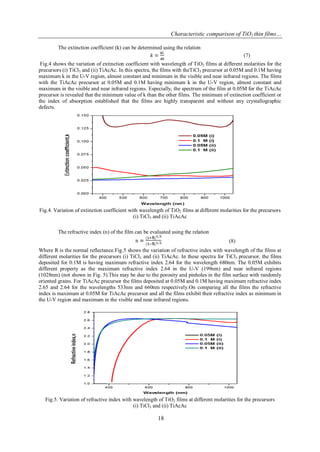
Fig.4 shows the variation of extinction coefficient with wavelength of TiO2 films at different molarities for the
precursors (i) TiCl3 and (ii) TiAcAc. In this spectra, the films with theTiCl3 precursor at 0.05M and 0.1M having
maximum k in the U-V region, almost constant and minimum in the visible and near infrared regions. The films
with the TiAcAc precursor at 0.05M and 0.1M having minimum k in the U-V region, almost constant and
maximum in the visible and near infrared regions. Especially, the spectrum of the film at 0.05M for the TiAcAc
precursor is revealed that the minimum value of k than the other films. The minimum of extinction coefficient or
the index of absorption established that the films are highly transparent and without any crystallographic
defects.
Fig.4. Variation of extinction coefficient with wavelength of TiO2 films at different molarities for the precursors
(i) TiCl3 and (ii) TiAcAc
The refractive index (n) of the film can be evaluated using the relation
(8)
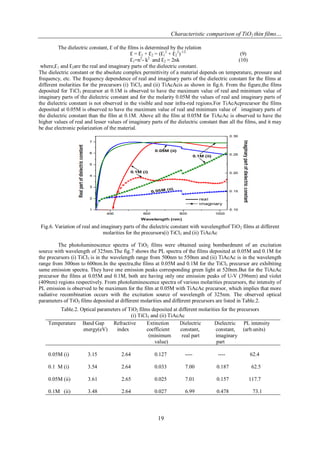
Where R is the normal reflectance.Fig.5 shows the variation of refractive index with wavelength of the films at
different molarities for the precursors (i) TiCl3 and (ii) TiAcAc. In these spectra for TiCl3 precursor, the films
deposited for 0.1M is having maximum refractive index 2.64 for the wavelength 680nm. The 0.05M exhibits
different property as the maximum refractive index 2.64 in the U-V (199nm) and near infrared regions
(1028nm) (not shown in Fig. 5).This may be due to the porosity and pinholes in the film surface with randomly
oriented grains. For TiAcAc precursor the films deposited at 0.05M and 0.1M having maximum refractive index
2.65 and 2.64 for the wavelengths 533nm and 660nm respectively.On comparing all the films the refractive
index is maximum at 0.05M for TiAcAc precursor and all the films exhibit their refractive index as minimum in
the U-V region and maximum in the visible and near infrared regions.
Fig.5. Variation of refractive index with wavelength of TiO2 films at different molarities for the precursors
(i) TiCl3 and (ii) TiAcAc
Characteristic comparison of TiO2 thin films…
19
The dielectric constant, Ɛ of the films is determined by the relation
Ɛ = Ɛ1 + Ɛ2 = (Ɛ1
2
+ Ɛ2
2
)1/2
(9)
Ɛ1=n2
- k2
and Ɛ2 = 2nk (10)
where,Ɛ1 and Ɛ2are the real and imaginary parts of the dielectric constant.
The dielectric constant or the absolute complex permittivity of a material depends on temperature, pressure and
frequency, etc. The frequency dependence of real and imaginary parts of the dielectric constant for the films at
different molarities for the precursors (i) TiCl3 and (ii) TiAcAcis as shown in fig.6. From the figure,the films
deposited for TiCl3 precursor at 0.1M is observed to have the maximum value of real and minimum value of
imaginary parts of the dielectric constant and for the molarity 0.05M the values of real and imaginary parts of
the dielectric constant is not observed in the visible and near infra-red regions.For TiAcAcprecursor the films
deposited at 0.05M is observed to have the maximum value of real and minimum value of imaginary parts of
the dielectric constant than the film at 0.1M. Above all the film at 0.05M for TiAcAc is observed to have the
higher values of real and lesser values of imaginary parts of the dielectric constant than all the films, and it may
be due electronic polarization of the material.
Fig.6. Variation of real and imaginary parts of the dielectric constant with wavelengthof TiO2 films at different
molarities for the precursors(i) TiCl3 and (ii) TiAcAc
The photoluminescence spectra of TiO2 films were obtained using bombardment of an excitation
source with wavelength of 325nm.The fig.7 shows the PL spectra of the films deposited at 0.05M and 0.1M for
the precursors (i) TiCl3 is in the wavelength range from 500nm to 550nm and (ii) TiAcAc is in the wavelength
range from 300nm to 600nm.In the spectra,the films at 0.05M and 0.1M for the TiCl3 precursor are exhibiting
same emission spectra. They have one emission peaks corresponding green light at 520nm.But for the TiAcAc
precursor the films at 0.05M and 0.1M, both are having only one emission peaks of U-V (396nm) and violet
(409nm) regions respectively. From photoluminescence spectra of various molarities precursors, the intensity of
PL emission is observed to be maximum for the film at 0.05M with TiAcAc precursor, which implies that more
radiative recombination occurs with the excitation source of wavelength of 325nm. The observed optical
parameters of TiO2 films deposited at different molarities and different precursors are listed in Table.2.
Table.2. Optical parameters of TiO2 films deposited at different molarities for the precursors
(i) TiCl3 and (ii) TiAcAc
Temperature Band Gap Refractive Extinction Dielectric Dielectric PL intensity
energy(eV) index coefficient constant, constant, (arb.units)
(minimum real part imaginary
value) part
0.05M (i) 3.15 2.64 0.127 ---- ---- 62.4
0.1 M (i) 3.54 2.64 0.033 7.00 0.187 62.5
0.05M (ii) 3.61 2.65 0.025 7.01 0.157 117.7
0.1M (ii) 3.48 2.64 0.027 6.99 0.478 73.1
Characteristic comparison of TiO2 thin films…
20
Fig.7. PL spectra of the TiO2 films at different molarities for the precursors (i) TiCl3 and (ii) TiAcAc
IV. CONCLUSIONS
The Titanium oxide (TiO2) films were deposited by spray pyrolysis technique using an inorganic
compound Titanium chloride(TiCl3) and an organic compound Titanylacetylacetonate(TiAcAc) as precursors.
The films were deposited at 0.05M and 0.1M for both the precursors and annealed at 500o
C for 5 hours in
stagnant air. On comparing the microstructural characteristics of the films at 0.05M and 0.1M for theTiCl3
precursor, the film deposited at 0.1M has (101) plane with very high intensity exhibited that the improved
crystalline structure, maximum of grain size and minimum of micro strain and dislocation density. On
comparing the films at 0.05M and 0.1M for theTiAcAc precursor, the film deposited at 0.05M has favorable
microstructural characteristics.In addition, on comparing these two,the film at 0.1M with TiCl3 precursor has
favorable microstructural characteristics than the other one. But the dislocation density is minimum for the film
at 0.05M with TiAcAc precursor than the 0.1M with TiCl3 precursor. The optical properties of semiconductors
mainly depends the structural disorder[16]. The film at 0.05M with TiAcAc precursor is having promising
optical properties such as high band gap energy as 3.6eV, high refractive index, low extinction coefficient and
high intense PL emission than the other films due to the minimum dislocation density. Furthermore the film
deposited for 0.05M for Titanyl acetylacetonate as precursor had appropriate characters, which make the
optimized deposition as the most suitable for gas sensing and optoelectronic applications.
REFERENCES
[1] S. K. Zheng, T. M. Wang, G. Xiang, C. Wang, 2001Vacuum j. 62: 361-366.
[2] M. Radecka, K. Zakrzewska, H. Czternastek, T. Stapinéski, S. Debrus, 1993Appl. Surf. Sci. j. 65: 227-234.
[3] D. Dumitriu, A. R. Bally, C. Ballif, P. Hones, P. E. Schmid, R. Sanjinés, F. Lévy, V. I.Pârvulescu, 2000Appl. Catal. B: Environ.
J. 25: 83-92.
[4] S. Takeda, S. Suzuki, H. Odaka, 2001Thin Solid Films j. 392: 338-344.
[5] F. Zhang, N. Huang, P. Yang1996Surf. Coat. Technol. J. 84: 476-479.
[6] A. Iwulska, G. Sliwinski, Photon. Lett. Poland 3 (2011) 98–100.
[7] E. Haimi, H. Lipsonen, J. Larismaa, M. Kapulainen, J. Krzak-Ros, S. P. Hannula, Thin Solid Films 519 (2011)
5882–5886.
[8] V.G.Bessergenev, I.V.Khmelinskii, R.J.F.Pereira, V.V.Krisuk, A.E. Turgambaeva, I.K. Igumenov, Vacuum 64 (2002)
275–279.
[9] U.M. Patil, K.V. Gurav, O. S. Joo, C.D. Lokhande, J. Alloys Compd. 478 (2009) 711–715.
[10] Q. Zhang, C. Sun, J. Yan, X. Hu, S. Zhou, P. Chen, Solid State Sci. 12 (2010) 1274–1277.
[11] U.M. Patil, S.B. Kulkarni, P.R. Deshmukh, R.R. Salunkhe, C.D. Lokhande, J. Alloys Compd. 509 (2011) 6196–199.
[12] N.C. Raut, T. Mathews, P. Chandramohan, M.P. Srinivasan, S. Dash, A.K. Tyagi, Mater. Res. Bull. 46 (2011) 2057–2063.
[13] R. Mechiakh, R. Bensaha, C. R. Phys. 7 (2006) 464–470.
[14] H. Hansel, H. Zettl, G. Kraush, R. Kisselev, M. Thelakat, H.W. Schmidt, Adv. Mater. 15 (2003) 2056–2060.
[15] K.L. Chopra, S.R. Das, Thin Film Solar Cells, Plenum Press, New York,1983.
[16] G. Paul, A. Choudhury, C. N. R. Rao, J. Chem. Soc. Dalton Trans. (2002) 3859-3867.

Characteristic comparison of TiO2 thin films with an inorganic and organic precursor at different molarities by Spray pyrolysis

  • 1.
    Research Inventy: InternationalJournal Of Engineering And Science Vol.4, Issue 11 (November2014), PP 15-20 Issn (e): 2278-4721, Issn (p):2319-6483, www.researchinventy.com 15 Characteristic comparison of TiO2 thin films with an inorganic and organic precursor at different molarities by Spray pyrolysis I.Joseph Panneerdoss, S.Johnson Jeyakumar, M.Jothibas Department of Physics,T.B.M.L.College,Porayar-609307,India ABSTRACT :TiO2 thin films were deposited by spray pyrolysis technique using TiCl3 and TiAcAc as precursors on glass substrate. The structural and optical characteristics have been studied with variation of precursor concentration and precursor. XRD showed the structural orientation of the films especially in (101) plane corresponding anatase phase of TiO2. Band gap energy, refractive index, extinction coefficient and dielectric constants were estimated from U-V absorption data. The variations of these optical parameters with molar concentrations and precursors had been studied. The intense green light emissions for the films at 0.05M and 0.1M for InCl3 precursor and U-V and violet emission for the films at 0.05M and 0.1M for TiAcAc precursor were observed in the PL spectra. KEYWORDS: TiAcAc, Pneumatic, Dielectric constant, organometallic. I. INTRODUCTION Titanium dioxide (TiO2) or titania thin films are widely studied because of their fascinating chemical, electrical and optical properties [1,2]. TiO2 film in anatase phase could achieve the photocatalytic degradation of organic compounds under the radiation of UV. So, it has a diversity of application views in the field of environmental protection [3,5]. TiO2 thin film in rutile phase is known as a good blood compatibility material and can be used as artificial heart valves [5]. In addition, TiO2 films are important optical films due to their high reflective index and transparency over a wide spectral range [2]. During the two last decades, several methods have been used for the TiO2 thin films preparation, [6], sol–gel method [7], chemical vapour deposition [8], successive ionic layer adsorption and reaction (SILAR) [9], solvothermal [10], chemical bath deposition [11] and spray pyrolysis [12]. Among these methods, spray pyrolysis technique has got many advantages such as the low cost of the apparatus and source materials, accurate control over the deposition parameters and producing large area films deposition compared to other deposition methods. TiO2 films were deposited so far with Titanium (III) chloride (TiCl3), Titanium (IV) Chloride (TiCl4), Titanium (IV) isopropoxide Ti(OCH(CH3)2)4, Titanium di-isopropoxyldi-ethyl hexanoate(Ti(OC3H7)2 (C7H15COO)2, Titanyl acetylacetonate (TiC10H14O5) etc used as precursors. Among these precursors, Titanyl acetylacetonate (TiAcAc) is a predominant and TiCl3 is an infrequent source material for TiO2 films deposition. In the present work we have compared the structural and optical characteristics of sprayed TiO2 films with an inorganic precursor TiCl3 and an organic or organometallicprecursor TiAcAc at different molar concentrations. Initially the XRD characterization of deposited films at different temperatures at a constant precursor concentration is studied and the optimum temperature was fixed for both the precursors. Then the optimum molarity was found by various studies of deposited TiO2 films for various precursor concentrations with this optimum temperature. The scope of this work is to optimize the molar concentration and precursor of highly transparent conductive TiO2 films by comparing the characteristics. II. EXPERIMENTAL DETAILS TiO2 films were deposited at different molarities for both the precursors by a pneumatic controlled spray pyrolysis. TiCl3 and deionized water mixtures, TiAcAc and methanol mixtures were sprayed on to glass substrates with dimension of 75 x 25 mm2 . During our experiments we had varied the precursor concentration to 0.05M and 0.1M by keeping substrate temperature and other deposition parameters as constant. In the spray pyrolysis unit the substrate temperature was maintained with help of a heater and an electronic circuitry, which contains a thermal sensor with relay switch. The precursor solution and career gas assembly connected to spray gun was moved in the horizontal plane by means of pneumatic controlled system. The substrate to nozzle distance was maintained at 25cm with 45o angle. The films deposited on pre-cleaned glass plates were gradually cooled to room temperature and then rinsed with deionized water and dried.The obtained TiO2 films were annealed at 500o C for 5 hours in stagnant air.
  • 2.
    Characteristic comparison ofTiO2 thin films… 16 The well-adherent TiO2 films underwent structural, optical studies. The structural studies were carried out by using on Pan Analytic X’Part PRO Powder X-ray diffractometer (XRD) equipped with Cu-Kα radiation (λ=1.5418Å). The optical absorption and photoluminescence spectra were recorded using UV-VIS- Perkin Elmer’s LAMBDA35 spectrophotometer and Varian Carry ellipse photoluminescence spectrometer respectively. III. RESULTS AND DISCUSSION 3.1. Structural studies: The XRD spectra of TiO2 films for the molarities 0.05M and 0.1M for the precursor (i) TiCl3 and (ii) TiAcAc are as shown in Fig.1.The XRD spectra of TiO2 films deposited at various molar concentrations of 0.05M and 0.1M and heat-treated at 500o C for 5 hours are shown in Fig.1. The plots show polycrystalline nature with a noticeable (1 0 1) peak of TiO2 at 2θ = 25.28o . This peak corresponds to the tetragonal crystal structure of anatase phase with space group I41/amd. The observed ‘d’ value is in good agreement with the JCPDS Card No- 21-1272. [13]. The lattice constants a and c have been determined from inter planar spacing of different (h k l) planes. The inter-planar distance between the lattice planes are consistent with the standard values and the calculated unit cell parameters a=3.778 Å, c=9.681 Å are nearly equal to the standard values a=3.785 Å and c=9.513Å. In the spectra, for the precursor TiCl3 the film deposited at 0.05M, only the plane Anatase(101) is present. While increasing molarity to 0.1M, the intensity of A(101) plane is increased along with some new planes A(004) and A(200) are appeared due to increasing nucleation and growth of the films. For the precursor TiAcAc the film deposited at 0.05M, along with intense A(101) plane a new plane A(211) is appeared with less intensity. Further increasing of molarity to 0.1M, the intensity of A(101) plane is decreased. Among these films, TiCl3 precursor 0.1M has A(101) plane with a very high intensity exhibiting the improved crystalline structure. Fig.1.XRD Spectra of TiO2 films at different molarities for the precursors (i) TiCl3 and (ii) TiAcAc The grain size calculations are carried out from the Scherer-Bragg equation (1) The micro strain (Ɛ) is determined with the relation: (2) The dislocation density (δ) is calculated using the relation: (3) The inter planar spacing (d hkl) is calculated using the relation (4) The parameters of (101) plane, for different molarities is listed in Table.1. It shows that the 0.1M with TiCl3 precursor has favorable structural parameters rather than other films.
  • 3.
    Characteristic comparison ofTiO2 thin films… 17 Table.1. microstructural parameters of anatase (101) plane of TiO2films deposited at different molarities for the precursors (i) TiCl3 and (ii) TiAcAc Molar Grain size, D Micro strain, Ɛ Dislocation density, δ Inter- planar concentration (nm) x10-3 x10¹⁵ (m-2 ) spacing (nm) 0.05M(i) 16.6 2.17 3.60 0.92 0.1 M (i) 20.7 1.74 2.31 1.12 0.05M(ii) 6.9 5.19 2.05 1.87 0.1 M (ii) 4.8 7.48 4.27 2.04 3.2. Optical properties of TiO2films The optical transmittance spectra of TiO2 films at the molarities 0.05M and 0.1M for the precursors (i) TiCl3 and (ii) TiAcAcare as shown in fig.2 for the wavelength range of 300 nm to 1000 nm. The percentage of transmittance for all the films is minimum in UV region and maximum in the visible and near infra-red regions. The increasing transmittance percentage is due to uniform oxidation and improved lattice arrangements [14]. From the transmittance spectra, the transmittance percentage of the film at 0.1M for the TiCl3precursor is maximum than the film at 0.05M.For the TiAcAc precursor the transmittance percentage of the film deposited at 0.05M is maximum than the film at 0.1M.On comparing the precursors the transmittance percentage is maximum at 0.05M with TiAcAc precursor. Fig.2. Optical Transmission spectra of TiO2 films at different molarities for the precursors (i) TiCl3 and (ii) TiAcAc The optical band gap of deposited TiO2 films is evaluated from the relation between absorption coefficient α and photon energy hν. (αhν) = A (hν-Eg)x (6) Where A is a constant, Eg is the optical band gap and x=1/2 for directly allowed electronic transitions. The fig.3 shows the plot between (αhν)2 and hν of the deposited films at 0.05M and 0.1M for the precursors (i) TiCl3 and (ii) TiAcAc.The extrapolation of linear portion of the curves on ɦν axis gives the direct band gap energy. The spectra shows that the band gap energy of the films ranging from 3.1 eV to 3.6 eV. The increasing of band gap energy is accredited to the carrier density due to Brustein-Moss effect [15]. The high value of band gap energy for the film at 0.05M for the TiAcAc precursor is 3.6eV. Fig.3 Optical band gap spectra of TiO2 films at different molarities for the precursors(i) TiCl3 and (ii) TiAcAc
  • 4.
    Characteristic comparison ofTiO2 thin films… 18 The extinction coefficient (k) can be determined using the relation (7) Fig.4 shows the variation of extinction coefficient with wavelength of TiO2 films at different molarities for the precursors (i) TiCl3 and (ii) TiAcAc. In this spectra, the films with theTiCl3 precursor at 0.05M and 0.1M having maximum k in the U-V region, almost constant and minimum in the visible and near infrared regions. The films with the TiAcAc precursor at 0.05M and 0.1M having minimum k in the U-V region, almost constant and maximum in the visible and near infrared regions. Especially, the spectrum of the film at 0.05M for the TiAcAc precursor is revealed that the minimum value of k than the other films. The minimum of extinction coefficient or the index of absorption established that the films are highly transparent and without any crystallographic defects. Fig.4. Variation of extinction coefficient with wavelength of TiO2 films at different molarities for the precursors (i) TiCl3 and (ii) TiAcAc The refractive index (n) of the film can be evaluated using the relation (8) Where R is the normal reflectance.Fig.5 shows the variation of refractive index with wavelength of the films at different molarities for the precursors (i) TiCl3 and (ii) TiAcAc. In these spectra for TiCl3 precursor, the films deposited for 0.1M is having maximum refractive index 2.64 for the wavelength 680nm. The 0.05M exhibits different property as the maximum refractive index 2.64 in the U-V (199nm) and near infrared regions (1028nm) (not shown in Fig. 5).This may be due to the porosity and pinholes in the film surface with randomly oriented grains. For TiAcAc precursor the films deposited at 0.05M and 0.1M having maximum refractive index 2.65 and 2.64 for the wavelengths 533nm and 660nm respectively.On comparing all the films the refractive index is maximum at 0.05M for TiAcAc precursor and all the films exhibit their refractive index as minimum in the U-V region and maximum in the visible and near infrared regions. Fig.5. Variation of refractive index with wavelength of TiO2 films at different molarities for the precursors (i) TiCl3 and (ii) TiAcAc
  • 5.
    Characteristic comparison ofTiO2 thin films… 19 The dielectric constant, Ɛ of the films is determined by the relation Ɛ = Ɛ1 + Ɛ2 = (Ɛ1 2 + Ɛ2 2 )1/2 (9) Ɛ1=n2 - k2 and Ɛ2 = 2nk (10) where,Ɛ1 and Ɛ2are the real and imaginary parts of the dielectric constant. The dielectric constant or the absolute complex permittivity of a material depends on temperature, pressure and frequency, etc. The frequency dependence of real and imaginary parts of the dielectric constant for the films at different molarities for the precursors (i) TiCl3 and (ii) TiAcAcis as shown in fig.6. From the figure,the films deposited for TiCl3 precursor at 0.1M is observed to have the maximum value of real and minimum value of imaginary parts of the dielectric constant and for the molarity 0.05M the values of real and imaginary parts of the dielectric constant is not observed in the visible and near infra-red regions.For TiAcAcprecursor the films deposited at 0.05M is observed to have the maximum value of real and minimum value of imaginary parts of the dielectric constant than the film at 0.1M. Above all the film at 0.05M for TiAcAc is observed to have the higher values of real and lesser values of imaginary parts of the dielectric constant than all the films, and it may be due electronic polarization of the material. Fig.6. Variation of real and imaginary parts of the dielectric constant with wavelengthof TiO2 films at different molarities for the precursors(i) TiCl3 and (ii) TiAcAc The photoluminescence spectra of TiO2 films were obtained using bombardment of an excitation source with wavelength of 325nm.The fig.7 shows the PL spectra of the films deposited at 0.05M and 0.1M for the precursors (i) TiCl3 is in the wavelength range from 500nm to 550nm and (ii) TiAcAc is in the wavelength range from 300nm to 600nm.In the spectra,the films at 0.05M and 0.1M for the TiCl3 precursor are exhibiting same emission spectra. They have one emission peaks corresponding green light at 520nm.But for the TiAcAc precursor the films at 0.05M and 0.1M, both are having only one emission peaks of U-V (396nm) and violet (409nm) regions respectively. From photoluminescence spectra of various molarities precursors, the intensity of PL emission is observed to be maximum for the film at 0.05M with TiAcAc precursor, which implies that more radiative recombination occurs with the excitation source of wavelength of 325nm. The observed optical parameters of TiO2 films deposited at different molarities and different precursors are listed in Table.2. Table.2. Optical parameters of TiO2 films deposited at different molarities for the precursors (i) TiCl3 and (ii) TiAcAc Temperature Band Gap Refractive Extinction Dielectric Dielectric PL intensity energy(eV) index coefficient constant, constant, (arb.units) (minimum real part imaginary value) part 0.05M (i) 3.15 2.64 0.127 ---- ---- 62.4 0.1 M (i) 3.54 2.64 0.033 7.00 0.187 62.5 0.05M (ii) 3.61 2.65 0.025 7.01 0.157 117.7 0.1M (ii) 3.48 2.64 0.027 6.99 0.478 73.1
  • 6.
    Characteristic comparison ofTiO2 thin films… 20 Fig.7. PL spectra of the TiO2 films at different molarities for the precursors (i) TiCl3 and (ii) TiAcAc IV. CONCLUSIONS The Titanium oxide (TiO2) films were deposited by spray pyrolysis technique using an inorganic compound Titanium chloride(TiCl3) and an organic compound Titanylacetylacetonate(TiAcAc) as precursors. The films were deposited at 0.05M and 0.1M for both the precursors and annealed at 500o C for 5 hours in stagnant air. On comparing the microstructural characteristics of the films at 0.05M and 0.1M for theTiCl3 precursor, the film deposited at 0.1M has (101) plane with very high intensity exhibited that the improved crystalline structure, maximum of grain size and minimum of micro strain and dislocation density. On comparing the films at 0.05M and 0.1M for theTiAcAc precursor, the film deposited at 0.05M has favorable microstructural characteristics.In addition, on comparing these two,the film at 0.1M with TiCl3 precursor has favorable microstructural characteristics than the other one. But the dislocation density is minimum for the film at 0.05M with TiAcAc precursor than the 0.1M with TiCl3 precursor. The optical properties of semiconductors mainly depends the structural disorder[16]. The film at 0.05M with TiAcAc precursor is having promising optical properties such as high band gap energy as 3.6eV, high refractive index, low extinction coefficient and high intense PL emission than the other films due to the minimum dislocation density. Furthermore the film deposited for 0.05M for Titanyl acetylacetonate as precursor had appropriate characters, which make the optimized deposition as the most suitable for gas sensing and optoelectronic applications. REFERENCES [1] S. K. Zheng, T. M. Wang, G. Xiang, C. Wang, 2001Vacuum j. 62: 361-366. [2] M. Radecka, K. Zakrzewska, H. Czternastek, T. Stapinéski, S. Debrus, 1993Appl. Surf. Sci. j. 65: 227-234. [3] D. Dumitriu, A. R. Bally, C. Ballif, P. Hones, P. E. Schmid, R. Sanjinés, F. Lévy, V. I.Pârvulescu, 2000Appl. Catal. B: Environ. J. 25: 83-92. [4] S. Takeda, S. Suzuki, H. Odaka, 2001Thin Solid Films j. 392: 338-344. [5] F. Zhang, N. Huang, P. Yang1996Surf. Coat. Technol. J. 84: 476-479. [6] A. Iwulska, G. Sliwinski, Photon. Lett. Poland 3 (2011) 98–100. [7] E. Haimi, H. Lipsonen, J. Larismaa, M. Kapulainen, J. Krzak-Ros, S. P. Hannula, Thin Solid Films 519 (2011) 5882–5886. [8] V.G.Bessergenev, I.V.Khmelinskii, R.J.F.Pereira, V.V.Krisuk, A.E. Turgambaeva, I.K. Igumenov, Vacuum 64 (2002) 275–279. [9] U.M. Patil, K.V. Gurav, O. S. Joo, C.D. Lokhande, J. Alloys Compd. 478 (2009) 711–715. [10] Q. Zhang, C. Sun, J. Yan, X. Hu, S. Zhou, P. Chen, Solid State Sci. 12 (2010) 1274–1277. [11] U.M. Patil, S.B. Kulkarni, P.R. Deshmukh, R.R. Salunkhe, C.D. Lokhande, J. Alloys Compd. 509 (2011) 6196–199. [12] N.C. Raut, T. Mathews, P. Chandramohan, M.P. Srinivasan, S. Dash, A.K. Tyagi, Mater. Res. Bull. 46 (2011) 2057–2063. [13] R. Mechiakh, R. Bensaha, C. R. Phys. 7 (2006) 464–470. [14] H. Hansel, H. Zettl, G. Kraush, R. Kisselev, M. Thelakat, H.W. Schmidt, Adv. Mater. 15 (2003) 2056–2060. [15] K.L. Chopra, S.R. Das, Thin Film Solar Cells, Plenum Press, New York,1983. [16] G. Paul, A. Choudhury, C. N. R. Rao, J. Chem. Soc. Dalton Trans. (2002) 3859-3867.