CREEP BEHAVIOUR OF KEVLAR 49
INOKUCHI MATHEMATIC ANALYSE
S. KACI1
, Z. TOUTOU1
, P. MORLIER2
1
Institut de Génie-Civil,
Université Mouloud MAMMERI de Tizi-Ouzou
Tizi-Ouzou, 15000, Algérie
2
Laboratoire de Rhéologie du Bois de Bordeaux
33610 Cestas-Gazinet, Pierroton, INRA, France
ABSTRACT :
Composite materials which are highly used in high technology industries such as aeronautic
and space are nowadays introduced in building industry.
Because of their good physicochemical characteristics, composite cables can be used as
substitute for steel in prestressed concrete. However, their long term mechanical behaviour is
still not fully understood. Therefore, a rheological model describing the creep behaviour of
cords of Kevlar type 49 is presented in this study.
The obtained simulations are in good agreement with the experimental results.
KEYWORDS : Kevlar, Prestress, Creep, Mechanical Behaviour, Viscoelasticity, Rheological
Model, Simulation, Building Industry.
INTRODUCTION
Composite cables, because of the fact that they are not subject to corrosion and, in addition, in
the long run and at room temperature, show prestress losses due to weak flow and relaxation,
can be used as prestress tools. Also their low density as well as their highly performing
tension features incite researchers and industry related people to use them to build bridges and
other structures, as well as for restoration purposes in damaged structures. Indeed, these
composite materials are being used in many industries such as aeronautics and car
manufacturing, and they are the subject of many research works (1,2, 3, 4, 5). However, to
use these Kevlar reinforced cables as means of prestress, it is necessary to get a good
knowledge tendon (6, 7, 8, 9), helped to know the evolution with time of its relaxation
modulud.
Within the scope of this article, the results of the research which has been carried out on the
study of the creep behaviour under tension of composite cables ( Kevlar high modulus, 0.95
TWA2 ) are presented.
INOKUCHI MATHEMATIC ANALYSE (Application to creep behaviour of Kevlar 49)
The material tested is a braided high modulus Kevlar cord, impregnated with a heat-hardening
resin of Polyester urethane; The composite, thus obtained, has a cylindrical shape of diameter
0.95 mm (11).
Using existing experimental results obtained on this cords of Kevlar type 0.95 TWA2 (12,13),
a rheological model, based on the method of Inocuchi (14), for the long term behaviour of this
material is presented.
The general model which correspond to a creep function of a viscoelastic material is made of
an association in series of a Maxwell cells and a certain number of Kelvin Voigt solids
depending on the viscoelasticity degree of the material.
The total strain is the sum of the elementary strains. Therefore, the general expression of the
creep function is given by:
∑
=
−
−++=
n
i
it
eiJ
t
Jtf
1
)
/
1(
0
0)(
θ
η
(1)
Now, the problem consists in obtaining the different parameters (η0 , J0, Ji, ηi and θi ).
DETERMINATION OF THE PARAMETERS (J0 , ηηηη0 , Ji, ηηηηi and θθθθi ).
Determination of Jo and ηηηη0
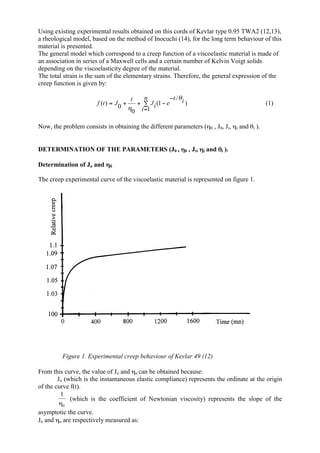
The creep experimental curve of the viscoelastic material is represented on figure 1.
Figure 1. Experimental creep behaviour of Kevlar 49 (12)
From this curve, the value of Jo and ηo can be obtained because:
Jo (which is the instantaneous elastic compliance) represents the ordinate at the origin
of the curve f(t).
1
0η
(which is the coefficient of Newtonian viscosity) represents the slope of the
asymptotic the curve.
Jo and ηo are respectively measured as:
Jo = 1.02*10-11
Pa-1
θ0 = 105
mn
And ηo =9800 GPa.mn ≈ ∞ (considered as infinite).
Next, there is still to determine the number ni of the Kelvin Voigt cells and, therefore, the
parameters ηi and Ji corresponding to each cell.
Determination of the parameters Ji, ηηηηi, and θθθθi
The parameters are determined by means of the mathematical analysis developed by Inocushi
(14).
Determination of the parameters J1, ηηηη1 and θθθθ1
Given a function such that:
Q t J ei
t
i
n
i
( ) /
= −
=
∑ θ
1
(2)
Considering that t is sufficiently big, it is clear from a first analysis that the function to be
considered is:
Q(t) = J1e-t/θ1
⇒ LnQ(t) = LnJ1 – t/θ1 .(3)
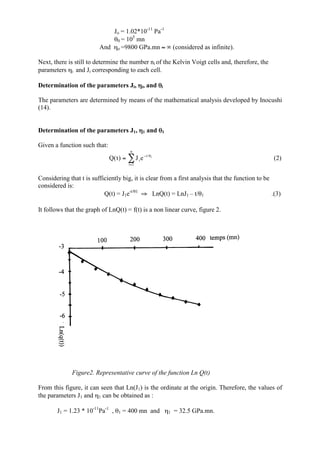
It follows that the graph of LnQ(t) = f(t) is a non linear curve, figure 2.
Figure2. Representative curve of the function Ln Q(t)
From this figure, it can seen that Ln(J1) is the ordinate at the origin. Therefore, the values of
the parameters J1 and η1 can be obtained as :
J1 = 1.23 * 10-11
Pa-1
, θ1 = 400 mn and η1 = 32.5 GPa.mn.
Determination of the parameters J2, ηηηη2 and θθθθ2
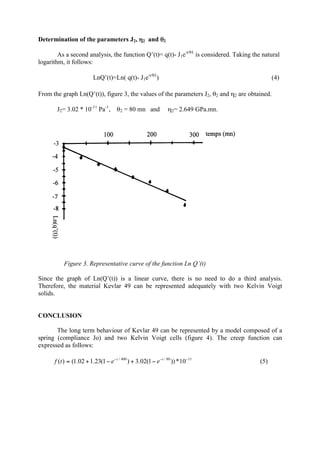
As a second analysis, the function Q’(t)= q(t)- J1e-t/θ1
is considered. Taking the natural
logarithm, it follows:
LnQ’(t)=Ln( q(t)- J1e-t/θ1
) (4)
From the graph Ln(Q’(t)), figure 3, the values of the parameters J2, θ2 and η2 are obtained.
J2= 3.02 * 10-11
Pa-1
, θ2 = 80 mn and η2= 2.649 GPa.mn.
Figure 3. Representative curve of the function Ln Q’(t)
Since the graph of Ln(Q’(t)) is a linear curve, there is no need to do a third analysis.
Therefore, the material Kevlar 49 can be represented adequately with two Kelvin Voigt
solids.
CONCLUSION
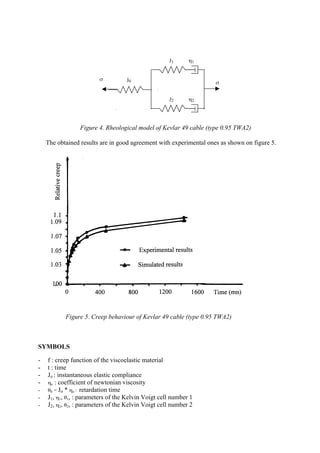
The long term behaviour of Kevlar 49 can be represented by a model composed of a
spring (compliance Jo) and two Kelvin Voigt cells (figure 4). The creep function can
expressed as follows:
1180/400/
10*))1(02.3)1(23.102.1()( −−−
−+−+= tt
eetf (5)
Figure 4. Rheological model of Kevlar 49 cable (type 0.95 TWA2)
The obtained results are in good agreement with experimental ones as shown on figure 5.
Figure 5. Creep behaviour of Kevlar 49 cable (type 0.95 TWA2)
SYMBOLS
- f : creep function of the viscoelastic material
- t : time
- Jo : instantaneous elastic compliance
- ηo : coefficient of newtonian viscosity
- θ0 = Jo * ηo : retardation time
- J1, η1, θ1, : parameters of the Kelvin Voigt cell number 1
- J2, η2, θ2, : parameters of the Kelvin Voigt cell number 2
J1
J0
J2
η1
η2
σ
σ
REFERENCES
1. Brandt J., Drechsler K., Richter H., The use of high-performance thermoplastic
composites for structural aerospace applications. Status and outlook, Proceeding of
Ninth International Conference on Composite Materials, vol. VI, pp 143-150, Ed. A.
Miravete, University of Zaragoza, (Spain) 1993.
2. Iyer S. L., Khubchandani A., Evaluation of graphite composite cables for prestressing
concrete, Proceeding of Première Conférence Internationale sur les Matériaux
Composites d’Avant-garde pour Ponts et Charpentes (MCAPC/1), pp 73-82, Ed. K.W.
Neal et P. Labossière, Société Canadienne de Génie-Civil, Sherbrooke, (Canada) 1992.
3. Nath R.B., Fenner D.N., Galiottis C., Progression of interfacial failure in Kevlar49 and
carbon fibre composites: elasto-plastic finite element analysis, Proceeding of Seventh
European Conference on Composite Materials, Vol.1, pp 27-32, Ed. The Institute of
Materials, (London) 1996.
4. Mc Kay K.S., Erki A.-H., Aramid tendons in pretensioned concrete applications,
Proceeding Première Conférence Internationale sur les Matériaux Composites d’Avant-
garde pour Ponts et Charpentes, pp 221-230, Ed. K.W. Neal et P. Labossière, Société
Canadienne de Génie-Civil, Sherbrooke, (Canada) 1992.
5. Reed P. E., Warnet L. L., Damage development in impacted composite pipes,
Proceeding of Third International Conference on Deformation and Fracture of
Composite, pp 345-351, Ed. The Institute of Materials, (Guilford, UK) 1995.
6. Kaci S., Câbles composites pour la précontrainte: Etude de la relaxation, Première
Conférence Internationale sur les Matériaux Composites d’Avant Garde pour Ponts et
Charpentes, pp 89-100, , Ed. K.W. Neal et P. Labossière, Société Canadienne de Génie-
Civil, Sherbrooke, (Canada) 1992.
7. Kaci. S., Experimental study of mechanical behavior of composite cables for prestress,
A.S.C.E, journal of engineering mechanics, vol. 121, NO. 6, pp 709-716, June 1995.
8. Kaci S., Khennane. A., Temperature effect on the relaxation modulus of composite
cables for prestress, Proceeding of Seventh European Conference on Composite
Materials, Vol. 1, pp 159-166, Ed. The Institute of the Materials, (London, U.K), 1996.
9. Kaci. S., Toutou. Z., Modélisation du comportement viscoélastique des câbles
composites pour la précontrainte, Deuxième Conférence Internationale sur les
Matériaux Composites d’Avant-garde pour Ponts et Charpentes, pp 335-340, Ed. M. El-
Badry, Société Canadienne de génie civil, (Canada), Aout 1996.
10. Kaci. S., Study of dynamic behavior of tension of prestressed composite cables
(temperature-related), Proceeding of Ninth International conference of Composite
Materials, Ed. A. Miravete, University of Zaragoza,. Vol. III, pp 293-300, (Madrid)
1993.
11. Kaci. S., Toutou. Z., Study of the viscoelastic functions of composite cables for
prestress, Proceeding of Fifth International Conference on Automated Composites, pp
435-442, Ed. The Institute of Materials, (Glasgow, U.K), September 1997.
12. Kaci. S., Khennane. A., Study of the creep behavior of composite cables for prestress,
Proceeding of Third International Conference on Deformation and Fracture of
Composite, University of Surrey, Ed. The Institute of Material, pp 644-652, (Guilford,
U.K) 1995.
13. Kaci. S., Khennane. A., Temperature effect on the creep and dynamic behaviors of K
evlar prestressing cables, Canadian Journal of Civil Engineering, Vol. 24, N° 3, Juin
1997.
14. Couarraze G., Grossiord J.L., Analyse Mathématique d’Inokuchi, in Initiation à la
rhéologie, 2nd
edition, Lavoisier Tec & Doc, June 1991.

Inocuchi[3]

  • 1.
    CREEP BEHAVIOUR OFKEVLAR 49 INOKUCHI MATHEMATIC ANALYSE S. KACI1 , Z. TOUTOU1 , P. MORLIER2 1 Institut de Génie-Civil, Université Mouloud MAMMERI de Tizi-Ouzou Tizi-Ouzou, 15000, Algérie 2 Laboratoire de Rhéologie du Bois de Bordeaux 33610 Cestas-Gazinet, Pierroton, INRA, France ABSTRACT : Composite materials which are highly used in high technology industries such as aeronautic and space are nowadays introduced in building industry. Because of their good physicochemical characteristics, composite cables can be used as substitute for steel in prestressed concrete. However, their long term mechanical behaviour is still not fully understood. Therefore, a rheological model describing the creep behaviour of cords of Kevlar type 49 is presented in this study. The obtained simulations are in good agreement with the experimental results. KEYWORDS : Kevlar, Prestress, Creep, Mechanical Behaviour, Viscoelasticity, Rheological Model, Simulation, Building Industry. INTRODUCTION Composite cables, because of the fact that they are not subject to corrosion and, in addition, in the long run and at room temperature, show prestress losses due to weak flow and relaxation, can be used as prestress tools. Also their low density as well as their highly performing tension features incite researchers and industry related people to use them to build bridges and other structures, as well as for restoration purposes in damaged structures. Indeed, these composite materials are being used in many industries such as aeronautics and car manufacturing, and they are the subject of many research works (1,2, 3, 4, 5). However, to use these Kevlar reinforced cables as means of prestress, it is necessary to get a good knowledge tendon (6, 7, 8, 9), helped to know the evolution with time of its relaxation modulud. Within the scope of this article, the results of the research which has been carried out on the study of the creep behaviour under tension of composite cables ( Kevlar high modulus, 0.95 TWA2 ) are presented. INOKUCHI MATHEMATIC ANALYSE (Application to creep behaviour of Kevlar 49) The material tested is a braided high modulus Kevlar cord, impregnated with a heat-hardening resin of Polyester urethane; The composite, thus obtained, has a cylindrical shape of diameter 0.95 mm (11).
  • 2.
    Using existing experimentalresults obtained on this cords of Kevlar type 0.95 TWA2 (12,13), a rheological model, based on the method of Inocuchi (14), for the long term behaviour of this material is presented. The general model which correspond to a creep function of a viscoelastic material is made of an association in series of a Maxwell cells and a certain number of Kelvin Voigt solids depending on the viscoelasticity degree of the material. The total strain is the sum of the elementary strains. Therefore, the general expression of the creep function is given by: ∑ = − −++= n i it eiJ t Jtf 1 ) / 1( 0 0)( θ η (1) Now, the problem consists in obtaining the different parameters (η0 , J0, Ji, ηi and θi ). DETERMINATION OF THE PARAMETERS (J0 , ηηηη0 , Ji, ηηηηi and θθθθi ). Determination of Jo and ηηηη0 The creep experimental curve of the viscoelastic material is represented on figure 1. Figure 1. Experimental creep behaviour of Kevlar 49 (12) From this curve, the value of Jo and ηo can be obtained because: Jo (which is the instantaneous elastic compliance) represents the ordinate at the origin of the curve f(t). 1 0η (which is the coefficient of Newtonian viscosity) represents the slope of the asymptotic the curve. Jo and ηo are respectively measured as:
  • 3.
    Jo = 1.02*10-11 Pa-1 θ0= 105 mn And ηo =9800 GPa.mn ≈ ∞ (considered as infinite). Next, there is still to determine the number ni of the Kelvin Voigt cells and, therefore, the parameters ηi and Ji corresponding to each cell. Determination of the parameters Ji, ηηηηi, and θθθθi The parameters are determined by means of the mathematical analysis developed by Inocushi (14). Determination of the parameters J1, ηηηη1 and θθθθ1 Given a function such that: Q t J ei t i n i ( ) / = − = ∑ θ 1 (2) Considering that t is sufficiently big, it is clear from a first analysis that the function to be considered is: Q(t) = J1e-t/θ1 ⇒ LnQ(t) = LnJ1 – t/θ1 .(3) It follows that the graph of LnQ(t) = f(t) is a non linear curve, figure 2. Figure2. Representative curve of the function Ln Q(t) From this figure, it can seen that Ln(J1) is the ordinate at the origin. Therefore, the values of the parameters J1 and η1 can be obtained as : J1 = 1.23 * 10-11 Pa-1 , θ1 = 400 mn and η1 = 32.5 GPa.mn.
  • 4.
    Determination of theparameters J2, ηηηη2 and θθθθ2 As a second analysis, the function Q’(t)= q(t)- J1e-t/θ1 is considered. Taking the natural logarithm, it follows: LnQ’(t)=Ln( q(t)- J1e-t/θ1 ) (4) From the graph Ln(Q’(t)), figure 3, the values of the parameters J2, θ2 and η2 are obtained. J2= 3.02 * 10-11 Pa-1 , θ2 = 80 mn and η2= 2.649 GPa.mn. Figure 3. Representative curve of the function Ln Q’(t) Since the graph of Ln(Q’(t)) is a linear curve, there is no need to do a third analysis. Therefore, the material Kevlar 49 can be represented adequately with two Kelvin Voigt solids. CONCLUSION The long term behaviour of Kevlar 49 can be represented by a model composed of a spring (compliance Jo) and two Kelvin Voigt cells (figure 4). The creep function can expressed as follows: 1180/400/ 10*))1(02.3)1(23.102.1()( −−− −+−+= tt eetf (5)
  • 5.
    Figure 4. Rheologicalmodel of Kevlar 49 cable (type 0.95 TWA2) The obtained results are in good agreement with experimental ones as shown on figure 5. Figure 5. Creep behaviour of Kevlar 49 cable (type 0.95 TWA2) SYMBOLS - f : creep function of the viscoelastic material - t : time - Jo : instantaneous elastic compliance - ηo : coefficient of newtonian viscosity - θ0 = Jo * ηo : retardation time - J1, η1, θ1, : parameters of the Kelvin Voigt cell number 1 - J2, η2, θ2, : parameters of the Kelvin Voigt cell number 2 J1 J0 J2 η1 η2 σ σ
  • 6.
    REFERENCES 1. Brandt J.,Drechsler K., Richter H., The use of high-performance thermoplastic composites for structural aerospace applications. Status and outlook, Proceeding of Ninth International Conference on Composite Materials, vol. VI, pp 143-150, Ed. A. Miravete, University of Zaragoza, (Spain) 1993. 2. Iyer S. L., Khubchandani A., Evaluation of graphite composite cables for prestressing concrete, Proceeding of Première Conférence Internationale sur les Matériaux Composites d’Avant-garde pour Ponts et Charpentes (MCAPC/1), pp 73-82, Ed. K.W. Neal et P. Labossière, Société Canadienne de Génie-Civil, Sherbrooke, (Canada) 1992. 3. Nath R.B., Fenner D.N., Galiottis C., Progression of interfacial failure in Kevlar49 and carbon fibre composites: elasto-plastic finite element analysis, Proceeding of Seventh European Conference on Composite Materials, Vol.1, pp 27-32, Ed. The Institute of Materials, (London) 1996. 4. Mc Kay K.S., Erki A.-H., Aramid tendons in pretensioned concrete applications, Proceeding Première Conférence Internationale sur les Matériaux Composites d’Avant- garde pour Ponts et Charpentes, pp 221-230, Ed. K.W. Neal et P. Labossière, Société Canadienne de Génie-Civil, Sherbrooke, (Canada) 1992. 5. Reed P. E., Warnet L. L., Damage development in impacted composite pipes, Proceeding of Third International Conference on Deformation and Fracture of Composite, pp 345-351, Ed. The Institute of Materials, (Guilford, UK) 1995. 6. Kaci S., Câbles composites pour la précontrainte: Etude de la relaxation, Première Conférence Internationale sur les Matériaux Composites d’Avant Garde pour Ponts et Charpentes, pp 89-100, , Ed. K.W. Neal et P. Labossière, Société Canadienne de Génie- Civil, Sherbrooke, (Canada) 1992. 7. Kaci. S., Experimental study of mechanical behavior of composite cables for prestress, A.S.C.E, journal of engineering mechanics, vol. 121, NO. 6, pp 709-716, June 1995. 8. Kaci S., Khennane. A., Temperature effect on the relaxation modulus of composite cables for prestress, Proceeding of Seventh European Conference on Composite Materials, Vol. 1, pp 159-166, Ed. The Institute of the Materials, (London, U.K), 1996. 9. Kaci. S., Toutou. Z., Modélisation du comportement viscoélastique des câbles composites pour la précontrainte, Deuxième Conférence Internationale sur les Matériaux Composites d’Avant-garde pour Ponts et Charpentes, pp 335-340, Ed. M. El- Badry, Société Canadienne de génie civil, (Canada), Aout 1996. 10. Kaci. S., Study of dynamic behavior of tension of prestressed composite cables (temperature-related), Proceeding of Ninth International conference of Composite Materials, Ed. A. Miravete, University of Zaragoza,. Vol. III, pp 293-300, (Madrid) 1993. 11. Kaci. S., Toutou. Z., Study of the viscoelastic functions of composite cables for prestress, Proceeding of Fifth International Conference on Automated Composites, pp 435-442, Ed. The Institute of Materials, (Glasgow, U.K), September 1997. 12. Kaci. S., Khennane. A., Study of the creep behavior of composite cables for prestress, Proceeding of Third International Conference on Deformation and Fracture of Composite, University of Surrey, Ed. The Institute of Material, pp 644-652, (Guilford, U.K) 1995. 13. Kaci. S., Khennane. A., Temperature effect on the creep and dynamic behaviors of K evlar prestressing cables, Canadian Journal of Civil Engineering, Vol. 24, N° 3, Juin 1997. 14. Couarraze G., Grossiord J.L., Analyse Mathématique d’Inokuchi, in Initiation à la rhéologie, 2nd edition, Lavoisier Tec & Doc, June 1991.