This paper addresses scheduling problems in a machine shop, focusing on the comparison of two priority sequencing rules: Earliest Due Date (EDD) and Shortest Processing Time (SPT). The findings show that while EDD improves customer service by reducing the average hours past due, SPT reduces average flow time, highlighting the importance of management's choice dependent on performance measures. Further experimentation is suggested to refine the decision-making process in job scheduling.

![Solving Machine Shops Scheduling…
www.theijes.com The IJES Page 18
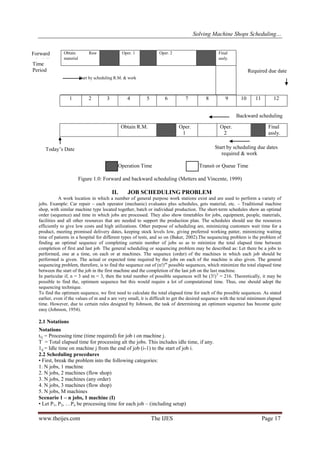
• The schedule possibilities are the permutations of n, which is equal to ―n!‖
• Since the total processing time, or make-span is independent of sequence, this is not a criterion for choice –
Consider using minimum mean flow time
Scenario 1 – n jobs, 1 machine (II)
Flow time for job in kth position is:
=
Mean flow time for n jobs:
= =
=
Scenario 1 – n jobs, 1 machine (III)
It can be proven that is minimized by taking jobs in order of shortest processing time [SPT]
That is order by increasing P, so that
P[1]≤ P[2]≤ P[3] …≤ P[n]
Scenario 1 – n jobs, 1 machine (IV)
Provide numerical weighting to jobs by priority
(w) – higher w, more important then
=
and jobs are sequenced by:
N Jobs, M Machines
Number of possible schedules is extremely large, (n!)m
Almost all solved by heuristics which are based on sequencing or dispatching rules.
N Jobs, M Machines
List of Heuristics are as follows:
1. R (Random) – Pick any Job in Queue with equal probability. This rule is often used as benchmark for other
rules
2. FCFS (First Come First Serve) – Jobs are processed in the order in which they arrived at the work center (also
called earliest release date)
3. SPT (Shortest Processing Time) –This rule tends to reduce both work-in-process inventory, the average job
completion (flow) time, and average job lateness.
4. EDD (Earliest Due Date) – Choose Job that has earliest due date
5. CR (Critical Ratio) = Processing Time / Time until due (Due Date – Current Time).
Take the highest value.
6. LWR (Least Work Remaining) – This rule is an extension of SPT variant that considers the number of
successive operations
7. ST (Slack Time) = Time until job is due - (Sum of processing time remaining). Take the job with the smallest
amount of slack time.
8. ST/O (Slack Time per Remaining Operation) = slack time divided by number of operations remaining. Take
the job with the smallest amount of slack time per remaining operation
When in Doubt, use SPT. Also, use SPT to break ties.
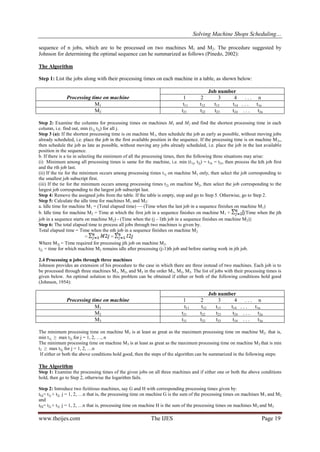
2.3 Processing n jobs through two machines
Let there be n jobs, each of which are to be processed through two machines, M1 and M2 in the order M1M2, i.e.
each job has to pass through the same sequence of operations. In other words, a job is assigned on machine M1,
first and after it has been completely processed on machine M1, it is assigned on machine M2. If the machine
M2, is not free at the moment for processing the same job, then the job has to wait in a waiting line for its turn
on machine M2, i.e. passing is not allowed.
Since passing is not allowed, therefore, machine M1 will remain busy in processing all the ii jobs one- by-one,
while machine M2, may remain idle time of the second machine. This can be achieved only by determining](https://image.slidesharecdn.com/c0362015022-140710044509-phpapp02/85/C0362015022-4-320.jpg)
![Solving Machine Shops Scheduling…
www.theijes.com The IJES Page 22
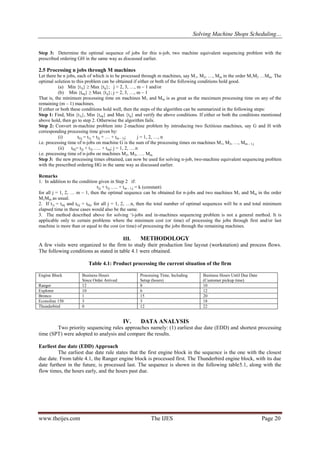
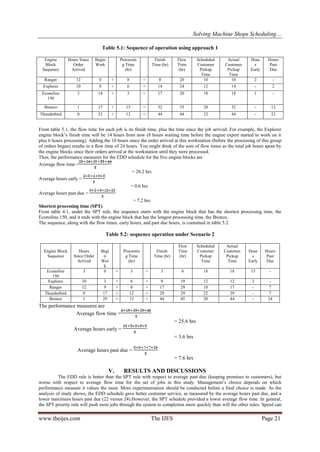
be an advantage—but only if jobs can be delivered sooner than promised and revenue collected earlier. If they cannot, the
completed job must stay in finished inventory. Consequently, the priority rule chosen can help or hinder the firm in meeting
its competitive priorities. The EDD rule performs well with respect to the percentage of jobs past due and the variance of
hours past due. For any set of jobs to be processed at a single workstation, it minimizes the maximum of the past due hours
of any job in the set. The EDD rule is popular with firms that are sensitive to achieving due dates, which usually are the basis
for setting priorities using MRP systems. The SPT rule tends to minimize the mean flow time (assuming time since arrival is
0 for all jobs) and the percentage of jobs past due. It also tends to maximize shop utilization. For the single-workstation case,
the SPT rule always will provide the lowest mean finish time. However, it could increase total inventory because it tends to
push all work to the finished state. In addition, it tends to produce a large variance in past due hours because the larger jobs
might have to wait a long time for processing. Also, it provides no opportunity to adjust schedules when due dates change.
The advantage of this rule over others diminishes as the load on the shop increases.
VI. CONCLUSION AND RECOMMENDATIONS
The challenges faced by management of Engr. Oformba machine shop has been examined in this paper with the
view that,oneway to generate schedules in machine shops is by usingpriority sequencing rules,which allows the schedule for
a workstation to evolve over a periodof time. The decision about which job to process next is made with simple priority
ruleswhenever the workstation becomes available for further processing. One advantage of thismethod is that last-minute
information on operating conditions can be incorporated intothe schedule as it evolves. Finally, we recommend that though
the FCFS rule is considered fair to the jobs (or customers), it performs poorly with respect to all performance measures. This
result is to be expected because FCFS does not acknowledge any job (or customer) characteristics. However, FCFS usually
is the only acceptable choice for service processes where the customer is present and demand leveling options such as
appointments or reservations are not used.
REFERENCE
[1] Baker, K. R., (2002). Elements of Sequencing and Scheduling. Hanover, NH: Baker Press.
[2] Hartvigsen, D., (2004).Sim Quick: Process Simulation with Excel, 2nd ed. Upper Saddle River, NJ: Prentice Hall.
[3] Johnson, S. M., (1954). Optimal Two Stage and Three Stage ProductionSchedules with Setup Times Included. Naval Logistics
Quarterly, vol. 1, no. 1 (1954), pp. 61–68.
[4] Kiran, A. S., and Thomas H. W., (1992). Simulation: Help forYour Scheduling Problems. APICS— The Performance Advantage, pp.
26–28.
[5] LaForge, R. L., and Christopher W. C., (2000). Computer-Based Scheduling in Manufacturing Firms: SomeIndicators of Successful
Practice. Production and InventoryManagement Journal, pp. 29–34.
[6] Metters, R. and Vincente, V., (1999). A Comparison ofProduction Scheduling Policies on Costs, Service Levels, and Schedule
Changes. Production and OperationsManagement, vol. 17, no. 3, pp. 76–91.
[7] Pinedo, M., (2002) Scheduling: Theory, Algorithms, and Systems, 2nd ed. Upper Saddle River, NJ: Prentice Hall.
[8] Pinedo, M., and Chao, X., (1998).Operations Scheduling withApplications in Manufacturing and Services. Boston: McGraw-
Hill/Irwin.
[9] Suresh, V., and Chaudhuri, D., (1993). Dynamic Scheduling-A Surveyof Research. International Journal of ProductionEconomics,
vol. 32, pp. 52–63.
[10] Vollmann, T. E., William, B., Whybark, D. C. and Robert, J., (2005). Manufacturing Planning and ControlSystems for Supply Chain
Management, 5th ed. New York: McGraw-Hill/Irwin.](https://image.slidesharecdn.com/c0362015022-140710044509-phpapp02/85/C0362015022-8-320.jpg)


