Chapter 1
Introduction to Operations and
Supply Chain Management
1-1
Lecture Outline
• What Operations and Supply Chain Managers Do
• Operations Function
• Evolution of Operations and Supply Chain
Management
• Globalization and Competitiveness
• Operations
• Strategy and Organization of the Text
• Learning Objectives for This Course
Copyright 2011 John Wiley & Sons, Inc. 1-2
What Operations and Supply Chain
Managers Do
• What is Operations Management?
• design, operation, and improvement of productive systems
• What is Operations?
• a function or system that transforms inputs into outputs of greater
value
• What is a Transformation Process?
• a series of activities along a value chain extending from supplier
to customer
• activities that do not add value are superfluous and should be
eliminated
Copyright 2011 John Wiley & Sons, Inc. 1-3
Transformation Process
• Physical: as in manufacturing operations
• Locational: as in transportation or warehouse
operations
• Exchange: as in retail operations
• Physiological: as in health care
• Psychological: as in entertainment
• Informational: as in communication
Copyright 2011 John Wiley & Sons, Inc. 1-4
Operations as a
Transformation Process
Copyright 2011 John Wiley & Sons, Inc. 1-5
INPUT
•Material
•Machines
•Labor
•Management
•Capital
TRANSFORMATION
PROCESS
OUTPUT
•Goods
•Services
Feedback & Requirements
Copyright 2011 John Wiley & Sons, Inc.Copyright 2011 John Wiley & Sons, Inc.
Operations Function
• Operations
• Marketing
• Finance and
Accounting
• Human
Resources
• Outside
Suppliers
1-6
How is Operations Relevant
to my Major?
• Accounting
• Information
Technology
• Management
• ―As an auditor you must understand the
fundamentals of operations
management.‖
• ―IT is a tool, and there’s no better place to
apply it than in operations.‖
• ―We use so many things you learn in an
operations class—scheduling, lean
production, theory of constraints, and
tons of quality tools.‖
Copyright 2011 John Wiley & Sons, Inc. 1-7
How is Operations Relevant
to my Major?
• Economics
• Marketing
• Finance
• ―It’s all about processes. I live by
flowcharts and Pareto analysis.‖
• ―How can you do a good job marketing a
product if you’re unsure of its quality or
delivery status?‖
• ―Most of our capital budgeting requests
are from operations, and most of our
cost savings, too.‖
Copyright 2011 John Wiley & Sons, Inc. 1-8
Evolution of Operations and
Supply Chain Management
• Craft production
• process of handcrafting products or services for
individual customers
• Division of labor
• dividing a job into a series of small tasks each
performed by a different worker
• Interchangeable parts
• standardization of parts initially as replacement parts;
enabled mass production
Copyright 2011 John Wiley & Sons, Inc. 1-9
Evolution of Operations and
Supply Chain Management
• Scientific management
• systematic analysis of work methods
• Mass production
• high-volume production of a standardized product for
a mass market
• Lean production
• adaptation of mass production that prizes quality and
flexibility
Copyright 2011 John Wiley & Sons, Inc. 1-10
Historical Events in
Operations Management
Era Events/Concepts Dates Originator
Industrial
Revolution
Steam engine 1769 James Watt
Division of labor 1776 Adam Smith
Interchangeable parts 1790 Eli Whitney
Scientific
Management
Principles of scientific
management
1911 Frederick W. Taylor
Time and motion studies 1911
Frank and Lillian
Gilbreth
Activity scheduling chart 1912 Henry Gantt
Moving assembly line 1913 Henry Ford
Copyright 2011 John Wiley & Sons, Inc. 1-11
Historical Events in
Operations Management
Era Events/Concepts Dates Originator
Human
Relations
Hawthorne studies 1930 Elton Mayo
Motivation theories
1940s Abraham Maslow
1950s Frederick Herzberg
1960s Douglas McGregor
Operations
Research
Linear programming 1947 George Dantzig
Digital computer 1951 Remington Rand
Simulation, waiting
line theory, decision
theory, PERT/CPM
1950s
Operations research
groups
MRP, EDI, EFT, CIM
1960s,
1970s
Joseph Orlicky, IBM
and others
Copyright 2011 John Wiley & Sons, Inc. 1-12
Historical Events in
Operations Management
Era Events/Concepts Dates Originator
Quality
Revolution
JIT (just-in-time) 1970s Taiichi Ohno (Toyota)
TQM (total quality
management)
1980s
W. Edwards Deming,
Joseph Juran
Strategy and
operations
1980s
Wickham Skinner,
Robert Hayes
Reengineering 1990s
Michael Hammer,
James Champy
Six Sigma 1990s GE, Motorola
Copyright 2011 John Wiley & Sons, Inc. 1-13
Historical Events in
Operations Management
Era Events/Concepts Dates Originator
Internet
Revolution
Internet, WWW, ERP,
supply chain management
1990s ARPANET, Tim
Berners-Lee SAP,
i2 Technologies,
ORACLE, Dell
E-commerce 2000s Amazon, Yahoo,
eBay, Google, and
others
Globalization WTO, European Union,
Global supply chains,
Outsourcing, Service
Science
1990s
2000s
China, India,
emerging
economies
Copyright 2011 John Wiley & Sons, Inc. 1-14
Historical Events in
Operations Management
Era Events/Concepts Dates Originator
Green
Revolution
Global warming, An
Inconvenient Truth, Kyoto
Today Numerous
scientists,
statesmen and
governments
Copyright 2011 John Wiley & Sons, Inc. 1-15
Evolution of Operations and Supply
Chain Management
• Supply chain management
– management of the flow of information, products, and services across a
network of customers, enterprises, and supply chain partners
1-16Copyright 2011 John Wiley & Sons, Inc.
Copyright 2011 John Wiley & Sons, Inc.Copyright 2011 John Wiley & Sons, Inc.
Globalization
• Why ―go global‖?
– favorable cost
– access to international markets
– response to changes in demand
– reliable sources of supply
– latest trends and technologies
• Increased globalization
– results from the Internet and falling trade barriers
1-17
Hourly Compensation
1-18
GDP per Capita
1-19
Trade in Goods, % of GDP
Copyright 2011 John Wiley & Sons, Inc. 1-20
Productivity and Competitiveness
• Competitiveness
• degree to which a nation can produce goods and
services that meet the test of international markets
• Productivity
• ratio of output to input
• Output
• sales made, products produced, customers
served, meals delivered, or calls answered
• Input
• labor hours, investment in equipment, material
usage, or square footage
Copyright 2011 John Wiley & Sons, Inc. 1-21
Measures of Productivity
Copyright 2011 John Wiley & Sons, Inc. 1-22
Osborne Industries
Copyright 2011 John Wiley & Sons, Inc. 1-23
C6*C8
C7*C9
C5/C6
C5/C7
C5/C13
Productivity Growth
Copyright 2011 John Wiley & Sons, Inc. 1-24
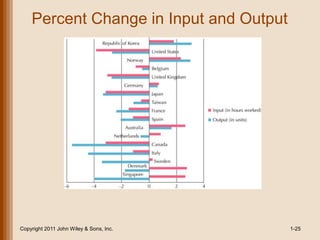
Percent Change in Input and Output
Copyright 2011 John Wiley & Sons, Inc. 1-25
Strategy and Operations
• How the mission of a company is accomplished
• Provides direction for achieving a mission
• Unites the organization
• Provides consistency in decisions
• Keeps organization moving in the right direction
Copyright 2011 John Wiley & Sons, Inc. 1-26
Strategy Formulation
1. Defining a primary task
• What is the firm in the business of doing?
2. Assessing core competencies
• What does the firm do better than anyone else?
3. Determining order winners and order qualifiers
• What qualifies an item to be considered for
purchase?
• What wins the order?
4. Positioning the firm
• How will the firm compete?
5. Deploying the strategy
Copyright 2011 John Wiley & Sons, Inc. 1-27
Copyright 2011 John Wiley & Sons, Inc.Copyright 2011 John Wiley & Sons, Inc.
Strategic Planning
1-28
Mission
and Vision
Corporate
Strategy
Operations
Strategy
Marketing
Strategy
Financial
Strategy
Order Winners
and Order Qualifiers
Copyright 2011 John Wiley & Sons, Inc. 1-29
Source: Adapted from Nigel Slack, Stuart Chambers, Robert Johnston, and Alan
Betts, Operations and Process Management, Prentice Hall, 2006, p. 47
Positioning the Firm
• Cost
• Speed
• Quality
• Flexibility
1-30
Positioning the Firm: Cost
• Waste elimination
• relentlessly pursuing the removal of all waste
• Examination of cost structure
• looking at the entire cost structure for reduction potential
• Lean production
• providing low costs through disciplined operations
Copyright 2011 John Wiley & Sons, Inc. 1-31
Positioning the Firm: Speed
• Fast moves, Fast adaptations, Tight linkages
• Internet
• Customers expect immediate responses
• Service organizations
• always competed on speed
(McDonald’s, LensCrafters, and Federal Express)
• Manufacturers
• time-based competition: build-to-order production and
efficient supply chains
• Fashion industry
• two-week design-to-rack lead time of Spanish retailer, Zara
Copyright 2011 John Wiley & Sons, Inc. 1-32
Positioning the Firm: Quality
• Minimizing defect rates or conforming to design
specifications
• Ritz-Carlton - one customer at a time
• Service system designed to ―move heaven and earth‖
to satisfy customer
• Employees empowered to satisfy a guest’s wish
• Teams set objectives and devise quality action plans
• Each hotel has a quality leader
Copyright 2011 John Wiley & Sons, Inc. 1-33
Positioning the Firm: Flexibility
• Ability to adjust to changes in product
mix, production volume, or design
• Mass customization: the mass production of
customized parts
• National Bicycle Industrial Company
• offers 11,231,862 variations
• delivers within two weeks at costs only 10% above
standard models
Copyright 2011 John Wiley & Sons, Inc. 1-34
Policy Deployment
• Policy deployment
• translates corporate strategy into measurable
objectives
• Hoshins
• action plans generated from the policy
deployment process
Copyright 2011 John Wiley & Sons, Inc. 1-35
Policy Deployment
Derivation of an Action Plan Using Policy Deployment
1-36Copyright 2011 John Wiley & Sons, Inc.
Balanced Scorecard
• Balanced scorecard
• measuring more than financial performance
1. finances
2. customers
3. processes
4. learning and growing
• Key performance indicators
• set of measures to help managers evaluate
performance in critical areas
Copyright 2011 John Wiley & Sons, Inc. 1-37
Balanced Scorecard Worksheet
Copyright 2011 John Wiley & Sons, Inc. 1-38
Balanced Scorecard
1-39Copyright 2011 John Wiley & Sons, Inc.
Radar Chart Dashboard
Copyright 2011 John Wiley & Sons, Inc.Copyright 2011 John Wiley & Sons, Inc.
Operations Strategy
Products
1-40
Services Process
and
Technology
Capacity
Human
Resources Quality
Facilities Sourcing Operating
Systems
Organization of This Text:
Part I – Operations Management
1. Intro. to Operations and Supply Chain
Management
2. Quality Management
3. Statistical Quality Control
4. Product Design
5. Service Design
6. Processes and Technology
7. Capacity and Facilities Design
8. Human Resources
9. Project Management
Copyright 2011 John Wiley & Sons, Inc. 1-41
Organization of This Text:
Part II – Supply Chain Management
10.Supply Chain Strategy and Design
11.Global Supply Chain Procurement and Distribution
12.Forecasting
13.Inventory Management
14.Sales and Operations Planning
15.Resource Planning
16.Lean Systems
17.Scheduling
Copyright 2011 John Wiley & Sons, Inc. 1-42
Learning Objectives of this Course
• Gain an appreciation of strategic importance of
operations and supply chain management in a global
business environment
• Understand how operations relates to other business
functions
• Develop a working knowledge of concepts and
methods related to designing and managing
operations and supply chains
• Develop a skill set for continuous improvement
Copyright 2011 John Wiley & Sons, Inc. 1-43
Copyright 2011 John Wiley & Sons, Inc. 1-44
Copyright 2011 John Wiley & Sons, Inc.
All rights reserved. Reproduction or translation of this
work beyond that permitted in section 117 of the 1976
United States Copyright Act without express permission
of the copyright owner is unlawful. Request for further
information should be addressed to the Permission
Department, John Wiley & Sons, Inc. The purchaser
may make back-up copies for his/her own use only and
not for distribution or resale. The Publisher assumes no
responsibility for errors, omissions, or damages caused
by the use of these programs or from the use of the
information herein.

C01

  • 1.
    Chapter 1 Introduction toOperations and Supply Chain Management 1-1
  • 2.
    Lecture Outline • WhatOperations and Supply Chain Managers Do • Operations Function • Evolution of Operations and Supply Chain Management • Globalization and Competitiveness • Operations • Strategy and Organization of the Text • Learning Objectives for This Course Copyright 2011 John Wiley & Sons, Inc. 1-2
  • 3.
    What Operations andSupply Chain Managers Do • What is Operations Management? • design, operation, and improvement of productive systems • What is Operations? • a function or system that transforms inputs into outputs of greater value • What is a Transformation Process? • a series of activities along a value chain extending from supplier to customer • activities that do not add value are superfluous and should be eliminated Copyright 2011 John Wiley & Sons, Inc. 1-3
  • 4.
    Transformation Process • Physical:as in manufacturing operations • Locational: as in transportation or warehouse operations • Exchange: as in retail operations • Physiological: as in health care • Psychological: as in entertainment • Informational: as in communication Copyright 2011 John Wiley & Sons, Inc. 1-4
  • 5.
    Operations as a TransformationProcess Copyright 2011 John Wiley & Sons, Inc. 1-5 INPUT •Material •Machines •Labor •Management •Capital TRANSFORMATION PROCESS OUTPUT •Goods •Services Feedback & Requirements
  • 6.
    Copyright 2011 JohnWiley & Sons, Inc.Copyright 2011 John Wiley & Sons, Inc. Operations Function • Operations • Marketing • Finance and Accounting • Human Resources • Outside Suppliers 1-6
  • 7.
    How is OperationsRelevant to my Major? • Accounting • Information Technology • Management • ―As an auditor you must understand the fundamentals of operations management.‖ • ―IT is a tool, and there’s no better place to apply it than in operations.‖ • ―We use so many things you learn in an operations class—scheduling, lean production, theory of constraints, and tons of quality tools.‖ Copyright 2011 John Wiley & Sons, Inc. 1-7
  • 8.
    How is OperationsRelevant to my Major? • Economics • Marketing • Finance • ―It’s all about processes. I live by flowcharts and Pareto analysis.‖ • ―How can you do a good job marketing a product if you’re unsure of its quality or delivery status?‖ • ―Most of our capital budgeting requests are from operations, and most of our cost savings, too.‖ Copyright 2011 John Wiley & Sons, Inc. 1-8
  • 9.
    Evolution of Operationsand Supply Chain Management • Craft production • process of handcrafting products or services for individual customers • Division of labor • dividing a job into a series of small tasks each performed by a different worker • Interchangeable parts • standardization of parts initially as replacement parts; enabled mass production Copyright 2011 John Wiley & Sons, Inc. 1-9
  • 10.
    Evolution of Operationsand Supply Chain Management • Scientific management • systematic analysis of work methods • Mass production • high-volume production of a standardized product for a mass market • Lean production • adaptation of mass production that prizes quality and flexibility Copyright 2011 John Wiley & Sons, Inc. 1-10
  • 11.
    Historical Events in OperationsManagement Era Events/Concepts Dates Originator Industrial Revolution Steam engine 1769 James Watt Division of labor 1776 Adam Smith Interchangeable parts 1790 Eli Whitney Scientific Management Principles of scientific management 1911 Frederick W. Taylor Time and motion studies 1911 Frank and Lillian Gilbreth Activity scheduling chart 1912 Henry Gantt Moving assembly line 1913 Henry Ford Copyright 2011 John Wiley & Sons, Inc. 1-11
  • 12.
    Historical Events in OperationsManagement Era Events/Concepts Dates Originator Human Relations Hawthorne studies 1930 Elton Mayo Motivation theories 1940s Abraham Maslow 1950s Frederick Herzberg 1960s Douglas McGregor Operations Research Linear programming 1947 George Dantzig Digital computer 1951 Remington Rand Simulation, waiting line theory, decision theory, PERT/CPM 1950s Operations research groups MRP, EDI, EFT, CIM 1960s, 1970s Joseph Orlicky, IBM and others Copyright 2011 John Wiley & Sons, Inc. 1-12
  • 13.
    Historical Events in OperationsManagement Era Events/Concepts Dates Originator Quality Revolution JIT (just-in-time) 1970s Taiichi Ohno (Toyota) TQM (total quality management) 1980s W. Edwards Deming, Joseph Juran Strategy and operations 1980s Wickham Skinner, Robert Hayes Reengineering 1990s Michael Hammer, James Champy Six Sigma 1990s GE, Motorola Copyright 2011 John Wiley & Sons, Inc. 1-13
  • 14.
    Historical Events in OperationsManagement Era Events/Concepts Dates Originator Internet Revolution Internet, WWW, ERP, supply chain management 1990s ARPANET, Tim Berners-Lee SAP, i2 Technologies, ORACLE, Dell E-commerce 2000s Amazon, Yahoo, eBay, Google, and others Globalization WTO, European Union, Global supply chains, Outsourcing, Service Science 1990s 2000s China, India, emerging economies Copyright 2011 John Wiley & Sons, Inc. 1-14
  • 15.
    Historical Events in OperationsManagement Era Events/Concepts Dates Originator Green Revolution Global warming, An Inconvenient Truth, Kyoto Today Numerous scientists, statesmen and governments Copyright 2011 John Wiley & Sons, Inc. 1-15
  • 16.
    Evolution of Operationsand Supply Chain Management • Supply chain management – management of the flow of information, products, and services across a network of customers, enterprises, and supply chain partners 1-16Copyright 2011 John Wiley & Sons, Inc.
  • 17.
    Copyright 2011 JohnWiley & Sons, Inc.Copyright 2011 John Wiley & Sons, Inc. Globalization • Why ―go global‖? – favorable cost – access to international markets – response to changes in demand – reliable sources of supply – latest trends and technologies • Increased globalization – results from the Internet and falling trade barriers 1-17
  • 18.
  • 19.
  • 20.
    Trade in Goods,% of GDP Copyright 2011 John Wiley & Sons, Inc. 1-20
  • 21.
    Productivity and Competitiveness •Competitiveness • degree to which a nation can produce goods and services that meet the test of international markets • Productivity • ratio of output to input • Output • sales made, products produced, customers served, meals delivered, or calls answered • Input • labor hours, investment in equipment, material usage, or square footage Copyright 2011 John Wiley & Sons, Inc. 1-21
  • 22.
    Measures of Productivity Copyright2011 John Wiley & Sons, Inc. 1-22
  • 23.
    Osborne Industries Copyright 2011John Wiley & Sons, Inc. 1-23 C6*C8 C7*C9 C5/C6 C5/C7 C5/C13
  • 24.
    Productivity Growth Copyright 2011John Wiley & Sons, Inc. 1-24
  • 25.
    Percent Change inInput and Output Copyright 2011 John Wiley & Sons, Inc. 1-25
  • 26.
    Strategy and Operations •How the mission of a company is accomplished • Provides direction for achieving a mission • Unites the organization • Provides consistency in decisions • Keeps organization moving in the right direction Copyright 2011 John Wiley & Sons, Inc. 1-26
  • 27.
    Strategy Formulation 1. Defininga primary task • What is the firm in the business of doing? 2. Assessing core competencies • What does the firm do better than anyone else? 3. Determining order winners and order qualifiers • What qualifies an item to be considered for purchase? • What wins the order? 4. Positioning the firm • How will the firm compete? 5. Deploying the strategy Copyright 2011 John Wiley & Sons, Inc. 1-27
  • 28.
    Copyright 2011 JohnWiley & Sons, Inc.Copyright 2011 John Wiley & Sons, Inc. Strategic Planning 1-28 Mission and Vision Corporate Strategy Operations Strategy Marketing Strategy Financial Strategy
  • 29.
    Order Winners and OrderQualifiers Copyright 2011 John Wiley & Sons, Inc. 1-29 Source: Adapted from Nigel Slack, Stuart Chambers, Robert Johnston, and Alan Betts, Operations and Process Management, Prentice Hall, 2006, p. 47
  • 30.
    Positioning the Firm •Cost • Speed • Quality • Flexibility 1-30
  • 31.
    Positioning the Firm:Cost • Waste elimination • relentlessly pursuing the removal of all waste • Examination of cost structure • looking at the entire cost structure for reduction potential • Lean production • providing low costs through disciplined operations Copyright 2011 John Wiley & Sons, Inc. 1-31
  • 32.
    Positioning the Firm:Speed • Fast moves, Fast adaptations, Tight linkages • Internet • Customers expect immediate responses • Service organizations • always competed on speed (McDonald’s, LensCrafters, and Federal Express) • Manufacturers • time-based competition: build-to-order production and efficient supply chains • Fashion industry • two-week design-to-rack lead time of Spanish retailer, Zara Copyright 2011 John Wiley & Sons, Inc. 1-32
  • 33.
    Positioning the Firm:Quality • Minimizing defect rates or conforming to design specifications • Ritz-Carlton - one customer at a time • Service system designed to ―move heaven and earth‖ to satisfy customer • Employees empowered to satisfy a guest’s wish • Teams set objectives and devise quality action plans • Each hotel has a quality leader Copyright 2011 John Wiley & Sons, Inc. 1-33
  • 34.
    Positioning the Firm:Flexibility • Ability to adjust to changes in product mix, production volume, or design • Mass customization: the mass production of customized parts • National Bicycle Industrial Company • offers 11,231,862 variations • delivers within two weeks at costs only 10% above standard models Copyright 2011 John Wiley & Sons, Inc. 1-34
  • 35.
    Policy Deployment • Policydeployment • translates corporate strategy into measurable objectives • Hoshins • action plans generated from the policy deployment process Copyright 2011 John Wiley & Sons, Inc. 1-35
  • 36.
    Policy Deployment Derivation ofan Action Plan Using Policy Deployment 1-36Copyright 2011 John Wiley & Sons, Inc.
  • 37.
    Balanced Scorecard • Balancedscorecard • measuring more than financial performance 1. finances 2. customers 3. processes 4. learning and growing • Key performance indicators • set of measures to help managers evaluate performance in critical areas Copyright 2011 John Wiley & Sons, Inc. 1-37
  • 38.
    Balanced Scorecard Worksheet Copyright2011 John Wiley & Sons, Inc. 1-38
  • 39.
    Balanced Scorecard 1-39Copyright 2011John Wiley & Sons, Inc. Radar Chart Dashboard
  • 40.
    Copyright 2011 JohnWiley & Sons, Inc.Copyright 2011 John Wiley & Sons, Inc. Operations Strategy Products 1-40 Services Process and Technology Capacity Human Resources Quality Facilities Sourcing Operating Systems
  • 41.
    Organization of ThisText: Part I – Operations Management 1. Intro. to Operations and Supply Chain Management 2. Quality Management 3. Statistical Quality Control 4. Product Design 5. Service Design 6. Processes and Technology 7. Capacity and Facilities Design 8. Human Resources 9. Project Management Copyright 2011 John Wiley & Sons, Inc. 1-41
  • 42.
    Organization of ThisText: Part II – Supply Chain Management 10.Supply Chain Strategy and Design 11.Global Supply Chain Procurement and Distribution 12.Forecasting 13.Inventory Management 14.Sales and Operations Planning 15.Resource Planning 16.Lean Systems 17.Scheduling Copyright 2011 John Wiley & Sons, Inc. 1-42
  • 43.
    Learning Objectives ofthis Course • Gain an appreciation of strategic importance of operations and supply chain management in a global business environment • Understand how operations relates to other business functions • Develop a working knowledge of concepts and methods related to designing and managing operations and supply chains • Develop a skill set for continuous improvement Copyright 2011 John Wiley & Sons, Inc. 1-43
  • 44.
    Copyright 2011 JohnWiley & Sons, Inc. 1-44 Copyright 2011 John Wiley & Sons, Inc. All rights reserved. Reproduction or translation of this work beyond that permitted in section 117 of the 1976 United States Copyright Act without express permission of the copyright owner is unlawful. Request for further information should be addressed to the Permission Department, John Wiley & Sons, Inc. The purchaser may make back-up copies for his/her own use only and not for distribution or resale. The Publisher assumes no responsibility for errors, omissions, or damages caused by the use of these programs or from the use of the information herein.