Chapter 7 Supplement

Facility Location Models
Lecture Outline

•   Types of Facilities
•   Site Selection: Where to Locate
•   Global Supply Chain Factors
•   Location Analysis Techniques


Copyright 2011 John Wiley & Sons, Inc.              Supplement 7-2
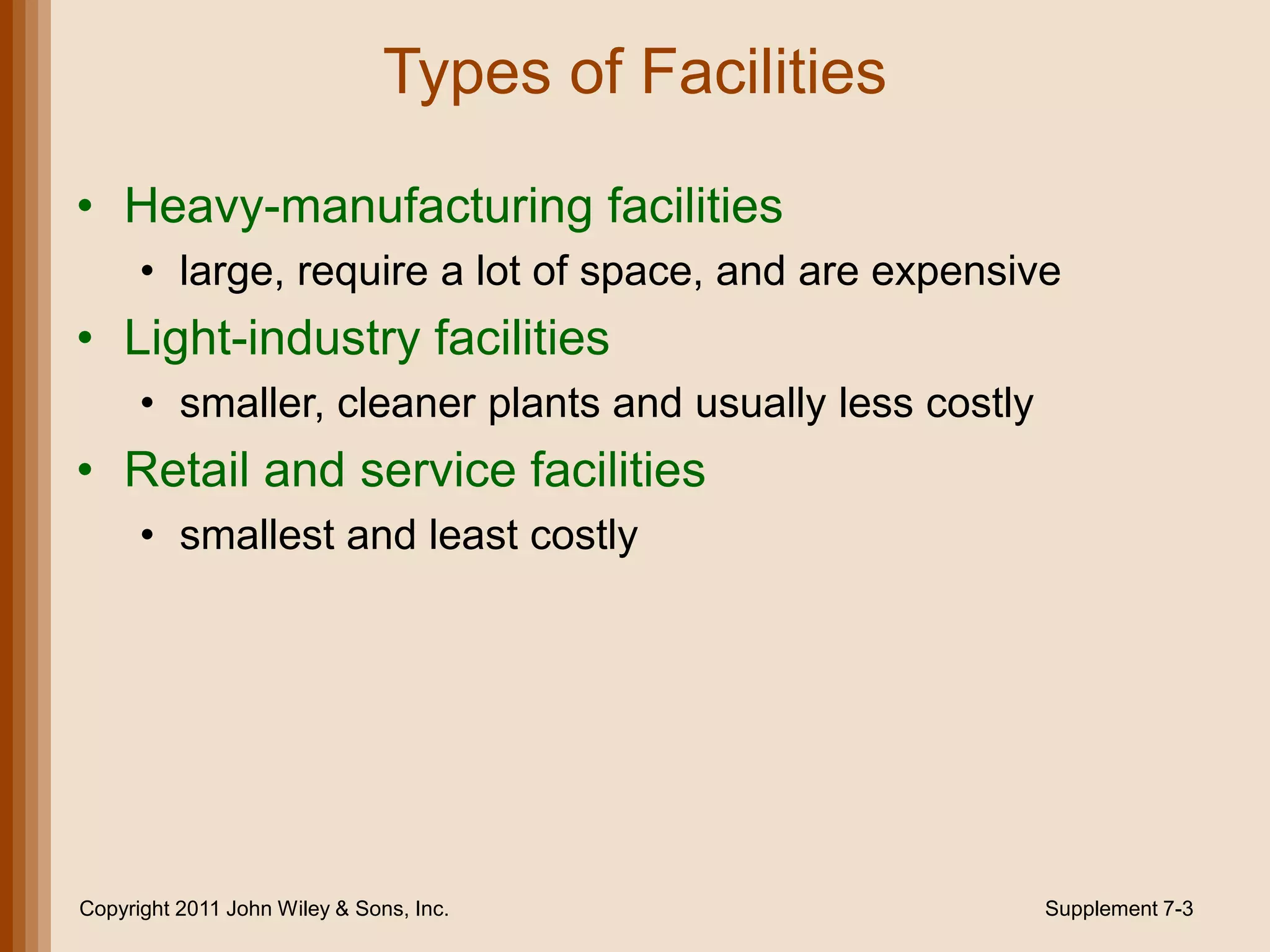
Types of Facilities

• Heavy-manufacturing facilities
      • large, require a lot of space, and are expensive
• Light-industry facilities
      • smaller, cleaner plants and usually less costly
• Retail and service facilities
      • smallest and least costly


Copyright 2011 John Wiley & Sons, Inc.                    Supplement 7-3
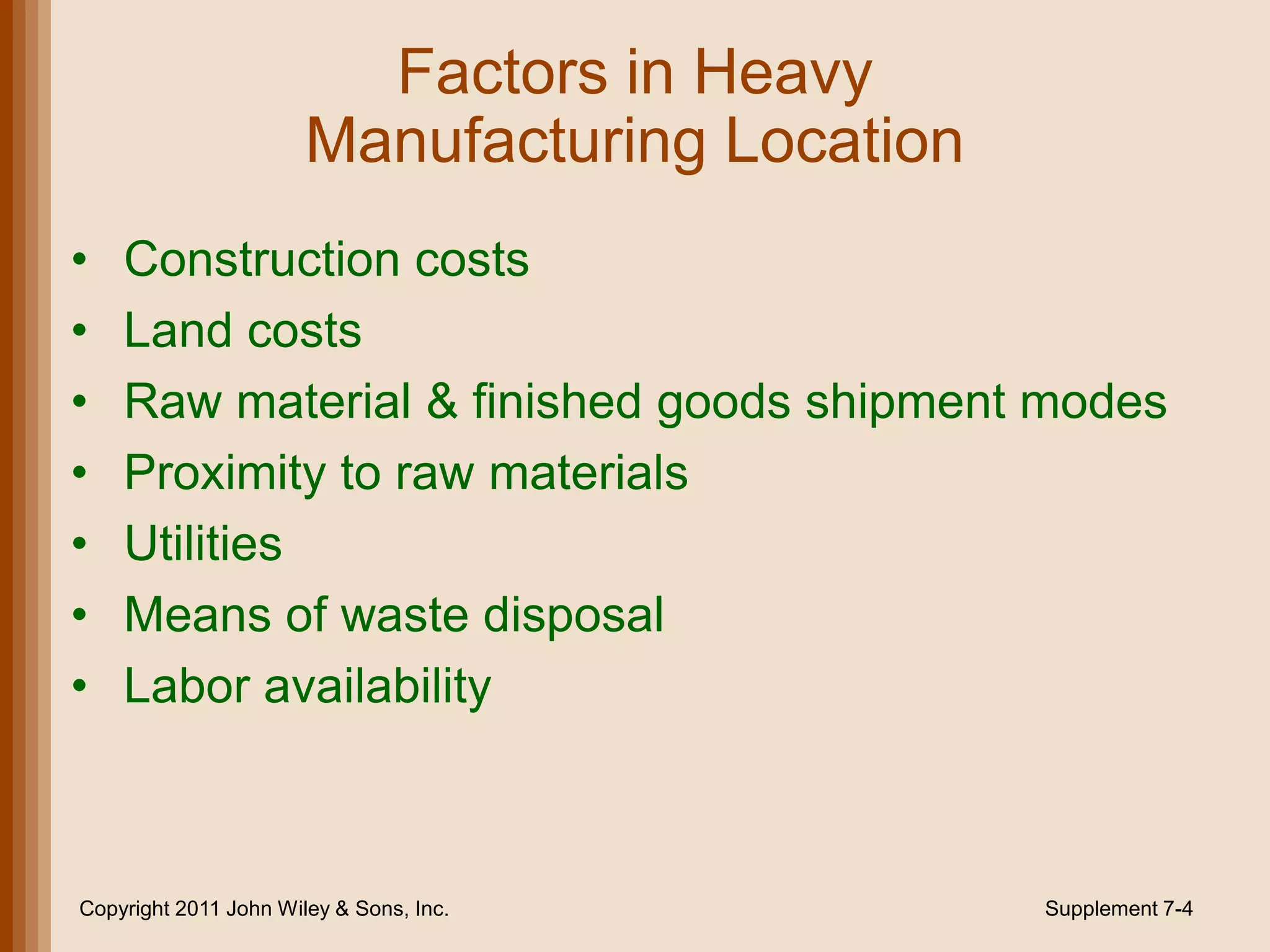
Factors in Heavy
                       Manufacturing Location
•   Construction costs
•   Land costs
•   Raw material & finished goods shipment modes
•   Proximity to raw materials
•   Utilities
•   Means of waste disposal
•   Labor availability


Copyright 2011 John Wiley & Sons, Inc.          Supplement 7-4
Factors in Light Industry Location

• Land costs
• Transportation costs
• Proximity to markets
   • depending on delivery requirements
     including frequency of delivery required by
     customer


Copyright 2011 John Wiley & Sons, Inc.       Supplement 7-5
Factors in Retail Location

• Proximity to customers
• Location is everything


Copyright 2011 John Wiley & Sons, Inc.           Supplement 7-6
Site Selection: Where to Locate
• Infrequent but important               • Location criteria for
      • being “in the right place at the   manufacturing facility
          right time”                    • nature of labor force
• Must consider other                    • labor costs
  factors, especially financial          • proximity to suppliers and
  considerations                           markets
• Location decisions made more           • distribution and transportation
  often for service operations             costs
  than manufacturing facilities          • energy availability and cost
• Location criteria for service          • community infrastructure
      • access to customers              • quality of life in community
                                         • government regulations and
                                           taxes


Copyright 2011 John Wiley & Sons, Inc.                        Supplement 7-7
Global Supply Chain Factors

• Government stability        •            Climate
• Government regulations      •            Number & proximity of
                                           suppliers
• Political & economic systems
                              •            Transportation & distribution
• Economic stability & growth              system
• Exchange rates              •            Labor cost & education
• Culture                     •            Available technology
• Export/import regulations, •             Commercial travel
  duties & tariffs            •            Technical expertise
• Raw material availability   •            Cross-border trade
                                           regulations
                                         • Group trade agreements

Copyright 2011 John Wiley & Sons, Inc.                       Supplement 7-8
Regional and Community
                    Location Factors in U.S.
• Labor                           •      Modes and quality of
  (availability, education, cost,        transportation
   and unions)                    •      Transportation costs
• Proximity of customers          •      Community government
• Number of customers                    Local business regulations
• Construction/leasing costs •           Government services (e.g.,
• Land cost                              Chamber of Commerce)


Copyright 2011 John Wiley & Sons, Inc.                    Supplement 7-9
Regional and Community
                    Location Factors in U.S.
•   Business climate                     • Infrastructure (road &
•   Community services                     utilities)
•   Incentive packages                   • Quality of life
•   Government regulations               • Taxes
•   Environmental regs.                  • Availability of sites
•   Raw material availability            • Financial services
•   Commercial travel                    • Community inducements
•   Climate                              • Proximity of suppliers
                                         • Education system


Copyright 2011 John Wiley & Sons, Inc.                    Supplement 7-10
Location Incentives

•   Tax credits
•   Relaxed government regulation
•   Job training
•   Infrastructure improvement
•   Money


Copyright 2011 John Wiley & Sons, Inc.             Supplement 7-11
Geographic Information Systems (GIS)

• Computerized system for
  storing, managing, creating, analyzing, integrati
  ng, and digitally displaying
  geographic, i.e., spatial, data
• Specifically used for site selection
• Enables users to integrate large quantities of
  information about potential sites and analyze
  these data with many different, powerful
  analytical tools


Copyright 2011 John Wiley & Sons, Inc.      Supplement 7-12
GIS Diagram


Copyright 2011 John Wiley & Sons, Inc.                 Supplement 7-13
Location Analysis Techniques

• Location factor rating
• Center-of-gravity
• Load-distance


 Copyright 2011 John Wiley & Sons, Inc.   Supplement 7-14
Location Factor Rating

•   Identify important factors
•   Weight factors (0.00 - 1.00)
•   Subjectively score each factor (0 - 100)
•   Sum weighted scores


Copyright 2011 John Wiley & Sons, Inc.           Supplement 7-15
Location Factor Rating
                                                  SCORES (0 TO 100)
  LOCATION FACTOR                        WEIGHT     Site 1   Site 2        Site 3
  Labor pool and climate                  .30         80      65             90
  Proximity to suppliers                  .20        100      91             75
  Wage rates                              .15         60      95             72
  Community environment                   .15         75      80             80
  Proximity to customers                  .10         65      90             95
  Shipping modes                          .05         85      92             65
  Air service                             .05         50      65             90

                 Weighted Score for “Labor pool and climate” for
                            Site 1 = (0.30)(80) = 24


Copyright 2011 John Wiley & Sons, Inc.                                Supplement 7-16
Location Factor Rating

                            WEIGHTED SCORES
                          Site 1         Site 2   Site 3
                           24.00         19.50    27.00
                           20.00         18.20    15.00
                                                              Site 3 has the
                            9.00         14.25    10.80
                                                           highest factor rating
                           11.25         12.00    12.00
                            6.50          9.00     9.50
                            4.25          4.60     3.25
                            2.50          3.25     4.50
                           77.50         80.80    82.05


Copyright 2011 John Wiley & Sons, Inc.                               Supplement 7-17
Location Factor Rating With Excel


Copyright 2011 John Wiley & Sons, Inc.   Supplement 7-18
Location Factor Rating With OM Tools


Copyright 2011 John Wiley & Sons, Inc.   Supplement 7-19
Center-of-Gravity Technique

• Locate facility at center of movement in
  geographic area
• Based on weight and distance traveled;
  establishes grid-map of area
• Identify coordinates and weights shipped for
  each location


Copyright 2011 John Wiley & Sons, Inc.        Supplement 7-20
Grid-Map Coordinates
 y                                                                 n                     n
                                                                       xiWi                  yiWi
                                  2 (x2, y2), W2                 i=1                   i=1
y2                                                         x=      n           y=        n
                                                                        Wi                   Wi
         1 (x1, y1), W1                                           i=1                  i=1
y1
                                                        where,
                                                          x, y = coordinates of new facility at
                                         3 (x3, y3), W3            center of gravity
y3                                                        xi, yi = coordinates of existing facility i
                                                            Wi = annual weight shipped from
                                                                   facility i


                      x1       x2          x3          x


Copyright 2011 John Wiley & Sons, Inc.                                                Supplement 7-21
Center-of-Gravity Technique
            y
                                                     A     B     C           D
          700
                             C                  x   200   100   250         500
          600                    (135)          y   200   500   600         300
                   B
                                                W    75   105   135         60
          500          (105)
  Miles


          400
                                         D
          300
                         A                   (60)
          200                (75)
          100

            0    100 200 300 400 500 600 700 x
                           Miles


Copyright 2011 John Wiley & Sons, Inc.                                Supplement 7-22
Center-of-Gravity Technique
            n
                    xiWi
          i=1                (200)(75) + (100)(105) + (250)(135) + (500)(60)
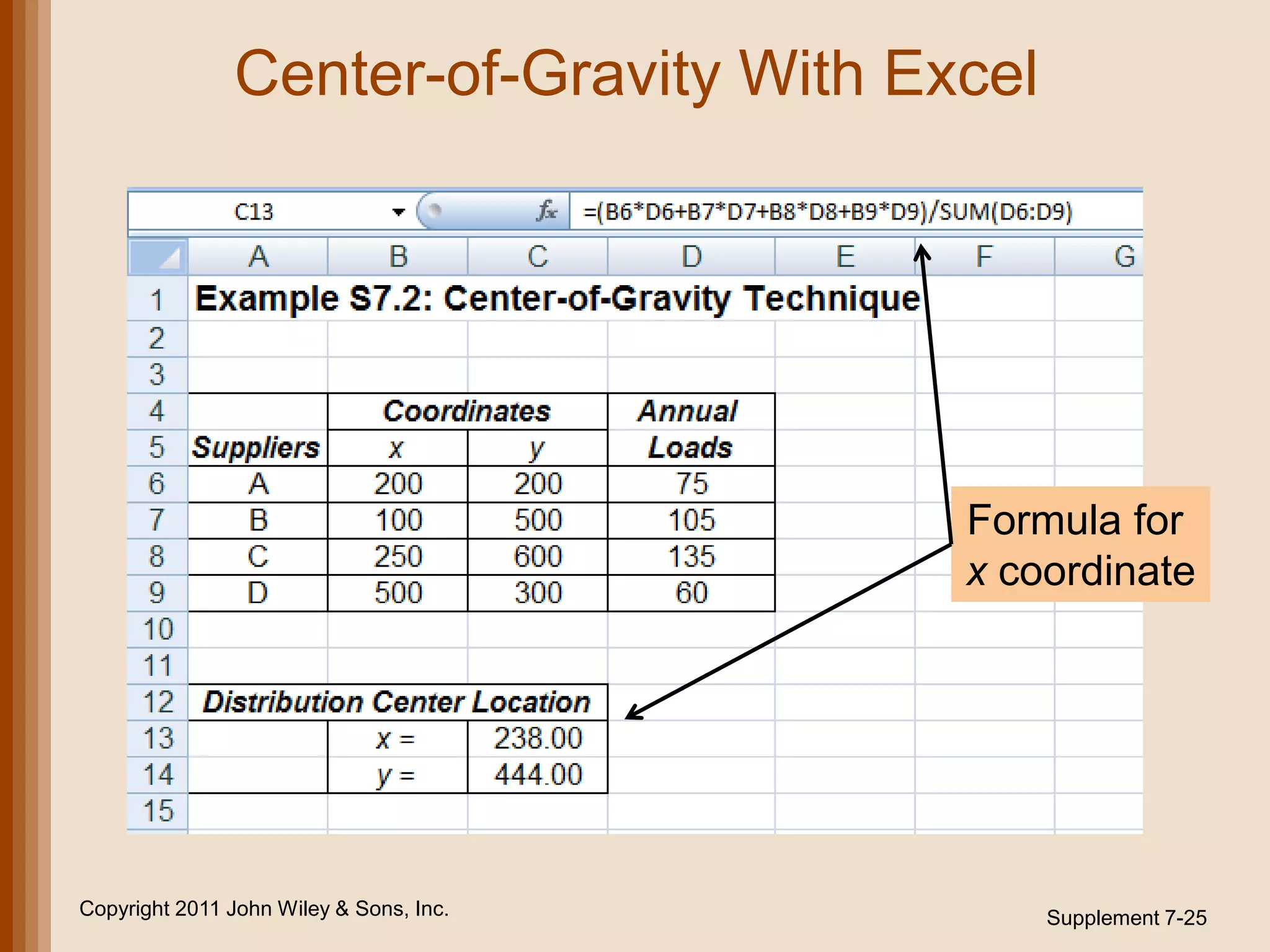
   x=                      =                                                 = 238
                n                          75 + 105 + 135 + 60
                     Wi
            i=1


            n
                    yiWi
          i=1                (200)(75) + (500)(105) + (600)(135) + (300)(60)
   y=                      =                                                 = 444
             n                             75 + 105 + 135 + 60
                    Wi
           i=1


Copyright 2011 John Wiley & Sons, Inc.                                     Supplement 7-23
Center-of-Gravity Technique
            y
                                                      A       B     C           D
          700
                             C                x      200     100   250         500
          600                    (135)        y      200     500   600         300
                   B
                                              W       75     105   135         60
          500          (105)
                                  Center of gravity (238, 444)
  Miles


          400
                                       D
          300
                         A                (60)
          200                (75)
          100

            0    100 200 300 400 500 600 700 x
                           Miles


Copyright 2011 John Wiley & Sons, Inc.                                   Supplement 7-24
Center-of-Gravity With Excel


                                         Formula for
                                         x coordinate


Copyright 2011 John Wiley & Sons, Inc.        Supplement 7-25
Center-of-Gravity With OM Tools


Copyright 2011 John Wiley & Sons, Inc.   Supplement 7-26
Load-Distance Technique

• Compute (Load x Distance) for each site
• Choose site with lowest (Load x Distance)
• Distance can be actual or straight-line


Copyright 2011 John Wiley & Sons, Inc.        Supplement 7-27
Load-Distance Calculations
                                               n
                                     LD =             li di
                                              i=1
       where,
       LD =          load-distance value
       li =         load expressed as a weight, number of trips or units
                    being shipped from proposed site and location i
       di    =      distance between proposed site and location i
       di    =        (xi - x)2 + (yi - y)2
       where,
       (x,y) = coordinates of proposed site
       (xi , yi) = coordinates of existing facility


Copyright 2011 John Wiley & Sons, Inc.                                     Supplement 7-28
Load-Distance

        Potential Sites                                      Suppliers
        Site    X                 Y                   A      B       C          D
        1       360               180        X        200    100     250        500
        2       420               450        Y        200    500     600        300
        3       250               400        Wt       75     105     135        60

     Compute distance from each site to each supplier

Site 1 dA =           (xA - x1)2 + (yA - y1)2     =   (200-360)2 + (200-180)2 = 161.2

           dB =       (xB - x1)2 + (yB - y1)2     =   (100-360)2 + (500-180)2 = 412.3

           dC = 434.2                        dD = 184.4


Copyright 2011 John Wiley & Sons, Inc.                                     Supplement 7-29
Load-Distance
             Site 2 dA = 333             dB = 323.9 dC = 226.7 dD = 170
             Site 3 dA = 206.2 dB = 180.3 dC = 200            dD = 269.3

   Compute load-distance
                                                 n
                                         LD =        li d i
                                                i=1
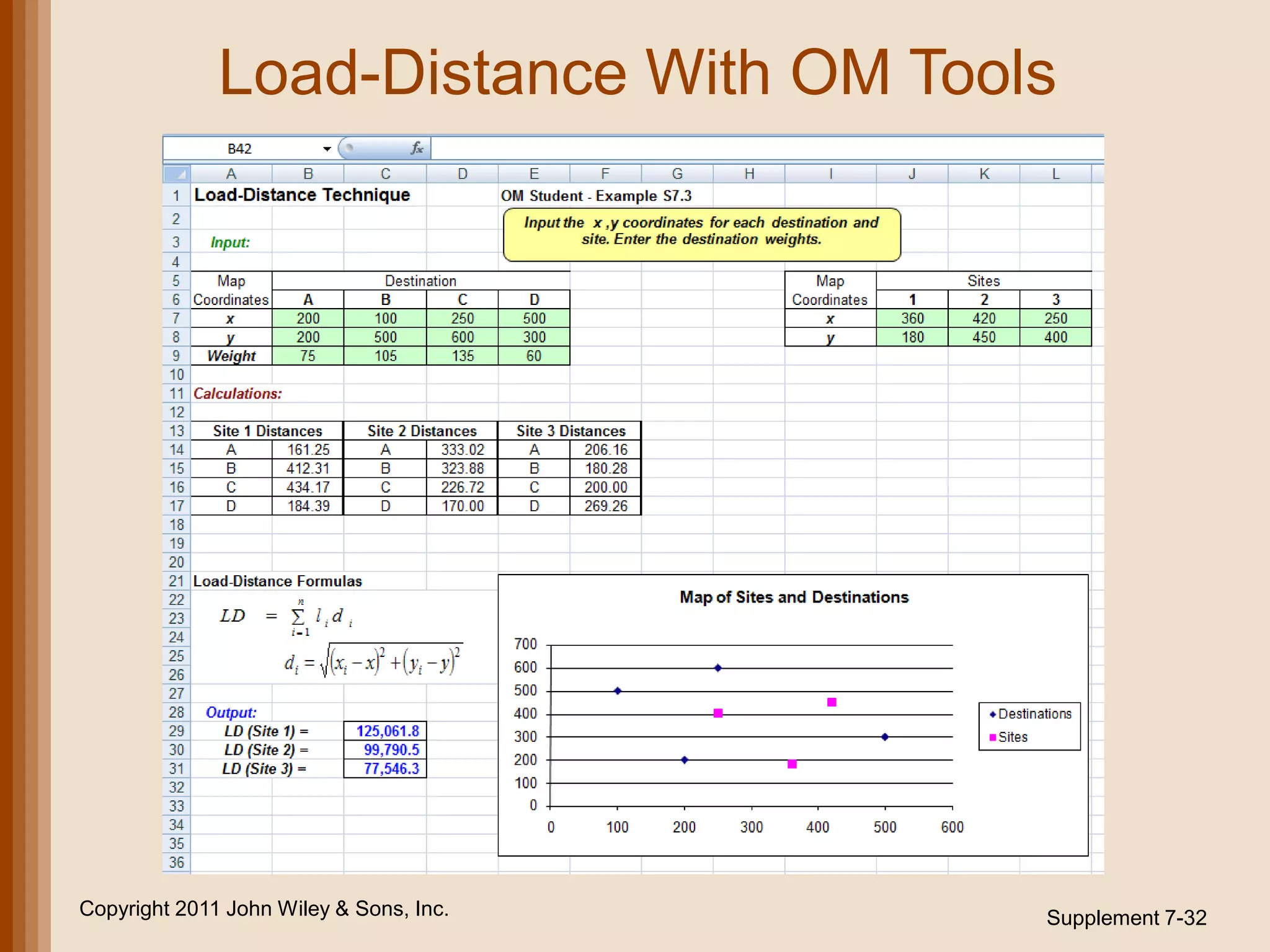
Site 1 = (75)(161.2) + (105)(412.3) + (135)(434.2) + (60)(434.4) = 125,063
Site 2 = (75)(333) + (105)(323.9) + (135)(226.7) + (60)(170) = 99,789
Site 3 = (75)(206.2) + (105)(180.3) + (135)(200) + (60)(269.3) = 77,555*

                                             * Choose site 3

Copyright 2011 John Wiley & Sons, Inc.                                    Supplement 7-30
Load-Distance With Excel


                                         =B7*C11+C7*C12+D7*C13+E7*C14


Copyright 2011 John Wiley & Sons, Inc.                       Supplement 7-31
Load-Distance With OM Tools


Copyright 2011 John Wiley & Sons, Inc.   Supplement 7-32
Copyright 2011 John Wiley & Sons, Inc.
      All rights reserved. Reproduction or translation of this
      work beyond that permitted in section 117 of the 1976
      United States Copyright Act without express permission
      of the copyright owner is unlawful. Request for further
      information should be addressed to the Permission
      Department, John Wiley & Sons, Inc. The purchaser
      may make back-up copies for his/her own use only and
      not for distribution or resale. The Publisher assumes no
      responsibility for errors, omissions, or damages caused
      by the use of these programs or from the use of the
      information herein.


Copyright 2011 John Wiley & Sons, Inc.               Supplement 7-33

C07s

  • 1.
  • 2.
    Lecture Outline • Types of Facilities • Site Selection: Where to Locate • Global Supply Chain Factors • Location Analysis Techniques Copyright 2011 John Wiley & Sons, Inc. Supplement 7-2
  • 3.
    Types of Facilities •Heavy-manufacturing facilities • large, require a lot of space, and are expensive • Light-industry facilities • smaller, cleaner plants and usually less costly • Retail and service facilities • smallest and least costly Copyright 2011 John Wiley & Sons, Inc. Supplement 7-3
  • 4.
    Factors in Heavy Manufacturing Location • Construction costs • Land costs • Raw material & finished goods shipment modes • Proximity to raw materials • Utilities • Means of waste disposal • Labor availability Copyright 2011 John Wiley & Sons, Inc. Supplement 7-4
  • 5.
    Factors in LightIndustry Location • Land costs • Transportation costs • Proximity to markets • depending on delivery requirements including frequency of delivery required by customer Copyright 2011 John Wiley & Sons, Inc. Supplement 7-5
  • 6.
    Factors in RetailLocation • Proximity to customers • Location is everything Copyright 2011 John Wiley & Sons, Inc. Supplement 7-6
  • 7.
    Site Selection: Whereto Locate • Infrequent but important • Location criteria for • being “in the right place at the manufacturing facility right time” • nature of labor force • Must consider other • labor costs factors, especially financial • proximity to suppliers and considerations markets • Location decisions made more • distribution and transportation often for service operations costs than manufacturing facilities • energy availability and cost • Location criteria for service • community infrastructure • access to customers • quality of life in community • government regulations and taxes Copyright 2011 John Wiley & Sons, Inc. Supplement 7-7
  • 8.
    Global Supply ChainFactors • Government stability • Climate • Government regulations • Number & proximity of suppliers • Political & economic systems • Transportation & distribution • Economic stability & growth system • Exchange rates • Labor cost & education • Culture • Available technology • Export/import regulations, • Commercial travel duties & tariffs • Technical expertise • Raw material availability • Cross-border trade regulations • Group trade agreements Copyright 2011 John Wiley & Sons, Inc. Supplement 7-8
  • 9.
    Regional and Community Location Factors in U.S. • Labor • Modes and quality of (availability, education, cost, transportation and unions) • Transportation costs • Proximity of customers • Community government • Number of customers Local business regulations • Construction/leasing costs • Government services (e.g., • Land cost Chamber of Commerce) Copyright 2011 John Wiley & Sons, Inc. Supplement 7-9
  • 10.
    Regional and Community Location Factors in U.S. • Business climate • Infrastructure (road & • Community services utilities) • Incentive packages • Quality of life • Government regulations • Taxes • Environmental regs. • Availability of sites • Raw material availability • Financial services • Commercial travel • Community inducements • Climate • Proximity of suppliers • Education system Copyright 2011 John Wiley & Sons, Inc. Supplement 7-10
  • 11.
    Location Incentives • Tax credits • Relaxed government regulation • Job training • Infrastructure improvement • Money Copyright 2011 John Wiley & Sons, Inc. Supplement 7-11
  • 12.
    Geographic Information Systems(GIS) • Computerized system for storing, managing, creating, analyzing, integrati ng, and digitally displaying geographic, i.e., spatial, data • Specifically used for site selection • Enables users to integrate large quantities of information about potential sites and analyze these data with many different, powerful analytical tools Copyright 2011 John Wiley & Sons, Inc. Supplement 7-12
  • 13.
    GIS Diagram Copyright 2011John Wiley & Sons, Inc. Supplement 7-13
  • 14.
    Location Analysis Techniques •Location factor rating • Center-of-gravity • Load-distance Copyright 2011 John Wiley & Sons, Inc. Supplement 7-14
  • 15.
    Location Factor Rating • Identify important factors • Weight factors (0.00 - 1.00) • Subjectively score each factor (0 - 100) • Sum weighted scores Copyright 2011 John Wiley & Sons, Inc. Supplement 7-15
  • 16.
    Location Factor Rating SCORES (0 TO 100) LOCATION FACTOR WEIGHT Site 1 Site 2 Site 3 Labor pool and climate .30 80 65 90 Proximity to suppliers .20 100 91 75 Wage rates .15 60 95 72 Community environment .15 75 80 80 Proximity to customers .10 65 90 95 Shipping modes .05 85 92 65 Air service .05 50 65 90 Weighted Score for “Labor pool and climate” for Site 1 = (0.30)(80) = 24 Copyright 2011 John Wiley & Sons, Inc. Supplement 7-16
  • 17.
    Location Factor Rating WEIGHTED SCORES Site 1 Site 2 Site 3 24.00 19.50 27.00 20.00 18.20 15.00 Site 3 has the 9.00 14.25 10.80 highest factor rating 11.25 12.00 12.00 6.50 9.00 9.50 4.25 4.60 3.25 2.50 3.25 4.50 77.50 80.80 82.05 Copyright 2011 John Wiley & Sons, Inc. Supplement 7-17
  • 18.
    Location Factor RatingWith Excel Copyright 2011 John Wiley & Sons, Inc. Supplement 7-18
  • 19.
    Location Factor RatingWith OM Tools Copyright 2011 John Wiley & Sons, Inc. Supplement 7-19
  • 20.
    Center-of-Gravity Technique • Locatefacility at center of movement in geographic area • Based on weight and distance traveled; establishes grid-map of area • Identify coordinates and weights shipped for each location Copyright 2011 John Wiley & Sons, Inc. Supplement 7-20
  • 21.
    Grid-Map Coordinates y n n xiWi yiWi 2 (x2, y2), W2 i=1 i=1 y2 x= n y= n Wi Wi 1 (x1, y1), W1 i=1 i=1 y1 where, x, y = coordinates of new facility at 3 (x3, y3), W3 center of gravity y3 xi, yi = coordinates of existing facility i Wi = annual weight shipped from facility i x1 x2 x3 x Copyright 2011 John Wiley & Sons, Inc. Supplement 7-21
  • 22.
    Center-of-Gravity Technique y A B C D 700 C x 200 100 250 500 600 (135) y 200 500 600 300 B W 75 105 135 60 500 (105) Miles 400 D 300 A (60) 200 (75) 100 0 100 200 300 400 500 600 700 x Miles Copyright 2011 John Wiley & Sons, Inc. Supplement 7-22
  • 23.
    Center-of-Gravity Technique n xiWi i=1 (200)(75) + (100)(105) + (250)(135) + (500)(60) x= = = 238 n 75 + 105 + 135 + 60 Wi i=1 n yiWi i=1 (200)(75) + (500)(105) + (600)(135) + (300)(60) y= = = 444 n 75 + 105 + 135 + 60 Wi i=1 Copyright 2011 John Wiley & Sons, Inc. Supplement 7-23
  • 24.
    Center-of-Gravity Technique y A B C D 700 C x 200 100 250 500 600 (135) y 200 500 600 300 B W 75 105 135 60 500 (105) Center of gravity (238, 444) Miles 400 D 300 A (60) 200 (75) 100 0 100 200 300 400 500 600 700 x Miles Copyright 2011 John Wiley & Sons, Inc. Supplement 7-24
  • 25.
    Center-of-Gravity With Excel Formula for x coordinate Copyright 2011 John Wiley & Sons, Inc. Supplement 7-25
  • 26.
    Center-of-Gravity With OMTools Copyright 2011 John Wiley & Sons, Inc. Supplement 7-26
  • 27.
    Load-Distance Technique • Compute(Load x Distance) for each site • Choose site with lowest (Load x Distance) • Distance can be actual or straight-line Copyright 2011 John Wiley & Sons, Inc. Supplement 7-27
  • 28.
    Load-Distance Calculations n LD = li di i=1 where, LD = load-distance value li = load expressed as a weight, number of trips or units being shipped from proposed site and location i di = distance between proposed site and location i di = (xi - x)2 + (yi - y)2 where, (x,y) = coordinates of proposed site (xi , yi) = coordinates of existing facility Copyright 2011 John Wiley & Sons, Inc. Supplement 7-28
  • 29.
    Load-Distance Potential Sites Suppliers Site X Y A B C D 1 360 180 X 200 100 250 500 2 420 450 Y 200 500 600 300 3 250 400 Wt 75 105 135 60 Compute distance from each site to each supplier Site 1 dA = (xA - x1)2 + (yA - y1)2 = (200-360)2 + (200-180)2 = 161.2 dB = (xB - x1)2 + (yB - y1)2 = (100-360)2 + (500-180)2 = 412.3 dC = 434.2 dD = 184.4 Copyright 2011 John Wiley & Sons, Inc. Supplement 7-29
  • 30.
    Load-Distance Site 2 dA = 333 dB = 323.9 dC = 226.7 dD = 170 Site 3 dA = 206.2 dB = 180.3 dC = 200 dD = 269.3 Compute load-distance n LD = li d i i=1 Site 1 = (75)(161.2) + (105)(412.3) + (135)(434.2) + (60)(434.4) = 125,063 Site 2 = (75)(333) + (105)(323.9) + (135)(226.7) + (60)(170) = 99,789 Site 3 = (75)(206.2) + (105)(180.3) + (135)(200) + (60)(269.3) = 77,555* * Choose site 3 Copyright 2011 John Wiley & Sons, Inc. Supplement 7-30
  • 31.
    Load-Distance With Excel =B7*C11+C7*C12+D7*C13+E7*C14 Copyright 2011 John Wiley & Sons, Inc. Supplement 7-31
  • 32.
    Load-Distance With OMTools Copyright 2011 John Wiley & Sons, Inc. Supplement 7-32
  • 33.
    Copyright 2011 JohnWiley & Sons, Inc. All rights reserved. Reproduction or translation of this work beyond that permitted in section 117 of the 1976 United States Copyright Act without express permission of the copyright owner is unlawful. Request for further information should be addressed to the Permission Department, John Wiley & Sons, Inc. The purchaser may make back-up copies for his/her own use only and not for distribution or resale. The Publisher assumes no responsibility for errors, omissions, or damages caused by the use of these programs or from the use of the information herein. Copyright 2011 John Wiley & Sons, Inc. Supplement 7-33