Presentation
Storage Units
Performance Appraisal by Jyoti Singh is under a Creative Commons
Attribution-NonCommercial-ShareAlike 4.0 International License.
Storage
Computer data storage often, called storage or memory,
is a technology consisting of computer components and
recording media used to retain digital data.
Storage is required for following reasons:
 The main memory is temporary memory. The storage
is required to store data and programs permanently.
 The capacity is limited. The storage is required to store
a large amount of data and program.
Use of storage in the field of
information technologies
 Files shares : It provides server based files shared storage
for individual , work groups and other departments.
 High capacity storage : it provides a high capacity storage
device to store data for future preference's.
 Data storage : Data storage is a key component of digital
devices to preserve information ranging from personal
photos to business critical information.
Storage unit of all generations
First generation1951 – 1958: The Vacuum Tube
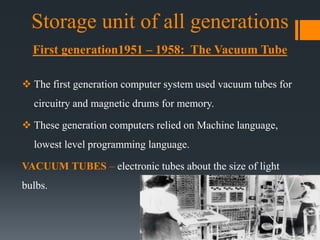
 The first generation computer system used vacuum tubes for
circuitry and magnetic drums for memory.
 These generation computers relied on Machine language,
lowest level programming language.
VACUUM TUBES – electronic tubes about the size of light
bulbs.
SECOND GENERATION
1959 – 1964: The Transistor
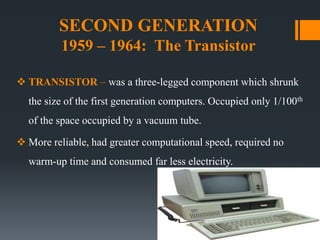
 TRANSISTOR – was a three-legged component which shrunk
the size of the first generation computers. Occupied only 1/100th
of the space occupied by a vacuum tube.
 More reliable, had greater computational speed, required no
warm-up time and consumed far less electricity.
THIRD GENERATION
1965 – 1970: The Integrated Circuit
 Third generation computers arose in 1965 with the invention of
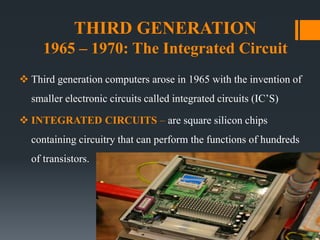
smaller electronic circuits called integrated circuits (IC’S)
 INTEGRATED CIRCUITS – are square silicon chips
containing circuitry that can perform the functions of hundreds
of transistors.
FOURTH GENERATION,
1971 – present: The Microprocessor
 The microprocessor brought the fourth generation of computers,
as thousands of integrated circuits were built onto a single
silicon chip.
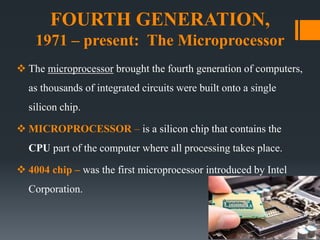
 MICROPROCESSOR – is a silicon chip that contains the
CPU part of the computer where all processing takes place.
 4004 chip – was the first microprocessor introduced by Intel
Corporation.
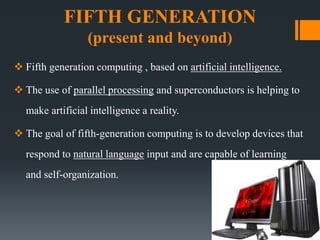
FIFTH GENERATION
(present and beyond)
 Fifth generation computing , based on artificial intelligence.
 The use of parallel processing and superconductors is helping to
make artificial intelligence a reality.
 The goal of fifth-generation computing is to develop devices that
respond to natural language input and are capable of learning
and self-organization.
Permanent storage memories
Computer storage that keeps the data or its content regardless if
the power is turned off or if the storage devise is moved to another
computer.
The most comely used permanent storage is the computer hard
drive.
Some more examples of permanent storage memories…
 Flash drivepen drive
 Memory card
 CD Disc
 Floppy disc
 DVD Disc
 Hard drive etc.
Magnetic Disks
(used in banking sector)
 In the banking area, the permanent storage will be used for keep
the record of every account numbers, account holders name,
DOB, address, pin code etc.
 The magnetized medium in which our data is stored.
 It is non volatile memory.
 The disk is coated by Metallic oxide.
 It is logically divided into tracks and sectors where the central
most track is called index track which is very important for
storing data.
 With the help of magnetic disk it is possible to read and write
information directly.
C storage units

C storage units

  • 1.
    Presentation Storage Units Performance Appraisalby Jyoti Singh is under a Creative Commons Attribution-NonCommercial-ShareAlike 4.0 International License.
  • 2.
    Storage Computer data storageoften, called storage or memory, is a technology consisting of computer components and recording media used to retain digital data. Storage is required for following reasons:  The main memory is temporary memory. The storage is required to store data and programs permanently.  The capacity is limited. The storage is required to store a large amount of data and program.
  • 3.
    Use of storagein the field of information technologies  Files shares : It provides server based files shared storage for individual , work groups and other departments.  High capacity storage : it provides a high capacity storage device to store data for future preference's.  Data storage : Data storage is a key component of digital devices to preserve information ranging from personal photos to business critical information.
  • 4.
    Storage unit ofall generations First generation1951 – 1958: The Vacuum Tube  The first generation computer system used vacuum tubes for circuitry and magnetic drums for memory.  These generation computers relied on Machine language, lowest level programming language. VACUUM TUBES – electronic tubes about the size of light bulbs.
  • 5.
    SECOND GENERATION 1959 –1964: The Transistor  TRANSISTOR – was a three-legged component which shrunk the size of the first generation computers. Occupied only 1/100th of the space occupied by a vacuum tube.  More reliable, had greater computational speed, required no warm-up time and consumed far less electricity.
  • 6.
    THIRD GENERATION 1965 –1970: The Integrated Circuit  Third generation computers arose in 1965 with the invention of smaller electronic circuits called integrated circuits (IC’S)  INTEGRATED CIRCUITS – are square silicon chips containing circuitry that can perform the functions of hundreds of transistors.
  • 7.
    FOURTH GENERATION, 1971 –present: The Microprocessor  The microprocessor brought the fourth generation of computers, as thousands of integrated circuits were built onto a single silicon chip.  MICROPROCESSOR – is a silicon chip that contains the CPU part of the computer where all processing takes place.  4004 chip – was the first microprocessor introduced by Intel Corporation.
  • 8.
    FIFTH GENERATION (present andbeyond)  Fifth generation computing , based on artificial intelligence.  The use of parallel processing and superconductors is helping to make artificial intelligence a reality.  The goal of fifth-generation computing is to develop devices that respond to natural language input and are capable of learning and self-organization.
  • 9.
    Permanent storage memories Computerstorage that keeps the data or its content regardless if the power is turned off or if the storage devise is moved to another computer. The most comely used permanent storage is the computer hard drive. Some more examples of permanent storage memories…  Flash drivepen drive  Memory card  CD Disc  Floppy disc  DVD Disc  Hard drive etc.
  • 10.
    Magnetic Disks (used inbanking sector)  In the banking area, the permanent storage will be used for keep the record of every account numbers, account holders name, DOB, address, pin code etc.  The magnetized medium in which our data is stored.  It is non volatile memory.  The disk is coated by Metallic oxide.  It is logically divided into tracks and sectors where the central most track is called index track which is very important for storing data.  With the help of magnetic disk it is possible to read and write information directly.