
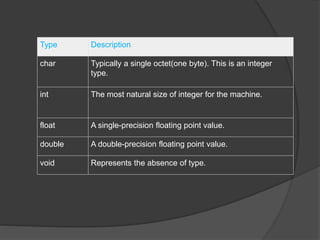
Type Description
char Typically a single octet(one byte). This is an integer
type.
int The most natural size of integer for the machine.
float A single-precision floating point value.
double A double-precision floating point value.
void Represents the absence of type.
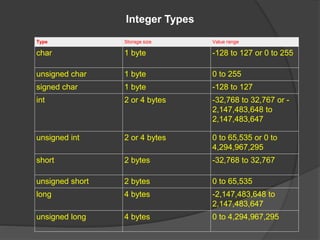
Type Storage size Value range
char 1 byte -128 to 127 or 0 to 255
unsigned char 1 byte 0 to 255
signed char 1 byte -128 to 127
int 2 or 4 bytes -32,768 to 32,767 or -
2,147,483,648 to
2,147,483,647
unsigned int 2 or 4 bytes 0 to 65,535 or 0 to
4,294,967,295
short 2 bytes -32,768 to 32,767
unsigned short 2 bytes 0 to 65,535
long 4 bytes -2,147,483,648 to
2,147,483,647
unsigned long 4 bytes 0 to 4,294,967,295
Integer Types
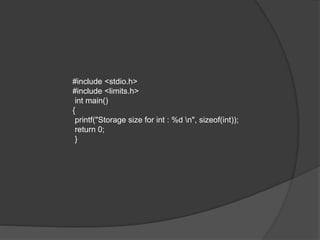
#include <stdio.h>
#include <limits.h>
int main()
{
printf("Storage size for int : %d n", sizeof(int));
return 0;
}
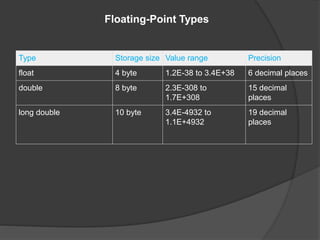
Floating-Point Types
Type Storage size Value range Precision
float 4 byte 1.2E-38 to 3.4E+38 6 decimal places
double 8 byte 2.3E-308 to
1.7E+308
15 decimal
places
long double 10 byte 3.4E-4932 to
1.1E+4932
19 decimal
places
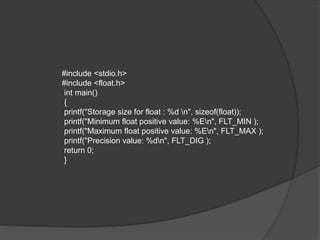
#include <stdio.h>
#include <float.h>
int main()
{
printf("Storage size for float : %d n", sizeof(float));
printf("Minimum float positive value: %En", FLT_MIN );
printf("Maximum float positive value: %En", FLT_MAX );
printf("Precision value: %dn", FLT_DIG );
return 0;
}
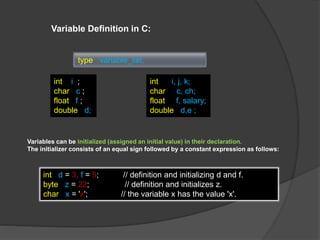
Variable Definition in C:
type variable_list;
int i, j, k;
char c, ch;
float f, salary;
double d,e ;
int i ;
char c ;
float f ;
double d;
Variables can be initialized (assigned an initial value) in their declaration.
The initializer consists of an equal sign followed by a constant expression as follows:
int d = 3, f = 5; // definition and initializing d and f.
byte z = 22; // definition and initializes z.
char x = 'x'; // the variable x has the value 'x'.
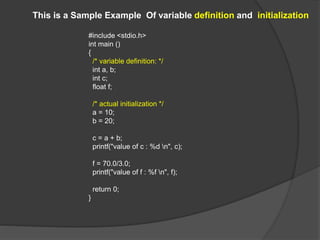
#include <stdio.h>
int main ()
{
/* variable definition: */
int a, b;
int c;
float f;
/* actual initialization */
a = 10;
b = 20;
c = a + b;
printf("value of c : %d n", c);
f = 70.0/3.0;
printf("value of f : %f n", f);
return 0;
}
This is a Sample Example Of variable definition and initialization
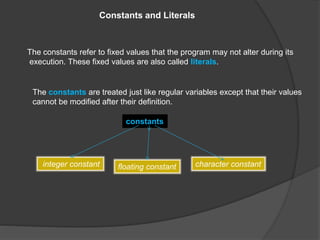
Constants and Literals
The constants refer to fixed values that the program may not alter during its
execution. These fixed values are also called literals.
The constants are treated just like regular variables except that their values
cannot be modified after their definition.
constants
integer constant floating constant character constant
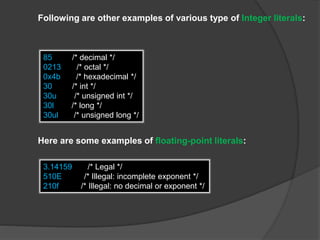
Following are other examples of various type of Integer literals:
85 /* decimal */
0213 /* octal */
0x4b /* hexadecimal */
30 /* int */
30u /* unsigned int */
30l /* long */
30ul /* unsigned long */
Here are some examples of floating-point literals:
3.14159 /* Legal */
510E /* Illegal: incomplete exponent */
210f /* Illegal: no decimal or exponent */
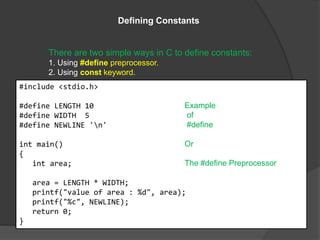
Defining Constants
There are two simple ways in C to define constants:
1. Using #define preprocessor.
2. Using const keyword.
#include <stdio.h>
#define LENGTH 10
#define WIDTH 5
#define NEWLINE 'n'
int main()
{
int area;
area = LENGTH * WIDTH;
printf("value of area : %d", area);
printf("%c", NEWLINE);
return 0;
}
Example
of
#define
Or
The #define Preprocessor
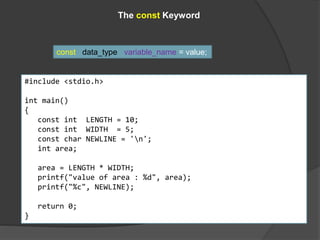
The const Keyword
const data_type variable_name = value;
#include <stdio.h>
int main()
{
const int LENGTH = 10;
const int WIDTH = 5;
const char NEWLINE = 'n';
int area;
area = LENGTH * WIDTH;
printf("value of area : %d", area);
printf("%c", NEWLINE);
return 0;
}

C Programming Language Step by Step Part 3

  • 2.
    Type Description char Typicallya single octet(one byte). This is an integer type. int The most natural size of integer for the machine. float A single-precision floating point value. double A double-precision floating point value. void Represents the absence of type.
  • 3.
    Type Storage sizeValue range char 1 byte -128 to 127 or 0 to 255 unsigned char 1 byte 0 to 255 signed char 1 byte -128 to 127 int 2 or 4 bytes -32,768 to 32,767 or - 2,147,483,648 to 2,147,483,647 unsigned int 2 or 4 bytes 0 to 65,535 or 0 to 4,294,967,295 short 2 bytes -32,768 to 32,767 unsigned short 2 bytes 0 to 65,535 long 4 bytes -2,147,483,648 to 2,147,483,647 unsigned long 4 bytes 0 to 4,294,967,295 Integer Types
  • 4.
    #include <stdio.h> #include <limits.h> intmain() { printf("Storage size for int : %d n", sizeof(int)); return 0; }
  • 5.
    Floating-Point Types Type Storagesize Value range Precision float 4 byte 1.2E-38 to 3.4E+38 6 decimal places double 8 byte 2.3E-308 to 1.7E+308 15 decimal places long double 10 byte 3.4E-4932 to 1.1E+4932 19 decimal places
  • 6.
    #include <stdio.h> #include <float.h> intmain() { printf("Storage size for float : %d n", sizeof(float)); printf("Minimum float positive value: %En", FLT_MIN ); printf("Maximum float positive value: %En", FLT_MAX ); printf("Precision value: %dn", FLT_DIG ); return 0; }
  • 7.
    Variable Definition inC: type variable_list; int i, j, k; char c, ch; float f, salary; double d,e ; int i ; char c ; float f ; double d; Variables can be initialized (assigned an initial value) in their declaration. The initializer consists of an equal sign followed by a constant expression as follows: int d = 3, f = 5; // definition and initializing d and f. byte z = 22; // definition and initializes z. char x = 'x'; // the variable x has the value 'x'.
  • 8.
    #include <stdio.h> int main() { /* variable definition: */ int a, b; int c; float f; /* actual initialization */ a = 10; b = 20; c = a + b; printf("value of c : %d n", c); f = 70.0/3.0; printf("value of f : %f n", f); return 0; } This is a Sample Example Of variable definition and initialization
  • 9.
    Constants and Literals Theconstants refer to fixed values that the program may not alter during its execution. These fixed values are also called literals. The constants are treated just like regular variables except that their values cannot be modified after their definition. constants integer constant floating constant character constant
  • 10.
    Following are otherexamples of various type of Integer literals: 85 /* decimal */ 0213 /* octal */ 0x4b /* hexadecimal */ 30 /* int */ 30u /* unsigned int */ 30l /* long */ 30ul /* unsigned long */ Here are some examples of floating-point literals: 3.14159 /* Legal */ 510E /* Illegal: incomplete exponent */ 210f /* Illegal: no decimal or exponent */
  • 11.
    Defining Constants There aretwo simple ways in C to define constants: 1. Using #define preprocessor. 2. Using const keyword. #include <stdio.h> #define LENGTH 10 #define WIDTH 5 #define NEWLINE 'n' int main() { int area; area = LENGTH * WIDTH; printf("value of area : %d", area); printf("%c", NEWLINE); return 0; } Example of #define Or The #define Preprocessor
  • 12.
    The const Keyword constdata_type variable_name = value; #include <stdio.h> int main() { const int LENGTH = 10; const int WIDTH = 5; const char NEWLINE = 'n'; int area; area = LENGTH * WIDTH; printf("value of area : %d", area); printf("%c", NEWLINE); return 0; }