
C & C++ TRAINING INSTITUTE IN
AMBALA
Presented By: Simran Grover
What is C ?
• C is a high-level and general purpose
programming language that is ideal
for developing firmware or portable
applications. Originally intended for
writing system software.
• C was developed at Bell Labs by
Dennis Ritchie for the Unix
Operating System (OS) in the early
1970s.
• Ranked among the most widely used
languages, C has a compiler for most
computer systems and influenced
many popular languages – notably
C++.
History of C
• C is a general-purpose programming language.
• C is a programming language which born at “AT &
T’s Bell Laboratory” of USA in 1972.
• C was written by Dennis Ritchie, that’s why he is
also called as father of c programming language.
• C language was created for a specific purpose i.e.,
designing the UNIX operating system (which is
currently base of many UNIX based OS From the
beginning, C was intended to be useful to allow
busy programmers to get things done because C is
such a powerful, dominant and supple language
• Its use quickly spread beyond Bell Labs in the late
70’s because of its long list of strong features.
History of C
• C language was created for a specific
purpose i.e., designing the UNIX
operating.
• Its use quickly spread beyond Bell
Labs in the late 70’s because of
its long list of strong features.
Features of C
• Fixed number of keywords, including a set
of control primitives, such as if, for, while,
switch and do while
• Multiple logical and mathematical
operators, including bit manipulators
• Multiple assignments may be applied in a
single statement.
Features of C
• Function return values are not always
required and may be ignored if
unneeded.
• Typing is static.
• Basic form of modularity, as files
may be separately compiled and linked
• Control of function and object
visibility to other files via extern and
static attributes
Advantages
• Procedure Oriented language
• Lots of Libraries
• Speed of Compilation
• Easy to Learn
• Portable
• It follows top – down approach
Applications of C
• C language is used for creating computer applications
• Used in writing Embedded software's
• Firmware for various electronics, industrial and
communications products which use micro-controllers.
• It is also used in developing verification software, test
code, simulators etc. for various applications and
hardware products.
• For Creating Compiles of different Languages which
can take input from other language and convert it
into lower level machine dependent language.
• C is used to implement different Operating System
Operations.
• UNIX kernel is completely developed in C Language.
Applications of C
• For Creating Compiles of different
Languages which can take input from
other language and convert it into
lower level machine dependent language.
• C is used to implement
different Operating System Operations.
• UNIX kernel is completely developed in
C Language.
Some More Applications of C
Operating Systems Network Drivers Print Spoolers
Language compilers Assemblers Text Editors
Modern Programs Data Bases Language Interpreters
Simulators Utilities Embedded System
What is C++ ?
• C++ is a general purpose object oriented
programming language. It is considered to
be an intermediate level language, as it
encapsulates both high and low level
language features. Initially, the language
was called 'C with classes’ as it had all
properties of C language with an additional
concept of 'classes’. However, it was
renamed to C++ in 1983.
• It is pronounced as "C-Plus-Plus."
History of C++
• C++ Development started in 1979.
• During the creation of Ph.D. thesis, Bjarne
Stroustrup worked with language called Simula.
• Bjarne Stroustrup identified that this OOP
features can be included in the software
development.
• After that Bjarne Stroustrup started working
on the C language and added more extra
OOP features to the classic C.
• C++ includes features such as classes,
inheritance, in-lining, default function
arguments, and strong type checking.
History of C++
• After that Bjarne Stroustrup started
working on the C language and added
more extra OOP features to the
classic C.
• C++ includes features such as classes,
inheritance, in-lining, default function
arguments, and strong type checking.
Features
• Simple
• Portability
• Powerful
• Platform dependent
• Object oriented
• Case sensitive
• Compiler based
• Syntax based language
• Use of Pointers
Applications of C++
• Google : Google uses C++ for indexing.
• Adobe Systems : All major software like
Photoshop, Adobe Premiere are made in C++.
• Mozilla : Mozilla Firefox and Thunderbird are
written in C++.
Applications of C++
• VLC media player is written in C language.
Many parts of Operating systems are
written in C/C++. And the very powerful
Linux is completely written in C.
• MySQL : The very powerful database
management application
Advantages
• Simple
• Secure
• Portable
• Object-Oriented
• Robust
• Multithreaded
• Interpreted
• Provides high
performance
• Distributed
• Dynamic
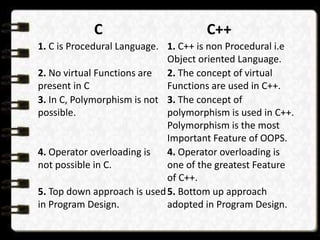
C C++
1. C is Procedural Language. 1. C++ is non Procedural i.e
Object oriented Language.
2. No virtual Functions are
present in C
2. The concept of virtual
Functions are used in C++.
3. In C, Polymorphism is not
possible.
3. The concept of
polymorphism is used in C++.
Polymorphism is the most
Important Feature of OOPS.
4. Operator overloading is
not possible in C.
4. Operator overloading is
one of the greatest Feature
of C++.
5. Top down approach is used
in Program Design.
5. Bottom up approach
adopted in Program Design.
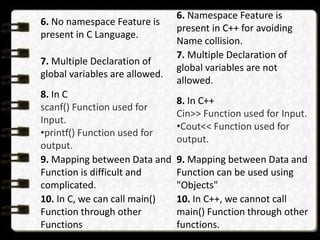
6. No namespace Feature is
present in C Language.
6. Namespace Feature is
present in C++ for avoiding
Name collision.
7. Multiple Declaration of
global variables are allowed.
7. Multiple Declaration of
global variables are not
allowed.
8. In C
scanf() Function used for
Input.
•printf() Function used for
output.
8. In C++
Cin>> Function used for Input.
•Cout<< Function used for
output.
9. Mapping between Data and
Function is difficult and
complicated.
9. Mapping between Data and
Function can be used using
"Objects"
10. In C, we can call main()
Function through other
Functions
10. In C++, we cannot call
main() Function through other
functions.
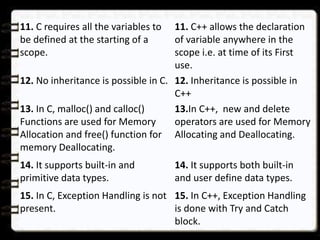
11. C requires all the variables to
be defined at the starting of a
scope.
11. C++ allows the declaration
of variable anywhere in the
scope i.e. at time of its First
use.
12. No inheritance is possible in C. 12. Inheritance is possible in
C++
13. In C, malloc() and calloc()
Functions are used for Memory
Allocation and free() function for
memory Deallocating.
13.In C++, new and delete
operators are used for Memory
Allocating and Deallocating.
14. It supports built-in and
primitive data types.
14. It supports both built-in
and user define data types.
15. In C, Exception Handling is not
present.
15. In C++, Exception Handling
is done with Try and Catch
block.
• BASIC COURSE
• C PROGRAMMING
• C++ PROGRAMMING
• WEB DESIGNING
• WEB DEVELOPMENT
• S.E.O
Basic Computer
• Notepad
• WordPad
• MS OFFICE 2010, 2013 [ Word, Excel,
Power Point]
• Internet [Gmail, Facebook, Twitter]
• Online Form Filling
• Bill paying, Mobile Recharge, Shopping
[Linked, Printerrest]
• Window Installation, Software Up-
Loadations.
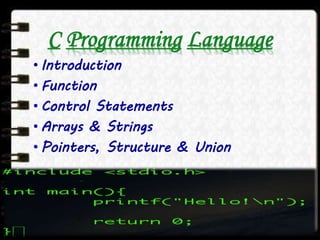
C Programming Language
• Introduction
• Function
• Control Statements
• Arrays & Strings
• Pointers, Structure & Union
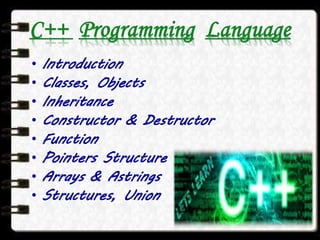
C++ Programming Language
• Introduction
• Classes, Objects
• Inheritance
• Constructor & Destructor
• Function
• Pointers Structure
• Arrays & Astrings
• Structures, Union
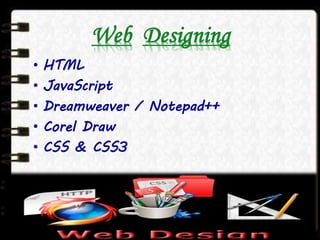
Web Designing
• HTML
• JavaScript
• Dreamweaver / Notepad++
• Corel Draw
• CSS & CSS3
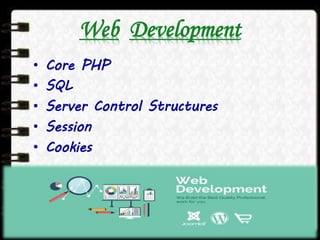
Web Development
• Core PHP
• SQL
• Server Control Structures
• Session
• Cookies
S.E.O Courses
• Search Engine Basic
• Keyword Research
• Best On-Page SEO Tricks
• Role of Word Press
• Domain Selection
• Social media Importance
• Anchor Text Messages
• Black Hat VS. White Hat Local Place
Courses Attractions
• Server Uploading
• Working on (Responsive, Creative, E-
Commerce Website)
• Title Meta Tag
• External Links
• Official Blogs
• Web 2.0 Blogs
ADDRESS:
SCO -15 Dayal Bagh,
Ambala Cantt , 133001
Near Panchmukhi Hanuman Mandir
Haryana.
Ph. No. : 9729666670, 4000670
E-Mail ID : jbjatinbatra@gmail.com
Website : www.batracomputercentre.com
CONTACT US
C & C++ Training Centre in Ambala! BATRA COMPUTER CENTRE

C & C++ Training Centre in Ambala! BATRA COMPUTER CENTRE

  • 1.
    C & C++TRAINING INSTITUTE IN AMBALA Presented By: Simran Grover
  • 3.
    What is C? • C is a high-level and general purpose programming language that is ideal for developing firmware or portable applications. Originally intended for writing system software.
  • 4.
    • C wasdeveloped at Bell Labs by Dennis Ritchie for the Unix Operating System (OS) in the early 1970s. • Ranked among the most widely used languages, C has a compiler for most computer systems and influenced many popular languages – notably C++.
  • 5.
    History of C •C is a general-purpose programming language. • C is a programming language which born at “AT & T’s Bell Laboratory” of USA in 1972. • C was written by Dennis Ritchie, that’s why he is also called as father of c programming language. • C language was created for a specific purpose i.e., designing the UNIX operating system (which is currently base of many UNIX based OS From the beginning, C was intended to be useful to allow busy programmers to get things done because C is such a powerful, dominant and supple language • Its use quickly spread beyond Bell Labs in the late 70’s because of its long list of strong features.
  • 6.
    History of C •C language was created for a specific purpose i.e., designing the UNIX operating. • Its use quickly spread beyond Bell Labs in the late 70’s because of its long list of strong features.
  • 7.
    Features of C •Fixed number of keywords, including a set of control primitives, such as if, for, while, switch and do while • Multiple logical and mathematical operators, including bit manipulators • Multiple assignments may be applied in a single statement.
  • 8.
    Features of C •Function return values are not always required and may be ignored if unneeded. • Typing is static. • Basic form of modularity, as files may be separately compiled and linked • Control of function and object visibility to other files via extern and static attributes
  • 9.
    Advantages • Procedure Orientedlanguage • Lots of Libraries • Speed of Compilation • Easy to Learn • Portable • It follows top – down approach
  • 10.
    Applications of C •C language is used for creating computer applications • Used in writing Embedded software's • Firmware for various electronics, industrial and communications products which use micro-controllers. • It is also used in developing verification software, test code, simulators etc. for various applications and hardware products. • For Creating Compiles of different Languages which can take input from other language and convert it into lower level machine dependent language. • C is used to implement different Operating System Operations. • UNIX kernel is completely developed in C Language.
  • 11.
    Applications of C •For Creating Compiles of different Languages which can take input from other language and convert it into lower level machine dependent language. • C is used to implement different Operating System Operations. • UNIX kernel is completely developed in C Language.
  • 12.
    Some More Applicationsof C Operating Systems Network Drivers Print Spoolers Language compilers Assemblers Text Editors Modern Programs Data Bases Language Interpreters Simulators Utilities Embedded System
  • 13.
    What is C++? • C++ is a general purpose object oriented programming language. It is considered to be an intermediate level language, as it encapsulates both high and low level language features. Initially, the language was called 'C with classes’ as it had all properties of C language with an additional concept of 'classes’. However, it was renamed to C++ in 1983. • It is pronounced as "C-Plus-Plus."
  • 14.
    History of C++ •C++ Development started in 1979. • During the creation of Ph.D. thesis, Bjarne Stroustrup worked with language called Simula. • Bjarne Stroustrup identified that this OOP features can be included in the software development. • After that Bjarne Stroustrup started working on the C language and added more extra OOP features to the classic C. • C++ includes features such as classes, inheritance, in-lining, default function arguments, and strong type checking.
  • 15.
    History of C++ •After that Bjarne Stroustrup started working on the C language and added more extra OOP features to the classic C. • C++ includes features such as classes, inheritance, in-lining, default function arguments, and strong type checking.
  • 16.
    Features • Simple • Portability •Powerful • Platform dependent • Object oriented • Case sensitive • Compiler based • Syntax based language • Use of Pointers
  • 17.
    Applications of C++ •Google : Google uses C++ for indexing. • Adobe Systems : All major software like Photoshop, Adobe Premiere are made in C++. • Mozilla : Mozilla Firefox and Thunderbird are written in C++.
  • 18.
    Applications of C++ •VLC media player is written in C language. Many parts of Operating systems are written in C/C++. And the very powerful Linux is completely written in C. • MySQL : The very powerful database management application
  • 19.
    Advantages • Simple • Secure •Portable • Object-Oriented • Robust • Multithreaded • Interpreted • Provides high performance • Distributed • Dynamic
  • 20.
    C C++ 1. Cis Procedural Language. 1. C++ is non Procedural i.e Object oriented Language. 2. No virtual Functions are present in C 2. The concept of virtual Functions are used in C++. 3. In C, Polymorphism is not possible. 3. The concept of polymorphism is used in C++. Polymorphism is the most Important Feature of OOPS. 4. Operator overloading is not possible in C. 4. Operator overloading is one of the greatest Feature of C++. 5. Top down approach is used in Program Design. 5. Bottom up approach adopted in Program Design.
  • 21.
    6. No namespaceFeature is present in C Language. 6. Namespace Feature is present in C++ for avoiding Name collision. 7. Multiple Declaration of global variables are allowed. 7. Multiple Declaration of global variables are not allowed. 8. In C scanf() Function used for Input. •printf() Function used for output. 8. In C++ Cin>> Function used for Input. •Cout<< Function used for output. 9. Mapping between Data and Function is difficult and complicated. 9. Mapping between Data and Function can be used using "Objects" 10. In C, we can call main() Function through other Functions 10. In C++, we cannot call main() Function through other functions.
  • 22.
    11. C requiresall the variables to be defined at the starting of a scope. 11. C++ allows the declaration of variable anywhere in the scope i.e. at time of its First use. 12. No inheritance is possible in C. 12. Inheritance is possible in C++ 13. In C, malloc() and calloc() Functions are used for Memory Allocation and free() function for memory Deallocating. 13.In C++, new and delete operators are used for Memory Allocating and Deallocating. 14. It supports built-in and primitive data types. 14. It supports both built-in and user define data types. 15. In C, Exception Handling is not present. 15. In C++, Exception Handling is done with Try and Catch block.
  • 26.
    • BASIC COURSE •C PROGRAMMING • C++ PROGRAMMING • WEB DESIGNING • WEB DEVELOPMENT • S.E.O
  • 27.
    Basic Computer • Notepad •WordPad • MS OFFICE 2010, 2013 [ Word, Excel, Power Point] • Internet [Gmail, Facebook, Twitter] • Online Form Filling • Bill paying, Mobile Recharge, Shopping [Linked, Printerrest] • Window Installation, Software Up- Loadations.
  • 28.
    C Programming Language •Introduction • Function • Control Statements • Arrays & Strings • Pointers, Structure & Union
  • 29.
    C++ Programming Language •Introduction • Classes, Objects • Inheritance • Constructor & Destructor • Function • Pointers Structure • Arrays & Astrings • Structures, Union
  • 30.
    Web Designing • HTML •JavaScript • Dreamweaver / Notepad++ • Corel Draw • CSS & CSS3
  • 31.
    Web Development • CorePHP • SQL • Server Control Structures • Session • Cookies
  • 32.
    S.E.O Courses • SearchEngine Basic • Keyword Research • Best On-Page SEO Tricks • Role of Word Press • Domain Selection • Social media Importance • Anchor Text Messages • Black Hat VS. White Hat Local Place
  • 33.
    Courses Attractions • ServerUploading • Working on (Responsive, Creative, E- Commerce Website) • Title Meta Tag • External Links • Official Blogs • Web 2.0 Blogs
  • 35.
    ADDRESS: SCO -15 DayalBagh, Ambala Cantt , 133001 Near Panchmukhi Hanuman Mandir Haryana. Ph. No. : 9729666670, 4000670 E-Mail ID : jbjatinbatra@gmail.com Website : www.batracomputercentre.com CONTACT US