AND

WITH FEATURES OF OOPS
In computing, C is a general-purpose programming
language initially developed by Dennis Ritchie between
1969 and 1973 at AT&T Bell Labs.

   C is a procedural language in which we focus on
mathematical and algorithm.
 Simple C Program
                           # include <stdio.h>
                      int main(void) {
                    printf(“Hello Worldn”);
                           return 0;
                              }
C++ was originally developed to be the next
version of C, not a new language. it was developed
by Bjarne Stroustrup starting in 1979 at Bell Labs

    It is an object oriented programming language in
which we focus on real life problem.

Simple C++ Program
                     #include <iostream.h>
                     int main(void) {
                      cout << “Hello Worldn”;
                       return 0;
                          }
Differences

C
      it is most stable for handling small
programme.

C++
      it is for handling large programme.

C
      it follows top down approach.

C++
      it flows bottom up approach.
C
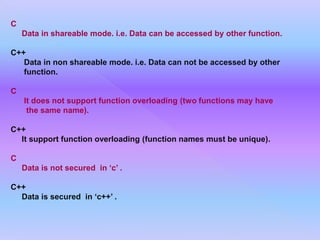
    Data in shareable mode. i.e. Data can be accessed by other function.

C++
   Data in non shareable mode. i.e. Data can not be accessed by other
   function.

C
    It does not support function overloading (two functions may have
     the same name).

C++
  It support function overloading (function names must be unique).

C
    Data is not secured in ‘c’ .

C++
  Data is secured in ‘c++’ .
BASIC FEATURES OF OBJECT ORIENTED
        PROGRAMMING LANGUAGE (OOPS)


           OBJECT               CLASS


MESSEGE
PASSING             OOPS            INERITANCE


          DYNAMIC            POLYMORPHI
          BINDING                SM
OBJECTS
      Objects are basic runtime entity in object oriented system. When a
program is executed, the objects interact by sending messages to one
another .


CLASS
         Classes are user defined data types and it behaves like built in
types of programming language. It is the way to bind the data and
function to gather in a single unit.


INHERITANCE
            The mechanism of deriving a new class from an old class is
called inheritance or derivation. The old class is known as base class
while new class is known as derived class or sub class. The inheritance is
the most powerful features of OOP.
POLYMORPHISM
       Polymorphism is a Greek term which means ability to take more than one
form.
For example, + is used to make sum of two numbers as well as it is used to combine
 two strings.


DYNAMIC BINDING
      Dynamic binding means link exist between procedure call and code to be
execute at run time when that procedure is call.


MESSAGE PASSING
    Objects can communicate with each others by passing message same as
people passing message with each other. Message passing involves name of object,
name of function (message) and information to be send.
C vs c++

C vs c++

  • 1.
  • 2.
    In computing, Cis a general-purpose programming language initially developed by Dennis Ritchie between 1969 and 1973 at AT&T Bell Labs. C is a procedural language in which we focus on mathematical and algorithm. Simple C Program # include <stdio.h> int main(void) { printf(“Hello Worldn”); return 0; }
  • 3.
    C++ was originallydeveloped to be the next version of C, not a new language. it was developed by Bjarne Stroustrup starting in 1979 at Bell Labs It is an object oriented programming language in which we focus on real life problem. Simple C++ Program #include <iostream.h> int main(void) { cout << “Hello Worldn”; return 0; }
  • 4.
    Differences C it is most stable for handling small programme. C++ it is for handling large programme. C it follows top down approach. C++ it flows bottom up approach.
  • 5.
    C Data in shareable mode. i.e. Data can be accessed by other function. C++ Data in non shareable mode. i.e. Data can not be accessed by other function. C It does not support function overloading (two functions may have the same name). C++ It support function overloading (function names must be unique). C Data is not secured in ‘c’ . C++ Data is secured in ‘c++’ .
  • 6.
    BASIC FEATURES OFOBJECT ORIENTED PROGRAMMING LANGUAGE (OOPS) OBJECT CLASS MESSEGE PASSING OOPS INERITANCE DYNAMIC POLYMORPHI BINDING SM
  • 7.
    OBJECTS Objects are basic runtime entity in object oriented system. When a program is executed, the objects interact by sending messages to one another . CLASS Classes are user defined data types and it behaves like built in types of programming language. It is the way to bind the data and function to gather in a single unit. INHERITANCE The mechanism of deriving a new class from an old class is called inheritance or derivation. The old class is known as base class while new class is known as derived class or sub class. The inheritance is the most powerful features of OOP.
  • 8.
    POLYMORPHISM Polymorphism is a Greek term which means ability to take more than one form. For example, + is used to make sum of two numbers as well as it is used to combine two strings. DYNAMIC BINDING Dynamic binding means link exist between procedure call and code to be execute at run time when that procedure is call. MESSAGE PASSING Objects can communicate with each others by passing message same as people passing message with each other. Message passing involves name of object, name of function (message) and information to be send.