Index
1. About C++
2. Difference between C and C++
3. History of C++
4. For Example
5. Why we learn C++
6. Application of C++
7. Types of Jobs in C++
8. Career in C++
9. The Demand for C++ in the Market
10. Advantages of C++
About C++
• C++ is a general-purpose programming language that was developed as an enhancement of the C
language to include object-oriented paradigm. It is an imperative and a compiled language.
• C++ is a middle-level language rendering it the advantage of programming low-level (drivers, kernels)
and even higher-level applications (games, GUI, desktop apps etc.). The basic syntax and code structure
of both C and C++ are the same.
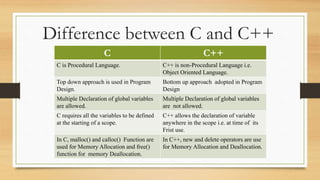
Difference between C and C++
C C++
C is Procedural Language. C++ is non-Procedural Language i.e.
Object Oriented Language.
Top down approach is used in Program
Design.
Bottom up approach adopted in Program
Design
Multiple Declaration of global variables
are allowed.
Multiple Declaration of global variables
are not allowed.
C requires all the variables to be defined
at the starting of a scope.
C++ allows the declaration of variable
anywhere in the scope i.e. at time of its
Frist use.
In C, malloc() and calloc() Function are
used for Memory Allocation and free()
function for memory Deallocation.
In C++, new and delete operators are use
for Memory Allocation and Deallocation.
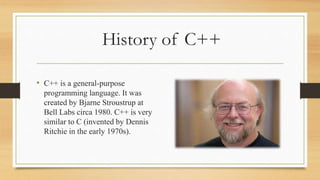
History of C++
• C++ is a general-purpose
programming language. It was
created by Bjarne Stroustrup at
Bell Labs circa 1980. C++ is very
similar to C (invented by Dennis
Ritchie in the early 1970s).
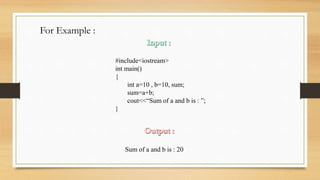
For Example :
#include<iostream>
int main()
{
int a=10 , b=10, sum;
sum=a+b;
cout<<“Sum of a and b is : ”;
}
Sum of a and b is : 20
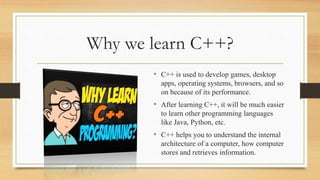
Why we learn C++?
• C++ is used to develop games, desktop
apps, operating systems, browsers, and so
on because of its performance.
• After learning C++, it will be much easier
to learn other programming languages
like Java, Python, etc.
• C++ helps you to understand the internal
architecture of a computer, how computer
stores and retrieves information.
Application of C++
C++ finds varied usage in applications such as:
• Operating Systems & Systems Programming. e.g. Linux-based OS (Ubuntu etc.)
• Browsers (Chrome & Firefox)
• Graphics & Game engines (Photoshop, Blender, Unreal-Engine)
• Database Engines (MySQL, MongoDB, Redis etc.)
• Cloud/Distributed Systems
Types of Jobs in C++
• Junior Programmer
• Senior Programmer
• Software Developer
• Quality Analyst
• Game Programmer
• Software Developer Engineer
• C/C++ Analyst
• Programming Architect
• UNIX Shell Scripting
• Backend Developer
• Embedded Engineer
• Database Developer
• Bioinformatician
• Computational Biologist
Career in C++
Today, almost every person is at least
familiar with the term “C and C++
programming” when it comes to
Computer Science. Even a person
from a non-technical background has
heard about these languages. The
establishment of the Information
Technology sector first started with
fundamental languages like C and
C++.
The Demand for C++ in the Market
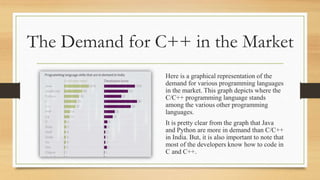
Here is a graphical representation of the
demand for various programming languages
in the market. This graph depicts where the
C/C++ programming language stands
among the various other programming
languages.
It is pretty clear from the graph that Java
and Python are more in demand than C/C++
in India. But, it is also important to note that
most of the developers know how to code in
C and C++.
Advantages of c++
• Portability
• Object-oriented
• Multi-paradigm
• Low-level Manipulation
• Memory Management
• Large Community Support
• Compatibility with C
• Scalability
Samyak Computer Classes
9772271081
Contact@digitalsamyak.com
WWW.SAMYAKINFOTECH.COM

Introduction of c++ course

  • 2.
    Index 1. About C++ 2.Difference between C and C++ 3. History of C++ 4. For Example 5. Why we learn C++ 6. Application of C++ 7. Types of Jobs in C++ 8. Career in C++ 9. The Demand for C++ in the Market 10. Advantages of C++
  • 3.
    About C++ • C++is a general-purpose programming language that was developed as an enhancement of the C language to include object-oriented paradigm. It is an imperative and a compiled language. • C++ is a middle-level language rendering it the advantage of programming low-level (drivers, kernels) and even higher-level applications (games, GUI, desktop apps etc.). The basic syntax and code structure of both C and C++ are the same.
  • 4.
    Difference between Cand C++ C C++ C is Procedural Language. C++ is non-Procedural Language i.e. Object Oriented Language. Top down approach is used in Program Design. Bottom up approach adopted in Program Design Multiple Declaration of global variables are allowed. Multiple Declaration of global variables are not allowed. C requires all the variables to be defined at the starting of a scope. C++ allows the declaration of variable anywhere in the scope i.e. at time of its Frist use. In C, malloc() and calloc() Function are used for Memory Allocation and free() function for memory Deallocation. In C++, new and delete operators are use for Memory Allocation and Deallocation.
  • 5.
    History of C++ •C++ is a general-purpose programming language. It was created by Bjarne Stroustrup at Bell Labs circa 1980. C++ is very similar to C (invented by Dennis Ritchie in the early 1970s).
  • 6.
    For Example : #include<iostream> intmain() { int a=10 , b=10, sum; sum=a+b; cout<<“Sum of a and b is : ”; } Sum of a and b is : 20
  • 7.
    Why we learnC++? • C++ is used to develop games, desktop apps, operating systems, browsers, and so on because of its performance. • After learning C++, it will be much easier to learn other programming languages like Java, Python, etc. • C++ helps you to understand the internal architecture of a computer, how computer stores and retrieves information.
  • 8.
    Application of C++ C++finds varied usage in applications such as: • Operating Systems & Systems Programming. e.g. Linux-based OS (Ubuntu etc.) • Browsers (Chrome & Firefox) • Graphics & Game engines (Photoshop, Blender, Unreal-Engine) • Database Engines (MySQL, MongoDB, Redis etc.) • Cloud/Distributed Systems
  • 9.
    Types of Jobsin C++ • Junior Programmer • Senior Programmer • Software Developer • Quality Analyst • Game Programmer • Software Developer Engineer • C/C++ Analyst • Programming Architect • UNIX Shell Scripting • Backend Developer • Embedded Engineer • Database Developer • Bioinformatician • Computational Biologist
  • 10.
    Career in C++ Today,almost every person is at least familiar with the term “C and C++ programming” when it comes to Computer Science. Even a person from a non-technical background has heard about these languages. The establishment of the Information Technology sector first started with fundamental languages like C and C++.
  • 11.
    The Demand forC++ in the Market Here is a graphical representation of the demand for various programming languages in the market. This graph depicts where the C/C++ programming language stands among the various other programming languages. It is pretty clear from the graph that Java and Python are more in demand than C/C++ in India. But, it is also important to note that most of the developers know how to code in C and C++.
  • 12.
    Advantages of c++ •Portability • Object-oriented • Multi-paradigm • Low-level Manipulation • Memory Management • Large Community Support • Compatibility with C • Scalability
  • 13.