Student : Volda Elliott
Title: Multimedia Project
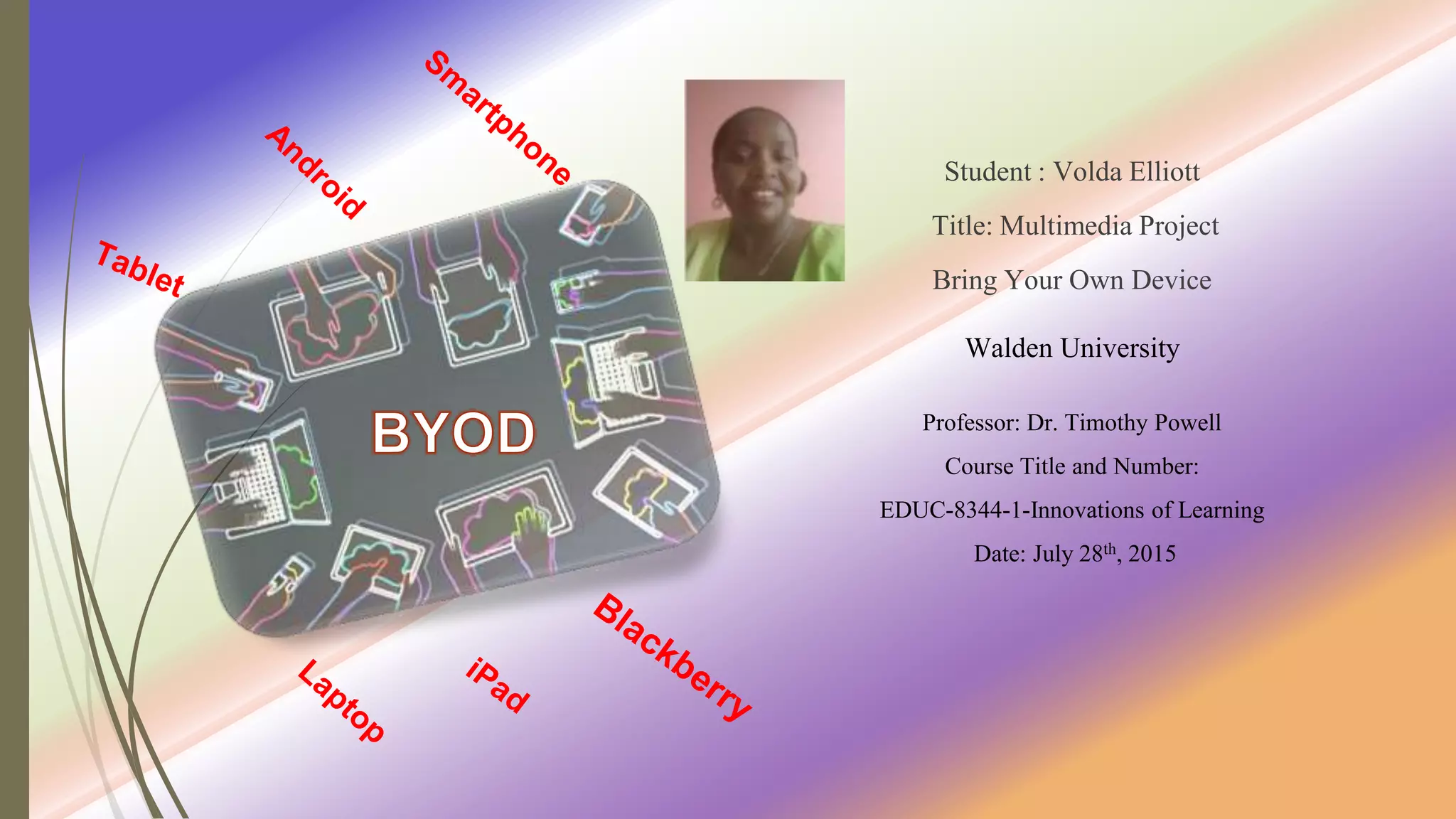
Bring Your Own Device
Walden University
Professor: Dr. Timothy Powell
Course Title and Number:
EDUC-8344-1-Innovations of Learning
Date: July 28th, 2015
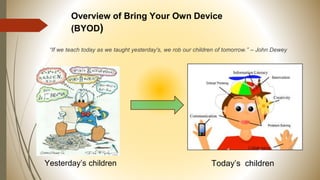
Overview of Bring Your Own Device
(BYOD)
“If we teach today as we taught yesterday's, we rob our children of tomorrow.” – John Dewey
Yesterday’s children Today’s children
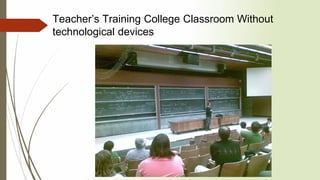
Teacher’s Training College Classroom Without
technological devices
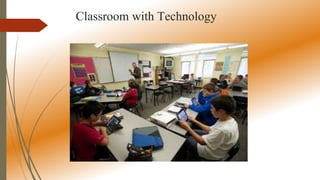
Classroom with Technology
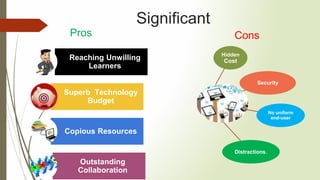
Significant
Pros
Reaching Unwilling
Learners
Superb Technology
Budget
Copious Resources
Outstanding
Collaboration
Cons
Hidden
Cost
Security
No uniform
end-user
Distractions.
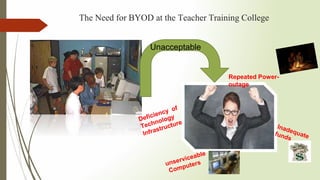
The Need for BYOD at the Teacher Training College
Repeated Power-
outage
Unacceptable
CISCO Virtual Forum for Education
Leaders 2014
UNESCO ( 2013)
EDUCAUSE Learning Initiative,
New Media Consortium
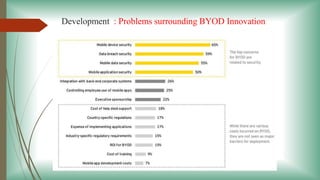
Development : Problems surrounding BYOD Innovation
Ken Robinson
http://www.ted.com/talks/sir_ken_robinson_bring_on_the_revolution?language=en
Learning Outside the College
Target Audience: Higher Education Teachers in Training
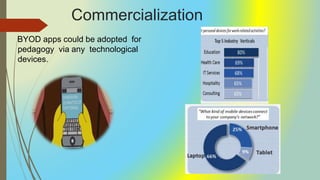
Commercialization
BYOD apps could be adopted for
pedagogy via any technological
devices.
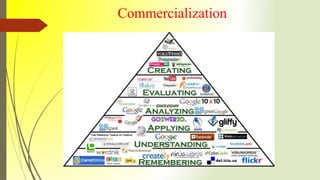
Commercialization
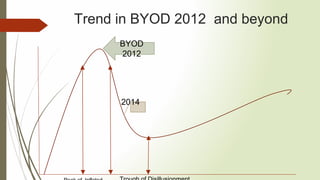
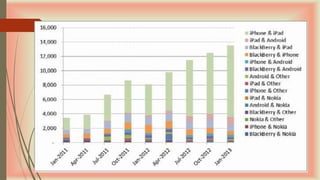
Trend in BYOD 2012 and beyond
BYOD
2012
2014
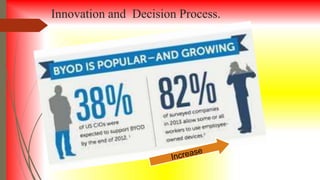
Innovation and Decision Process.
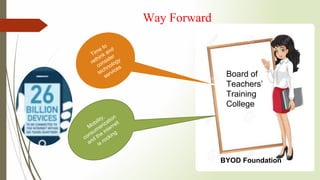
Way Forward
BYOD Foundation
Board of
Teachers’
Training
College
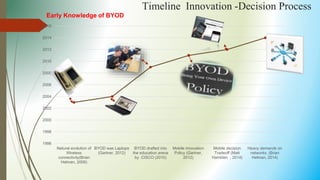
Timeline Innovation -Decision Process
1996
1998
2000
2002
2004
2006
2008
2010
2012
2014
2016
Natural evolution of
Wireless
connectivity(Brian
Helman, 2009)
BYOD was Laptops
(Gartner, 2012)
BYOD drafted into
the education arena
by CISCO (2010)
Mobile innovation
Policy (Gartner,
2012)
Mobile decision
Tradeoff (Matt
Hamblen , 2014)
Heavy demands on
networks. (Brian
Helman, 2014)
Early Knowledge of BYOD
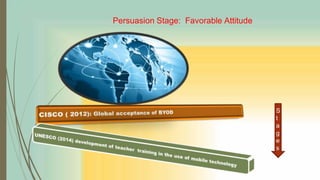
Persuasion Stage: Favorable Attitude
S
t
a
g
e
s
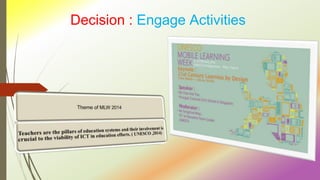
Decision : Engage Activities
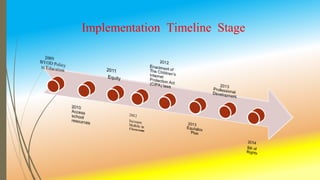
Implementation Timeline Stage
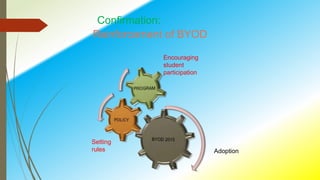
Confirmation:
Reinforcement of BYOD
Setting
rules
Encouraging
student
participation
Adoption
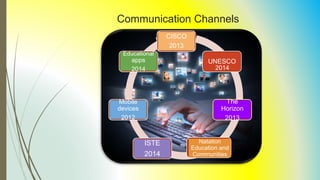
CISCO
2013
UNESCO
The
Horizon
2013
Natation
Education and
Communities
ISTE
2014
Mobile
devices
2012
Educational
apps
2014
Communication Channels
2014
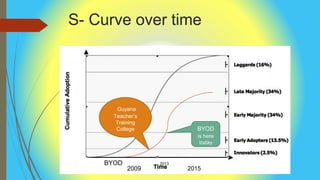
S- Curve over time
2009 2015
BYOD
Guyana
Teacher’s
Training
College BYOD
is here
today
2013
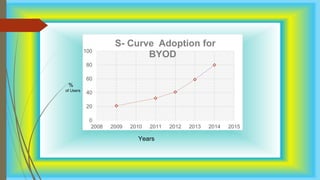
0
20
40
60
80
100
2008 2009 2010 2011 2012 2013 2014 2015
S- Curve Adoption for
BYOD
Years
%
of Users
Goal
Application
Need Assessment
Policy
Action Plan
Evaluate
Who will you
recommend as key
change agents in
your organization?
How can the seven roles
of a change agent be used
in your organization to
effect positive social
change
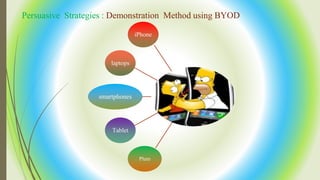
iPhone
laptops
smartphones
Tablet
Plum
Persuasive Strategies : Demonstration Method using BYOD
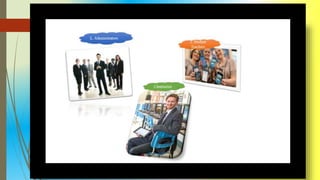
Administrators and
Instructors
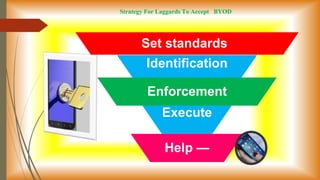
Strategy For Laggards To Accept BYOD
Set standards
Identification
Enforcement
Execute
Help —
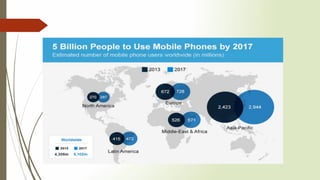
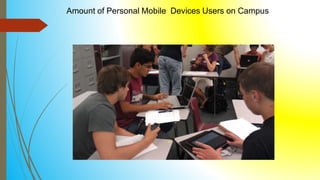
Amount of Personal Mobile Devices Users on Campus
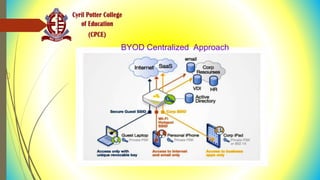
BYOD Centralized Approach
Herreman
, 2013
Support
Currently
Planning
Considering
Not Planning
Critical Mass
Technological Innovation
Transforms the Delivery of
Education Is the way to Go…
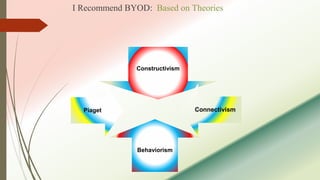
I Recommend BYOD: Based on Theories
Constructivism
Connectivism
Behaviorism
Piaget
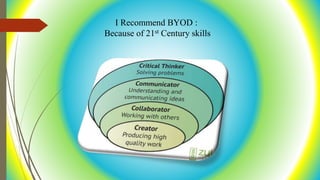
I Recommend BYOD :
Because of 21st Century skills
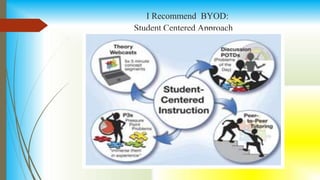
I Recommend BYOD:
Student Centered Approach
I Recommend BYOD :
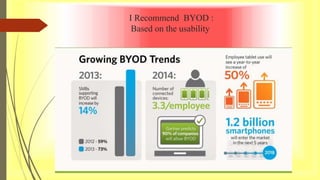
Based on the usability
➢ Bradley, T. (2011). Pros and cons of bringing your own device to work. PCWorld. Retrieved from
http://www.pcworld.com/article/246760/pros_and_cons_of_byod_bring_your_own_device_.htm
➢ Clerk, J.P( 2012). The tipping point of consumerisation and BYOD. Retrieved from
https://letstalk.globalservices.bt.com/en/2012/08/the-tipping-point-of-consumerisation-and-byod/
➢ Dewey, J. (1916). Democracy and Education. New York: Macmillan. Education Week. (1999). Technology
Counts ’99. Retrieved January 04, 2003, from http://www.edweek.org/sreports/tc99
➢ Harkins, M. (2013). Mobile: Learn from Intel's CISO on securing employee-owned devices. Information Security Media
Group. Retrieved from http://www.govinfosecurity.com/webinars/mobile-learn-fromintels-ciso-on-securing-employee-
owned-devices-w-264
➢ Hoffman, M., & Vance, D. (2004). Computer literacy: What students know and from whom they learned it. Association of
Computing Machinery. Proceedings from 36th SIGCSE Technical Symposium on Computer Science Education, 37(1), 356
– 360.
➢ http://www.insight.com/insighton/education/k-12-blueprint-getting-started-byod/
➢ New Media Consortium. (n.d.). NMC Horizon. Retrieved December 12, 2014, from http://www.nmc.org/horizon-project
➢ Matt Hamblen (2014)With BYOD smartphones on the rise, IT headaches will become migraines
Retrieved fromhttp://www.computerworld.com/article/2487005/byod/with-byod-smartphones-on-the-rise--it-headaches-
will-become-migraines.html
➢ Rogers, E. M. (2003). Diffusion of innovations (5th ed.). New York, NY: Free Press.
References

Volda Byod Innovation