Examining the Adoption of Bring
Your Own Device at the workplace
STUDENT NAME STUDENT ID
CEDRIC OMMEH M00502567
MICHAEL CHITWA M00502568
MODULE LEADER: Kelvin Harewood
MODULE TRAINER: Mr. Boaz Juma
SUBMISSION DATE: 11th July 2014
Definition
 BYOD is an acronym that stands for bring your own
device.
 Allows employees use their personal mobile devices
such as smart phones and tablets at work
 It is viewed as:-
 A trend – new fashionable way of doing things
 A program-schedule of activities
 A policy –rules and regulations
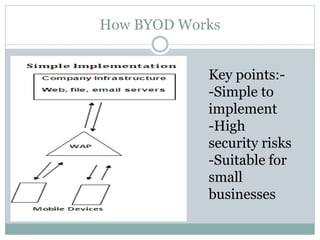
How BYOD Works
Key points:-
-Simple to
implement
-High
security risks
-Suitable for
small
businesses
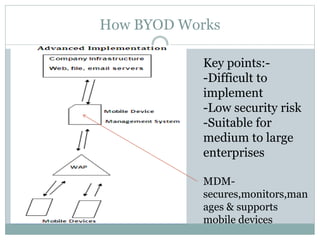
How BYOD Works
Key points:-
-Difficult to
implement
-Low security risk
-Suitable for
medium to large
enterprises
MDM-
secures,monitors,man
ages & supports
mobile devices
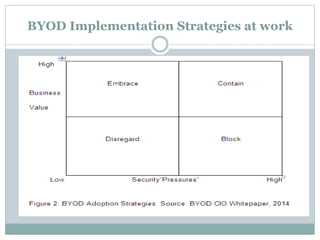
BYOD Implementation Strategies at work
Drivers/Triggers For The Adoption Of A
Bring Your Own Device (Byod) Policy
 Increased Flexibility – employees are able to
work in or out of office
 Increased Worker Productivity – due to
flexibility the overall output of the worker is
improved
 Greater Mobility – not limited to one station
 Employee job satisfaction – through being able
to use a device of your choice, no strict employer
monitoring
Triggers for BYOD, cont’d.
 Supports a mobile and cloud-focused IT
Strategy – access of work from the cloud using your
own personal devices
 Collaboration and Communication – tablets
and smart phones as personal diaries in meetings
 Information Sharing – screen sharing
presentations in meetings
 Employee demand – to use their own personal
devices
 Compliance Requirements – HIPAA, PSQIA,
PCI DSS, GLBA – big fines if violated
Triggers for BYOD, cont’d.
 Nature of the business – some businesses are
more suited to BYOD than others
 Technology-rich classrooms - Virtual Learning
Environment (VLE)
 Initiates new ways of learning – do more things
for themselves, more inclined to collaborate
 Increases student engagement – more inclined
to participate
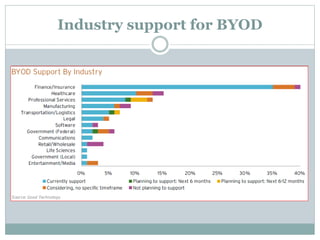
Industry support for BYOD
Challenges of a BYOD Policy
 Theft
 Viruses and other malware
 Privacy issues and legal concerns – tracking and
monitoring
 Cost – incurred from managing these devices
 Data protection – more prone to loss/theft;
compromise data
 Security
 Support
 Lack of awareness
Conclusion
 BYOD is now moving from devices to technology
(BYOT)
 Despite the challenges it has, it is a good policy to be
implemented by organizations
 Will be a competitive advantage for upcoming
organizations

BYOD (Bring Your Own Device)

  • 1.
    Examining the Adoptionof Bring Your Own Device at the workplace STUDENT NAME STUDENT ID CEDRIC OMMEH M00502567 MICHAEL CHITWA M00502568 MODULE LEADER: Kelvin Harewood MODULE TRAINER: Mr. Boaz Juma SUBMISSION DATE: 11th July 2014
  • 2.
    Definition  BYOD isan acronym that stands for bring your own device.  Allows employees use their personal mobile devices such as smart phones and tablets at work  It is viewed as:-  A trend – new fashionable way of doing things  A program-schedule of activities  A policy –rules and regulations
  • 3.
    How BYOD Works Keypoints:- -Simple to implement -High security risks -Suitable for small businesses
  • 4.
    How BYOD Works Keypoints:- -Difficult to implement -Low security risk -Suitable for medium to large enterprises MDM- secures,monitors,man ages & supports mobile devices
  • 5.
  • 6.
    Drivers/Triggers For TheAdoption Of A Bring Your Own Device (Byod) Policy  Increased Flexibility – employees are able to work in or out of office  Increased Worker Productivity – due to flexibility the overall output of the worker is improved  Greater Mobility – not limited to one station  Employee job satisfaction – through being able to use a device of your choice, no strict employer monitoring
  • 7.
    Triggers for BYOD,cont’d.  Supports a mobile and cloud-focused IT Strategy – access of work from the cloud using your own personal devices  Collaboration and Communication – tablets and smart phones as personal diaries in meetings  Information Sharing – screen sharing presentations in meetings  Employee demand – to use their own personal devices  Compliance Requirements – HIPAA, PSQIA, PCI DSS, GLBA – big fines if violated
  • 8.
    Triggers for BYOD,cont’d.  Nature of the business – some businesses are more suited to BYOD than others  Technology-rich classrooms - Virtual Learning Environment (VLE)  Initiates new ways of learning – do more things for themselves, more inclined to collaborate  Increases student engagement – more inclined to participate
  • 9.
  • 10.
    Challenges of aBYOD Policy  Theft  Viruses and other malware  Privacy issues and legal concerns – tracking and monitoring  Cost – incurred from managing these devices  Data protection – more prone to loss/theft; compromise data  Security  Support  Lack of awareness
  • 11.
    Conclusion  BYOD isnow moving from devices to technology (BYOT)  Despite the challenges it has, it is a good policy to be implemented by organizations  Will be a competitive advantage for upcoming organizations